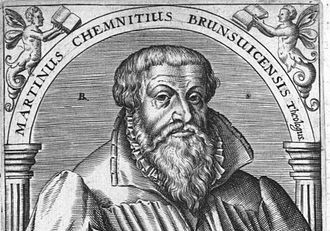
The following is a translation of Martin Chemnitz’s homily outline found in his postil for the Seventh Sunday after Epiphany (Postilla, Volume I, pg. 362, 363, 395). The assigned Gospel reading is Matthew 20:1–16. I’ve added additional scriptural references in square brackets where it may be useful to the reader.
Summary of the Parable (pg. 362)
“What now concerns the parable of today’s Gospel [Matthew 20:1–16], it is thereby directed to hear it with your love that the Lord Christ deals with this necessary and high teaching:
- How our Lord God has gathered here on earth a holy Christian Church for himself, in which God pleasures, as a man has pleasure in his vineyard or garden;
- How God also demands and call those whom he wants to have in this His garden, just as a father of a house hires people to work in His vineyard;
- How He tells them what they ought to do in the garden, what they ought to carry out for work therein, that God has also thus prescribed for us what He wants from us, how we ought thereby employ ourselves with all diligence, that we do it that God thereby can take pleasure in it;
- How when we are ready to allow ourselves to become sour with the work, we nevertheless must recognize that we have not done as we ought well done, so that we thereby do not build on our merits and works, but rather look only to God’s grace, what God wants to bestow on us out of good favor;
- And that we take care not to ruin what we have with God, and invite His disgrace (Ungnade) and disfavor (Unhuld) upon us, and what more teachings, admonitions, and warnings there are which we all find properly in this parable.”
Division of the Sermon (pg. 363)
That we may now handle this teaching in an orderly manner, rightly understand it, and make use of it in true Christian fear of God, we will thus divide it that we will hear a report in this sermon of the these parts:
- First, how common the parable of the vineyard and field or garden is in Scripture; and how therein everything is to be understood; how God deals with His Christian Church here on earth in this world; how He transplants us men, we who are vain weeds, and works on us that we may again become a good plant; and how wrathfully angry he is if we stand in His garden without fruit, or bear wicked and unlovely fruit, and threatens us with temporal and eternal punishment, so that He may win us and bring us to obedience, that we better ourselves now, because the day is still called today, so that we not be thrown hereafter as dry wood and unfruitful trees into eternal hellish fires, for which reason He then admonishes and exhorts us daily to do better.
- Second, we will also see how we ought to learn to grasp the high article concerning the eternal providence of God (which is currently being disputed so quickly and subtly, even dangerously) thoroughly in the simplest possible way from the parable; so that everyone can make use of this doctrine as a warning and consolation, and may know, whether he is also destined (aussersehen) for eternal salvation, and whereupon we ought see that we can be completely certain, and each one in particular, of such consolation; how as everyone should see to it that when he is called that he does not turn back, but enters into the vineyard with true repentance, right faith, and new life, and therein truly work, so he can be certain that he is also called and chosen by God.
- Third, How God does not call us into the vineyard in a single way, but rather in different ways, earlier for the one, later for the other, as it pleases him, appointing to this one this work, to the other another work; how one ought to be careful therein, that no one becomes bored of his work, but rather carries it out obediently, however difficult it may also seem to him.
- Fourth, how it is to be understood, as the parable says, that the Father of the house wants that we should work diligently in His vineyard, to bear the heat and the burden of the day, and yet at the same time not to build upon our merit and thereafter look for the wage, but rather only look for God’s grace and goodness.
- Finally, how we ought to pay attention to the use of this parable.
These five points we will now deal shortly in today’s Gospel. May the beloved God grant that it bless us for our good through the assistance of the Holy Spirit.”
Conclusion of the Sermon (pg. 395)
Will work on getting this done on Saturday (02/15/2025).
 PATTERN OF SOUND WORDS