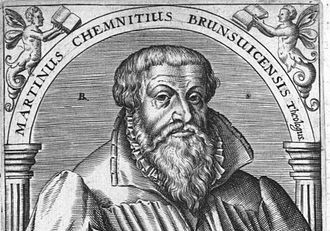
The following is a translation of Martin Chemnitz’s homily outline found in his postil for Estomihi, or Quinquagesima(Postilla, Volume I, pgs. 426–427). At Chemnitz’s time it was common for churches to observe the Baptism of our Lord on the final Sunday before Lent, which connects the Baptism of our Lord to His temptation (the Gospel reading for the First Sunday of Lent). Chemnitz cites all three versions of the Baptism of our Lord found in the synoptic gospels (Matthew 3:13–17; Mark 1:9–11; Luke 3:21–22). The Evangelical Lutheran Synod (ELS) still follows this tradition. In the ELS lectionary, the assigned Old Testament reading is Isaiah 42:1–7 and the Epistle is 1 Peter 3:18–22.
Chemnitz’s Outline:
“We will now thus explain this glorious and beautiful account that we may set forth these points:
- First, as this account reports, in what manner and in which form our Lord and Savior Jesus Christ was ordained and anointed to the office (Ampt) of Messiah, so that we can be certain of this when we recognize and accept Him as the Messiah, confess Him and hold to Him, that we therefore make no error, but rather receive in Him God’s grace and help, eternal life, and salvation.
- Second, what office (Ampt) Christ has, that He is anointed as the High Priest, King, and Prophet, and how He holds this office in heaven, and what counts there.
- Third, because Christ is proclaimed here as the only Messiah, and all men are commanded that they recognize Him as such, and ought to hear Him, so here we have this point, which is of the upmost importance for us, that we can know what we ought to hold concerning the doctrine of Christ (Lehre Christi) and everything that we find therein, namely, that it is the doctrine to which God the Father Himself has directed us, and in which the Holy Spirit is present, and He wants to be thereby efficacious so that heaven may be opened to us through it, and the way to eternal life may be prepared and readied.
- Fourth, next to the Word, we also have the most revered sacraments, to which we are directed and bound just as much as to the Word [i.e. Acts 2:42]. This account also teaches us further as to what we ought to hold concerning these sacraments, and what they count before God in heaven; but particularly, what concerns the Sacrament of Holy Baptism, which is chiefly dealt with here, what we ought to know about it, and what Christ has brought into our baptism through His baptism, and what He has confirmed [i.e., Matthew 3:15].
- Fifth and Last, how the holy Divine majesty has revealed Himself here, how we ought to recognize Him rightly according to His essence and will, to the end that we also ought to be certain of this, each for himself, that God wants to be gracious to us and is heartily pleased with us for the sake of Christ [i.e, Matthew 3:17].
On these five points, we will now set forth the explanation of this beautiful and comforting account. The almighty God and Father of our Lord Jesus Christ grant us His Holy Spirit, grace, and blessing that we may not only understand this in a historical manner, but rather also may make use of it in a Christian manner through God’s grace.”
 PATTERN OF SOUND WORDS