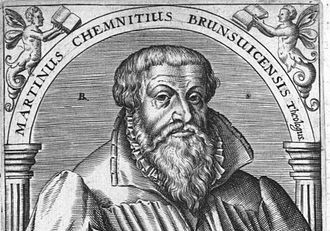
The following is a translation of Chemnitz’s homily outline for Laetare (Lent 4), found in his Postilla (Vol I, pgs. 550–51). Chemnitz uses a combination of all four Gospel accounts: Matthew 14:13–21; Mark 6:30–44; Luke 9:10–17; and John 6:1–15 (see below). Square brackets indicate my own notes.
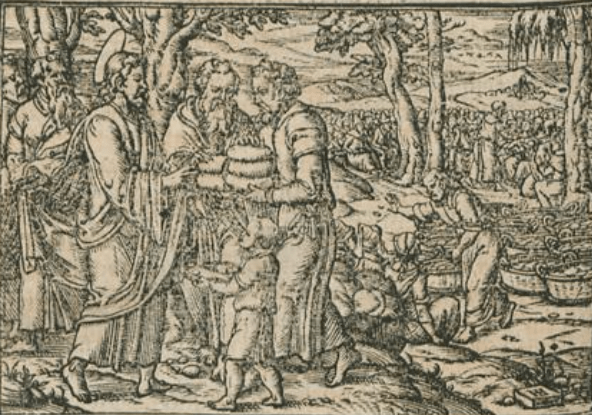
Chemnitz’s Combined Reading:
And the apostles came again to gather to Jesus, and they reported everything to Him (what had happened to John), and they told Him the great things they had done and what they had taught. And He said to them, “Let us go into the desert and rest a little.” For there were many of them coming and going and they did not have enough time to eat. And he took them with Him and went away in a boat over the sea, to the place of Tiberias, in Galilee, which is called Bethsaida. And when the people heard this, and became aware of this, and they saw Him depart, they followed Him and went after Him. And many knew Him, and went together on foot from all the cities. And a great multitude followed Him and arrived before Him and came to Him because they saw the signs that He had done for the sick.
But Jesus went up on a mountain and sat there by Himself with His disciples. Now the Passover, the Jewish festival, was near. And Jesus went out and saw the large crowd and He had compassion on them, for they were like sheep who had no shepherd. And He called them to Himself and began a long sermon and spoke to them of the Kingdom of God, and He healed their sick and made healthy those who were needy.
But in the evening, when the day was beginning to draw to a close and the day was almost over, His disciples, the Twelve, came to Him, and said to Him, “This is a desert, and it is desolate here, and the day is now spent and the night is falling. Send the crowd away that they may go around into the villages and markets and buy themselves bread and food, for they have nothing to eat; that they may find lodging and food, for we are here in the desert.”
But Jesus answered and said to them, “It is not necessary that they depart. You give them to eat.” And they said to Him, “Should we depart and and go buy two hundred pfennigs worth of bread and give it to them to eat?” Then Jesus lifted up His eyes and saw a great crowd coming to Him, and He said to Philip, “Where can we buy bread, that these may eat?” (He said this to test him, for He knew what He wanted to do.) But Philip answered Him, “Two hundred pfennigs is not enough for them that each of them take a little.”
But He said to them, “How much bread do you have? Go and see.” And when they had found out, they said, “We have nothing more than five loaves of bread and two fish. Therefore, we must go and buy food for so large a crowd.” (For there were about five thousand men.) Then Andrew, Simon Peter’s brother, said to them, “There is a boy here who has five barley loaves and two fish, but what is this among so many?”
But Jesus said to His disciples, “Make the people to lie down and sit in groups, fifty by fifty.” Now there was plenty of grass in that place. And He commanded them all to sit down in full table groups on the green grass. And they did so, all of them sat down in groups, hundreds by hundreds, fifty by fifty, so that about five thousand men laid down.
Now Jesus took the five loaves of bread and two fish, sighed into heaven, gave thanks over them, and broke the bread, and gave it to the disciples so that they lay it before the people, and He divided the two fish among them all. And the disciples gave it to those who were seated, and likewise of the fish, as much as each desired. They all ate and they were satisfied.
Now when they were satisfied, He said to His disciples, “Gather up the remaining fragments, so that nothing be lost.” So they gathered them and took up what remained of the fragments of the five barley loaves and fish which remained from those who had eaten. Now those who had eaten were five thousand men, besides women and children. Now, when the men saw the sign which Jesus did, they said, “Truly, this is the Prophet who is to come into the world.” When Jesus therefore noticed that they were coming to take him in order to make Him king, He immediately urged His disciples that they get into the boat and go over before Him to Bethsaida, until He had dismissed the crowd. And when He dismissed the crowd and sent them away, He climbed up into a mountain alone so that He could pray, and He withdrew once more to the mountain, He Himself alone.
Chemnitz’s Homily Outline
“We now want to take up these accounts for ourselves and deal with these points in an orderly manner:
- First, how in this account we see that it is God’s work, that God feeds and nourishes us men and provides for all our needs richly, which He has demonstrated not only in the first creation, but He does this indeed in every year, every hour, and every moment to men, beasts, and everything that lives on earth and brings it into effect; and how we ought to recognize this and give thanks to God for it.
- Second, pious Christians ought to accustom themselves that they always make use of this as a reminder and for comfort, and think that this therefore happened at that time, at the beginning of the New Testament, so that Christians of every time, who belong in the New Testament, can grasp constant comfort, so that just as the Lord Christ once took care of His disciples—leading them out of danger, feeding them in times of hunger and need, and comforting them in times of affliction—that we likewise also even today have to look to him with certainty, so that if we should also suffer something for the sake of God’s Word, be hated and be persecuted, hunger and thirst for the Gospel, we will not become fainthearted, much less despair, but rather trust God, who surely will sustain and provide for us; how this is so beautifully presented to us here, when the Lord sits down in the midst of His disciples and looks over them, comforts them, and speaks to satisfy them, then allows also the people to come to Him, allows Himself to be aroused to pity so that they are not abandoned and left comfortless, and takes care of them and helps them out. From this we ought also learn that God wants to do the same for us, as we have God’s Word, promise, and assurance to which we ought to firmly hold on to, and with this and other examples from Scripture, whereby God has proven that He wants to keep His promise and assurance, that we should regard them as certain and hold them to be true, and from this we ought to look to God, for He wants to provide for us both in body and in soul; and that we can now look to God for us in this time, just as the children of Israel had experienced this in the Old Testament; that we ought to remember and console ourselves with these accounts, just as the Jews had remembered and comforted themselves with the miracles that took place in the desert for forty years.
- Third, we also have in this account the manner and way in which God does things when He wants to help those who belong to Him, namely, that He does it in such a wonderful and peculiar way that we cannot judge it and understand it with our reason. For He begins with His beloved children to whom He promises salvation and rich blessings, so wonderfully that everyone must be astonished by it and often become fainthearted, and see nothing other than that everything is against them, and that they have no hope that God Himself will take care of them, while, in contrast, it goes well for the godless, who have everything to the full, who lack nothing, but rather find vain happiness wherever they turn and go about; that we ought not be troubled by this, but rather console ourselves that the happiness and prosperity of the godless will one day come to an end, and that all our misery and suffering will, in turn, come to a blessed end, and that we therefore ought not to place our trust in things that are temporal and transient, but rather that we ought to be content that we have the heavenly eternal goods and eternal salvation with our dear Lord Jesus Christ. Likewise, if our reason cannot deal with it and cannot understand how God wants to help, that we should not therefore think as if it were impossible, but rather that we ought to put all our reason aside and entrust it to God, who, in His time, will surely know how to find the means and way by which He will help us, even when we cannot yet see nor find it. Also that we recognize our misery and weakness, how little we often believe this, so also, that the irrational animals surpass us in this case who can trust God more than men; which is a shame to us and ought to guide us that we can learn to trust God also a little more than we usually do, and that we comfort ourselves with the examples of Holy Scripture, that just as God has cared for His own at all times, so He wants to prove it to us also now, however strange it may otherwise seem to us.
- Fourth, we then want to consider these accounts as they are described to us so powerfully by all four evangelists at length and with many beautiful circumstances so that we learn from how God tends to act, that when He has appeared as a stranger, as if He did not know what to advise us or as if He could not help us, He nevertheless finally, when His time has come, He comes for to us and proves Himself so that we must confess that it is a powerful thing and goes beyond all reason, so that God can prove His majesty and omnipotence, so that He can help powerfully, and thus, as St. Paul says, that we cannot understand or comprehend it [Romans 11:33].
We want to consider these points in this sermon and deal with them briefly and simply in order that our faith may thereby be strengthened and that our confidence in God may be strengthened in both temporal and eternal needs and concerns.”
 PATTERN OF SOUND WORDS