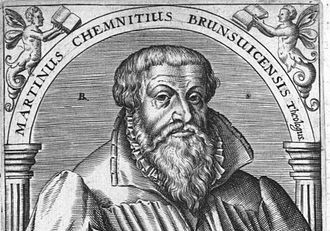
The following is my translation of Martin Chemnitz’s homily outline for the Third Sunday after Easter (Dominica Cantate) as found in his Postilla (Vol. II, pgs. 161–62). Chemnitz’s text is John 16:5–15. Square brackets indicate my own personal notes.

Chemnitz’s Homily Outline:
Now because this text seems to be a dark text which not everyone can easily grasp and understand, so we will deal with the doctrine briefly and simply which is prescribed to us herein:
- First, we will hear how in the Gospel Christ shows us that we ought to properly know what He has for a kingdom, and how He leads it, also what goods and jewels He distributes to us in His kingdom so that we do not imagine as if we chiefly ought to expect temporal prosperity, joy and pleasure in the kingdom of Christ, but rather that we turn away from our thoughts and know that Christ’s kingdom is a heavenly kingdom [John 18:36] and that He gives and distributes to us the eternal goods, so that we do not therefore set ourselves on things temporal (Zeitliche), but rather on things eternal (Ewige) [Colossians 3:2]; and how we ought to have our greatest pleasure and joy in this when we hear these this and concern ourselves with it, and thereafter strive that we might become partakers of these goods; but how naive and foolish we are that we do not particularly concern ourselves with it, but rather become sad over it when our fortune and wellbeing do not immediately begin in this life, which the Lord here rebukes in us.
- Second, it is also brought to our remembrance how the Son of God deals with us when He wants to bring us into the fellowship (Gemeinschafft) of His kingdom, that for this He uses the Preaching Office (Predigampt) through which the Holy Spirit is effective and works in us so that we also come into the kingdom of God and may become partakers of the goods which He has acquired for us, and how the Holy Spirit deals with us in this, namely that He teaches (lehret) us the right way through one comes into the kingdom of Christ, and if we fall short of the right way, that He at that point rebukes us (straffen) and teaches us to know our sin and our unbelief and that we lack the righteousness that is acceptable to God and that we do not trust in God from the heart, but rather that we fear the devil and the world more than we fear God; but when we recognize our lack and failure, then at that point He further comforts (trösten) us so that we do not despair on account of our sins, nor that we become distressed too much while under the cross.
- Third, what benefit it is for us that the Holy Spirit thus carries out His office (Ampt) by manner of teaching, by manner of rebuking, and by manner of comforting (Lehrweise, Straffweise, und Trostweise), namely that He leads us thereby into all truth, to the righteousness that is acceptable before God, and that He comes to help us in our weakness, comforts us while under the cross, and points us to the hope of the future eternal salvation.
 PATTERN OF SOUND WORDS