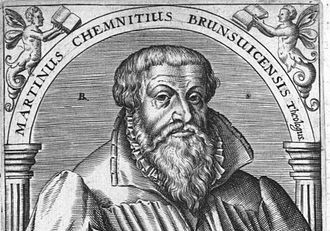
The following is my translation of Martin Chemnitz’s Homily Outline for the Fifth Sunday after Easter (Dominica Rogationum, or, Vocem Jucunditatis) as found in his Postilla (Vol. II, pg. 176). Chemnitz’s gospel text is John 16:23b–33 (beginning from “Amen, Amen…” or “Most assuredly…”). Square brackets indicate my own personal notes or additions.
Chemnitz’s Homily Outline for Rogate
“Now in order that a pious Christian cannot falsely use (fälschen) this doctrine, so we want to divide it thus:
- First, we want to remember how much depends on it, that on prays and performs this divine service (Gottesdienst) with all diligence, and how therefore dear prayer has been in use and has remained in constant practice among all the saints and children of God at all times [e.g., Acts 2:42; Ephesians 6:18; Colossians 4:2; 1 Thessalonians 5:16–18].
- Second, that there is a great distinction in prayer, that not ever prayer is pleasing and acceptable to God [e.g., Isaiah 1:15]; how one therefore thus ought to take care that, above all things, he removes from the way everything that defiles and corrupts a prayer so that it does not become displeasing and abominable before God [e.g., Psalm 66:18; James 4:3].
- Third, then what all belongs to right prayer (rechten Gebett); how it must be directed on certain grounds, and to what the heart ought to look when one wants to pray so that God can be at peace with our prayer and may hear it and accept it, that we may thereby obtain that which we seek from God through it. Namely, that we first call upon the correct true God (den rechten wahren Gott) who is God the Father, Son, and Holy Spirit [Matthew 28:19]. Thereafter, how we ought to pay attention the causes (die Ursachen), which ought to move us to prayer, such as God’s will and command (Gottes will und Befehl) [1 John 5:14], our great present need (unsere fürstehende hohe Nicht) [e.g., Psalm 50:15], and the dear God’s kind promise and pledge (Verheissung und Zusage) that He will surely hear our prayer [e.g., Matthew 7:7; John 16:23–24].
- Lastly, how we ought to bring all of this together and into Christian use; how the heart ought to learn to exercise itself through prayer before God; how we ought to seek the eternal good (das ewig Gut) from God with full confidence and faith, and with what condition we ought to pray for daily bread and temporal need (tägliche Bordt und zeitliche Notturft).
We want to handle these points briefly and simply in this sermon. May the dear God indeed grant that it may produce much fruit in us so that we may accustom ourselves and be diligent (uns gewehnen und befleissigen) to pray willingly, often, and with devotion (gern, oft, und mit Andacht).”
 PATTERN OF SOUND WORDS