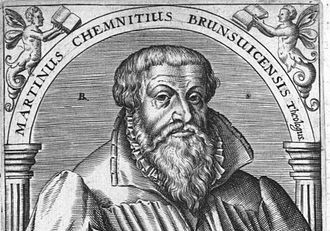
The following is my translation of Martin Chemnitz’s outline for the second homily for Pentecost as found in his Postilla (Vol. II, pg. 234). The first homily explanation and outline on the history of Pentecost (Acts 2) can be found here. Chemnitz’s reading is John 14:15–31. Square brackets indicate my own notes and additions.
Chemnitz’s Explanation and Homily Outline
This morning your grace has heard of this feast which we now celebrate and keep holy, and how we maintain our Pentecost against the Pentecost of the Old Testaments, and ought to thereby compare [our Pentecost] with it so that this feast may become all the more dear to us. Thereafter we dealt with the account and explained its circumstances from which we have heard much fine doctrine and admonition (Erinnerung).
After this, we now want to deal with this second part which belongs to this feast for ourselves, namely, as it pertains to the doctrine which ought to be dealt with on this feast. Now your grace has heard that this is the chief doctrine (Hauptlehre) of this feast, that in these three days the entire third article of our Christian faith is explained by us; as today, the first part, “I believe in the Holy Spirit;” the second part, “one holy Christian Church, the congregation of saints” on this upcoming Tuesday; and the third part, “I believe in the forgiveness of sins, and an eternal life” tomorrow.
So we want to now take the first part of the third article [of the Apostles’ Creed] for ourselves and explain it in the manner of the Catechism (auff Catechismus Art), that:
- First, we want to hear how we can grasp the doctrine of the person and of the office of the Holy Spirit (die Lehre von der Person und von der Ampt deß heiligen Geists) accurately and usefully.
- Second, how and through which means (Mittel) the Holy Spirit comes to us and is given to us, namely, through the Word, the Sacraments, and prayer.
- Third, to what end we need the Holy Spirit, and what He creates and works in us.
- Fourth, how we ought to examine ourselves as to whether we also have the Holy Spirit [~2 Corinthians 13:5], and how we can come to be certain of it, what are the marks (Merckzeichen) [of the Holy Spirit] whereby one knows the Holy Spirit and can know that He dwells in our hearts.
- And then lastly, how each person ought to conduct himself, so that if He has the Holy Spirit, He does not lose Him again, that He does not grieve Him [Ephesians 4:30], nor drive Him from himself.
This we now want to briefly deal with in this sermon.
 PATTERN OF SOUND WORDS