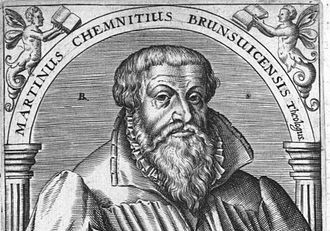
The following is my translation of Martin Chemnitz’s homily outline for Holy Trinity Sunday, as found in his Postilla (Vol. II, pg. 273). Chemnitz’s Gospel text is John 3:1–15, although the reader will notice that Chemnitz preaches on the mystery of the Trinity in general and not so much the text. His homily is more topical and systematic than exegetical. Square brackets indicate my own notes and additions.
Chemnitz’s Explanation and Outline
Beloved in Christ the Lord,
This is a particularly high feast in which the right knowledge of God is dealt with, so far as God has revealed it to in His Word and as much as is necessary for us to know for salvation. However, it is thus crudely called “threefoldness” (Dreifaltigkeit) as if a threefold God (dreifältiger Gott) or a threefoldness (Dreifaltigkeit) were in the Divine essence (Göttlichen Wesen), although there is no such threefoldness (Dreifaltigkeit). Therefore, it would be better to call it “Trinity” (Dreieinigkeit) or “Threeness” (Dreiheit) because in the Divine essence there is one singular God (ein einger Gott) and yet three distinct persons (drei unterschiedene Personen).
With this doctrine, it is not enough that we name God, for the Jews and the heathen do that also, but rather we must thus found our faith upon God’s Word and rightly know God as He has thus revealed Himself so that we separate ourselves from Jews, Turks [i.e., Muslims], and heathen who either believe in many gods [i.e., polytheism] or confess only one person in the Godhead [i.e., the Jews]; for, against both, the Scripture reports to us differently as is seen in other passages besides this text, which is one of the foremost in the New Testament. For God had promised in the Old Testament that, when the Messiah would come into the world, God would put His Word into His mouth (Deuteronomy [18:18]), and such Word was to begin in Jerusalem and go forth from Zion (Isaiah 2[:3]). Therefore, the Evangelist John, with particular diligence, also recorded the Lord Christ’s first sermon which He gave at night to Nicodemus, in which is summarized, with beautiful and lovely words, the summary and the right core of the doctrine in the Gospel concerning the forgiveness of sins and the true saving faith; that this account [John 3:1–15] is indeed worthy that one diligently hear and consider it.
Now, for this reason [the doctrine of the Trinity] has been appointed to be dealt with on this day, because it is not in our liberty to decide what and how we are to think of God, because it says in Jeremiah 10[:10–11] and Psalm 79[:6] that God pours out His wrath upon the heathen who do not know Him. Likewise, in John 17[:3] that “This is eternal life, that they know You, that You alone are the true God, and the one You have sent, Jesus Christ.” And in John 5[:23], “Whoever does not honor the Son does not honor the Father who sent Him.” And 1 John 5[:12], “Whoever does not have God the Son does not have the Life.” And Isaiah 53[:11], “By His knowledge will He, My Servant, the Righteous One, make many righteous.” And John 14[:17], “The world cannot receive the Holy Spirit because it does not see Him and does not know Him.” And Romans 8[:9], “Those who do not have the Spirit of Christ are not Christ’s, and they do not belong to Him.” From such and similar passages it is evident how much is dependent upon the right knowledge of God.
However, we ought not to sharply dispute concerning the Divine essence, but rather learn to know, honor, and call upon God and the persons of the Godhead from and according to the articles of creation, redemption, and sanctification, because otherwise it is not a life-giving knowledge (lebendigmachendes Erkenntniß). Therefore, this text, which can rightly and well serve us, is now appointed not for a sharp dispute as to how the persons are distinguished internally in their essence, but rather for the simple knowledge of God from the articles of faith (schlechten Erkenntniß Gottes, auß den Artickeln deß Glaubens).
Now, this doctrine consists in the following five points:
- First, that truly there is one God over all creatures, who governs all of them.
- Second, that there is not many gods, but rather only one singular God.
- Third, that in the same singular Divine essence there are three persons: Father, Son, and Holy Spirit.
- Fourth, how such persons are distinguished [from one another].
- And then fifth and last, how the knowledge of God is presented to us in His works in the articles of creation, redemption, and sanctification from which we can thereby make use of it all the better.
 PATTERN OF SOUND WORDS