The following is my translation of Martin Chemnitz’s homily for the feast day of St. Bartholomew (Nathanael) as found in his Postilla (Vol. III, pgs. 106–117). Curly brackets indicate marginal notes present in the original text. Square brackets indicate my own notes and additions. I have broken up some of the longer paragraphs for the sake of readability.
Gospel Text (Luke 22:24–30)
A dispute also arose among the disciples as to which among them ought to be the considered the greatest. But [Jesus] said to them, “The worldly kings exercise lordship (herrschen), and the authorities call themselves gracious lords (gnaädige Herrn), but not in this way for you; rather, the greatest among you ought to be as the youngest, and the foremost as a servant. For who is the greatest? The one who sits at the table? Or the one who serves? Is not thus, that it is the one who sits at the table? However, I am among you as a servant (ein Diener). But you are those who have been with me in my afflictions (Anfechtungen). And I will bestow the kingdom upon you, as My Father bestowed upon Me, that you shall eat and drink at My table and My kingdom, and sit on thrones and judge the twelve tribes of Israel.”
Explanation
{History of St. Bartholomew}
On this day we observe the commemoration of the Apostle Bartholomew, of whom we have nothing more in the history of the Gospels that that he was chosen by Christ to be a disciple without means [John 1:43–50], instructed by Christ in His school, and finally, chosen to be an apostle, and together with the others, he was filled with the Holy Spirit, made fit (düchtig) to preach the Gospel in the whole world.
{The Death of St. Bartholomew}
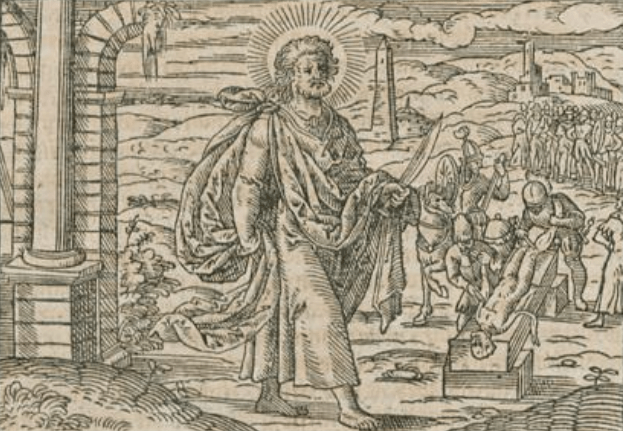
Other histories further testify concerning him that, when the apostles had divided themselves through the entire world, he made his way to India and there spread the doctrine of the Gospel and planted a Church of God, and then finally, King Astyages had him put to death and had his head struck off. Some say that since he would not abstain from teaching, he was nailed to the cross and taken down again from it and that afterwards his skin was flayed from him while he was still living.
Chemnitz is referring to the account recorded by Eusebius of Caesarea, where he only records that Bartholomew went to India. Later traditions speak of Bartholomew’s martyrdom. One martyrdom account only mentions his beheading by King Astreges (ANF 8:553ff.). It seems that the tradition of his skin being flayed is a later tradition. Others held that Bartholomew went to Armenia instead.
{Dionysius}
Dionysius [the Areopagite] makes mention of this concerning Bartholomew, that he used this parable (Gleichnuß) in his sermons, that he said, “The Gospel is both a short and long doctrine,” from which it is to be inferred that he maintained the distinction in his preaching, that for the simple he made short a simple sermons and briefly summarized the doctrine of the Gospel in a few chief points; but at the same time, he reminded his hearers that it is such a rich and expensive doctrine, which one cannot completely study in this life, but rather it is only a part that we grasp here, but the rest one must spare for that life in the glorious high school where we shall completely study it from the foundation and learn and understand everything perfectly.
This quote from Dionysius the Areopagite may be found in his Mystical Theology (MPG III.999–1000), which reads, “Thus the divine Bartholomew says that theology is both much and least, and the Gospel is both broad and great, and, on the other hand, concise.” The Latin reads, “Hac utique ratione divus Bartholomaeus ait et copiosam esse theologiam, et minimam, atque Evangelium amplam et magnum, et rursus concisum.” The Greek reads, “Οὕτω γοῦν ὁ Βαρθολομαῖός φησι, καὶ πολὴν τὴν θεολογίαν εἴναι καὶ ἐλαχίστην καὶ τὀ Εὐαγγέλιον πλατὺ καὶ μέγα, καὶ αὔθις συντετημημένον.”
{Why This Text is Appointed for This Day}
Now this Gospel, which your grace has now heard read, has been appointed for this day because therein the Lord Christ promises and assures all preachers and pious Christians who must suffer and endure much in this world on account of their confession that He will grant them His kingdom after this life, that they shall thereafter come to great honor, and that they shall rejoice in eternal joy and blessedness after this temporal cross, misery, and persecution. Otherwise, one might think, “What does it profit us if we are pious and have love for the doctrine of the Gospel? How does it go with those who diligently and faithfully preach and present the doctrine and those who hear it? They must suffer so that everyone in the world hates and avoids them, that they are persecuted and even killed. Who then would want to have any desire for this, that he should commit himself to it, if in the end one has nothing else to expect than such pitiful pay and profit, as Bartholomew and many others have received?” Then the Gospel comes and says, “Be at peace, dear children, and do chiefly seek temporal fortune and prosperity by the Gospel, but rather see to it that after this temporal life you should obtain the kingdom of God, which is My kingdom, which I have won, wherein you shall be with Me in eternal joy and blessedness.” Thus this text corresponds very well to the history of Bartholomew and the one fits nicely with the other. [The history of Bartholomew] is an example of the cross and suffering of Christians, and alongside it, the comfort of which pious Christians should hereby remind themselves.
Division of the Sermon
Now we want to pay attention to this Gospel in these three points:
- How the history says that after Christ had reported to His disciples that now the hour and time had come in which He must suffer and die and thus establish His kingdom [cf. Luke 22:16, 18], He thereafter also conferred with His disciples everything that He considered needful for remembrance before His departure, and had fed them with His body and blood, and admonished (vermahnet) them how they should conduct themselves against the impending danger so that they would not be overpowered by the devil and showed them the great danger that was present; and how thereafter the apostles took occasion so that they began to fall into fleshly thoughts (fleischliche Gedancken) and supposed that Christ would lead a worldly kingdom (ein weltliches Reich) in which they would be great, notable lords, and murmured among one another who then would have preeminence among them in such a kingdom of Christ; and how Christ so kindly admonished them and said to them that it would be quite a different situation in His kingdom and led them away from such thoughts; and what we thereby ought to remember.
- Second, how Christ makes a distinction in this text between His kingdom and those who serve Him in His kingdom, and between the worldly kingdom, and those servants who are great and notable, who have power, honor, and riches, who are called ‘gracious lords,’ and who are highly esteemed by everyone. However, they should not imagine that it will go also with them who are servants of Christ, but rather that it will be quite the opposite for them, such that whoever wanted to be greatest in the kingdom of Christ must be the servant of the others, be laden with much toil and labor, and along with it expect nothing else than the world’s ingratitude, envy, and hatred.
- Third, how the apostles conducted themselves at the admonition of Christ, that they did not become impatient, and did not throw the keys of the kingdom which Christ had promised them at His feet and renounced their service to Him; rather, they gave themselves to this and were at peace with it when that they heard it was vain and to no purpose if they wanted to hope for temporal joy and glory, and let it be enough for them that Christ promises them the eternal inheritance of the heavenly goods and assured them that those who had preached to the highest in that world [that] the world will be judged, they would then be co-judges (Beiseitzer) of the judgement.
We will now briefly hear a report of these three parts in the Gospel of today’s Apostle’s Day.
First Part
Forthcoming – 08/21/25
Second Part
Forthcoming – 08/22/25
Third Part
Forthcoming – 08/23/25
 PATTERN OF SOUND WORDS