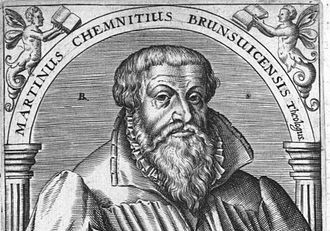
The following is my translation of Martin Chemnitz’s sermon for the Twelfth Sunday after Trinity as found in his Postilla (Vol. II, pgs. 429–434). Chemnitz uses a composite text based off of Matthew 15:29–31 and Mark 7:31–37. Curly brackets indicate marginal notes present in the original text. Square brackets indicate my own notes and additions. I have broken up some of the longer paragraphs for the sake of readability.

Composite Gospel Text (Matthew 15[:29–31]; Mark 7[:31–37])
And when Jesus went out again from the region of Tyre and Sidon, He went on further from there and came to the Galilean Sea, in the midst of the region of the Decapolis, and He went up on a mountain and sat down there. And there came to Him many people, having with themselves the lame, the blind, the mute, the crippled, and many others, and they cast them at the feat of Jesus, and He healed them so that the people marveled when they saw that the mute speaking, the crippled were healed, the lame walking, the blind seeing, and they praised the God of Israel.
And they brought to him a deaf man who was mute, and they asked Him that He lay hands on him, and He took him aside from the people, placed His finger in his ear and spit, and touched his tongue, and He looked up to heaven, groaned, and said, “Ephphatha,” that is, “Be thou opened.” And immediately his ears were opened, and the bond of his tongue was loosed, and he spoke right. And He forbid them that they should tell no one. But the more He forbid them, the more they spread it, and they marveled beyond measure and said, “He has made all well, He makes the deaf hear and the speechless speak.”
Explanation of the Gospel
{Ordering of the Doctrine in the Sunday Gospels}
If one pays attention diligently to the order of the Sunday Gospels, then one has from it a beautiful reminder (Erinnerung). We have previously heard how God punishes those who despise His Word, and how one should guard against such punishment so that he makes the temple of God to a house of prayer (Bethauß). It is also reported how one can make it into a house of prayer in the Law, in the article of justification or the Gospel, and in prayer according to the example of the tax collector [Luke 18:9–14]. Thereupon it follows that we do not have such from our own powers, but rather, with respect to this, we are deaf, mute, and blind.
{Summary of the Doctrine of this Gospel}
Before the Fall, we were thus created so that we made the temple a house of prayer in the Law, the Gospel, and the doctrine of prayer, so that when God saw everything that He had made, it was not only good, but very good [Genesis 1:31], especially the rational creatures, angels, and men. However, many of the angels have fallen; also, the serpent deceived mankind and thus sin came into the world and everything became wicked so that we are now deaf and blind by nature. But God had compassion on us and sent His Son, who has now brought again into right what was corrupted in Adam through Satan, and has thereby healed us, that He makes healthy our external members where we understand it most easily; likewise, He thereby heals our inner wound and evil from which we cannot rescue ourselves, as we are “children of wrath” (Ephesians 2[:3]) and our ears are deaf, our eyes are blind, are are tongue is bound, but God alone rescues and helps. And finally, that He thereby frees us from eternal punishment. Thus, He has made all things good [Mark 7:37], and He still does it, says Mark, and for this He uses lowly means: He speaks a word, He spits, He places His finger in the ears, etc. Then, one might think that the ears should well be stopped much more, and the eyes become darker! But when Christ uses such despised means, whereby the Word of God and the most worthy Sacraments are signified, He thereby helps and makes all things good, so that the temple among us becomes a house of prayer, and God may thus graciously turn away the well-deserved punishment. These we do not want to deal with at great length now, but rather only want to pay attention to what this Gospel teaches us for comfort under the cross (zum Trost im Creutz).
{Division of the Sermon}
Now there are here three kinds of people: [1] the Gergesenes [i.e., the crowd], [2] the mute man, [3] and the Lord Christ, and thus there are also three kinds of doctrine under the cross which we thus want to make use of and that we want to take away from this lesson.
- First, what we ought to do and think when God lays a cross upon other people.
- Second, how we ought to conduct ourselves when we ourselves come under the cross.
- Third, what the Lord Christ does here, and what we have to comfort ourselves in Him.
First Part
Forthcoming at a later time.
Second Part
Forthcoming at a later time.
Third Part
Forthcoming at a later time.
 PATTERN OF SOUND WORDS