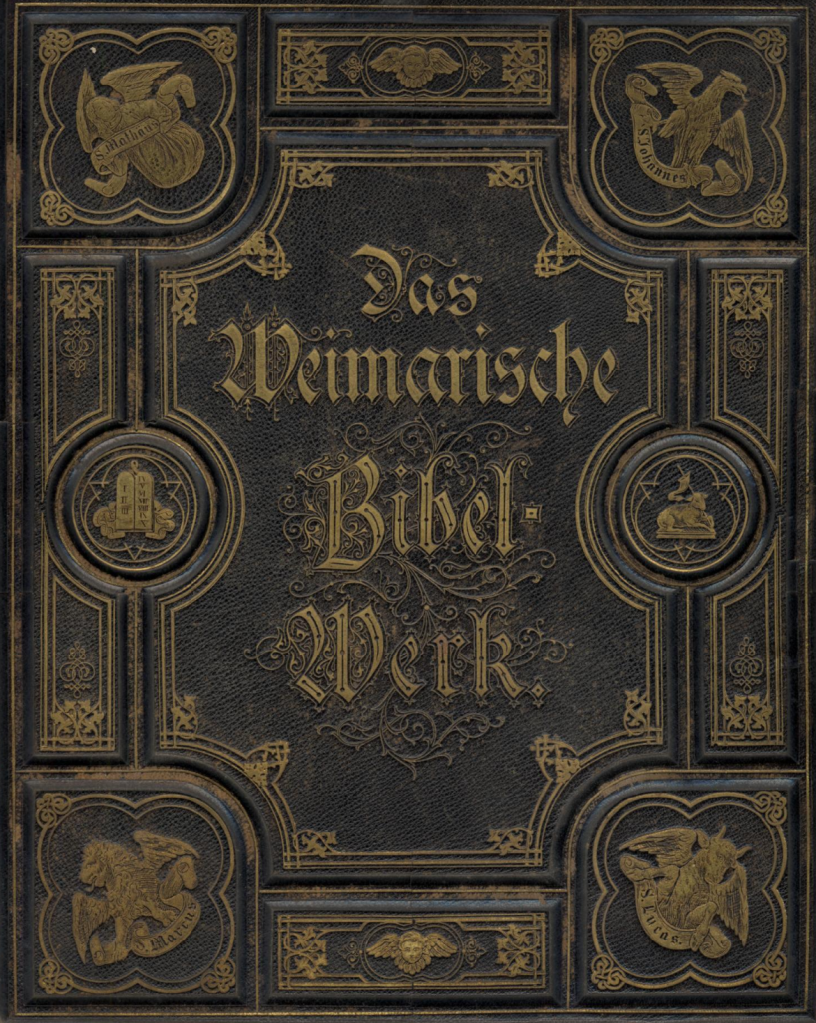
The following is my translation of the notes and useful applications for the Holy Gospel of the Feast of the Holy Innocents, Matthew 2:13–18, as they are found in Das Weimarische Bibelwerk (1877). Square brackets indicate my own notes and additions. For the useful applications, I recommend the reader see this very helpful article by Dr. Benjamin T. G. Mayes.
II. The flight of Joseph and Mary with the little Child, and what soon followed thereafter, namely, Herod’s Slaughter of the Innocents. (v. 13–18)
Annotated Text
13. Now when they had departed (and before the child was presented to the Lord in the temple at Jerusalem, Luke 2:22, and His parents had returned to Nazareth, Luke 2:39),1 behold, then the Angel of the Lord appeared to Joseph in a dream, and said, “Stand up and take the little Child and His mother (which little Child is far more noble than the mother, and therefore is properly set forth before her; which Child is also born of your wife, but not begotten of you) to yourself, and flee (with haste, without any delay) into the land of Egypt, and remain there, until I tell you (that you should come back. From which, then, Joseph could conclude that He would not always remain in Egypt); for it is the case that Herod seeks the little Child,2 to kill Him.“
(Matthew 1:20)
1 † This last event some bring in somewhat of a different chronological order, and not without any basis.
2 Greek: “for Herod will seek out the little Child” [μέλλει γὰρ Ἡρῷδης ζητεῖν τὸ παιδὶον]
14. And he (Joseph) stood up and took the little Child and His mother to himself, during the night (still in the same night in which he received the command), and escaped into the land of Egypt (He made upon the way at night so that no one would notice his flight).
15. And he remained there (with the Child Jesus and His mother Mary) until the death of Herod, so that it would be fulfilled what the Lord had spoken through the * prophet (Hosea), when He said, “Out of Egypt, I have called My Son.” (The prophet indeed speaks properly of the Israelite people, whom God loved with a fatherly manner as His son, Exodus 4:22, and led out of Egypt. However, the holy evangelist can apply this saying to the Lord Christ very well and justifiably, as the One in whom God loves His own, and who is the Head of the spiritual body [i.e., the Church, including the Israelites who looked forward to the Messiah], for what is ascribed to the body can also certainly be applied to the Head, Acts 9:4–5, as, on the other hand, what belongs to the Head can also be ascribed to the members to a certain measure, Ephesians 2:6; Revelation 12:5)1
* Hosea 11:1
1 Some understand this prophecy to be of Christ Himself, namely, that God in the future would call His own Son out of Egypt out of love for the Jews, beyond the former benefits. Hosea’s own words will give the best decision.
16. Now when Herod saw that he was deceived by the wise men (because they did not come back to him in Jerusalem on their return, which he falsely interpreted as though he had been deceived by them), he became very wrathful and sent out and had all the children who were two years old and under put to death in Bethlehem and in all its surrounding areas, according to the time which he had diligently learned from the wise men. (Because he had diligently inquired at to which time the new star had first appeared to them, therefore he made an assumption as to approximately how old the newborn King might be. However, because he nevertheless could not be certain of His age, so He also wanted both the younger and older children strangled together, not only at Bethlehem, but also in the nearest adjacent surrounding areas. According to some who draw their opinion from Macrobius[2], among these boys was also [Herod’s] own son, whom, according to his own thoughts, [He had killed] so that he might not miss the right one.)
1 † Whether this happened secretly or publicly by force is not certain. However, the former is more probable because Josephus does not think of it.
[2] [This is a reference to Ambrosius Theodosius Macrobius, who in his Saturnalia (2.4.11) recorded that Herod had also killed his own son.]
17. Then was fulfilled what had been said by the * prophet Jeremiah, when he said:
* Jeremiah 31:15
18. “Upon the mountain (at Ramah, which was a mountain-city in the tribe of Benjamin not far from Bethlehem, Joshua 18:25; Judges 19:13) one has heard a cry—much lamentation, weeping, and wailing—Rachel (the wife of the patriarch Jacob, who died and was buried in that same region, Genesis 35:19, from whom, as the matriarch, the descendants of Jacob and Benjamin come from) weeping for her children (her descendants) and not allowing herself to be comforted (from great resentment and grieving), for they were no more (as far as their earthly and temporal life is concerned; however, the souls of these holy tender martyrs live in heavenly joy and blessedness. Luther: “St. Matthew has especially drawn in this saying that he thereby might show how it always is for Christianity, for it always allows itself to be seen before the world as though it were all over with Christianity, yet it is, against the power of hell, wonderfully preserved by God. And one sees here in these children how a Christian existence rightly consists in suffering.” The saying cited from the prophet properly speaks of the misery that befell the descendants of Rachel, namely, the Israelites of the tribe of Benjamin, for the ten tribes, among whom the tribe of Benjamin was the foremost, were led away into the Assyrian captivity; this misery was so great, that their matriarch, Rachel, who had been deceased for many years, might well have risen from the dead and bewailed them. However, the evangelist does not apply this saying to the strangled Bethlehemite children unjustifiably, because their misery was not less than the former, and the gruesome murders occurred around the region where Rachel lay buried. And although the strangled Bethlehemite children do not come directly from Rachel as those who sprang up from the tribe of Joseph and Benjamin, nevertheless, they are properly also regarded as Rachel’s children because they come from Jacob, the husband of Rachel).1
* Genesis 35:19
1 † Many, not without reason, understand Jeremiah to be speaking properly of this Bethlehemite slaughter of children, since especially the entire thirty-first chapter deals with the spiritual redemption expected after the [Assyrian] captivity through Christ, in which manner Rachel, as a mother anguished unto death over the misery of her children, would be set forth as [a type] of each [of these mothers].
Useful Applications
II. DOCTRINE: Concerning the state of humiliation of Christ on earth, when he, as a poor human child, was brought by Joseph to Egypt away from the madman Herod so that He might not be killed. (v. 13–14)
 PATTERN OF SOUND WORDS