Author: revblanken

  • Chemnitz’s Homily Outline and Summary for the Purification of Mary, or Candlemas

    Chemnitz’s Homily Outline and Summary for the Purification of Mary, or Candlemas

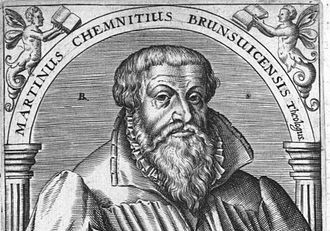
    The following is a translation of Martin Chemnitz’s homily outline found in his postil for the Purification of Mary, or Candlemas (Postilla, Volume III, pg. 38). While Lutheran Service Book only calls for Luke 2:22–32 and leaves verses 33–40 as optional, Chemnitz includes the entire reading. In addition, I have included other Scripture citations in brackets for ease of use.

    “In this homily we will take the three accounts of today’s feast day, which have now been reported and belong to this feast, one after the other, and briefly handle each one as much as serves for instruction (Lehr), admonition/remembrance (Erinnerung), and comfort (Trost):

    1. And thus, first, we will hear what had been ordered in the Old Testament with regard to postpartum Jewish women (Kindbetterin oder Sechswöcherin der Jüdischen Weiber) [see Leviticus 12:1–8] and why God had made the same order at that time, but how far it concerns us now and how we ought to use it at the present time.
    2. Second, we will hear of the Law of the firstborn [See Exodus 13:1, 11–16], where this had come from, and why our Lord God has reserved and dedicated the firstborn of men and cattle to Himself, what this signifies, or would we ought to remember or learn from it, and how we can make use of it for our comfort.
    3. Third, we will hear the beautiful glorious account of old Simeon which is told in the Gospel, how it was so mightily done, not indeed for the world, but for God, when the old respectable Simeon, who was a learned and holy man, and was a prophet, comes in and takes the little child Jesus into his arms from the inspiration of the Holy Spirit, and makes such a glorious confession of His person and office; and that he is an example that ought to gladden the heart of a pious Christian and be a guide to everyone as to how he ought to lead his life in this world, that, when his last hour has come, he may then depart with a cheerful heart and conscience and go to Christ.”

    Likewise, here is Chemnitz’s concluding summary (Postilla, Volume III, pg. 50):

    1. “First, what had been ordered with regard to postpartum women, to what end God had founded and commanded this order, and how all Christian God-fearing honorable mothers ought to today ought to make use of them in a right and Christian manner.
    2. Second, where the Law of the Firstborn came from, what it signifies that God reserves and dedicates the firstborn of cattle and men, what can be marked as a glorious reminder/admonition (Erinnerungen) and teaching, and how we can make use of this in all matters (Anliegen).
    3. Third, the spiritual history of old Simeon, and how this story was so excellent before God’s eyes, that Simeon so clearly and lovingly testifies of this little child, and comforts himself so highly in his heart, and thereby rejoices that this greeting (Salutare) mightily redeems him and bring him out from all the bitterness and danger of death and hell, and can and will move and transport him into the unending joy of heaven.

    Afterwards, how we ought to follow such an example of this blessed Christian man, and also trust and build on this one Savior and Redeemer, who has taken away the power of death and brought life, immortality and light, with a joyful undaunted heart in life and death and in true saving faith and confidence in finally departing and falling asleep in blessedness, and in His light beholding the eternal light. To this end, the highly praised Trinity, the Father, the Son, and the Holy Spirit, one true God in eternity, help us all. Amen.”

  • Chemnitz’s Homily Summary for the Third Sunday after Epiphany

    Chemnitz’s Homily Summary for the Third Sunday after Epiphany

    The following is a translation of Martin Chemnitz’s homily summary found at the end of his postil for the Third Sunday after the Epiphany (Postilla, Volume II, pg. 316).

    “We have now heard the teaching of these two accounts of today’s Gospel.

    1. First, we ought to learn to pray rightly in all our needs and bring them to God our heavenly Father in Christ that we may be graciously heard by Him.
    2. Second, thereafter, what kind of faith must have in order to trust Christ with certainty, that He can and is able to do all things and that He will accept us, not for the sake of our merit and worthiness, but rather according to His grace, and give us what is useful, blessed, and good for us in body and soul, for this life and for eternal life.

    May God our heavenly Father grant this to us in His grace, for the sake of His beloved Son Jesus Christ, our Savior and Redeemer, through His Holy Spirit. Amen.”

  • Martin Chemnitz’s Homily Summary for the Second Sunday after the Epiphany

    Martin Chemnitz’s Homily Summary for the Second Sunday after the Epiphany

    The following is a translation of Martin Chemnitz’s homily summary found at the end of his postil for the Second Sunday after the Epiphany (Postilla, Volume II, pg. 296) I have added Scriptural references in brackets for easy of use.

    “So now, this is the summary of the teaching which we ought to hold on to from this sermon:

    1. First, as far as the history is concerned, [we ought to know] how it goes one after another, how after the Lord Christ entered His office (Ampt) at thirty years old, was baptized by John, and was publicly called (außgeruffen) by God His Heavenly Father form heaven that He was the Messiah, and that all the world should hold and recognize Him as such [Matthew 3:13–17]. Soon afterward, He was led by the Holy Spirit into the wilderness, whereafter forty days [Matthew 4:1–11], He returned to John and once more received from Him the testimony that He was the Lamb of God who would offer Himself for the sins of the entire world [John 1:29–42]. From this testimony, five of John’s hearers were moved to follow Jesus, with whom he went down to Galilee and was invited to a wedding at Cana, where He performed His very first miracle (Wünderwerck) and made water into wine [John 2:1–11]. Thereby, He wanted to prove that He was not only a great prophet, but rather was the only-begotten Son of God. This miracle He had performed before He came to Jerusalem the following Easter, that He might make an appearance through it and His teaching; and how, for the very first, He gave His mother so much to understand, that she ought not interfere in the least with His office (Ampt) and prescribe Him what He ought to do.
    2. Second, because the Lord did this His first miracle at a wedding (Hochzeit), the doctrine of the estate of marriage is to be dealt with in the congregation of God as a chief doctrine in this Gospel, and that we can first confront the heretics who bring in this devil’s doctrine (as Paul calls it in 1 Timothy 4[:1–5]), namely, that the estate of marriage is a fleshly estate which is forbidden to Christians. We have good reason [to believe] that the estate of marriage is a holy and God-pleasing estate, which God the Father instituted [Genesis 2:18–25], God the Son has confirmed [Matthew 19:1–6], and the Holy Spirit has spoken blessing over (Psalm 128). Then, how one ought to take hold of this estate in all the fear of God, live in it, and how married couples ought to behave toward one another [Ephesians 5:22–33], both in love and sorrow (in Lieb und Leid). Then, when the dear cross comes in, how one should grasp on [to the marriage estate] in patience, keep quiet for God, and take up prayer into his hands, and thereby seek help and comfort from God. However, when God tests us and does not help so quickly, when He allows the cross to become more difficult at first and it appears as if He does not want to help us at all, how we should then restrain ourselves and take a stand, fight with God in true faith and certain confidence in His Word and promise, and should not let ourselves be pulled away until He finally hears us.

    These are the two points which we ought to hold on to from this Gospel. May the beloved God inscribe this teaching in our hearts, that, by God’s grace, we may grasp it well, hold on to it, and use it in a Christian manner. Amen.”