The following is my translation of the notes and useful applications for Numbers 14:26–35, as they are found in Das Weimarische Bibelwerk (1877). This passage is not assigned as a reading for any particular Sunday. However, St. Paul references this even in the Epistle Reading for Septuagesima, 1 Corinthians 9:4–10:5. Square brackets indicate my own notes and additions. For the useful applications, I recommend the reader see this very helpful article by Dr. Benjamin T. G. Mayes.
III. Moses’s intercession for the people, and what he thereby accomplished. (v. 13–35)
Annotated Text
26. And the Lord spoke with Moses and Aaron (what God had recently said to Moses only [v. 20–25], He repeated with more detail in the presence of Aaron), and said:
27. “How * long will this evil congregation murmur against Me?1 For I have heard the murmuring of the children of Israel, that they have murmured against Me.
* Psalm 106:25
1 Hebrew: “How long shall I overlook this evil congregation, which (still) murmurs against Me (incessantly)?”
28. Therefore, say to them, ‘As truly as I live,’ says the Lord, ‘I will do to you, that which you have said before my ears (since you have clarified that you would much rather die in this wilderness than cross over into the promised land, v. 2).
29. Your * bodies shall decay (and not be buried in the promised land where your forefathers, the patriarchs, lie) in thiswilderness (that is so unpleasant to you); and all of you who were numbered1 from twenty years old and above, you who have murmured against Me (as well as your wives who likewise murmured, all of you together),
30. You shall not come into the land over which I have lifted up my hand (sworn), that I would let you dwell therein; except * Caleb, the son of Jephunneh and Joshua, the son of Nun (and others from the tribe of Levi, who did not concur with your murmuring).
* Numbers 26:65, 32:12
31. Your * children, of whom you said, ‘They will be prey’ (v. 3), I will bring them in, that they shall know (and occupy) the land, which you have despised.
* Deuteronomy 1:39
32. But you, together with * your bodies, shall decay in this wilderness.
* Numbers 14:36
33. And your children shall be shepherds in the wilderness (tending livestock; indeed, even themselves wandering about as a herd of cattle in the wilderness) for forty years (the two years that have already passed being included, Deuteronomy 2:14), and they shall bear * your harlotry (to repay your wickedness and unfaithfulness against Me, your faithful God, and to fully make you partakers of your spiritual harlotry, namely, the idolatry and murmuring against Me), until your bodies are all in the wilderness (until they are altogether ground up);
* Psalm 95:10–11; Ezekiel 4:6; Hebrews 3:17
34. According to the number of forty days in which you had scouted the land, for each you shall count a year (as many days as you spent scouting the land of Canaan, so many years you shall still remain in the wilderness), so that they2 shall bear your misdeeds for forty years (and not only your children, but also you yourselves, inasmuch as within such time you shall be decimated and die), * so that you (experience in fact and) become awarewhat it is when I withdraw2(and, in addition, oppose myself to them in My wrath) the † hand (My grace, protection, and assistance from stiff-necked sinners).
1 Hebrew: “You shall”
* Jeremiah 2:19
2 Hebrew: “when one makes Me turn away (that is, hinders My purpose, as you have done).” See Numbers 30:6, 12; 32:7, 9.
† Deuteronomy 31:6, 8; Psalm 74:11
35. I * the Lord have spoken that I will also do so to all this evil congregation, who have rebelled against Me. In this wilderness they shall all be, and there they shall die (and thus remain).’”
* Ezekiel 5:17
Useful Applications
III. DOCTRINE: Concerning God’s righteous judgment against impatient doubters. (v. 26, 35)
The following is my translation of the notes and useful applications for the Epistle Reading of Septuagesima, 1 Corinthians 9:24–10:5, as they are found in Das Weimarische Bibelwerk (1877). Square brackets indicate my own notes and additions. For the useful applications, I recommend the reader see this very helpful article by Dr. Benjamin T. G. Mayes.
1 Corinthians 9:24–27
II. Concerning Paul’s lifestyle, that he lives moderately and that he still is of the single estate; but especially, that he preaches the Gospel without pay, etc. (v. 24–27)
Annotated Text
24. Do you not know,1 that those who run in the race (Luther: “In or around the competition”) all run, but (only) one obtains the (set forth) prize? (namely, the one who first reaches the goal) Run now thus (carry out your run in Christendom in such a manner), that you may seize it (that you may obtain the promised heavenly reward out of grace, so that you do not run in vain).
1 † Here follows the conclusion of all the preceding admonitions to right use of freedom, and therein rests the greater part on the little word “abstain” [ἐγκρατεύεται] (v. 25), which here signifies so much as “to exercise self-control” [abbrechen sich], as that upon which [the right use of freedom] continually depends.
25. But * everyone who competes restrains himself in all things (that might hinder him in the attainment of the victory); those (those who run or compete in the race) such that they receive a perishable crown (or wreath, for the most part of leaves or herbs), but we (all of us together who as spiritual combatants must always be at war against the devil, the world, and our sinful flesh; if we overcome, we will obtain) an imperishable one (an incorruptible eternal crown, 1 Peter 5:4).
26. Now1 I run in this way, not as uncertain (as those who do not know that they will reach and will win without fail, and thus have striven for nothing and in vain); I fight in this way, not as one who strikes in the air (as swordsman at times make many failing strikes in that they do not hit their opponent, but rather, strike the air; rather, I have set before myself a certain victory in my spiritual race and combat, toward which I direct all my doings, namely, God’s honor, the conversion and salvation of men, and my own eternal welfare. Luther: “Just as a combatant who runs out of bounds must miss the goal and one who strikes and makes failing strikes, swings vainly into the air, in this way it goes with all who indeed do many good works without faith, for they are uncertain how they are with God, therefore, they are mere missed runs, failing strikes, and false works”).
(2 Timothy 1:8)
1Greek: “Therefore, I also run (as you previously heard) …” [ἐγὼ τοίνυν οὕτως]
27. Rather, I * subdue (and overcome) my body and tame it (through moderation and fasting; I also do not indulge in my fleshly lusts and desires that want to hold me back from right course and combat, but rather I subdue them and guard against them so that they do not break out into works), that I not preach to others (and that they would be saved through the preaching of the Gospel, 1 Corinthians 4:16), and disqualify myself (that I do not make myself unfit for good and give an evil example to others).1
* Romans 8:13, 13:14 (Galatians 5:24)
1 † Because the apostles has previously spoken about restraining oneself and exercising self-control out of love toward others in the use of middle things [i.e., adiaphora] and also about taking pay, so this also must without doubt be understood as abstaining from various things of the like to avoid offense, even if became hard upon his flesh and blood. For properly speaking, the discourse here is not concerning fasting.
Useful Applications
II. COMFORT and CORRECTION: It is a great comfort for Christians that their running finally brings a glorious crown; however, each must see to it that he does not forfeit it with loveless self-will. (v. 24–27)
1 Corinthians 10:1–5
I. Paul counters the objection of the converted Corinthians, since they supposed that, by virtue of Baptism and the Lord’s Supper, there would be no distress with them in the rest, even if they made use of idol sacrifices; there, Paul holds before them certain types from the Old Testament, with proof, [namely, that] just as the Jews misused those same signs of grace and yet finally were harshly punished, that God also in this way will visit those who eat of idol-sacrifices. (v. 1–14)
Annotated Text
1. But I do not want to hold back from you, beloved brothers, that * our fathers (our forefathers, the Israelites in the Old Testament, in whose stead you have been received as the people of God in the New Testament) were (indeed) all under the cloud (under the pillar of cloud in which the Lord went before them by day so that He led them on the right way; the cloud which also stood over them, Numbers 14:14, and which overshadowed them), and † all went through the (Red) Sea (and thus were rescued from the hand of Pharoah who pursued them with a great army).
* Exodus 13:1
† Exodus 14:22 (Nehemiah 9:19; Psalm 78:14)
2. And they were all baptized under Moses1(who led them through the Red Sea and through the wilderness) with the cloud and with the sea. (This passage through the Red Sea and this covering by the cloud was a type of Holy Baptism, which has been instituted in the New Testament. For in the same way that God the Lord assured the Israelites of His gracious presence and His help against enemies through these wonderful blessings, in the same way Holy Baptism is a powerful seal of the divine promise and a certain testimony of the grace of God. Just as the Israelites were rescued from the bondage of Pharoah by such passage, but Pharoah with all his hosts was drowned in the Red Sea, in this way Holy Baptism is the saving bath of renewal and regeneration [Titus 3:5], by which we are redeemed from the power of the devil and the bondage of sin, that the old man with his evil lusts be drowned, and the new man may arise [Romans 6:4, 6]. Just as the Israelites by this blessing were obliged to believe the doctrine of Moses, in the same we are baptized into Christ and are thereby obliged to believe His Word and follow His commandments.)
(1 Peter 3:21)
1 Greek: “into Moses” [εἰς τὸν Μωϋσῆν], that is, into that church polity [German: Kirchenverfassung] that was set by him before the people from Sinai as a covenant.
3. And * they all ate the same spiritual food (namely, the Manna, which is therefore called a spiritual food, because it fell from heaven in an wonderful unnatural manner, and because it signified the spiritual soul-food, Christ Jesus, John 6:32–33, who feeds us with His flesh in the Holy Supper);
* Exodus 16:15ff. (Psalm 105:40)
4. And * they all drank the same spiritual drink (namely, the water that flowed from the rock, which is called a spiritual drink because it sprung forth from the hard rock in a supernatural manner, and because it signified the spiritual soul-drink, Christ Jesus, who quenches us with His blood in the Holy Supper); but they drank from the spiritual rock that followed them, which was Christ. (As our fathers altogether, both the wicked as well as the pious, drank from the same water which flowed from the rock, so they also, according to the figure and type, drank from the spiritual rock which led them through the wilderness, which spiritual rock was no one other than the Son of God, Christ Jesus.)
5. But with many of them (among those same Israelites) God had no good pleasure; for * they were struck down (and all those who were over twenty years perished altogether when they were led out of Egypt, only Joshua and Caleb excepted) in the wilderness. (From this, it sufficiently appears that God has no pleasure in them.)
* John 6:49 (Numbers 26:65; Psalm 106:26; Hebrews 3:17ff.)
Useful Applications
I. WARNING: Because Paul warns his own of idolatry, fornication, tempting God, and impatient murmuring on the basis that the end of the world had come upon them, how much more ought we allow ourselves to be warned, we who live seventeen hundred years afterward and who have fallen into the last sludge of the evil world? (v. 1, 11)
The following is my translation of the notes and useful applications for the Holy Gospel of Septuagesima, Matthew 20:1–16, as they are found in Das Weimarische Bibelwerk (1877). Square brackets indicate my own notes and additions. For the useful applications, I recommend the reader see this very helpful article by Dr. Benjamin T. G. Mayes.
I. An explanation of the nearest preceding words [from v. 15], “There are many who are first, etc.,” with a parable of the laborers. (v. 1–16)
Annotated Text
1. “The 1kingdom of heaven is like a House-father, who went out (first thing) in the morning to hire laborers into * His vineyard. (In this parable, by the kingdom of heaven is understood the estate of the Church of God, or the kingdom of grace here on earth, not only with regards to the call of God into the Church, but also the transfer of men out of the kingdom of grace into the kingdom of glory and majesty. By the house-father is understood God the Lord, the heavenly House-Father, John 15:1, who immediately from the beginning of the world has called men into vineyard of His Church through the preaching of His Word and continues this calling until the end of the world in such a form that at different times of the world He calls men to His Church and kingdom of grace.)2
1 Greek: “For…” [γάρ] — One should note here this little word, which provides the occasion [v. 15] and the key to the parable, which most German editions have omitted.
* Matthew 21:33 (Isaiah 5:1ff.)
2 † In particular, He calls at all times laborers as stewards (that is, teachers) into His vineyard of the Christian Church, whom He does not allow to labor vainly, but rather He kindly divides His gifts, bodily benefits and provisions, necessary relief, internal consolation, and the like in His order and measure.
2. And when He came to agreement with the laborers for a groschen[1](concerning the value of a groschen, see Matthew 18:28) for a day (when He made a promise to those who had been called by Him into the spiritual vineyard that their labor shall not remain unrewarded), He sent them into His vineyard (to carry out their labor in it according to estate and calling of each person).
[1] A groschen was a silver coin that was often issued as part of a daily wage. The Greek word here is denarius (δηναρίου).
3. And He went out (by this going out is signified that God, out of the hidden light of His majesty, as it were, has stepped forth and revealed Himself in His Word) around the third hour (when it was already three hours of the day) and He saw others in the market (in this world) standing idly (who had not yet come into the spiritual vineyard of the Church, and therefore, were not rightly serving God),
4. and He said to them, ‘You go out (as the previous workers who were called before you) into the vineyard; I will give to you what is right (I will thus make it with you that you should have no cause to complain about me, as if I wanted to allow myself to be worked for and served for free).’
(1 Corinthians 15:58)
5. And they went out. Once more, He went around the sixth and ninth hour (the sixth hour is the time of midday, the ninth hour is the time of vespers, three hours before the setting of the sun) and did likewise in this manner (He called those whom He saw standing idly in the market, likewise to go into the vineyard in order to work).
6. But around the eleventh hour (when only one hour was remaining until sunset, John 11:9) He went out and found others (by which the Gentiles can be understood, as those who were called in the last part of the world) standing idly and said to them, ‘Why are you standing here idly the entire day?’
7. They said to Him, ‘No one has hired us.’ He said to them, ‘You also go out into the vineyard, and whatever is right, shall become you.’ (cf. v. 4)
8. Now when it had become evening (),1 the Lord of the vineyard (the heavenly House-Father, who is Lord over all) said to His Steward (to Christ, His Son, whom He has set as Lord over His house, Hebrews 3:6), ‘Call the laborers and give to them the wage and begin with the last, until the first (thus, that you give to each a groschen, to the last as well as to the first).’
1 † Others understand by the evening not precisely the end of the world, but rather the time of the promised reward of grace in general; since some, especially the reward-seeking Jews, according to the nature of their special covenant shall receive only a temporal reward, but others, [namely,] the right-believing in Christ from the Jews and Gentiles shall receive the eternal reward of grace by faith, according to God’s promise, certainly, but none from merit.
9. When they came who were hired around the eleventh hour, they each received a groschen.
10. But when the first came, they thought they would receive more (because they had labored longer in the vineyard); and each of them also received his groschen. (By those who were hired around the eleventh hour are understood those who at the preceding calling willingly entered into the vineyard of the Christian Church, labored faithfully therein, and in their labor did not look to the reward, but rather to the goodness of the heavenly House-Father and to His promise. In particular, this refers to believing Gentiles, who do not rely upon their own righteousness and upon the merit of their works, but only upon the grace of God in Christ. By the first are understood those men who indeed followed the call, came into the fellowship of the Church of God, and labored therein; but only sought the reward, and therefore relied upon the merit of their works and in their hearts exalted themselves over the laborers of grace. In particular, this pertains to the Jews who were called to the Kingdom of God first, that is, before the Gentiles; but they sought to establish their own righteousness, Romans 10:3, and placed the trust of their hearts in the merit of their works. These receive their groschen, that is, the promised reward, which they have already received in this life in the manifold temporal blessings, Matthew 6:2; but they neither have any share in the eternal reward, nor anything for which to hope.)
11. And when they received it, they murmured (from impatience and seeking a better reward) against the House-Father (who, in their opinion, maintained no equity).
(Luke 15:28ff.)
12. And they said, ‘These last have only labored for an hour, and you have made them equal to us who have born the burden and heat of the day (having labored throughout the entire day with great hardship).’
13. But He answered and said to one among them (namely, one who elevated himself before others), ‘My friend, I have done you no injustice. Did you not agree with Me for a groschen?
14. Take what is yours and go away. But I will give to these last just as I gave to you. (This must not be understood as if even the murmuring work-saints, who build and presume upon their own merit, will obtain eternal life, since by the groschen is not to be understood precisely eternal life, but rather, in general every kind of reward, whether it be here temporally in this, or there eternally in that life; and thus indeed these murmuring work-saints also receive their reward, namely, temporal blessing, but not the eternal reward in heaven.)
15. * Or do I not have the right to do what I want with that which is Mine? (Should it be forbidden to Me to deal with that which is My own, and which no one can earn from me, according to My gracious will?) Do you therefore see askew (are you therefore so resentful and envious), that I am so kind (free-giving)?’
* Romans 9:21
16. Thus (all servants of God, especially Church ministers, should not to look for temporal gain, honor, and the like in their work, much less should they envy others; but rather, in faithful and honest purpose toward God’s promise, they ought to persevere in their duty and call with true godliness, so that they do not deprive themselves of God’s grace and eternal blessing with pride, envy, and murmuring. For) the * last (the laborers of grace, who rely only on God’s grace and do not insist upon their merit) will be the first (will be preferred to the first), and the first (those who are murmuring work-righteous men) willbe the last (that is, will be rejected). For many (that is, all, all men) are called (through the Word to the Church of God); but few (reckoned contrary to the great heap of the damned) are chosen (by God to eternal life because they seek righteousness and eternal life not only and solely in the grace of God and in Christ, but rather in the merit of their own works and exalt themselves over others).”
* Matthew 19:30, 22:14 (Mark 10:31; Luke 13:30)
Useful Applications
I. CORRECTION: That we, by impatience and grumbling, shall not overcome [or become master of] God in His governance and in the rewarding of good, but rather ought to leave everything to His holy will and allow ourselves to be content with that which He bestows upon us with thanksgiving. (v. 11–15)
The following is my translation of the notes and useful applications for one of the Old Testament Readings assigned for the Transfiguration of our Lord, Exodus 3:1–14, as they are found in Das Weimarische Bibelwerk (1877). Square brackets indicate my own notes and additions. For the useful applications, I recommend the reader see this very helpful article by Dr. Benjamin T. G. Mayes.
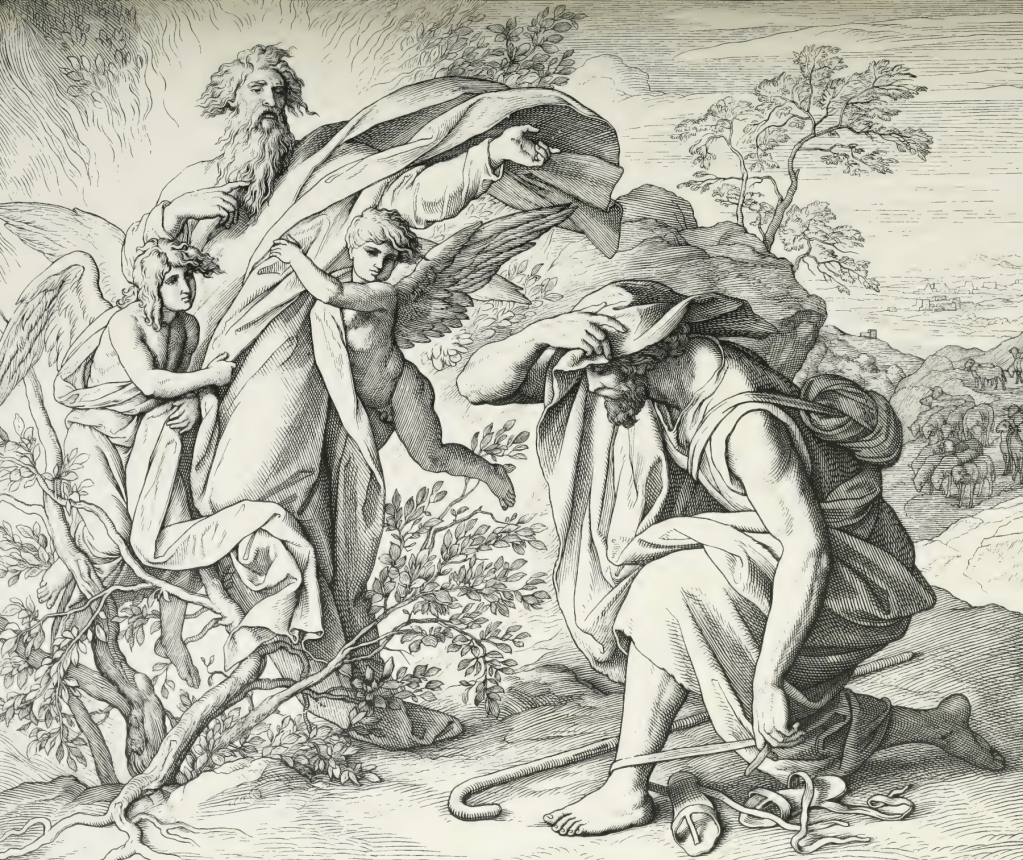
Moses is Called to Lead Israel from Egypt, by Julius Schnorr von Carolsfeld
I. The appearance of the Son of God in the fiery bush, and how Moses approached. (v. 1–6)
II. The promise of God concerning help and salvation, and how Moses was called to his office. (v. 7–10)
III. How Moses refused this call two distinct times, partly on account of his unworthiness, partly on account of the ignorance of the children of Israel, that they may not know the name of God; and how the Lord answered thereafter. (v. 11–14)
Annotated Text
1. Now Moses tended (in those days in the fortieth year) the sheep of Jethro, his father-in-law,1 the priest (the captain and magistrate) in Midian, and he drove the sheep out in the wilderness (into the land of Arabia, which is called the wilderness of Sinai), and came to the mountain of God (so named on account of the present and following divine revelation, called) Horeb.
1 † Perhaps the brother-in-law, for the word from which the Hebrew comes signifies in general a relationship through marriage and can be that the son follows the father in office. Age and names can suggest this. See Exodus 2:18, 23; Numbers 10:29; Judges 1:16, 4:11, etc.
2. And the Angel of the Lord (the Lord, the eternal self-subsisting Son of God, who afterward in the fullness of time was sent into the flesh by the Father, the Lord) appeared to him * in a fiery flame from the bush.1 And he saw that the bush burned with fire and was nevertheless not consumed (by the flame of fire).
* Exodus 23:20; Deuteronomy 33:16 (Acts 7:30)
1 † Thornbush, particularly a bramble-bush; from this Mount Sinai appears to have received its name.
3. And he said (to himself with wonder), “I will (go) there and see this great sight (I will inspect and research), why the bush does not burn (what the cause might be that the green wood in the midst of which the flame of fire burns is not consumed? By this fiery bush is prefigured the mystery of the incarnation of the Son of God, that namely, in the fullness of time, He would unite true human nature to Himself personally, and also fill it with the light of His divine majesty and divine attributes, yet so that human nature would not be harmed or consumed by the divine nature in the least, and that in such personal union His assumed human nature would complete the work of redemption of the human race, prefigured by the deliverance from Egyptian slavery.)1
(Acts 7:31)
1 † Whether the divine preservation of His Church in the fire and thorns of the (Egyptian) afflictions has no place here is to be considered, and it is likely that it was in view.
4. But when the Lord saw (the Son of God in the fiery bush) that he went over (wanted to draw near) to see, God (the Son of God) called to him from the bush, and * said, “Moses, Moses!” He answered, “Here I am. (What is your desire? Speak, for Your servant listens, 1 Samuel 3:10.)”
* Genesis 22:11
5. He said, “Do not tread here, take off your shoes from1 your feet (as a sign of your impurity); for the place upon which you stand is (on account of My divine presence and revelation through the Word and through sign of the fiery bush) a * holy land.”
1 Hebrew: “cast them down” (For the Jewish shoes were fasted to the foot only from above with a strap, as they are still worn by the Capuchin friars.)
* Genesis 28:17 (Joshua 5:15)
6. And He said further, * “I am the God of your father, the God of Abraham, the God of Isaac, and the God of Jacob (I have established a gracious covenant with your forefathers, the holy patriarchs, and promised them that I would be their God, that I would nourish and protect them, that I would sanctify and renew them, and that I would bestow all good upon them, that I would resurrection them again after their death, and that I would gather them into eternal life; but, in particular, that I would give the land of Canaan to their descendants, and that the Messiah shall be born from their race).” And Moses hid his face, for he (as an impure sinner) was afraid to look upon God (the most-holy Lord).
* Matthew 22:32 (Mark 12:26; Luke 20:37; Acts 7:37, 32)
7. And the Lord said, “I have (indeed) seen (from before time and even now) the misery of My people in Egypt (the descendants of Abraham, Isaac, and Jacob, who are the people of My special possession), and I have heard their cries over those who drive them (King Pharoah, his counselors, and his officials); I have known their sorrow (and let it come into My heart),
(Acts 7:34)
8. And I have come down (I have revealed My special presence in the fiery bush and am determined) that I rescue them from the hand of Egypt (slavery and oppression), and lead them out from this land into * a good and far land, in a land in which flows milk and honey (which is rich and fruitful), namely, to the place (into the land) of the Canaanites, the Hittites, the Amorites, the Perizzites, the Hivites, and the Jebusites (whom altogether are accursed and notorious sinners, Leviticus 18:24–25).
9. Because now the cry of the children of Israel has come before me (because the children of Israel, in their cries and prayers have set My covenant and promise before Me), and I have seen their fear (the external bodily need), how the Egyptians frighten them;
10. so * go now, I will send you to Pharoah (the King in Egypt), that you1 lead my people, the children of Israel from Egypt (the house of slavery).”
1 Hebrew: “Come now! Behold, the cry has come, etc.” (v. 9) “Come! (I say) go, for I will send you to Pharoah, and you will lead My people, etc.”
11. Moses said to God, * “Who am I, that I should go to Pharoah and lead the children of Israel from Egypt?” (My person, reputation, and strength are far too meagre for such a great work.)
* Exodus 4:10; 1 Samuel 18:18
12. He said, * “I will be with you (as Immanuel, the strong God). And this shall be the sign for you (a sign of remembrance, to remind you of what I now say to you in the future, and now are assured of this blessing), that I have sent you: When you have led My people from Egypt, you will offer sacrifice to God on1 this mountain (where I have now appeared to you and have given you the call to lead My people).”
* Genesis 31:3; Judges 6:16
1 Hebrew: “in” (For sacrifices were never offered upon it, also upon which few were allowed come. See Exodus 24:9ff.)
13. Moses said to God, “Behold, when I come to the children of Israel, and say to them, ‘The God of your fathers has sent me to you,’ they will say to me, ‘How shall we call His name (what is His proper name, by which He will be distinguished from the gods of the Egyptians)?’ What shall I say to them (as an answer)?”
14. God said to Moses, * “I AM WHO I AM (I am the eternal, unchangeable God, the Creator and Preserver of all creatures, complete in Myself; I will also the fullness of time assume human nature, and in it complete the great work of redemption from spiritual slavery.).” And He said, “Thus you shall say to the children of Israel (the only true God’s name is this): ‘I AM has sent me to you (Luther: “When you come there, then I will be with you, and show Myself such that you shall know that it is I.”).”
* Deuteronomy 4:35; Revelation 1:4, 8
Useful Applications
I. CORRECTION: That we ought to come to the place where God deals with us through His word with reverence, just as Moses did. (v. 1–6) II. DOCTRINE: That God alone knows how to raise up useful people for the help and comfort of His suffering Church, as He did with Moses. (v. 7–10) III. COMFORT: That those who are orderly called, even to a dangerous office, ought to comfort themselves with the assistance of God. (v. 11–12)
The following is my translation of the notes and useful applications for the Epistle Reading of the Transfiguration of our Lord, 2 Peter 1:16–21, as they are found in Das Weimarische Bibelwerk (1877). Square brackets indicate my own notes and additions. For the useful applications, I recommend the reader see this very helpful article by Dr. Benjamin T. G. Mayes.
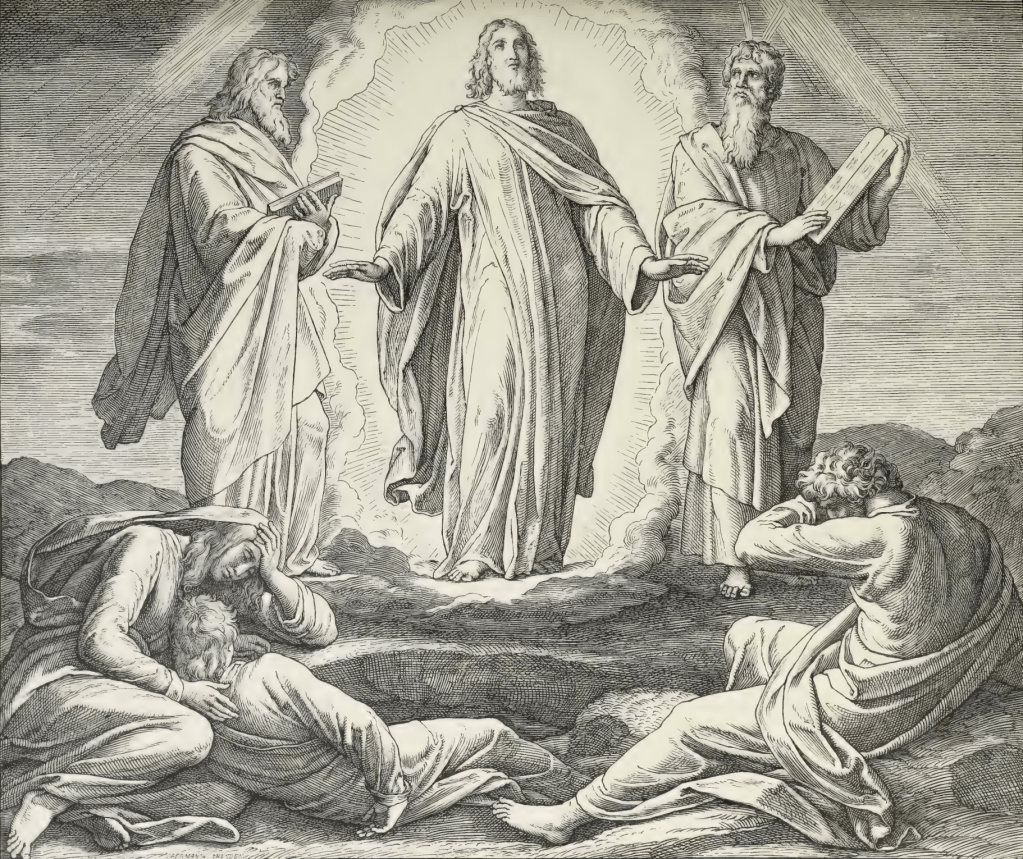
The Transfiguration of Jesus, by Julius Schnorr von Carolsfeld
IV. A new admonition to pure apostolic doctrine. (v. 16–21)
Annotated Text
16. For we (I and other apostles) have not followed * clever fables (cleverly devised poems), when we had proclaimed † the power and coming1 of our Lord Jesus Christ (how He will one day come for judgment in power and glory); but rather we have seen His glory (and divine majesty) ourselves;
*1 Corinthians 1:17
† 1 Corinthians 2:4 (John 1:14)
1 Greek: present (that He now shines in reality as the Savior of the world)
17. when1 He (in His transfiguration) received honor and praise from God the Father through a (clear and audible) voice that came2 to Him from the great Glory, “This is My (only-begotten, own, and) beloved Son, in whom I have good pleasure (whom I not only love in a fatherly way, but rather, for His sake, also have good pleasure in all who believe in Him, Ephesians 1:6).”
* Matthew 3:17, 17:1–5; Luke 9:35 (Matthew 12:18)
1 Greek: “For when…” [γὰρ]
2 Greek: “and such a voice came to Him…” [φωνῆς ἐνεχθείσης αὐτῷ τοιᾶσδε]
18. And we (I and my fellow apostles James and John) have heard this Voice which was came from heaven,1 * when we were with Him on the holy mountain (which, on account of this divine revelation, is called the holy mountain, Exodus 3:5).
1 Greek: “So we (ourselves) also have heard this voice (clearly), when it resounded from heaven” [καὶ ταύτην τὴν φωνὴν ἡμεῖς ἠκούσαμεν ἐξ οὐρανοῦ ἐνεχθεῖσαν]
* Matthew 17:5 (Luke 9:35ff.)
19. We have1 a firm (even more firm than the aforementioned revelation on the mountain and the divine Voice which was heard there, namely, a) prophetic Word (contained in the Scriptures of the Old Testament inspired by God, through which the doctrine of Jesus Christ and His righteousness, which comes through faith, is manifestly attested, Romans 3:21), and you do well that you pay heed to it (and diligently search therein, John 5:39, Acts 17:11) as to * a light, which here (together with the doctrine of the Gospel contained in the New Testament in the apostolic Scriptures, 2 Peter 3:15–16) shines in a dark place (in this poor mortal life, which in comparison to the future eternal life is a true land of darkness and gloom, Job 10:21),2 until the day (of the full radiance and the glorious light of eternal life) dawns and the Morningstar (Christ Jesus, Revelation 22:16) rises in your hearts (when there will be no more night, and one will not need a lamp or the light of the sun because God the Lord Himself will illumine the elect, Revelation 22:5).3
1 Greek: “We also have” [καὶ ἔχομεν] (namely, beyond the first vision mentioned)
* Psalm 119:105; 2 Corinthians 4:6
2 Or, “in your soul,” which without this light is darkness by nature.
3 This may also be a description of the dawn, that is, the believing knowledge of Christ that appears to us here and always is increased in divine grace, upon which the full day of eternal life follows. See Isaiah 8:20.
20. And that you should know this first (first of all), that no prophecy in Scripture (thus recorded in Holy Divine Scripture) happened from one’s own interpretation1(which a man spins and devises from his own mind, but rather, the interpretation of the prophetic prophecy must be taken from Holy Scripture itself);
(Romans 12:7; 2 Timothy 3:16)
1 Greek: Alternatively, “As you know above all (as a foundational principle of your faith), that no prophecy contained in (Holy) Scripture comes from one’s own resolution (or the arbitrary will of men).” [τοῦτο πρῶτον γινώσκοντες ὅτι πᾶσα προφητεία γραφῆς ἰδίας ἐπιλύσεως οὐ γίνεται]
21. For no prophecy ever (contained in Holy Scripture) was ever brought about from the will of men; rather, the * holy men of God (the holy prophets) spoke (of divine mysteries), being driven † by the Holy Spirit. (Therefore, just as Holy Scripture did not flow forth from human reason, but is inspired by God, 2 Timothy 3:16, so also must the correct interpretation of prophetic Scripture not be spun from human reason, but rather must arise from the Holy Spirit, who, just as He is the origin of Holy Scripture, must also be its most certain interpreter.)
* Wisdom 7:27
† Acts 28:25 (2 Samuel 23:2; Acts 2:16; 1 Peter 1:11)
Useful Applications
IV. CORRECTION: To pay attention to the prophetic Holy Scriptures, to hold them high and of worth, and also to follow them in faith and life as a light bestowed by God. (v. 19) * COMFORT: Because the Holy Scripture is not man’s Word, but rather is God’s Word, so we ourselves can rely upon it in life and death. (v. 20–21)
The following is my translation of the notes and useful applications for the Holy Gospel of the Transfiguration of our Lord, Matthew 17:1–9, as they are found in Das Weimarische Bibelwerk (1877). Square brackets indicate my own notes and additions. For the useful applications, I recommend the reader see this very helpful article by Dr. Benjamin T. G. Mayes.
The Transfiguration of Jesus, by Julius Schnorr von Carolsfeld
I. The history of the transfiguration of Christ on Mount Tabor. (v. 1–8) II. The conversation of Christ with His disciples concerning the future Elijah. (v. 9–13)
Annotated Text
1. And after * six days (In Luke it says, “And it came to pass about eight days after these sayings,” [Luke 9:28]. For there had been six days between the time Jesus spoke these words at the end of the nearest preceding chapter and afterwards on the eighth day this Transfiguration followed), Jesus took to Himself Peter and James and John, his (James’s) brother (which three He likewise afterwards took to Himself when He wanted to go to His suffering in the garden of the Mount of Olives, Matthew 26:37, to indicate that those who have much of the suffering of Christ are also richly comforted through Christ, 2 Corinthians 1:5), and lead them (specially alone from other people, and went with them) to a high mountain (called Tabor, situated in Galilee,1 to which He withdrew to pray, and when He prayed, the form of His face was altered, Luke 9:28–29).
* Mark 9:2 (Luke 9:28)
1 † Or as others hold, “Panium, near Caesarea Philippi.” Peter calls it simply “the holy mountain” [τῷ ἁγίῳ ὄρει], 2 Peter 1:18.
2. And (He) was * transfigured before them (He was transfigured before them, Mark 9:2, in such a way that He received an entirely different form, He allowed them to see a glance of His heavenly, peculiar Majesty and glory, which was communicated to Him according to His human nature by virtue of the personal union, so that they would be guarded against the offense of the cross of Christ), and His face shown as the sun, and His clothes were white (and gleamed) as light (they became bright and very white as the snow, in such a way that no fuller on earth can make them so white, Mark 9:3).
* John 1:14; 2 Peter 1:16–17
3. And behold, there appeared to them (two men bodily, who were) Moses and Elijah, who (appeared in radiance and) spoke with Him (concerning the departure [τὴν ἔξοδον] which He was to fulfill at Jerusalem, that is, concerning His suffering. As Moses and the prophets had prophesied of Christ in their writings, John 5:39, 5:46, Acts 10:43, so also Moses thus speaks here with Christ, as well as Elijah in the name of the all the prophets, and give Him testimony, that He is the Messiah and Savior of the world).
4. But Peter (and those who were with Him were full of sleep; but when they awoke, they saw His radiance and the two men standing with Him. And it came to pass when they were departing from Him, Luke 9:32–33, Peter began) answered and said to Jesus, “Lord (and Rabbi, Mark 9:5, that is, Master, Luke 9:33), it is good to be1 here (for this transfiguration of Christ and this bodily conversation which Moses and Elijah held with Christ was a foretaste and prefiguration of the joy of eternal life); if you would like, then I will make three huts here, one for you, one for Moses, and one for Elijah (but he did not know what he was saying, for they were confused, Mark 9:6).
1 Greek: “It is something (truly) beautiful (and pleasant), that we are here (in such a pleasurable bright light).” [καλόν ἐστιν ἡμᾶς ὧδε εἶναι]
5. Then while He was thus still speaking, behold, there (came and) overshadowed them a luminous cloud (so that they were surrounded by it and were terrified when the cloud covered over them). And behold, a Voice (namely, the heavenly Father, fell) from the cloud (which) said (concerning Jesus Christ), * “This is My beloved (only-begotten) Son (whom I have begotten from eternity out of My essence), in whom I have good pleasure, whom you ought to hear (that you believe what He says to you and do what He commands you. Thus there is found here once more a glorious revelation of the most-holy Trinity: the Father allows His voice to beard from heaven, the Son stands in His transfiguration on the mountain, the Holy Spirit, who enlightens the hearts of men, reveals Himself in a bright cloud).”
* Matthew 3:17ff.; 2 Peter 1:17
6. When the disciples heard this, they fell (from fear) on their faces, and were very terrified (because they could not bear God’s majesty).
7. But Jesus came to them, * touched them (strengthened and comforted them) and said, “Stand up, and do not be afraid.”
* Daniel 8:18, 10:10
8. Now then they lifted up their eyes (and looked around themselves, Mark 9:8, and while such a Voice occurred, Luke 9:36, they found and) they saw no one (with them), except Jesus alone (Moses and Elijah had disappeared again).1
1 * Or rather had entered the bright cloud, Luke 9:35.
9. And when they descended from the mountain, Jesus commanded them and said, “You shall tell no one this vision (this revelation of My glory) until the Son of Man is raised from the dead (for Christ at that time was still in the state of His humiliation, and wanted that He should suffer and die beforehand before He entered into His glory, Luke 24:26. But afterward, after Christ’s resurrection and ascension, both apostles Matthew and Peter not only proclaimed such, but rather also recorded it in their Scriptures. The disciples have followed such a command, as is fitting; for Luke reports of them when he says, “And they were silent and proclaimed nothing to anyone in those days as to what they had seen,” Luke 9:36).
* Matthew 16:20
Useful Applications
I. DOCTRINE: Christ’s transfiguration according to His humanity on the mountain is a picture of the glory and transfiguration of the bodies of believers as they will be in the resurrection of the dead and in eternal life (v. 1–2)
The following is my translation of the notes and useful applications for the Holy Gospel of the Second Sunday after Epiphany, John 2:1–11, as they are found in Das Weimarische Bibelwerk (1877). Square brackets indicate my own notes and additions. For the useful applications, I recommend the reader see this very helpful article by Dr. Benjamin T. G. Mayes.
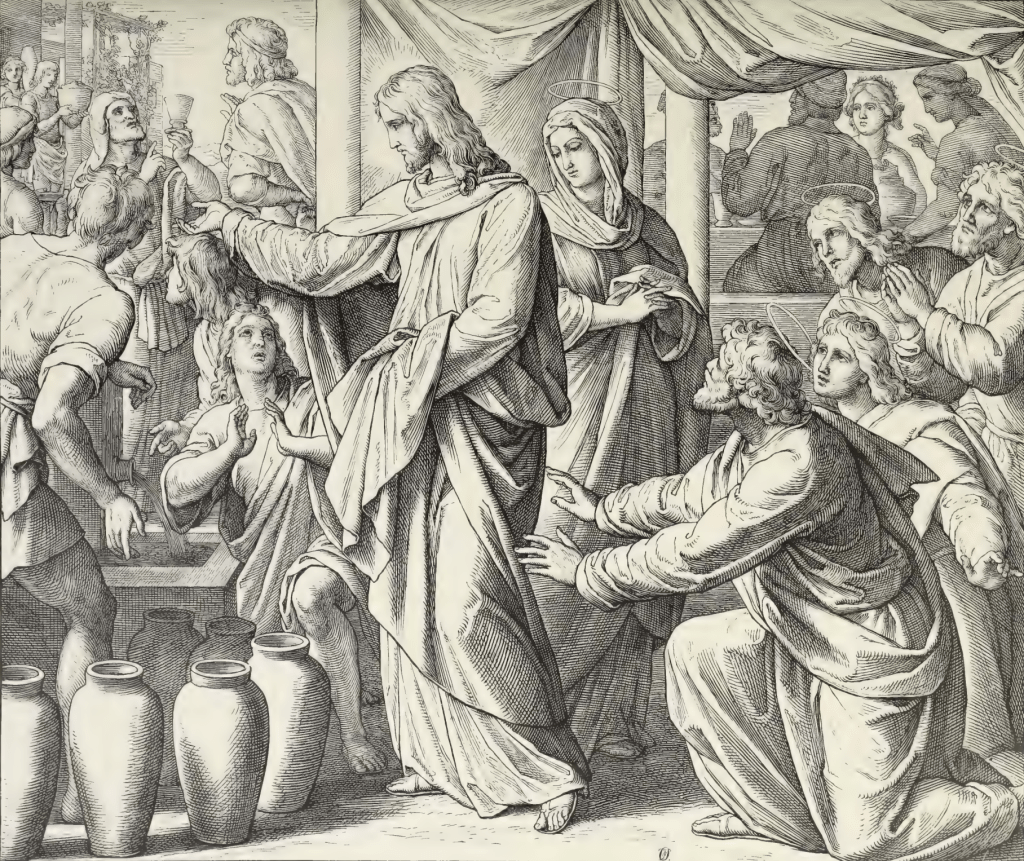
The Wedding at Cana, by Julius Schnorr von Carolsfeld
I. The history of the wedding at Cana. (v. 1–11)
Annotated Text
1. And on the third day (after Jesus had gone into Galilee, John 1:43, and had spent two days on the way) there was a wedding at Cana in Galilee, and the mother of Jesus was there (perhaps as a related kinswoman).
2. Now Jesus and His disciples (who were mentioned in John 1[:35–51]) were also invited to the wedding (therefore, they were also present there. With His presence, Christ not only wanted to demonstrate His affability, but rather, by His very first miracle, He also wanted to honor the married estate as the first ordinance of God among men and the most excellent picture of the communion of Christ with His Church and teach that marriage ought to be held in honor by all, and the marriage bed ought to be kept undefiled, Hebrews 13:4.).
3. And when the wine had been used up (because the supply was meagre on account of the poverty of the newly married couple), the mother of Jesus said (from good intention and care, but at an inopportune time, and also with a certain timidity, worry, and faint-heartedness) to Him, “They have no wine (They do not have enough wine; therefore, prove yourself as an almighty and miracle-working Lord in this emergency).”
4. Jesus said to her, “Woman, what * have I (in such a work that concerns My office) to do with you? My hour is not yet come (I know well how and when I shall help).”
* 2 Samuel 16:10 (Matthew 12:48)
5. His mother (was assured by these words, that her Son Jesus would prove Himself helpful at the right time, and) said to the servants, * “Whatever He (this my Son) says to you, do it (even though it may seem illogical to you).”
* Genesis 41:55
6. Now there were set there six stone water jars (large containers or tubs)1, according to the manner of * Jewish purification (from which the Jews, according to old custom and according to the ordinances of the fathers, were accustomed not only to wash and purify their hands, but rather also the dishes, cups, and other vessels many times), and in each of them were two or three measures. (Luther: “Metreta in Greek [μετρητὰς]; two metreta make about one Eimer[2] of wine among us .”)
1 * Or also “immovable troughs,” as one calls them in some places.
* Mark 7:3
[2] An “Eimer” was perhaps around 56.5 liters.
7. Jesus said to them (to the servants and waiters, John 2:5), “Fill the water jars with water.” And they filled them until them up to the top.
8. And He said to them (after He had changed the water into wine by His divine power), “Draw [some] now (into your vessels), and bring it to the master of the feast1(to taste it, so that he might let it be served afterward to the guests). And they brought it (to him, as the Lord commanded them).
1 * To “the steward of the feast,” who was chosen at times by lot. Today one might say “the host.”
9. But when the master of the feast tasted the wine which has become water and did not know from whence it (such a fine wine kept until now) came (but the servants who had drawn the water knew) (and they did not immediately tell it to the master of the feast, to have him test it as to what he would say about it), the master of the feast called the bridegroom,
10. and said to him, “(How should I understand this?) Everyone gives (at his appointed banquet and celebration) the good wine first, and when they (the guests) have become drunk (have enjoined themselves a little and drunk for merriment), then the inferior; (but) You (on the other hand) have kept the good wine until now (which seems strange to me.” However, there is no doubt that afterward the master of the feast with all the other attendees came to know the truth of this miracle of Christ.)
11. This is the first sign (visible miracle), that Jesus did (after He had begun His preaching office), that happened at Cana in Galilee; and He revealed (thereby) His (until now completely hidden under the form of a servant) glory (glory as of the only-begotten Son of the Father, John 1:14, of which He only allowed a single ray to shine forth, as the sun does at time from the clouds). And His disciples believed in Him (their faith in Him as the now appeared Messiah was thereby markedly strengthened).
Useful Applications
I. DOCTRINE: That the Lord Christ Himself, together with His mother and disciples, was at a wedding in Cana in Galilee, redounds to the married estate a particularly great honor, that it is a holy well-pleasing estate to God. (v. 1–2)
The following is my translation of the notes and useful applications for the Epistle Reading of the Second Sunday after Epiphany (Lutheran Service Book), Ephesians 5:22–33, as they are found in Das Weimarische Bibelwerk (1877). Square brackets indicate my own notes and additions. For the useful applications, I recommend the reader see this very helpful article by Dr. Benjamin T. G. Mayes.
Note: The historic reading is Romans 12:6–16a.
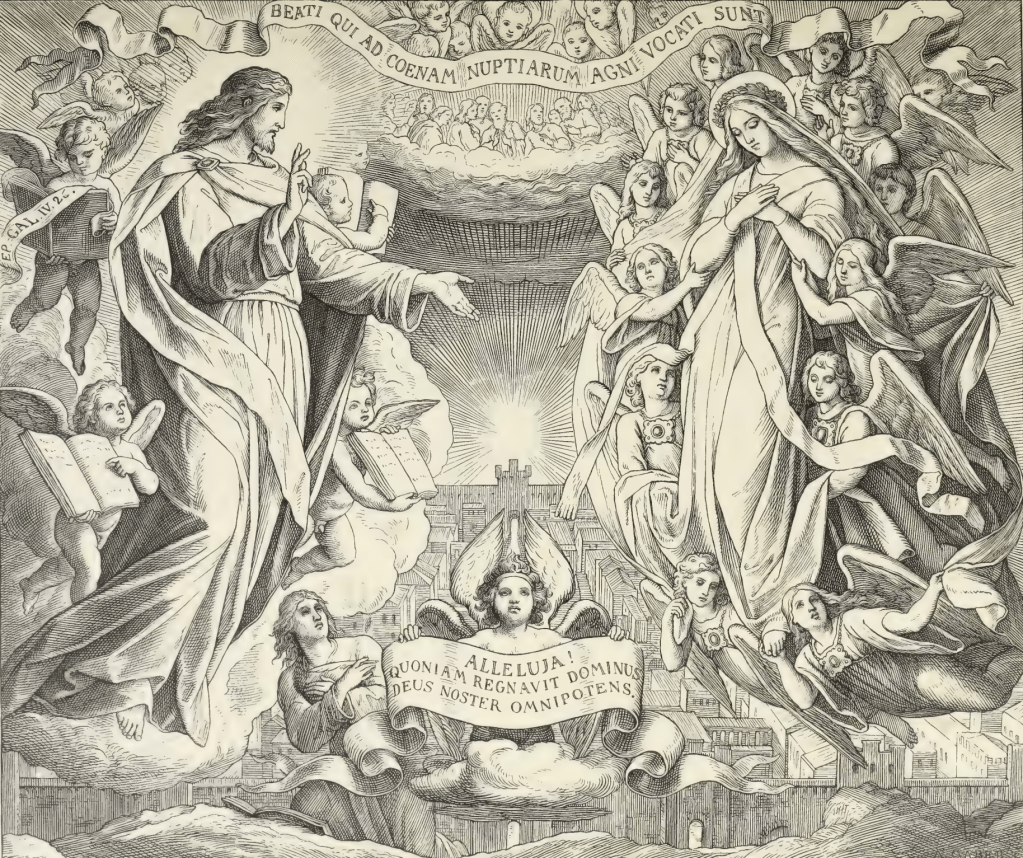
John Sees the New Jerusalem, by Julius Schnorr von Carolsfeld
II. Special rules for wives who have become believers, how they ought to conduct themselves toward their husbands. (v. 22–24)
III. An instruction for the men, together with a strong admonition to both parts taken from the example of Christ and the congregation. (v. 25–33)
Annotated Text
22. The (married) wives to be subject to their husbands,1 as to the Lord (as to God Himself,2 because He has commanded such obedience, and also has good pleasure in it, and wants it to be regarded and considered as rendered to Himself).
* Genesis 3:16; Colossians 3:18; 1 Peter 3:1 (Titus 2:5)
1 Greek: “You wives to be subject to your husbands” [αἱ γυναῖκες τοῖς ἰδίοις ἀνδράσιν]
2 † See Ephesians 6:6ff.
23. For the * husband is the head of the wife (He has authority over his wife from God’s order); just as Christ also is the Head of the congregation (His Church), and He (Christ) is the Savior (who defends her against all enemies in this world and wants to make her blessed there) of (this) His (spiritual) body (the Church).
* 1 Corinthians 11:3ff. (1 Timothy 2:11–12)
24. But, as now the congregation is subject to Christ (as their Lord and Head), in this way (ought) also the wives to their husbands (as those from whom they have honor and protection, being subject and obedient) in all (just) things.
(Colossians 3:18ff.)
25. You (married) * husbands, love your wives, just as Christ also has loved the congregation (His Church), and has given Himself (into death) for her,
* Colossians 3:19ff. (1 Peter 3:7)
26. so that He might sanctify * her (that she be considered holy and made holy, both through the donation of His righteousness and the indwelling of the Holy Spirit), and purify1 her (being washed from the filth of sin) † through the water-bath in the Word (through Holy Baptism, in which water and Word are bound with one another),
* John 17:17
1 Greek: Alternatively, “in that He purified her…” [καθαρίσας]
† John 3:5
27. that He might present her to Himself (then on the Last Day and in eternal life) a (such a) congregation (and spiritual bride), which * is glorious (and indeed beautiful), not having a spot or wrinkle (any stain of sin or disfigurement), or any such thing (that could make her unsightly), but rather that she would be holy and blameless (in this life through the reckoned holiness of Christ, 1 Corinthians 1:30, and through the begun sanctification of the Spirit, but there in that life through perfect holiness, so that the Law can neither condemn nor accuse her).
* Psalm 45:14; Song of Songs 4:7; 2 Corinthians 11:2 (Revelation 19:7ff.; 1 Thessalonians 3:13, 5:23)
28. In this way the (married) husbands also ought to love their wives as their own bodies (because they on account of the marriage covenant are one flesh, Genesis 2:24; Matthew 19:5–6). Whoever loves his wife, loves himself (His own body and His own flesh).
29. For no one ever hated his own flesh (unless he was completely insane); but rather he nourishes it, and tends to it (he provides for his body with all its needs[1]), just as also the Lord (Christ) the congregation (as He provides for all her needs and protects her).
(Colossians 2:23)
[1] German: “Hülle und Fülle”
30. For * we (true believers) are members of His (spiritual) body, (His Church, and on account of His flesh and His assumed human nature we are) of His flesh and of His bones (His blood relatives, indeed His brothers, Genesis 37:27).
31. For this reason (on account of the close married union of husband and wife) a man (a married man) * will leave father and mother, and will cling to his wife (love the wife more than father and mother), and the two will be1 one flesh.
* Matthew 19:5ff. (Genesis 2:24)
1 Greek: “these” (thus bound in marriage)
32. This mystery is great (and incomprehensible to human reason), but I speak of Christ and the congregation (of the spiritual union of Christ with His bride, the Christian Church, whose close union is prefigured in the married estate. Luther: “A sacrament or mystery is called a secret or a hidden thing, which nevertheless shows its meaning from the outside. In this way, Christ and His congregation is a secret thing, a great holy hidden thing, that one believes and cannot see. But through a husband and wife, as through an external sign, it is signified that just as a husband and a wife are one body and have all goods in common, so also the congregation has everything that Christ is and has”).
(Song of Songs 1:1ff; Psalm 45:10ff; Isaiah 62:4)
33. Nevertheless (although this great secret properly refers to Christ and His Church, nevertheless it ought to be an admonition to you that) you also (according to the example of Christ), indeed each and every (Christian married husband), have love for His wife as for Himself; but let the wife fear (and honor in all subjection) the husband1(her married lord).
(Colossians 3:19; 1 Peter 3:6)
1 Greek: “(Yet let him love her) in such a way, that the wife always maintains due reverence toward the husband.”
Useful Applications
II. CORRECTION: That wives are to be subject to their husbands in true love and obey in just things, because God has thus commanded it. (v. 22)
III. CORRECTION: That husbands, on the other hand, ought to love, honor, nourish, and care of them as their own bodies. (v. 28–29) DOCTRINE and CORRECTION: That there is no more beautiful image of the union of Christ and His Church, indeed, of all believers with Him, than the holy married estate, which also for that reason is to be entered into and led with all faithfulness and love. (v. 30–33)
The following is my translation of the notes and useful applications for the Epistle Reading of the Sixth Sunday after Trinity, Romans 6:1–11, as they are found in Das Weimarische Bibelwerk (1877). Square brackets indicate my own notes and additions. For the useful applications, I recommend the reader see this very helpful article by Dr. Benjamin T. G. Mayes.
I. An answer to the objection as though this doctrine of justification by faith gives a reason to sin. (v. 1–11)
Annotated Text
1. What shall we1 say to this? (Namely, to that which the godless deduce and conclude from what is said in Romans 5:20) * Ought we then to persist in sin (and continue wantonly), so that grace be all the more powerful? (So that God might have an occasion to pour out His grace and mercy all the more richly upon us?)
1 Greek: “now” (since we are assured of so rich a grace). [The Greek text has οὖν, literally, “therefore.”]
* Galatians 2:17
2. May that be far (from us, that we should say or think such, much less that we do such! For) How should we1 want to live in sin, we2 who have died to it? (In a spiritual manner, that it has just as little right over us as over a dead man, and that accordingly we ought noy allow sin to live, work, and rule in us.)
1 Greek: “still further”
2 Greek: “we as those who”
* Galatians 6:14 (1 Peter 2:24)
3. Do you * not know1, that all who of us2 who have been baptized in (and upon) Jesus Christ (and were incorporated into Him in a spiritual manner) were baptized into His death? (So that we become partakers of the power of His death in no other way than if we ourselves were already dead to sins. Through such power of the death Christ, not only were our sins forgiven us, but we also received the Holy Spirit, who curbs and puts sin to death in us. Luther: “We are baptized into Christ’s death so that we die as He did; for we do not die completely to sin unless the flesh also dies bodily.”)
4. Therefore, we were each * buried with Him (in a spiritual manner) through Baptism into death so that just as Christ was raised from the dead through the glory of the Father (through the glorious power of God, which He allowed to be seen in the resurrection of Christ), † in this way we also ought to walk in a new life (henceforth lead a new life and no longer a sinful life. The holy apostle is referring to the practice that was used in the first apostolic Church, that those who were baptized were completely immersed under the water and thus, as it were, buried, and afterward were drawn out again of the water, and thus, as it were, raised again, to indicate, that they had become partakers of the power of the death and resurrection of Christ, and that they ought to die to sin, but on the other hand, walk in new holy life).
5. Therefore, we were planted together with Him to a similar death (that through Baptism we are planted into Him in such way that we are like Him in death, because we died to sin, Romans 6:2), so we will also be1 [planted with Him] (our beloved Savior) [in]* the resurrection.
* 2 Timothy 2:11f. (John 15:5; Colossians 3:1ff.)
1 Greek: “For if we are planted together with him (as it were, grafted into Him [σύμφυτοι]) according to the likeness of His death (that its power is reckoned and imparted to us), so it follows that we also ought to be planted together with Him in the likeness of His resurrection (and its power show itself in us).”
6. Because we know, that our old man (our sinful flesh with its lusts and cravings) was crucified together with Him * (curbed, put to death, and made nothing; consequently its power to condemn us and to rule in us has been taken away through Christ’s suffering and death), so that the sinful body (the body of sin, the inherited sin, which poisons us in body and soul, and itself rules in all members) might cease (become powerless and no longer have reign [over us]), that we henceforth not serve sin.
* Galatians 5:24 (Colossians 3:5)
7. For whoever has died (has died in a spiritual manner to sin, Romans 6:2, and has rendered satisfaction to righteousness through one’s own or another’s death reckoned to him), he has been justified (made free and exonerated) from sin (that inherited sin and also his committed sins are no longer reckoned to him, so that sin also can no longer have dominion over him).
8. Now if we have died (died to sin) with Christ (in a spiritual manner), so we believe that we also will live (in a new and spiritual manner) with him (because we have been raised by Him to a spiritual life).
(Romans 8:17; Galatians 5:24, 2:20)
9. And we know that Christ, being raised from the dead, * henceforth does not die (but rather remains in the new heavenly life always and eternally, into which He entered through the resurrection); death henceforth does not rule over Him (as also previously death did not rule over Him, because He died not under compulsion, but rather willingly).
10. For in that He died, He died to sin * once for all (so that with His single sacrifice He might make full atonement for the sin of the entire world, which He had taken upon Himself, and also that He might abolish it and destroy it, Hebrews 9:26); but in that He (now)† lives (in highest and heavenly joy), He lives to God (with God, His heavenly Father, and to the honor of God the Father, Philippians 2:11).
* Hebrews 9:28
† Isaiah 53:10 (Hebrews 7:16)
11. In this way, you also consider yourselves, that you (with Christ) are dead to sin (and therefore you should no longer have any fellowship with it), and alive to God in Christ Jesus, our Lord (in whom you now ought to lead a new heavenly life before God, not only for a time, but rather continually, in spiritual joy which comes from a clear conscience and irreproachable conduct).
(Galatians 2:19; Colossians 3:3)
Useful Applications
I. CORRECTION: The doctrine of justification and salvation which comes by grace only through faith in Christ ought not tempt us to sin, as though grace thereby would become all the more powerful, rather, it ought to restrain us from sin, because in Baptism we have renounced sin and, so to speak, have died with Christ so that as Christ was raised from the dead, so also we ought to walk in a new life. (v. 1–4)
The following is my translation of the notes and useful applications for the Old Testament reading of the First Sunday after Epiphany, Isaiah 42:1–9, as they are found in Das Weimarische Bibelwerk (1877). Square brackets indicate my own notes and additions. For the useful applications, I recommend the reader see this very helpful article by Dr. Benjamin T. G. Mayes.
Note: This is the appointed reading from the Lutheran Missal Project.
I. A promise of God the heavenly Father and a prophecy concerning Christ as to what kind of office He will have and how He will carry it out. (v. 1–9)
Annotated Text
1. Behold, this is * My Servant (although Christ, according to His divine nature, is equal to God the Father in essence, power, and honor and also according to His human nature has received divine attributes by virtue of the personal union, nevertheless, for our sake, He has become the servant of God the Father through His humiliation, Philippians 2:7), whom I uphold;1 and (this is) My Elect (the one whom I have chosen for the work of redemption from eternity past), in † whom My soul has good pleasure. I have given Him My Spirit (without any measure, so that He should rest fully on Him, Isaiah 11:2, John 3:34), He will bring forth justice (how a man must become righteous before God and be blessed) among the Gentiles (through the preaching of the Gospel).
* Matthew 12:18
1 Hebrew: “I grasp Him and support Him” (see Exodus 17:12). Thus, in Matthew 12[:18–21] is the meaning only expressed.
† Matthew 3:17, 17:5; 2 Peter 1:17 (Isaiah 49:6)
2. He will not cry out nor call (Christ will not establish a worldly kingdom in which there is much turmoil and unrest, Luke 17:20), and His voice will not be heard in the streets (He will conduct Himself in humility and in the lowly form of a servant, Philippians 2:7).
(Matthew 12:19)
3. The * bruised reed He will not break (He will not further trouble contrite and broken hearts, but much more comfort them and bless them), and the smoldering wick (the little light of weak faith in the one who wants to despair on account of his sins) He will not quench (He will show Himself gentle toward those who labor and are burdened, Matthew 11:28–29, and He will bear with their weaknesses with patience). He will teach to keep the justice (which counts before God) truthfullly1 (He will also instruct those who have become righteous through faith in Him as to how henceforth they ought to serve God the Lord in holiness and righteousness, Luke 1:74–75).
* Matthew 12:20; Psalm 34:19 (Matthew 9:12ff.)
1 Hebrew: “to bring forth to firm conviction” (that is, “perform.” Therefore, it is also given as “unto victory” or “victorious” [εἰς νῖκος] in Matthew 12[:20].
4. He will be neither sullen nor dreadful (Luther: “He will not be harsh or irascible and sour, but rather friendly, gentle, and benevolent”), until He establishes justice on earth;1 and the islands will wait (there will also be far remote Gentile peoples called to His kingdom, who dwell on the islands) for His Law (for the doctrine of the Gospel).
(Jeremiah 23:5; Matthew 12:21)
1 Hebrew: “He will not become distressed (that is, disgruntled, Isaiah 61:3), nor retreat, until He establishes justice in the land (of Israel); thereafter, etc.”
5. Thus says God, the Lord, who created and spread out heaven, who made the earth and its vegetation, who gives breath to the people who are on it and spirit (life) to those who go on it:
6. I, the Lord (God the Father) have called (I have ordained You for this, that You shall carry out the work of redemption) You (My beloved Son, Christ) with righteousness (in such manner that You will render a complete payment to My righteousness, and obtain the perfect righteousness that counts before Me for the human race), and I will grasp You by the hand (as You contend against death, sin, devil, and hell), and I will keep you, and I will have You given as a covenant (as Mediator of the New Testament or Covenant) among the people1 (that You establish and confirm them through Your blood), as Light * to the Gentiles (that You bring not only the Jews but also the Gentiles through the light of the Gospel into the light of the saving knowledge of God and their Savior);
1 The people of Israel (see Romans 9:4, 15:8; Acts 3:25).
7. that You shall open the eyes of the blind (those stuck in spiritual blindness), and lead the prisoners from the prison (that You redeem them from the curse of the Law, as well as death and eternal condemnation) and those who * sit in darkness (who lack the true knowledge of God in Christ), from the prison (in which no light lightens or shines).
* Matthew 4:16 (Isaiah 35:5, 61:1; Luke 1:79; Acts 26:18)
8. * I am the Lord (who alone am the only true self-subsisting God), that is My (proper) name; † and I will give My honor to no other (false god), nor My praise to idols.
* Exodus 3:15
† Isaiah 48:11 (Exodus 6:3; Psalm 83:19)
9. Behold what shall come I proclaim to you beforehand,1 and I proclaim new things (of which no one could have surmised); before they come up (spring forth and flourish), I let you hear of them (Here, the promise properly speaking is to be understood of the coming of the Messiah, who in the prophet Zechariah 6:12 is called “Zemah,” that is, a “Branch”).
(Isaiah 41:26)
1 Hebrew: “Behold, the first things (which I had previously allowed to be spoken, e.g., the conquest of Canaan, the kings of Israel, etc.) have come, and what is new (that is, what has not yet come), etc.” See Isaiah 43:19.
Useful Applications
I. COMFORT: That all repentant, troubled, and broken hearts (who are like a bruised reed and a smoldering wick) ought to be raised up, comforted, and made joyful by their Savior Christ from His holy Word. (v. 3–4)

 PATTERN OF SOUND WORDS