The following is my translation of the notes and useful applications for the Second Reading for the Feast of St. Michael and All Angels, Revelation 12:7–12, as they are found in Das Weimarische Bibelwerk (1877). Square brackets indicate my own notes and additions. For the useful applications, I recommend the reader see this very helpful article by Dr. Benjamin T. G. Mayes.
Notes
II. The Beginning of the Fourth Vision, in which two opposing parties are described, who have strong enmity against one another: the woman and the dragon; likewise, Michael and His angels on one side, and the dragon together with his angels on the other side. v. 19, 1–17.
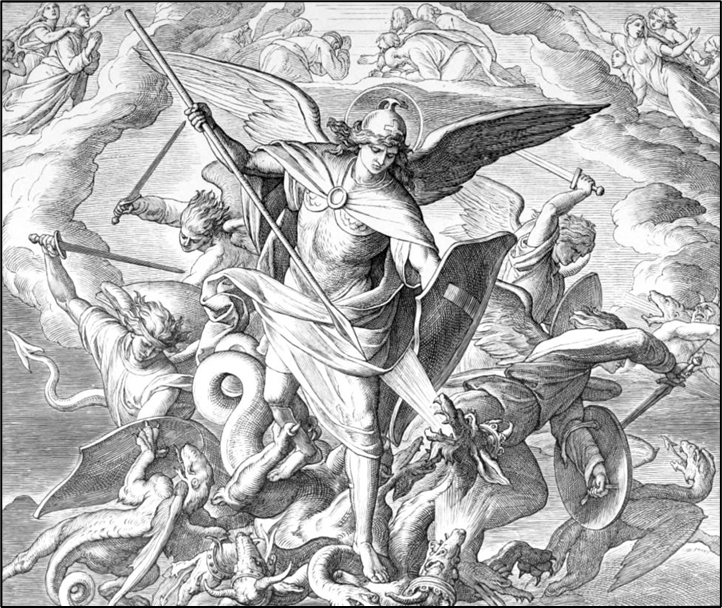
7. And there was a fight in heaven (in the Church-heaven here on earth; for after the devil, on account of his fall, has been cast out of the heaven of eternal glory, he may not come back into it again): * Michael and his angels fought with the dragon, and the dragon and his angels fought (This Michael is God’s Son, as it is explained in v. 10; He is, among other things, also called an angel for this reason, because in the protection of the Church, He carries out the office of an angel; otherwise, Michael is also the name of an archangel, Jude 9. But here Christ, the Son of God, is meant by this name, who is of one essence, one power, and one glory with God, His heavenly Father; for Michael means ‘Who is like God?’ And with this name the Holy Spirit directs us to the last chapter of the prophet Daniel, where it is proclaimed that in the last times, the great prince Michael shall arise, who stands for the holy people, Daniel 12:1. For since the dragon wants to attack the woman, that is, the true Church and the members of the spiritual body of Christ, so Christ takes His Church to Himself, and fights with His angels, by which not only the holy spirits in heaven are understood, but also all faithful teachers and preachers, against the dragon and his angels, by which not only the evil spirits who joined themselves to the devil and fell away from God are understood, but also the persecutors, the heretics, and all the scales of the hellish dragon). **
* Daniel 10:13, 21; 12:1.
** And: This battle is without doubt the blessed Reformation. If it were about the freedom of the Christian Church after the heathen persecutions [i.e., the legalization of Christianity in the Fourth Century], then one would have to seek it in the wars of Constantine the Great with Licinius, Maxentius, and so on.
8. And they did not win (for how could the devil overcome Christ, who is the power of God, 1 Corinthians 1:24? “The prince of this world is coming, and he has nothing in me,” says Christ to HIs disciples, John 14:30); also there was no more found to be a place for them in heaven (they were put to flight and cast out of heaven).
9. And the great dragon was cast out *, the old serpent (the evil enemy, who deceived our first parents through the serpent, Genesis 3:1, and has practiced his cunning and wickedness for a long time), who is called the Devil (the accuser, because he slanders God before men, Genesis 3:5, men before God, Job 1:9, and men against other men) and Satan (the adversary, because he is the enemy of God and men), who deceives the entire world (through his cunning and lies he deceives all those who allow themselves to be led by the spirit of the world, 1 Corinthians 2:12); and he was cast ** to the earth (by these words refers to the curse which God, after the fall of our first parents, pronounced upon the serpent: “Upon your belly you shall go, and dust you shall eat all the days of your life,” Genesis 3:14), and his angels were also *** cast out at that time (By this casting out of the devil from heaven it is signified that, after Christ through His death and resurrection had overcome the devil and taken power from him, Hebrews 2:14, He then, after His victorious resurrection, in which He stripped the principalities and the powers and made a show of them openly, and made a triumph out of them through Himself, Colossians 2:15, and after He sat down at the right hand of God, caused such obtained victory to be proclaimed in all the world, whereby the devil everywhere is driven out and trodden under the feet of the believers, Romans 16:20. “I saw Satan fall from heaven as lightning,” says Christ, Luke 10:18. Afterward, this overcoming and casting out took place at the time of Emperor Constantine the Great [in the Fourth Century], when the great persecutions ceased and peace was grated to the Church. In particular, this conflict and victory against the hellish dragon refers to our last times, when the kingdom of the antichrist and the doctrine of devils is attacked through the preaching of the Gospel, 1 Timothy 4:1, and are driven out of the Church-heaven; and this casting out will only fully happen on the Last Day, in which the dragon with his angels will be cast into the hellish pool, Revelation 20:14).
* Luke 10:18; John 12:31 (Revelation 20:2; Zechariah 3:1)
** Greek: “(Indeed), he was cast out,” or, “He was (I say) cast out”
*** Greek: “with him”
10. And I heard a great voice, which spoke in heaven, * “Now is the salvation, and the strength, and the kingdom, and the power of our God, His Christ ** (This is the triumph song and rejoicing of the true believers over this victory of the great prince Michael against the dragon, who in the same fight proved Himself to be an invincible hero and savior of His Church), because the accuser of our brethren has been cast out, *** who accuses them before God day and night.
* Revelation 11:15 (Job 1:9, 2:5; Zechariah 3:1)
** Greek: “Now has come (in powerful demonstrate made known and been revealed) the salvation and the power and the kingdom of our God, and the glory of His Christ (Anointed One).”
*** Greek: “is cast out (hurled down).”
11. And they * (the believers) have overcome ** him through the Lamb’s blood (because they firmly believed that Christ, through His suffering and the shedding of HIs blood, had overcome the devil for their good, and they set this victory in true faith against the devil’s accusation), and by the Word of their testimony *** (in that they remained steadfast in the confession of the Gospel, which is the testimony concerning Christ); and they have not loved their life even to death (their life was not so dear to them that in order to preserve it they would have denied Christ and His Word).
* Greek: “Also they themselves”
** Romans 8:37 (v. 17)
*** Concerning this, see Revelation 11:3.
12. Therefore *, rejoice you, you heaven, and those who dwell therein (all believers and elect of God, whose names are written in heaven, Luke 10:20, whose citizenship is in heaven, Philippians 3:20). But woe to those who dwell on the earth and on the sea (those who are minded toward earthly things, Philippians 3:19, who love the world and what is in the world, 1 John 2:15, since everything that is in the world, such as honor, riches, pleasure, power, etc., is unstable as the sea), for the devil has come down to you, and he has great wrath, and he knows that he has little time (because the time of the Judgement Day is near, in which he is to be cast into the hellish pool and will no longer exercise his malice upon the earth).
* Psalm 96:11
Useful Applications
II. COMFORT: That Christ Himself (who is signified by Michael) faithfully takes care of His believers in the militant church on earth and powerfully protects them against the devil and the antichrist, is depicted in this vision, v. 7–9.

 PATTERN OF SOUND WORDS