The following is my translation of the notes and useful applications of the Epistle Reading for the Feast of the Holy Cross, 1 Corinthians 1:18–25, as they are found in Das Weimarische Bibelwerk (1877). Square brackets indicate my own notes and additions. For the useful applications, I recommend the reader see this very helpful article by Dr. Benjamin T. G. Mayes.
III. A report against two vices, which have been found over the Preaching Office: one, where the people, who are otherwise completely union in religion, nevertheless become divided for the sake of the teachers; second, where people, because of human wisdom and vain eloquence, marvel highly at the false teachers. (v. 10–31)
[v. 10–17 omitted due to the appointed reading]
18. For the Word of the cross(the doctrine of the Gospel concerning Christ, the crucified)is(according to their erring thoughts, v. 25)foolishness to those, * who(in their unbelief)are perishing; but to us, we who are (through faith in Christ)being saved, it is ** a power of God(through which He strengthens us and keeps us to eternal life).
* 2 Corinthians 4:3.
** Romans 1:16.
(Cf. 1:24; 4:10)
19. For it stands * written: “I will make as nothing the wisdom of the wise, and the understanding of the understanding(those who in divine matters follow their human reason) I will destroy.
* Isaiah 19:14.
(Job 12:17)
20. Where * are the wise men (among the Gentiles)? Where are the scribes(among the Jews)? Where are the philosophers?(those who can make from human skill many disputations? Among all these, is there anyone who knows how to declare the counsel of God for our salvation?)Has not God the ** wisdom of this world made as foolishness?(And what they put forward as the way to salvation, is it not shown to be foolishness? Because they regulate the doctrine of the Gospel according to reason and do not receive it in simplicity of faith, they thereby become fools before God.)
* Job 12:17; Isaiah 33:18.
** Baruch 3:28.
(Matthew 11:25; Romans 1:22)
21. For because the world(the philosophers)through their (imagined) wisdom * did not know (but rather much more became futile in their reasoning, Romans 1:21) God in their wisdom, it well-pleased God, through the foolish preaching to save those, who believe in it.(That is, because body Jews and Gentiles much more value their earthly and natural wisdom rather than the heavenly wisdom, which God reveals through His Word and in His works, and therefore they neither know nor honor Him, much less can they be saved; so it has pleased His eternal wisdom through the preaching of the Gospel, which appears entirely strange, absurd, and silly to the philosophers, to save all those who believe in it, whereby the highly-praised wisdom of the world is made to shame and pure foolishness.)
* Matthew 11:25; Luke 10:21.
(Isaiah 55:8ff.)
22. Since * the Jews demand signs(they do not allow themselves to be content with the evident and powerful miracle-signs of Christ and the Apostles, but rather continually, of their own mind, want to have new and greater miracle-signs)and ** the Greeks (the Gentiles)ask according to wisdom(they judge the doctrine of the Gospel according to their reason, and want to have it proved from philosophy).
* Matthew 12:38; 1 Corinthians 16:1; John 4:48
** Baruch 3:23.
(John 6:30)
23. But we preach the crucified Christ, (who)* to the Jews is a stumbling block(who was from the beginning and still is; who seemed to them much to lowly and powerless that He should be the promised Messiah who was to deliver them from their bondage. And it was no small scandal for them that He was condemned to death by the great council in Jerusalem as a blasphemer), and to the ** Greeks is foolishness(it seemed to be, as those thought it was great foolishness if one should believe that through the death of one man the sin of the entire world has been atoned for and [eternal] life has been won).
* Matthew 11:6; John 6:61; Romans 9:32
** 1 Corinthians 2:14
(Acts of the Apostles 26:24)
24. But to those who are called(through the Gospel to knowledge of Christ, and do not despise such call willingly), both Jews and Greeks, we preach Christ(who indeed is [the Christ] in fact, whether or not they recognize Him as such), * divine power and divine wisdom.(The holy Apostle calls Christ divine power and divine wisdom, not only because He is true God, of one essence of the Father, and divine power and wisdom is essential to Him, but also because God proved His power and wisdom through Him, in that Christ through His suffering and death has blotted out the sin of the entire world, has powerfully overcome death and the devil, and has thereby fulfilled the most wise counsel of God concerning our salvation; that He also has revealed this same divine wisdom in the preaching of the Gospel, and thereby has gathered a Church for Himself from the human race, which He powerfully sustains and protects against all the the raging of the gates of hell; and finally, because He has made us wisdom from God, v. 1 Corinthians 1:30, and we are preserved by His power through faith unto salvation, 1 Peter 1:5.)
* Romans 1:16; Colossians 2:3.
25. For the divine foolishness(what the Gentiles who demand wisdom, v. 22, according to their corrupted reason judge as foolishness) is wiser than men are(not only than human wisdom, but rather also than men themselves); and the divine weakness(what the Jews, who demand signs, v. 22, consider as weakness) is stronger than men are.(Luther: “Divine foolishness and weakness is the Gospel, which is foolish in the eyes of the wise, but is powerful and wise in the eyes of Christians.”)
[v. 26–31 omitted due to the appointed reading]
Useful Applications
III. DOCTRINE: That generally, those who are foolish, weak, ignoble, despised, and nothing before the people of this world are chosen and called by God by faith to eternal life; but on the other hand, many among the wise, powerful, and noble (for the sake of their unbelief) are rejected to condemnation, v. 26–28. DOCTRINE: The grace of God is still to be recognized and praised in a congregation, wherein the chief work, His pure Word, goes rightly, even though many deficiencies are otherwise found therein, v. 4–30.
The following is my translation of the notes and useful applications of the Old Testament for the Feast of the Holy Cross, Numbers 21:4–9, as they are found in Das Weimarische Bibelwerk (1877). Square brackets indicate my own notes and additions. For the useful applications, I recommend the reader see this very helpful article by Dr. Benjamin T. G. Mayes.
II. Concerning the grumbling of the Israelites, and how they were punished with fiery serpents. (v. 4–6)
4. Then they traveled(the Israelites by God’s command)from Mount Hor by the way of the Sea of Reeds, so that they * went around the land of Edom(because they could not obtain from them friendly passage, cf. 20:20, for which reason they deviated from the correct highway which led to the land of Canaan, and it had the appearance as though they would much sooner come to Egypt than to the land of Canaan).
* Cf. Deuteronomy 2:1.
5. And the people became * disgruntled on the way **(because they detoured so far away, also because their journey lasted so long, and they saw no end of it yet), and they spoke ** against God and against Moses(from great impatience), “Why have you *** led us out from Egypt so that we die in the wilderness? For there is no bread or water here, and our soul is nauseated over this worthless food(we have become weary of the manna, and can no longer look upon it without disgust, because we have eaten the same thing a whole forty years).
* Cf. Numbers 11:1
** These words still belong to v. 4 and are to be translated, “but the people became disgruntled over which way (or un-way); v. 5. “therefore then the people, etc.”
*** Hebrew: You have, etc. (Moses and Aaron, who was indeed dead, however while he was alive had had led the matter together with Moses).
6. Then the Lord sent fiery * serpents among the people(Luther: “Therefore, they were called fiery because the people bitten by them became fiery-red by their poison and died from the burning heat, as from a pestilence or a carbuncle); they bit the people, so that a great people in Israel died(a painful and wretched death).
* Cf. Wisdom of Solomon 16:5; 1 Corinthians 10:9.
III. Concerning their repentance, and how God averted the plague. (v. 7–18)
7. Then they came to Moses(as the serpents had already bitten many of them and a great multitude of people had perished and the others had been humbled through their punishment)and said, * “We have sinned, for we have spoke against the Lord and against you(murmured out of impatience); pray to the Lord, that He take away the serpents from us(that we might not perish so miserably). Moses prayed for the people(who nevertheless had so often shown themselves rebellious and ungrateful toward him).
* Cf. Numbers 14:40; 1 Samuel 7:6.
8. Then the Lord said to Moses, “You make a * bronze serpent(which was formed as the fiery serpents, because it was made from copper), and set it for a sign **; that whoever is bitten and looks at it, he shall live(he shall recover and through this special wondrous sign be kept alive).
* See John 3:14.
** Hebrew: on a banner-pole (so that it might stand quite high and could be seen from afar)
9. Then Moses made a bronze serpent, and set it for a sign; and when a snake bit someone, so he looked at the bronze serpent, and he remained alive.(John 3:14–15 applies such image to Christ Himself, that, whoever is wounded by the bite of the old poisonous serpent and looks Him lifted on the cross with true faith, he shall be healed spiritually and eternally.)
(2 Kings 18:4; John 6:40)
[v. 10–18 omitted due to the assigned reading]
Useful Applications
II. WARNING: With respect to the despising of God and His benefits, which is severely punished by Him, is to be seen in the people of Israel when they became disgusted with the manna, v. 4–6; III. DOCTRINE: That God demonstrates His mercy in the midst of punishment to those who turn back to Him [i.e., repent], v. 7–9.
The following is my translation of Martin Chemnitz’s sermon for the Twelfth Sunday after Trinity as found in his Postilla (Vol. II, pgs. 429–434). Chemnitz uses a composite text based off of Matthew 15:29–31 and Mark 7:31–37. Curly brackets indicate marginal notes present in the original text. Square brackets indicate my own notes and additions. I have broken up some of the longer paragraphs for the sake of readability.
Composite Gospel Text (Matthew 15[:29–31]; Mark 7[:31–37])
And when Jesus went out again from the region of Tyre and Sidon, He went on further from there and came to the Galilean Sea, in the midst of the region of the Decapolis, and He went up on a mountain and sat down there. And there came to Him many people, having with themselves the lame, the blind, the mute, the crippled, and many others, and they cast them at the feat of Jesus, and He healed them so that the people marveled when they saw that the mute speaking, the crippled were healed, the lame walking, the blind seeing, and they praised the God of Israel.
And they brought to him a deaf man who was mute, and they asked Him that He lay hands on him, and He took him aside from the people, placed His finger in his ear and spit, and touched his tongue, and He looked up to heaven, groaned, and said, “Ephphatha,” that is, “Be thou opened.” And immediately his ears were opened, and the bond of his tongue was loosed, and he spoke right. And He forbid them that they should tell no one. But the more He forbid them, the more they spread it, and they marveled beyond measure and said, “He has made all well, He makes the deaf hear and the speechless speak.”
Explanation of the Gospel
{Ordering of the Doctrine in the Sunday Gospels}
If one pays attention diligently to the order of the Sunday Gospels, then one has from it a beautiful reminder (Erinnerung). We have previously heard how God punishes those who despise His Word, and how one should guard against such punishment so that he makes the temple of God to a house of prayer (Bethauß). It is also reported how one can make it into a house of prayer in the Law, in the article of justification or the Gospel, and in prayer according to the example of the tax collector [Luke 18:9–14]. Thereupon it follows that we do not have such from our own powers, but rather, with respect to this, we are deaf, mute, and blind.
{Summary of the Doctrine of this Gospel}
Before the Fall, we were thus created so that we made the temple a house of prayer in the Law, the Gospel, and the doctrine of prayer, so that when God saw everything that He had made, it was not only good, but very good [Genesis 1:31], especially the rational creatures, angels, and men. However, many of the angels have fallen; also, the serpent deceived mankind and thus sin came into the world and everything became wicked so that we are now deaf and blind by nature. But God had compassion on us and sent His Son, who has now brought again into right what was corrupted in Adam through Satan, and has thereby healed us, that He makes healthy our external members where we understand it most easily; likewise, He thereby heals our inner wound and evil from which we cannot rescue ourselves, as we are “children of wrath” (Ephesians 2[:3]) and our ears are deaf, our eyes are blind, are are tongue is bound, but God alone rescues and helps. And finally, that He thereby frees us from eternal punishment. Thus, He has made all things good [Mark 7:37], and He still does it, says Mark, and for this He uses lowly means: He speaks a word, He spits, He places His finger in the ears, etc. Then, one might think that the ears should well be stopped much more, and the eyes become darker! But when Christ uses such despised means, whereby the Word of God and the most worthy Sacraments are signified, He thereby helps and makes all things good, so that the temple among us becomes a house of prayer, and God may thus graciously turn away the well-deserved punishment. These we do not want to deal with at great length now, but rather only want to pay attention to what this Gospel teaches us for comfort under the cross (zum Trost im Creutz).
{Division of the Sermon}
Now there are here three kinds of people: [1] the Gergesenes [i.e., the crowd], [2] the mute man, [3] and the Lord Christ, and thus there are also three kinds of doctrine under the cross which we thus want to make use of and that we want to take away from this lesson.
First, what we ought to do and think when God lays a cross upon other people.
Second, how we ought to conduct ourselves when we ourselves come under the cross.
Third, what the Lord Christ does here, and what we have to comfort ourselves in Him.
The following is my translation of the notes and useful applications of the Epistle Reading for the Twelfth Sunday after Trinity, 2 Corinthians 3:4–11, as they are found in Das Weimarische Bibelwerk (1877). Square brackets indicate my own notes and additions. For the useful applications, I recommend the reader see this very helpful article by Dr. Benjamin T. G. Mayes.
2. A report as to whence the working [of the Preaching Office] comes. (v. 4–6)
4. But we have such a trust * through Christ to God(Luther: “that we have prepared you for the letter,” and that our Preaching Office is effective for the conversion of many people).
* Compare John 14:6ff.
5. Not * that we are sufficient of ourselves to think (much less to do or to think) something(good, which is for the promotion of our salvation or the salvation of other people)as from ourselves(from human powers), but rather, that we are sufficient, is(solely and only) from God.
* Compare 2 Corinthians 2:16; Philippians 2:13.
6. Who also has made us sufficient, to carry out the Office of the New Testament (which is an Office), not(primarily)of the letter(of the Law, which with letters was written on stone tablets, and prescribed a completely perfect obedience, which alone is not able to give grace to sinners, nor the power to such obedience), but rather of the Spirit (of the Gospel, through which the Holy Spirit works faith in the hearts of men, and is given to the faithful. Luther: “to teach the letter is to teach merely the Law and works without the knowledge of the grace of God, by which everything that man is and does is condemned and is recognized as guilty of death, for without God’s grace he can do nothing good. To teach the Spirit is to teach grace without Law and merit, by which man is made living and is saved.”). For the letter(of the Law) kills(because it gives man knowledge of his sins, Romans 3:20; it accuses man and convicts him in his heart that he is guilty of eternal death, Romans 4:15.), but * the Spirit(the Gospel) makes alive(it draws man out again from such terror of death because it directs him to Christ, the Mediator, who is the end of the Law, Romans 10:4.).
3. How the Law and the Gospel are to be held against one another, and how the Gospel is to be greatly esteemed compared to the Law. (v. 7–11)
7. But the office(of the Law in the Old Testament), that through the letter kills(v. 6)and in the stone is formed (written) **, has glory(is preached with a particular clarity, as when God glorified Moses before the people when he brought down the tablets of the Law the second time), in such a way that the children of Israel could not(properly and precisely)look * upon the appearance of Moses on account of the glory of His appearance, it nevertheless ceased(for when Moses died, this glory had ceased).
* See Exodus 34:30.
** Greek: graven –
8. How shall not much more the office (of the Gospel in the New Testament), that gives the * Spirit **,(which the Word of the Gospel writes in the heart, a particular)glory have?(which was proved in the miracles of Christ and His Apostles, as well as in the bodily glory of the appearance of Christ, which He allowed to be seen at His Transfiguration, which glory remains into eternity, and then in the powerful working of the Gospel, through which the hearts of men are enlightened.)
* See Galatians 3:14; Galatians 3:2ff.
** Greek: the office of the Spirit
9. For as the office that preached condemnation(which convicted men through the Law, that they merit condemnation), had glory; * much more does the office ** which preaches righteousness(which teaches men how they can and ought to be come righteous and be saved through Christ), have a surpassing glory.
* Greek: is glorious (that is, brings with itself and works [glory])
** See Romans 1:17; cf. 2 Corinthians 3:21; John 5:45.
10. For even that part(the office of the Old Testament), which was glorified(because the Law was given with great glory on Mount Sinai, and Moses, with a shining appearance, presented it to the people of Israel), is no to be considered glorious compared to this surpassing glory. *
* Greek: For in so far as it was honored with glory (the office of the Law), it is not even worthy that one call it (radiance or) glory, (in view of and) compared to this surpassing glory.
11. For if that has glory which ceases(since the Old Testament is abolished by the New Testament and believers are redeemed from the curse and coercion of the Law), much more will that have glory * which remains (because the New Testament will remain until the Last Day, and the benefits which have been distributed to us through the Gospel in the New Testament will extend to eternal life).
The following is my translation of the notes and useful applications of the Holy Gospel for the Twelfth Sunday after Trinity, Mark 7:31–37, as they are found in Das Weimarische Bibelwerk (1877). Square brackets indicate my own notes and additions. For the useful applications, I recommend the reader see this very helpful article by Dr. Benjamin T. G. Mayes.
III. A deaf man, who was mute. (v. 31–37)
31. And when He had departed again from region of Tyre and Sidon, He came to the * Galilean Sea, in the midst of the region of the Decapolis.
* Compare Matthew 15:29f.
Greek: And when He went back from the region of Tyre and Sidon, He came again to the Galilean Sea through the –
32. And * they brought to Him a deaf man, who was mute(the one who spoke evil, whom the devil through God’s appointment had almost completely robbed of hearing and speech)and they asked Him that He lay hands on him(and give him his hearing and speech again).
* Compare Matthew 9:32; Luke 11:14.
No possession is thought of here. What is written in Matthew 9:32 is a different history.
33. And He took him aside from the people, and placed His finger in His ear, and * He spat, and touched(with His spit)his tongue(to show that His flesh, through the personal union, is endowed with the power to do miracles, as well as to make health and living).
* Compare Mark 8:23; John 9;6.
34. And * He looked up to heaven, sighed(over the miserable condition of the human race)and said to him: “Ephphatha,” that is, “Be thou opened.”
* Compare John 11:41.
35. And immediately his ears his ears were opened, and the bond of his tongue was loosed, and he spoke right.
36. And He forbid them that they should tell no one.(The cause of such prohibition is told in Matthew 8:4)But the more He forbid them, the more they spread it.
37. And they were astonished beyond measure and said, * “He has made all well(in this miracle and in His entire way of life); He makes the deaf to hear, and the speechless to speak.
* Compare Genesis 1:31.
Greek: Also – (For they had not yet seen the like, even they they had seen other miracles.)
Useful Applications
III. COMFORT: That Christ the Lord makes all well and good, everything that was corrupted in us by the devil, as the people praise Him, v. 37; DOCTRINE and COMFORT: That also our wretched body shall partake of this [blessing], if the heart remains steadfast in Him, v. 33–37.
The following is my translation of the notes and useful applications of the Old Testament Reading for the Twelfth Sunday after Trinity, Isaiah 29:16–24, as they are found in Das Weimarische Bibelwerk (1877). Square brackets indicate my own notes and additions. For the useful applications, I recommend the reader see this very helpful article by Dr. Benjamin T. G. Mayes.
IV. The Call of the Gentiles (Isaiah 29:17–24)
17. Now, is it not a little while until Lebanon should become a [fruitful] field , and the field be reckoned as a forest?
Compare Isaiah 32:15.
By “Lebanon” the Jews are understood, as Luther says, “because the city of Jerusalem was built from Lebanon.” Their ancestors were a beautiful fruitful field at the time of the Old Testament, as Lebanon; however, they had become as a cut down forest and an unfruitful field in the New Testament because of their repudiation of the Gospel. However, on the other hand, by the field the Gentiles are to be understood, who previously, in the time of the Old Testament, were an unfruitful field; however, in the New Testament, they have become a beautiful fruitful field, that is, through Christ they have been enlightened, converted, and made fruitful unto good works.
The prophetic way of speaking often compares the heathen with Lebanon (see Song of Songs 4:8; Isaiah 60:13), according to which, the reception of the Gentiles and the rejection of the Jews from the Church would here be described (see 18f.).
18. For at that time the deaf (the Gentiles, who are spiritual deaf) shall hear the words of the book (of the Gospel, see v. 11) and the eyes of the blind (those who are spiritually blind) will see out of the darkness and gloom (they will be enlightened by the Holy Spirit, and will know rightly God in Christ from the Word of the Gospel).
Compare Isaiah 35:5; 42:7; 60:1; Ephesians 3:9.
19. And the wretched will once again have joy in the Lord, and the poor among men will be happy in the Holy One (in) Israel (the poor will have the Gospel preached to their comfort and joy of the heart, Matthew 11:5).
Compare Isaiah 61:1ff; 51:3, 11; Psalm 22:27.
Hebrew: Joy over strangers.
20. When the tyrant has an end, and the scoffers are extinguished, and all who watch to cause trouble (Luther: “false doctrine and works”)are destroyed .
21. Who make the people sin through preaching(those who preach only human trifles, or who flatter their hearers, and make cushions for them under their arms and pillows for their heads, Isaiah 13:18)and hunt the one who rebukes them in the gate(publicly and without fear), who turn aside from righteousness by lies(they turn themselves away from the truth by lies, and from unrighteousness by injustice).
See Matthew 15:3ff.; Amos 5:10.
Hebrew: through (the oral forthplanted) Word.
Hebrew: they entice the righteous man (thereby seducing him from good to evil) through vain things (human ordinances).
22. Therefore, says the Lord, the one who has redeemed Abraham (and led him out out of the idolatrous Ur in Chaldea, Genesis 11:31, 12:1), to the house of Jacob(those according to the Spirit)thus: “Jacob shall no more be disgraced, and his countenance shall no more be ashamed(nor will it become pale when they are converted and steadfastly believe in Christ).
Compare Isaiah 41:8ff.; Genesis 48:16.
Hebrew: Now (or from now on).
Hebrew: Now no more.
23. For when they see their children, the work of my hands (those I have given rebirth to by water and the Spirit, John 3:5) among them, they will hallow My name, and they will fear (Me)the Holy One in Jacob and (Me)the God of Israel.
Hebrew: at those who press with power (frequently), Matthew 11:12.
24. For those who had who had an erring spirit, will receive understanding, and those who complain(Luther: “the useless chatterers, such as the enthusiasts who boast of a vain spirit” )will allow themselves to be taught(although they indeed had previously sharply fought for their errors).
Compare Acts 9:5ff.; 2 Corinthians 10:15.
Hebrew: the rebellious murmurers, see John 6:52, 61; Acts 17:32; 1 Corinthians 1:24ff.
Useful Applications
IV. Doctrine/Teaching: That through the Word of the Gospel, those men who receive it in faith will be graced, quickened, and made joyful, v. 18–19; Doctrine/Teaching: That on the other hand, the despising of the [Gospel] causes the judgement of blindness, v. 10ff.; Comfort: That God will hold His Christian people in grace, if they only faithfully abide by and with His Word, v. 22f.
The following is my translation of Martin Chemnitz’s homily for the feast day of St. Bartholomew (Nathanael) as found in his Postilla (Vol. III, pgs. 106–117). Curly brackets indicate marginal notes present in the original text. Square brackets indicate my own notes and additions. I have broken up some of the longer paragraphs for the sake of readability.
Gospel Text (Luke 22:24–30)
A dispute also arose among the disciples as to which among them ought to be the considered the greatest. But [Jesus] said to them, “The worldly kings exercise lordship (herrschen), and the authorities call themselves gracious lords (gnaädige Herrn), but not in this way for you; rather, the greatest among you ought to be as the youngest, and the foremost as a servant. For who is the greatest? The one who sits at the table? Or the one who serves? Is not thus, that it is the one who sits at the table? However, I am among you as a servant (ein Diener). But you are those who have been with me in my afflictions (Anfechtungen). And I will bestow the kingdom upon you, as My Father bestowed upon Me, that you shall eat and drink at My table and My kingdom, and sit on thrones and judge the twelve tribes of Israel.”
Explanation
{History of St. Bartholomew}
On this day we observe the commemoration of the Apostle Bartholomew, of whom we have nothing more in the history of the Gospels that that he was chosen by Christ to be a disciple without means [John 1:43–50], instructed by Christ in His school, and finally, chosen to be an apostle, and together with the others, he was filled with the Holy Spirit, made fit (düchtig) to preach the Gospel in the whole world.
{The Death of St. Bartholomew}
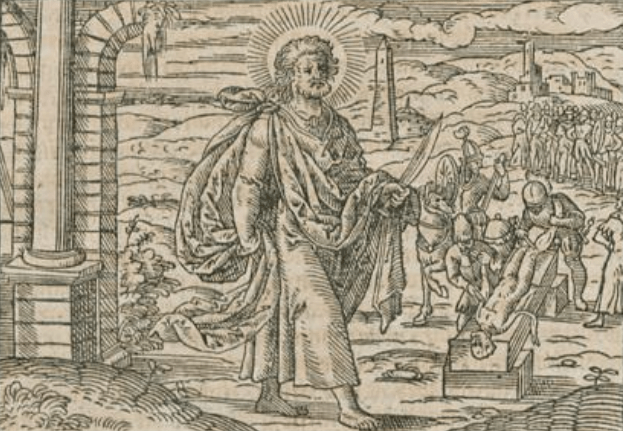
Other histories further testify concerning him that, when the apostles had divided themselves through the entire world, he made his way to India and there spread the doctrine of the Gospel and planted a Church of God, and then finally, King Astyages had him put to death and had his head struck off. Some say that since he would not abstain from teaching, he was nailed to the cross and taken down again from it and that afterwards his skin was flayed from him while he was still living.
Chemnitz is referring to the account recorded by Eusebius of Caesarea, where he only records that Bartholomew went to India. Later traditions speak of Bartholomew’s martyrdom. One martyrdom account only mentions his beheading by King Astreges (ANF 8:553ff.). It seems that the tradition of his skin being flayed is a later tradition. Others held that Bartholomew went to Armenia instead.
{Dionysius}
Dionysius [the Areopagite] makes mention of this concerning Bartholomew, that he used this parable (Gleichnuß) in his sermons, that he said, “The Gospel is both a short and long doctrine,” from which it is to be inferred that he maintained the distinction in his preaching, that for the simple he made short a simple sermons and briefly summarized the doctrine of the Gospel in a few chief points; but at the same time, he reminded his hearers that it is such a rich and expensive doctrine, which one cannot completely study in this life, but rather it is only a part that we grasp here, but the rest one must spare for that life in the glorious high school where we shall completely study it from the foundation and learn and understand everything perfectly.
This quote from Dionysius the Areopagite may be found in his Mystical Theology (MPG III.999–1000), which reads, “Thus the divine Bartholomew says that theology is both much and least, and the Gospel is both broad and great, and, on the other hand, concise.” The Latin reads, “Hac utique ratione divus Bartholomaeus ait et copiosam esse theologiam, et minimam, atque Evangelium amplam et magnum, et rursus concisum.” The Greek reads, “Οὕτω γοῦν ὁ Βαρθολομαῖός φησι, καὶ πολὴν τὴν θεολογίαν εἴναι καὶ ἐλαχίστην καὶ τὀ Εὐαγγέλιον πλατὺ καὶ μέγα, καὶ αὔθις συντετημημένον.”
{Why This Text is Appointed for This Day}
Now this Gospel, which your grace has now heard read, has been appointed for this day because therein the Lord Christ promises and assures all preachers and pious Christians who must suffer and endure much in this world on account of their confession that He will grant them His kingdom after this life, that they shall thereafter come to great honor, and that they shall rejoice in eternal joy and blessedness after this temporal cross, misery, and persecution. Otherwise, one might think, “What does it profit us if we are pious and have love for the doctrine of the Gospel? How does it go with those who diligently and faithfully preach and present the doctrine and those who hear it? They must suffer so that everyone in the world hates and avoids them, that they are persecuted and even killed. Who then would want to have any desire for this, that he should commit himself to it, if in the end one has nothing else to expect than such pitiful pay and profit, as Bartholomew and many others have received?” Then the Gospel comes and says, “Be at peace, dear children, and do chiefly seek temporal fortune and prosperity by the Gospel, but rather see to it that after this temporal life you should obtain the kingdom of God, which is My kingdom, which I have won, wherein you shall be with Me in eternal joy and blessedness.” Thus this text corresponds very well to the history of Bartholomew and the one fits nicely with the other. [The history of Bartholomew] is an example of the cross and suffering of Christians, and alongside it, the comfort of which pious Christians should hereby remind themselves.
Division of the Sermon
Now we want to pay attention to this Gospel in these three points:
How the history says that after Christ had reported to His disciples that now the hour and time had come in which He must suffer and die and thus establish His kingdom [cf. Luke 22:16, 18], He thereafter also conferred with His disciples everything that He considered needful for remembrance before His departure, and had fed them with His body and blood, and admonished (vermahnet) them how they should conduct themselves against the impending danger so that they would not be overpowered by the devil and showed them the great danger that was present; and how thereafter the apostles took occasion so that they began to fall into fleshly thoughts (fleischliche Gedancken) and supposed that Christ would lead a worldly kingdom (ein weltliches Reich) in which they would be great, notable lords, and murmured among one another who then would have preeminence among them in such a kingdom of Christ; and how Christ so kindly admonished them and said to them that it would be quite a different situation in His kingdom and led them away from such thoughts; and what we thereby ought to remember.
Second, how Christ makes a distinction in this text between His kingdom and those who serve Him in His kingdom, and between the worldly kingdom, and those servants who are great and notable, who have power, honor, and riches, who are called ‘gracious lords,’ and who are highly esteemed by everyone. However, they should not imagine that it will go also with them who are servants of Christ, but rather that it will be quite the opposite for them, such that whoever wanted to be greatest in the kingdom of Christ must be the servant of the others, be laden with much toil and labor, and along with it expect nothing else than the world’s ingratitude, envy, and hatred.
Third, how the apostles conducted themselves at the admonition of Christ, that they did not become impatient, and did not throw the keys of the kingdom which Christ had promised them at His feet and renounced their service to Him; rather, they gave themselves to this and were at peace with it when that they heard it was vain and to no purpose if they wanted to hope for temporal joy and glory, and let it be enough for them that Christ promises them the eternal inheritance of the heavenly goods and assured them that those who had preached to the highest in that world [that] the world will be judged, they would then be co-judges (Beiseitzer) of the judgement.
We will now briefly hear a report of these three parts in the Gospel of today’s Apostle’s Day.
The following is my translation of Martin Chemnitz’s homily for the Eighth Sunday after Trinity as found in his Postilla (Vol. II, pgs. 369–92). Chemnitz uses a composite text based on Matthew 7:15–27 and Luke 6:43–49. Square brackets indicate my own notes and additions whereas curly brackets indicate marginal notes present in the original text. Please note that this page is a work in progress.
Gospel Text
Forthcoming.
Explanation
Forthcoming.
{Division of the Sermon}
This is thus the summary of this Gospel, whose explanation we now want to pay attention to in these four points.
First, that we want to see to this, how the Lord Christ does not vainly make this earnest admonition (Vermahnung) to the Church and the congregation (an die Kirche und Gemeine) that they ought to watch themselves when they have and hear God’s Word taught clearly and purely, that they also then ought to remember that the time could come when they could be robbed again of this precious treasure so that we are not scandalized when we see that it still goes on today that where the pure doctrine and Church of Christ is, there the devil also has a chapel there and wants to bring in his false lying-doctrine (LügenLehre) among the people.
Second, that we not only ought to know that false teachers will arise at all times and trouble the Church of God and presume to seduce Christians with their false doctrine, but rather that He also earnestly and diligently admonishes us that we ought to beware of them and fear them, so that we also not be led into an error through them.
Third, because the false teachers can cleverly cover their knavery and deceit, we must therefore learn to recognize them so that we may beware of them and not be deceived and led astray by them so easily. How we ought not concern ourselves with the external sheep’s clothing (eusserlichen Schafpeltz), but rather ought to look at their fruits and mark them, what they say and teach, and from what fruit the tree bears, take judgement of each preacher (Prediger).
Finally, fourth and last, when we now have God’s Word clearly and purely and God has preserved us from false doctrine, and allows His Word to be preached to us without any falsification (Verfälschung), that we nevertheless ought not think that it is now enough and we need nothing more because we hear God’s Word, make use of the sacraments, pray, and call upon God our Lord, and lead a fine external appearance before the world; rather, that we should then look closely that we do not deceive ourselves, do not fall into security (Sicherheit) and let it remain only with the hearing of the Word and external exercises (äusserlichen Ubungen), but that we ought to be diligent to conduct ourselves according to God’s Word in our lives and do the will of God the heavenly Father, and thus may not be only mouth-Christians (Maulchristen) and hypocrites, but rather true Christians and doers of the word, and not only hearers.
Your grace ought to now pay attention to these four points in this sermon, and thereby grasp simply and finely grasp the right use of this Gospel.
The following is my translation of Martin Chemnitz’s explanation and homily outline for the Sixth Sunday after Trinity (Postilla, Vol. II, pgs. 348–50). Chemnitz’s Gospel text is Matthew 5:20–26. Square brackets indicate my own notes and additions. Curly brackets indicate marginal notes in the original text. I have also broken up some of the larger paragraphs for the sake of readability.
Gospel Text – Matthew 5:20–26
Jesus said to His disciples, “Unless your righteousness is better than the scribes and the Pharisees, you will never come into the kingdom of heaven. You have heart that it was said to those of old, “You shall not murder, but whoever murders, he shall be liable to judgment.” But I say to you, Whoever is angry with his brother will be liable to judgment. Whoever says to his brother, “Racha!” [i.e. empty-head], will be liable to the council. Whoever says, “You fool!”, will be liable to the hellish fire. For if you are offering your gift at the altar, and there remember that you have something against your brother, so leave your gift there before the altar, and go to him and be reconciled with your brother, and then come and offer your gift. Be well-disposed (wilfertig) toward your brother quickly, because you are still on the way with him in order that your adversary not hand you over to the judge, and the judge hand you over to the servants, and you are thrown into the dungeon. I tell you, truly, you will never come out from there until you have paid the last mite (Heller).”
Explanation
{Summary of the Doctrine of This Gospel}
In this text we have the explanation of the Fifth Commandment, how we ought to rightly understanding what the meaning of this word is when it says, “You shall not murder.” Now you often hear that the Gospels are so divided that one can therein can set forth the Christian doctrine and teach it to the common man. Now since the Law and the Gospel are the chief parts of Christian doctrine, the ancients [i.e., the Church fathers] have thus ordained it that on Sundays they ordinarily teach the Law and the Gospel. So we now we have hear the explanation of the Fifth Commandment, and not the entire Law altogether. Why is it then useful and good that one learn the Law? And why is it good that the correct understanding of the Law is urged in the Church? John thus distinguishes between the Law and the Gospel: “The Law was given through Moses, but grace through Jesus Christ.” [John 1:17] Now since the preaching of the Gospel properly belongs to the office of Christ, what need is there, then, that the Law be urged?
Christ Himself shows here in this Gospel why the one who shall teach the Gospel must first preach the Law. This is now the reason: The Pharisees thought that they could be saved through their good works. They asked nothing about the Gospel because they thought, “If we can be saved through ourselves when we do much as is possible for us, then what need do we have of Christ?” This stood in the way so that Christ could not teach the Gospel without the Law, therefore, Christ takes up the Law first.
Another error still hindered Christ so that He could not teach the Gospel. Christ had now preached the Gospel an entire year. Now there were many people who thus understood it: “If [the Gospel] has the meaning that God does not forgive sin on account of merit, but solely for the sake of CHRIST’S merit, why should we then ask about the Law? Let it thunder freely! We have nothing to do with it!” As CHRIST says, “I have not come to abolish the Law. This is not the meaning [of the Gospel]. I have come to fulfill the Law. Therefore, it is not the same whether the Law is kept or not kept. I say to you, before heaven and earth should pass away, it shall not happen that a single letter or tittle pass away from the Law which is not thus fulfilled.” [Matthew 5:18]
{Use of the Doctrine of the Law for Our Time}
Thus now that Christ had a reason that He wanted to preach the Gospel, so He had to first make the way through the Law. This reason applied at that time, so does one now have the reason that he should also preach the Law? Pay attention to the entire world and to all men, and then you will see that we have much more reason than Christ to urge the Law.
{Against the Papists}
One one side, we have the papacy. The Papists allow it to become sour for themselves, live strictly, etc., then they say that they thereby merit forgiveness of sins. When much is said of the Gospel, it does not strike them where the path has not been first made through the Law, that no one can become righteousness and be saved through the Law.
{As Well as the Evangelicals}
And pay attention also to those who hold to and confess themselves to the doctrine of the Gospel, and then you will see how greatly it is also necessary for them that this preaching of the law remain in practice among them next to the Gospel. For many think thus, “The Gospel holds these both against one another, that God is indeed angry because of sin; however the Gospel says, ‘Do not ask about that. Do not concern yourselves with it. God is merciful, who has given His Son for our sins, it is now all good.” In this opinion, many people go on their way and heap up sin day to day and yet still want to be saved nonetheless.
However the people that do this misuse the Gospel as a cover for shame (Schandideckel), and this is not its use. Therefore, one ought always to preach and teach the Law next to the Gospel and what is meant by this, that God in the law is an enemy of sin (der Sünde feindt ist), and makes Himself known otherwise and is friendly toward us in the Gospel, and allows His wrath to fall and speaks grace to those who repent, believe, and lead a new life. For a Christian must be able to distinguish this, and “He is a good theologian,” says Luther, “who properly knows and understands the distinction between both of these doctrines, the Law and the Gospel.” Whoever does not consider this distinction or reflect on it, also goes away in security and brings God’s judgement upon his neck.
This reminder serves to this end, that each person may know what the use of the doctrine of the Law is for us, and how we ought to rightly understand it. Therefore, certain commandments of the law are interpreted and explained by Christ in order that one can understand from it the right understanding of the doctrine of the entire Law.
{Division of the Sermon}
In order that we may deal with this Gospel in a useful manner, so we want to lay out its doctrine briefly and simply in these points, and divide this sermon into three parts:
That in this Gospel Christ teaches how the Law shows us what kind of righteousness we have through Christ. Likewise, how the Law shows directs us from our own works to Christ’s works and merit.
How here the right understanding and use of the Fifth Commandment, and under it, the entire Law, is shown to us; how a Christian, who has now become righteous ought to make use of the Law unto true repentance (rechter Buß) so that he may remain in right faith with Christ.
What ought to move and cause us that we gladly reconcile with our neighbor and do not delay reconciliation for a long time, and how we are to be good-willed and well-disposed toward this.
We will now divide the sermon briefly into these three points, and deal with them in a simple manner.
Concerning the First Part
{Concerning the True Righteousness Which Counts Before God}
The Lord Christ begins in today’s Gospel by saying, “Unless your righteousness is better than the Pharisee’s righteousness, you will not come into the Kingdom of Heaven” (Matthew 5:20). Here, you hear that Christ is speaking of such a righteousness that is necessary for us unto salvation, through which we come into the Kingdom of Heaven. And He lays out this righteousness through the explanation of the Law. He shows what sort of righteousness it must be through which we ought to be saved.
{The Pharisee’s Opinion}
The Pharisees were of the opinion that they would be saved, all their heart and mind were set on it; so now they took the Law unto themselves, they were zealous for it, as much as they could, they allowed it to become sour for themselves. Nevertheless they clearly saw that they could not keep the Law entirely and ward off all wicked sinful desires and inclinations toward evil, nor control their wicked thoughts. But that this is still not the perfect keeping of the Law, our Lord here shows this to them in the actual explanation and exposition of the Fifth Commandment and several others in the following text. Thus, by this He takes away from them all their thoughts and false delusions which they had previously imagined. For they thought thus: “It is indeed true that God says in the Fifth Commandment that a man ought not be angry; however, how can a man entirely refrain from this, that he should nevermore be moved to anger? So, this is also one of the lesser sins (der geringen Sünde), God does not ask much about it if a man only takes care that he does not kill his neighbor with his fist. Whatever other transgressions happen alongside this against the Fifth Commandment, God is surely at peace with it, He does not want to deal so strictly with us if we only do so much as is possible for us and bring it as far as we can; and by this, we merit eternal life.”
These were the thoughts of the Pharisees and the scribes which they built and founded their salvation upon; if one meant good and did what he could, then God must be at peace with him, especially if he guarded himself against great sins and vices, then that would be entirely enough.
{Christ’s Position}
However, Christ will not let this be good enough for them; rather, He says, “Unless your righteousness is better than that of the Pharisees, then you cannot go into the Kingdom of Heaven” (Matthew 5:20). For this is the meaning of the Ten Commandments, they want to be kept pure and perfectly; if the least thing, even a tittle, is lacking, then all the rest counts for nothing. Indeed, even if were possible for a man to keep the entire Law except for the least letter, then a man cannot thereby be saved. The reason is this: God did not give His Law in such a way that He says, ‘Whoever keeps some of it and as much as he can, he is excused even if he cannot keep all of it perfectly.’ Rather, it says, “Whoever does not keep all that is written in the Law, he is cursed and condemned.” Therefore, the Apostles St. James says, “If anyone keeps the entire Law and sins in one point, he is guilty of all of it” (James 2[:10]).
Indeed, dear Lord God, who then can be righteous if God deals so strictly with us? “No one,” says Paul, “if He deals so strictly with us” (Galatians 3[:10]; Romans 2). For God demands a perfect obedience, indeed He deals so strictly and demands such a strict obedience from us that it is impossible for even one to keep and fulfill it all. And whoever does not keep it perfectly as God has commanded, he is cursed.
{To What End the Law Ought to be Preached}
Now to what end does this doctrine serve when it is presented to us so earnestly that it brings us to despair when we hear that God demands that which is impossible for us to keep in His Law and says that if we do not do it perfectly, then we shall be condemned? Does not such a doctrine bring nothing other except despair? Answer: No, that is not God’s intent, that thereby He should seek such a thing. Rather this is directed to this that it ought to drive us and direct us away from our merit and works to another ground upon which we should build our salvation; and that we should dismiss the Pharisees and scribes who allow it to be sour for themselves and suppose they will thereby be saved. However, the Law says, “It is lacking in you, you cannot do it. There is no one who can keep the Law.” It is certainly true that you do not kill with your fist; yet, you still sin against the Fifth Commandment with thoughts and words when you hate your neighbor and transgress against him with words and say, “You fool.” And when you do this, then you are guilty of the hellish fire. For the Law demands a perfect obedience of anyone who wants to be saved otherwise through the Law. The righteousness of the Pharisees will not avail us, there must be a better righteousness [Matthew 5:20]. But where, then do I obtain this righteousness? We do not find it in ourselves, but rather a mercy seat (ein Gnadenstul) has been set before us, namely, Jesus Christ (Romans 3[:25–26]; 1 Corinthians 1[:30]). There we find the righteousness which is perfect and endures before God.
The word for mercy seat in Greek is ἱλαστήριον. “God set forth [Christ] as a mercy seat (ἱλαστήριον) by His blood” (Romans 3:25) . It is a reference to the mercy seat which was placed upon the ark of the covenant in the Old Testament (see Exodus 25:17–22). The blood of sacrificed animals in the OT was placed upon the mercy seat to make atonement before God (e.g., Leviticus 16:13–19).
{What is the True Righteousness}
What kind of righteousness is this then? There are many people who fall into this opinion as if it were such a righteousness that because God has given us His Son that it now has the meaning as if God said, “I have indeed said in the Law ‘You shall not murder; you shall not commit adultery; etc.,’ but now I want to let go of all of it; I will not even think of sin anymore.” So many of us understanding this article concerning righteousness. But Christ leads us to another ground on this from which one can see what is the meaning of this article. And the ground comes from the Law. And now Christ thus says, “I have come to give you life; but I have not come for this purpose: to abolish the Law, that God no longer ask whether or not the Law is kept.” No, the Law must be fulfilled, and it is laid out as such, just as Paul precisely explains in Galatians 3 and in Romans 3. Therefore, you ought to know that not only is the one who murders guilty, but also whoever says to his brother “Fool!” is guilty of the hellish fire; whoever says “Racha!” [i.e., empty-head] is liable to the council. God has written this with His finger; it cannot be changed. All of it must be fulfilled if you want to be saved through the Law. Now Christ has come that He give us the righteousness which God demands of us in the Law. For we could not obtain such a righteousness from ourselves. What now has Christ done? Did He say, “This shall not longer be in force”? No. The Father says of Him, “You are in the stead of man. There it is written, “Cursed is the man who does not keep everything that is written in the Law” [Deuteronomy 27:27]; whoever acts against it, he is guilty of the hellish fire. You must bear this, if man is to be saved otherwise.” For the Law cannot fail. It is God’s eternal unchangeable will. Therefore, you should not think thus: “God will no longer pay attention to sin.” No! Everything must be fulfilled which has been written. Because we cannot do this, God therefore sent His Son who has fully satisfied the Law, and we are justified for His sake because He has fulfilled the Law.
One must mark this well, for whoever does not pay attention here cannot comport himself in this matter, but rather falls into such thoughts: “Well, God is indeed the enemy of sin, but now that His Son has come, He has let His wrath fall away and no longer upholds the Law.” Those who think this way fall into security (Sicherheit); but we must stand fast upon this ground: It is impossible that a tittle of the Law ought remain unfulfilled. It must all be fulfilled, but we cannot do it. Therefore, the Son of God has come who has taken the Law upon Himself and fulfilled it; and for His sake, because He has fulfilled all of it, we are also righteous. Thus, the Law drives us away from our own righteousness to another righteousness. The Law must be fulfilled, but we cannot fulfill it; therefore, Christ comes in our stead and fulfills the entire Law that we thus might obtain eternal righteousness.
{Conclusion of the First Part}
This is the first part that we ought to mark in this sermon, namely, that the Lord Christ did not only preach the Gospel to His hearers, but rather also the Law. He thereby remove this delusion from the hearts of the people so that they do not think that God has now allowed His law to fall away because He has given His Son to as Redeemer of the world, and that now each man may do whatever he wants and that it would in no way harm him. CHRIST has paid for all sin and made full satisfaction. Likewise, the LORD says that this is not its meaning. The Law is the unchangeable will of God, and it must remain and must be fulfilled. When the Pharisees then come and say, “Behold, we do the Law and keep it; we our diligent that we conduct ourselves obediently in our whole life and conduct to it as much as possible. Thus, we will be justified through works of the Law, right?”
“Yes,” says CHRIST, “If you could keep it perfectly, then that would be something, then you would be saved by it, but there it is lacking and it fails you. For if you already do as much as is possible for you, and live externally according to the Law and guard yourselves against gross actual sin—murder, manslaughter, adultery, fornication, and the like—yet, you nevertheless have evil desire and inclination in your heart, then you still have evil thoughts and words which are contrary to God’s Law. Therefore, if your obedience is not perfect, then you cannot thereby stand before God. You must look for a better righteousness.” Where does a man find this? “Christ has made righteousness for us by God.” (1 Corinthians 1[:30]. See that you lay hold of Him, then you shall be saved through Him. This is the first doctrine.
Concerning the Second Part
{Explanation of the Fifth Commandment}
Forthcoming.
Concerning the Third Part
Forthcoming.
{Conclusion of the Sermon}
These are the three parts of doctrine that we ought to maintain from this sermon.
What is the true righteousness which counts before God, how we ought to rightly know and learn this from the Law and the Gospel.
Concerning the right understanding of the Law of God, that it is not enough that one does something, but rather that one must entirely keep it.
How one ought not live in envy and hatred (Neid und Hassz), but rather be well-disposed toward reconciliation in order that God also forgive us our deficiencies and errors (Mängel und Fehl).
The following is my translation of Martin Chemnitz’s homily outline for the Fifth Sunday after Trinity (Postilla, Vol. II, pg. 237). Chemnitz’s Gospel text is Luke 5:1–11. Square brackets indicate my own notes and additions. Curly brackets indicate marginal notes in the text. I have also broken up some of the longer paragraphs for the sake of readability.
Explanation of the Gospel
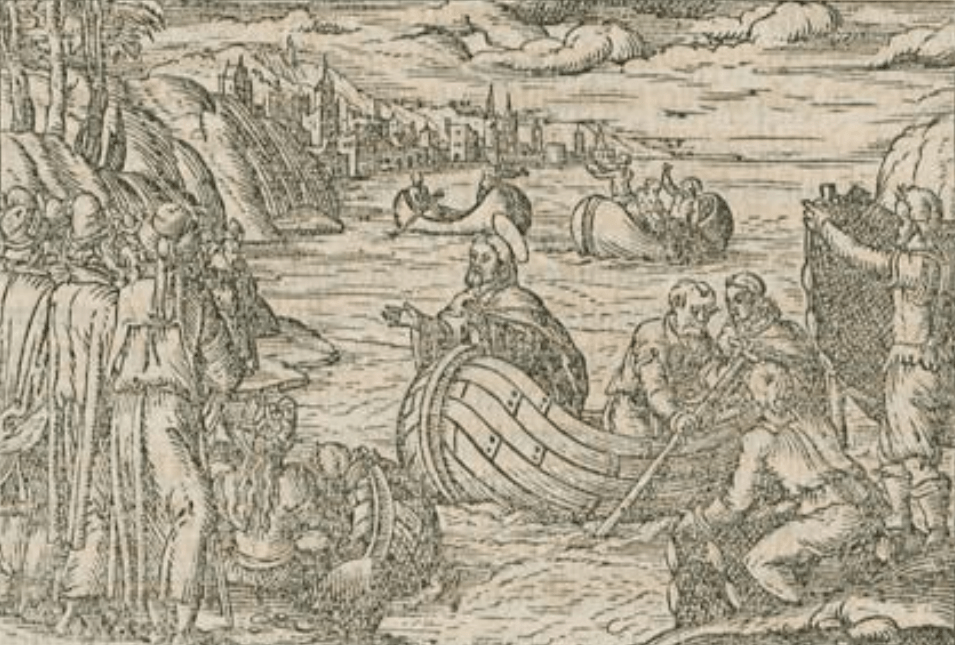
God the heavenly Father, who in Matthew 20 is liked by the Lord Christ to a house-father (Haußvater; [οἰκοδεσπότης]) calls and admonishes all His children and servants within His great household, that is, all men, that they should gladly and diligently hear the Word of God before everything else; and that they should continually exercise themselves in godliness (Gottseligkeit), and thereafter, diligently and faithfully attend to their work and promises them, in addition, that if they show themselves as His dear children and faithful servants, then He will give and bestow them a fitting livelihood in this world. And this Gospel shows that both of these points can very well stand next to one another, and indeed always ought to, namely, that [1] one serves God and then [2] attends to his work with diligence. For the four men who mentioned here were not godless fishermen, but rather when John the Baptist began to teach and to preach, these were the first who had received his sermon and followed it. Thereafter, when John saw Christ coming toward him and said, “Behold, this is the Lamb of God, who bears the sin of the world” (John 1:29, 36), Andrew reported it to his brother and said, “We have found the Messiah, for whom so long a time we have longed for” (John 1:41), and thus they followed him and when they had listened to Him for a long time, they returned again to their vocation (Beruf), for they had not yet been called (berufen) to the apostolic office (Apostelamt). But now when the Lord is preaching at the Sea of Gennesaret, they come to Him again, and after the sermon has been delivered, He commands them to work and says, “Now, at this very moment, launch out into the deep and cast out your nets” (Luke 5:4).
{Idleness has not been commanded by God.}
From this it is then to be seen that our Lord God by no means wants that a Christian man should entirely renounce all other earthly work so that he desire to undertake or do nothing other than perhaps singing in the church, etc. as was taught in the papacy and asserted that one may otherwise profane the spiritual estate and orders [i.e., monasteries]. Precisely for this reason, in John 6, when very many people were following after Him had the opinion that they would not need to work with Him and yet could have their sustenance, the Lord Christ did not consent that they should make him king, but rather left each one in his vocation (Beruff).
Even so it is portrayed here for us that a Christian ought to hold both together; he ought to gladly occupy himself with God’s Word persist in prayer for God’s blessing, and thereafter in order that he may also acquire daily bread it is said to him, “Go to work!,” as David also points in Psalm 128:2, “You shall feed yourself the work of your hand.” Thus, one must not tear apart or separate that which God the Lord wants to be carried on next to one another in His household, that is, that one must uphold and keep both the Seventh Commandment, in which work is included and commanded, as well as the Third Commandment concerning the Holy Day and the Divine Service (Gottesdienst). Peter must not only catch fish, but he must also learn Christ’s preaching, the Word of God, so that through the Word his toil and work may be sanctified and be blessed.
Chemnitz is alluding to Martin Luther’s explanation of the Third Commandment in the Large Catechism, § 91ff.
Thus, under the Seventh Commandment, our work can continually remind us of the Third Commandment, that we were not only created for work in this toilsome life, but rather, that we should bring to mind the gracious will of God and in the midst of our work comfort ourselves with the coming eternal joy, when after all our toil and work we come to rest and celebrate the eternal Sabbath, and thus shall have life and full satisfaction (John 10[:10]).
{Example}
Now this is often presented to his here and there in Holy Scripture with glorious sayings, but in today’s Gospel, it is presented to us with a beautiful living example. Peter, John, James, and Andrew had previously been with John in the wilderness and listened to him; thereafter, they also come to the Lord Christ, indeed, in this Gospel they hear His sermon. Now when they have heard the Word of God and the sermon is over, the Lord Christ says to them, “Go now back to work, make a cast,” and He Himself gives an instruction and command that they ought to again apply themselves in their vocation and usual work so that the Seventh and the Third Commandments thus be carried out alongside one another.
{Practice of this Doctrine}
Yet, one ought to carry this out, especially with respect to the Third Commandment, so that it not made only into an Opus Operatum, and one would think if only the work itself had been performed and churchgoing had taken place that it would then be enough even if one would never think of it even once afterward. Rather, one ought to undertake it as David says in the 119th Psalm, “Lord, Your statutes, or Your Word, are my counselors” (Psalm 119:24), that is, “everything that I hear and learn from Your Word, I use it thereafter in all my doing and refraining (thun und lassen), and Your glorious sayings, they are my closest advisors.”
{Christian Usage with Prayer for the Blessing of God}
Therefore, in former times it was customary in the Christian Church that one gathered together in the morning and called upon God so that He would give His blessing upon the work of the day. Likewise, in the evening, one gave thanks publicly to dear God for His protection. This is still also practiced among us, when, among other things, the ringing of the prayer bell at certain hours encourages people, even in the midst of work, to the fear of God and Christian prayer so that you begin and end your work with God’s Word, just as this account shows that after the sermon was heard the Lord said to Peter to cast out the net, and then, when the work was done, that they followed after Christ.
{Luther}
And this is described so simply and beautifully especially for this reason, so that, as Luther says elsewhere in his explanation of the Gospel in Matthew 8, that when the sea restless, then we ought to learn to say this proverb: “Christ is with me in the ship.” So you also ought to learn this proverb here, “Well then, Christ is with me in my ship, it is He who bids me to work when I have heard the sermon.” Just as He Himself first preached to this people and thereafter said to Peter that He ought to go out and catch fish, by this He reminds others that each one ought to return back to his vocation (Beruff).
See Luther’s homily for the Fourth Sunday after Epiphany, AE 76:287.
Homily Outline
This is the summary of this Gospel that herein this chief doctrine (Häuptlehr) is dealt with: how one ought to exercise oneself in the fear of God and in work. We now want to summarize the doctrine of this Gospel in these following points:
How we ought to hear God’s Word dutifully and readily before all things.
How we therefore ought to work according to God’s command.
If perhaps the promised blessing of God does not follow from the work, how we ought to then conduct ourselves.
When our Lord God gives His blessing so that your net encloses a great multitude, how you ought to use it with humility and thankfulness; or if your net obtains a tear in such great fortune and the ship wants to sink, how you then ought to conduct yourself.
Finally, when Christ says, “Follow Me,” how one ought to forsake everything and follow Him as the One who catches us out of this world with the net of His Holy Gospel and receives us to Himself into His eternal kingdom.
Thus, you can make a house postil (Haußpostill) for yourself from this account, and apply this doctrine in Christian usage.


 PATTERN OF SOUND WORDS