Tag: 2 Corinthians

  • Aegidius Hunnius’s Sermon Outline for the Epistle of Sexagesima

    The following is my translation of Aegidius Hunnius’s introduction and sermon outline for the Epistle Reading of Sexagesima (2 Corinthians 11:19–12:9) from his Postilla (Vol. I, pgs. 255–256). Square brackets and footnotes are my own notes and additions.
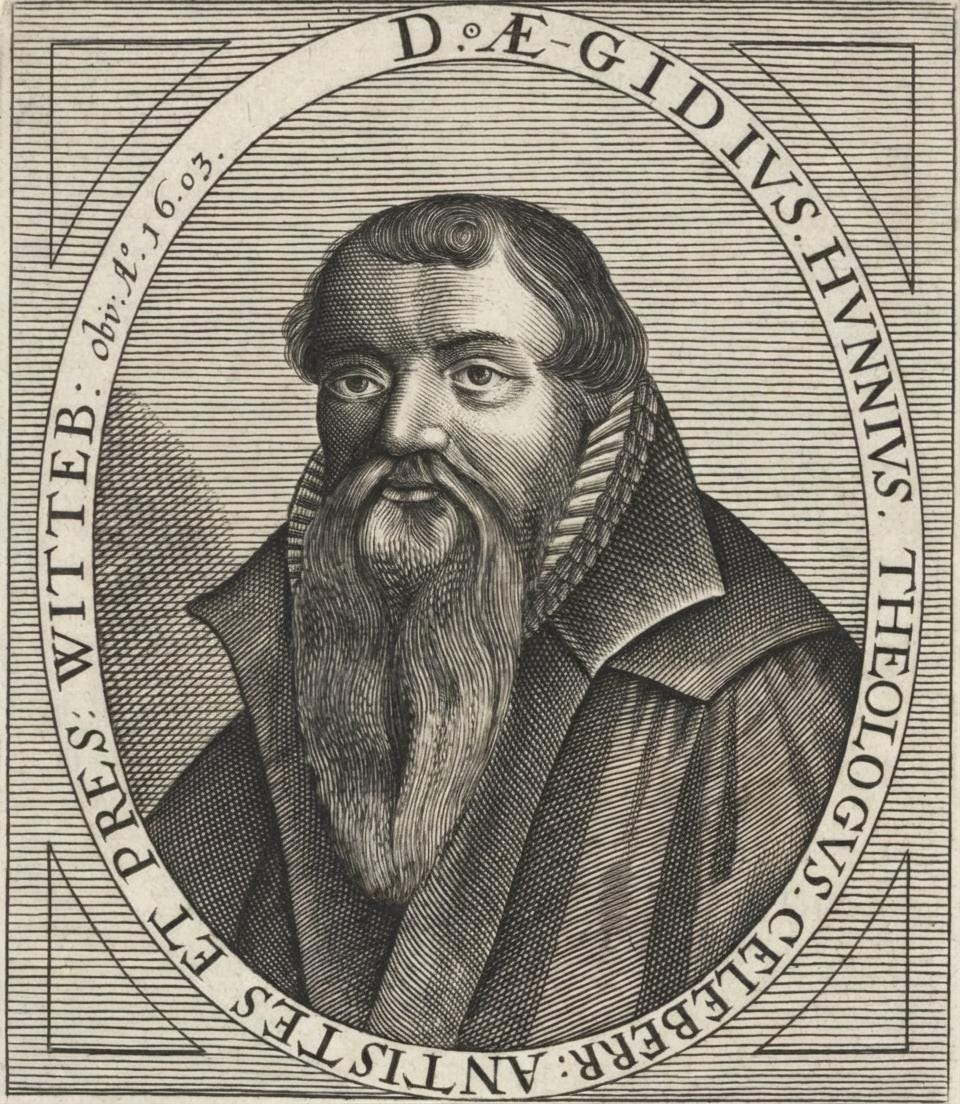
    Explanation of the Epistle

    Beloved in the Lord, all ambition and fame-seeking was foreign and far from St. Paul; he sought his honor not in himself, but rather in God and in His Lord Christ. As he writes to the Galatians in the sixth chapter: “Far be it from me to boast, except concerning the cross of Jesus Christ” (Galatians 6:14).

    But the false teachers who had snuck into the Christian congregations undertook to diminish this precious worthy apostle and make him despised among the Corinthians, which Paul would have suffered and gotten over silently if the contempt were about His person alone. However, the deceitful evil enemy most of all desired to bring the Gospel into contempt and to make wide room and opportunity for the false apostles with their unsound doctrine, so that they could come forward with it into the marketplace and sell their unfit evil truth as good, their false doctrine as pure evangelical truth, thereby falsifying the pure doctrine, leading astray the simple, and murdering souls, indeed, even wrecking the Gospel with eternal harm to many people.

    Thus, the holy teacher and apostle Paul was urged by necessity to recount in an extensive record what good he did in regard to the Gospel, how much he suffered and endured over it, also that he had studied and learned his doctrine through a heavenly revelation in the paradise of God. He did all of this not for himself for his own boast, but rather for the praise, honor, and glory of God, for the advancement of the Gospel which he preached, for the edification of the Christian congregation in Corinth as well as in other places, and, on the other hand, for the annoyance the devil together with his scales, and for the detriment, destruction, and demise of his damned kingdom.

    We will listen to the beloved apostle and summarize this text into two chief points:

    1. First, how he does not make himself equal to the false apostles from Judaism only on account of his origin and blood [v. 11:22], but rather also far surpasses them in his labor and tribulation he suffered for the Gospel [v. 11:23–29], and thus boasts of his own weakness [v. 11:30, 12:5, 9].1
    2. Second, how he also boasts of the power of God, namely, the glorious revelation that happened to him in the third heaven [v. 12:1–5], and boasts of the doctrine which he learned there to properly save its reputation against the diminishment of his enviers.

    1. “Troubles are not always punishments or signs of wrath. Indeed, terrified consciences should be taught that there are more important purpose for afflictions, so that they do not think God is rejecting them when they see nothing but God’s punishment and anger in troubles. The other more important purposes are to be considered, that is, that God is doing His strange work so that He may be able to do His own work… Therefore, troubles are not always punishments for certain past deeds, but they are God’s works, intended for our benefit, and that God’s power might be made more apparent in our weakness. So Paul says God’s strength “is made perfect in weakness” (2 Corinthians 12:9).” (Ap XIIb.61, 63) ↩︎
  • Notes and Useful Applications for 2 Corinthians 3:4–11 from Das Weimarische Bibelwerk (1877)

    The following is my translation of the notes and useful applications of the Epistle Reading for the Twelfth Sunday after Trinity, 2 Corinthians 3:4–11, as they are found in Das Weimarische Bibelwerk (1877). Square brackets indicate my own notes and additions. For the useful applications, I recommend the reader see this very helpful article by Dr. Benjamin T. G. Mayes.

    2. A report as to whence the working [of the Preaching Office] comes. (v. 4–6)

    4. But we have such a trust * through Christ to God (Luther: “that we have prepared you for the letter,” and that our Preaching Office is effective for the conversion of many people).

    * Compare John 14:6ff.

    5. Not * that we are sufficient of ourselves to think (much less to do or to think) something (good, which is for the promotion of our salvation or the salvation of other people) as from ourselves (from human powers), but rather, that we are sufficient, is (solely and only) from God.

    * Compare 2 Corinthians 2:16; Philippians 2:13.

    6. Who also has made us sufficient, to carry out the Office of the New Testament (which is an Office), not (primarily) of the letter (of the Law, which with letters was written on stone tablets, and prescribed a completely perfect obedience, which alone is not able to give grace to sinners, nor the power to such obedience), but rather of the Spirit (of the Gospel, through which the Holy Spirit works faith in the hearts of men, and is given to the faithful. Luther: “to teach the letter is to teach merely the Law and works without the knowledge of the grace of God, by which everything that man is and does is condemned and is recognized as guilty of death, for without God’s grace he can do nothing good. To teach the Spirit is to teach grace without Law and merit, by which man is made living and is saved.”). For the letter (of the Law) kills (because it gives man knowledge of his sins, Romans 3:20; it accuses man and convicts him in his heart that he is guilty of eternal death, Romans 4:15.), but * the Spirit (the Gospel) makes alive (it draws man out again from such terror of death because it directs him to Christ, the Mediator, who is the end of the Law, Romans 10:4.).

    * Compare John 6:63; 2 Corinthians 5:18; Romans 7:6, 10–11; 2 Corinthians 5:20ff.; Galatians 3:10ff.

    3. How the Law and the Gospel are to be held against one another, and how the Gospel is to be greatly esteemed compared to the Law. (v. 7–11)

    7. But the office (of the Law in the Old Testament), that through the letter kills (v. 6) and in the stone is formed (written) **, has glory (is preached with a particular clarity, as when God glorified Moses before the people when he brought down the tablets of the Law the second time), in such a way that the children of Israel could not (properly and precisely) look * upon the appearance of Moses on account of the glory of His appearance, it nevertheless ceased (for when Moses died, this glory had ceased).

    * See Exodus 34:30.

    ** Greek: graven –

    8. How shall not much more the office (of the Gospel in the New Testament), that gives the * Spirit **, (which the Word of the Gospel writes in the heart, a particular) glory have? (which was proved in the miracles of Christ and His Apostles, as well as in the bodily glory of the appearance of Christ, which He allowed to be seen at His Transfiguration, which glory remains into eternity, and then in the powerful working of the Gospel, through which the hearts of men are enlightened.)

    * See Galatians 3:14; Galatians 3:2ff.

    ** Greek: the office of the Spirit

    9. For as the office that preached condemnation (which convicted men through the Law, that they merit condemnation), had glory; * much more does the office ** which preaches righteousness (which teaches men how they can and ought to be come righteous and be saved through Christ), have a surpassing glory.

    * Greek: is glorious (that is, brings with itself and works [glory])

    ** See Romans 1:17; cf. 2 Corinthians 3:21; John 5:45.

    10. For even that part (the office of the Old Testament), which was glorified (because the Law was given with great glory on Mount Sinai, and Moses, with a shining appearance, presented it to the people of Israel), is no to be considered glorious compared to this surpassing glory. *

    * Greek: For in so far as it was honored with glory (the office of the Law), it is not even worthy that one call it (radiance or) glory, (in view of and) compared to this surpassing glory.

    11. For if that has glory which ceases (since the Old Testament is abolished by the New Testament and believers are redeemed from the curse and coercion of the Law), much more will that have glory * which remains (because the New Testament will remain until the Last Day, and the benefits which have been distributed to us through the Gospel in the New Testament will extend to eternal life).

    (See Hebrews 12:27ff.)

    * Greek: be in glory (and constantly keep it).