Tag: Acts of the Apostles

  • Notes and Useful Applications for Isaiah 2:2–5 from Das Weimarische Bibelwerk (1877)

    The following is my translation of the notes and useful applications for the Old Testament of the Ember Wednesday of Advent, Isaiah 2:2–5, as they are found in Das Weimarische Bibelwerk (1877). Square brackets indicate my own notes and additions. For the useful applications, I recommend the reader see this very helpful article by Dr. Benjamin T. G. Mayes.

    I. Isaiah deals with the future calling of the Gentiles to the Kingdom of Christ. (v. 1–5)

    Annotated Text

    1. This is that which Isaiah, the Son of Amoz, saw concerning Judah and Jerusalem. (The prophecy belongs to the New Testament.)

    2. It shall come to pass in the latter time that the mountain where the house of the Lord (the Kingdom of Christ and God, where He will dwell and reveal Himself) shall certainly be higher (Luther: “that one no longer needs to run here and there, but rather will certainly find God,” namely, in the Christian Church, which is built upon Christ as the Rock, Matthew 16:18; the same is also called Mount Zion here because it was first assembled together in Jerusalem at the time of Christ and His apostles and then from there spread itself into all the world) than all mountains and be exalted over all hills (the Christian Church and the Kingdom of the Lord Messiah [Christ] will far excel all other kingdoms and will have a different and better condition than the Church of the Jewish people), and all the Gentiles will run1 to it (Luther: “as water runs with force and freely of itself”);

    * Jeremiah 3:17; Micah 4:1 (Psalm 68:16–17)

    1 Hebrew: “flow” (in heaps)

    3. And1 many people will go forth and say, “Come, let us go to the mountain of the Lord, to the house of the God of Jacob, that He may teach us His ways, and that we may walk in his paths. For from Zion the Law will go forth, and the Lord’s Word from Jerusalem (the apostles will begin to preach the doctrine of the Gospel at Jerusalem and in the Jewish land, and from there spread it until the end of the world, Acts 1:8).

    (Psalm 50:2; Psalm 110:2; Zechariah 8:23)

    1 Hebrew: “For it will happen…” (This is an explanation of what preceded.)

    4. And He (Christ, to whom His heavenly Father has given all judgment, John 5:22) will judge among the Gentiles and rebuke many people (He will convince them through the preaching of His Word that they have merited eternal damnation, and therefore admonish them that so that they may flee from such condemnation and be all the more eager and willing to accept His Gospel). Then they1 will make their * swords into plowshares and their spears into sickles (Luther: “or reaping hooks.” Jews and Gentiles will in Christ will have love and value for one another, and not, as previously, be hostile toward one another, rather they will have one heart, mouth, and mind according to the Gospel). For no people will2 lift up a sword against another, and they no longer learn war (They will no longer hold so stiffly to pagan idolatry, but rather will give themselves captive with their reason under the obedience of Christ, 2 Corinthians 10:5).

    * Micah 4:3 (Isaiah 11:3ff.; Romans 12:16; 1 Corinthians 1:10, 16:14; Ephesians 2:14)

    1 Hebrew: “for they shall” — (This is Christ’s doctrine of love from true faith, John 13:34ff.)

    2 Hebrew: “shall” — ([At the same time,] lawful governmental war protection, which comes from love toward one’s own, still remains unchanged in times of need according to Romans 13:4)

    5. Come now, you of the house of Jacob, let us * walk in the light of the Lord (Christ; that is, the converted Gentiles will admonish the Jews themselves to true recognition of God in Christ).

    * John 8:12

    Useful Applications

    I. DOCTRINE: Concerning the universal call of the Gentiles to the Kingdom of Christ through the preaching of the Apostles. (v. 2–4)
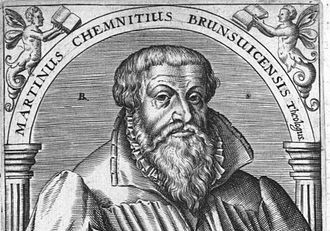
  • Chemnitz’s Explanation and Homily Outline for the History of Pentecost Day (Acts 2:1–21)

    Chemnitz’s Explanation and Homily Outline for the History of Pentecost Day (Acts 2:1–21)

    The following is my translation of an excerpt from Martin Chemnitz’s Homily for the History of Pentecost (Pfingst Tage) as found in his Postilla (Vol. II, pg. 224–26). Chemnitz’s reading is Acts 2:1–21. Square brackets indicate my own notes and additions.

    As a side note, the Feast of Pentecost was normally celebrated over three days (Sunday, Monday, Tuesday). You will hear Chemnitz reference this in the explanation of Pentecost. It is my personal contention that if our churches are not having services on Monday and Tuesday, then we ought to read the entire account of Pentecost (Acts 2:1–47) on Sunday.

    Excerpt from His Exegesis (Auslegung)

    (How we Christians ought to keep our Pentecost. What doctrine (Lehre) is dealt with now.)

    From this we therefore see that we have not less, but indeed a much greater cause than the Jews to keep Pentecost holy and to commemorate it joyfully. Since on this day a far greater benefit is preached to us than that for which the Jews had held their festival of Pentecost. For this doctrine is now set before us, how God the Holy Spirit is one united (ein einiger), eternal, true, omnipotent God with the Father and the Son, equal to the Father and the Son in eternity and omnipotence, and is of one divine essence with them, proceeding from the Father and sent to us by Christ, so that He may enlighten our heart through God’s Word, govern us, and lead us in true repentance (wahrer Buß) and right faith (rechtem Glauben) to eternal life and eternal salvation; and that He thus leads us into the communion of saints (Gemeine der Heiligen) so that we also become members of the Christian Church and thereby may become partakers of the goods which Christ has obtained for us in the Church and congregation (in der Kirchen und Gemein), namely, [that we may partake of] the forgiveness of sins and the the resurrection of the flesh, an everlasting life, as the doctrine in the is summarized and explained in the third article of our Christian faith.

    This doctrine is now, during these three days of this festival [of Pentecost], entirely and perfectly presented to us by the ordered texts (ordentlichen Texten) that are read over these days. From this we may thus hear and learn today and during the following two days of this festival the explanation of the third article, just as we heard the explanation of the entire second article of our faith before and after Easter and thereafter on Ascension Day (of the incarnation of Christ on the Annunciation of Mary, of the suffering and death of Christ on Good Friday, of the resurrection on Easter Day, of the ascension and the session at the right hand of God on Ascension Day). Thus it is distributed over these three days that we hear today about the first part of the third article, “I believe in the Holy Spirit,” and the last part will be dealt with tomorrow, “I believe in the forgiveness of sins, and in eternal life.” The middle portion (Das mittelste) of the third article, “I believe in a holy Christian Church, the communion of saints (Gemeinschafft der Heiligen), is explained on the last day. And this is our Christian Pentecost, for which we now come together, and celebrate these days, so that we consider, learn, and make use of the doctrine therein concerning the Holy Spirit, His office (Ampt), and His working in us, directed to this end: that we become Christians and may have forgiveness of sins and the eternal life.

    This is the doctrine which we Christians ought to take into consideration during our Pentecost festival, that which went forth from Zion on the day of Pentecost, as the prophet Isaiah prophesied in 2[:3] and Micah prophesied in 4[:2]. These two kinds of Pentecost (zweierlei Pfingsten), the one of the Jews in the Old Testament and our Christian [Pentecost] in the New Testament, ought always be held against each other; that will serve us for this, that we from this may be able to see that our Pentecost is much more glorious and comforting than was the first [Pentecost]. Just as St. David held these two Pentecosts against one another in Psalm 68 and compares and contrasts them with one another, when he says, “O God, when You first allowed Yourself to be seen on mount Sinai, when You gave Your law to Your people, everything happened with terror, with thunder, lightning, fire, smoke, and vapor” [~Psalm 68:7–8] so that Moses himself and all the people trembled because of it, as it says in Hebrews 12[:18–21].

    However, since we are not to remain with this, as David says, rather, the time will come when God will allow another Pentecost to come on which He will give His people them a new and different Law [Jeremiah 31:33]. That God will give a gracious rain [Psalm 68:9], where there will not be such a storm as there was on Mount Sinai; but rather, when he will give the Holy Spirit in a bodily and friendly form (leiblichen und freundtlichen Gestalt), like a fruitful rain, thereby the earth, which is otherwise dry and unfruitful, will be moistened and made fruitful (for with this same likeness the Holy Spirit is described in John 7[:37–39]). So that we, who are God’s portion (Thier), says David, may dwell in His land and may be God’s little plantings (Pläntzlein) and that we, who otherwise are apostate, lazy, dry sprigs may bring forth His good fruits through this lovely and fruitful rain, through the power and the working of the Holy Spirit, and that we may be brought to this: that we also grow and flourish (grünen), and this not only of the common man, but also some of the fat (den Fetten), etc. [~Psalm 68:18, 30], as the dear David so beautifully and comfortingly describes in the same place.

    And thus, we also ought to learn to distinguish both Pentecosts, so that, when we see, how the gloriously the Jews keep their Pentecost, we may thereby be moved not to approach ours with no less joy, as well as the doctrine that is set before us at this festival, which is far more lovely and comforting than the [doctrine of the] Law which was given to the Jews on this day.

    Homily Outline

    So let us now make the beginning of this teaching, which is preached on our Pentecost day, and take up for ourselves the first part of the third article and see that we rightly grasp the doctrine and learn to understand it, when we say, “I believe in the Holy Spirit,” what belongs to this doctrine and to its right use, that we want to draw from the appointed accounts (Historien) and learn according to their guidance.

    And that we may thus grasp this preaching so that one can learn what is useful from it, so we want to divine the same into two parts:

    1. First, we want to pay attention to the account as it is here described, how it happened when Christ finally sent and gave the Holy Spirit whom he had promised [John 14:26] to His apostles on the day of Pentecost.
    2. And thereafter, second, how we from this account [ought to learn] the doctrine of the person and office of the Holy Spirit (die Lehre von der Person und Ampt deß heiligen Geists), to what end He was given to us and what He creates and works in us, how we also receive Him, through what means, and how we ought to be diligent that we may retain Him and not drive Him away from us.

    To these two points give attention, your grace (E. L.; “eure Liebden”), and grasp them from this sermon. Then you can apply it yourself all the better, rightly understand it, and use it in a Christian manner.