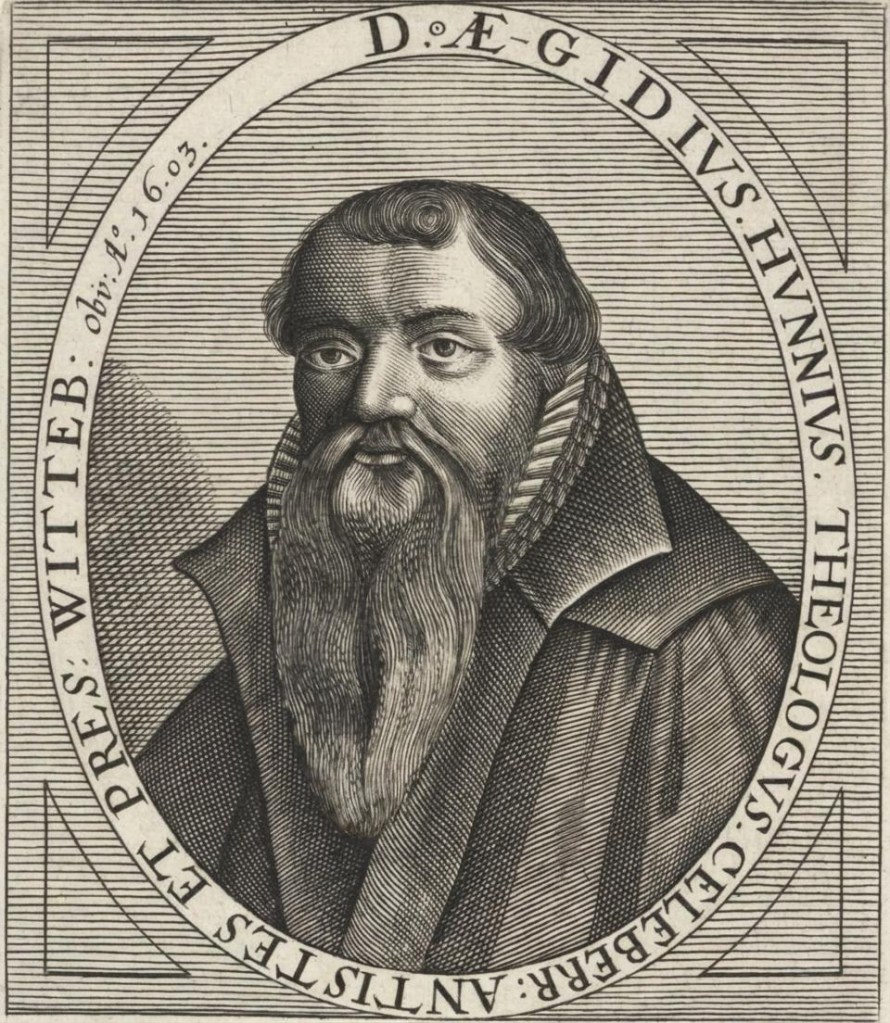
The following is my translation of Aegidius Hunnius’s introduction and sermon outline for the Epistle of Quinquagesima (1 Corinthians 13:1–13) from his Postilla (Vol. I, pg. 276–77). Square brackets and footnotes are my own notes and additions.
Explanation of This Text
In [St. Paul’s] epistle to the Galatians we read, “Beloved in Christ the Lord, in Christ Jesus neither circumcision nor uncircumcision counts for anything, but rather faith which is active through love” [Galatians 5:6].1 With this short quote, the Holy Spirit teaches that Christians in the New Testament under Christ’s kingdom are such a free people, who are weighed down neither with circumcision nor other Mosaic laws and ordinances which belonged to the Levitical Divine Service (Gottesdienst), but rather are relieved and freed from all this through Christ; and that nothing further or more is laid upon them other than true faith and unfeigned brotherly love. These two parts hang upon one another in such a way that although faith alone in Jesus Christ justifies and saves, nevertheless, the same [faith], when it is upright is soon busy, effective and active through true love (on the other side, where it does not have to deal with God in man’s justification, but rather with the neighbor). Thus, after the abolition of the Mosaic ordinances, all of Christianity rests upon faith and love as the two chief pillars. It rests upon faith indeed as that which brings the sinner to righteousness before God’s judgment and grasps salvation in Christ Jesus; but it rests upon love as that which heartily loves God the Lord for the received grace of salvation and in common life does good to the neighbor through its praiseworthy works and beautiful fruits.
Since at other times faith is much and often dealt with, we will this time hear from St. Paul’s words concerning love.
- First, how [love] is necessary, and how a Christian indeed may not go without it in his walk, life, and being.2 [v. 1–3]
- Second, how the Holy Spirit through St. Paul pen depicts love in its nature and characteristics. [v. 4–7]
- Third, how the same [love], above many other gifts and virtues remains and endures into eternity. [v. 8–10]
- Hunnius’s entire introduction seems to be a reflection of what is said in the Epitome of the Formula of Concord: “We believe, teach, and confess that the contrition that comes before justification, and the good works that follow it, do not belong to the article of justification before God. Yet one is not to imagine a kind of faith that can exist and abide with, and alongside of, a wicked intention to sin and to act against the conscience. But after man has been justified through faith, then a true living faith works by love (Galatians 5:6). Good works always follow justifying faith and are surely found with it—if it is true and living faith [James 2:26]. Faith is never alone, but always has love and hope with it [1 Corinthians 13:13].” (FC Ep III.11) ↩︎
- Concerning the necessity of good works (or love), see FC SD IV.7–12. ↩︎
 PATTERN OF SOUND WORDS