The following is my translation of the notes and useful applications for one of the Old Testament Readings assigned for the Transfiguration of our Lord, Exodus 3:1–14, as they are found in Das Weimarische Bibelwerk (1877). Square brackets indicate my own notes and additions. For the useful applications, I recommend the reader see this very helpful article by Dr. Benjamin T. G. Mayes.
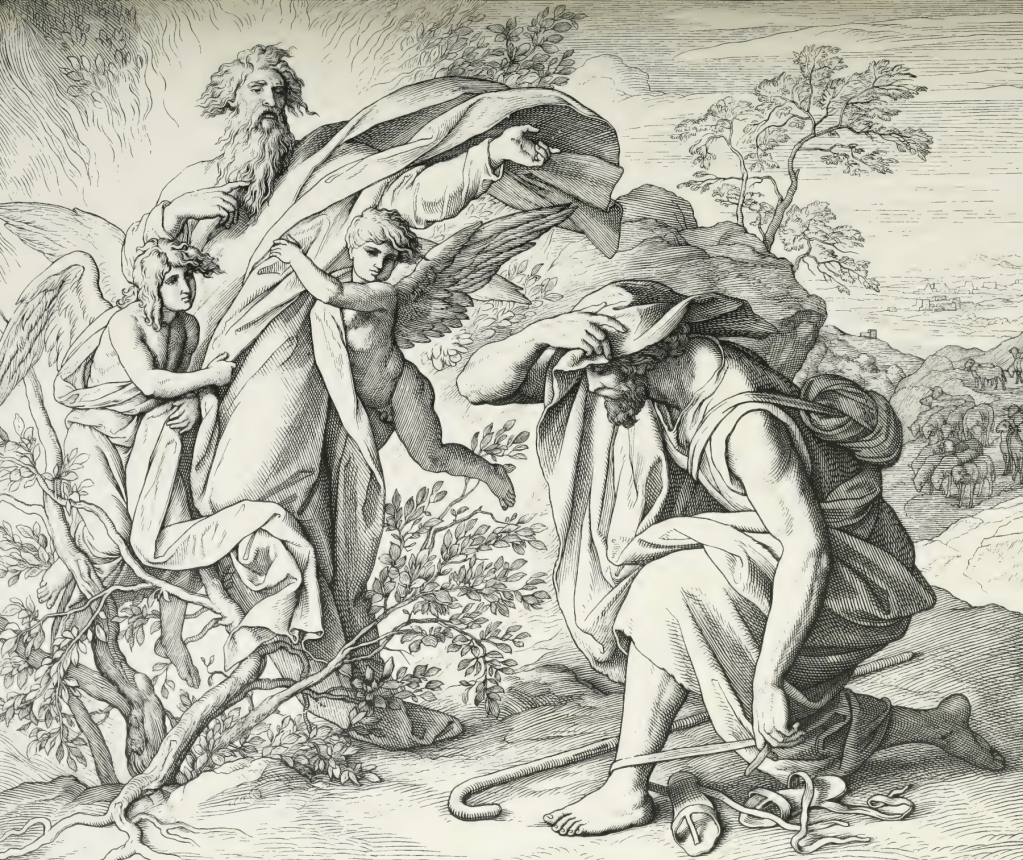
I. The appearance of the Son of God in the fiery bush, and how Moses approached. (v. 1–6)
II. The promise of God concerning help and salvation, and how Moses was called to his office. (v. 7–10)
III. How Moses refused this call two distinct times, partly on account of his unworthiness, partly on account of the ignorance of the children of Israel, that they may not know the name of God; and how the Lord answered thereafter. (v. 11–14)
Annotated Text
1. Now Moses tended (in those days in the fortieth year) the sheep of Jethro, his father-in-law,1 the priest (the captain and magistrate) in Midian, and he drove the sheep out in the wilderness (into the land of Arabia, which is called the wilderness of Sinai), and came to the mountain of God (so named on account of the present and following divine revelation, called) Horeb.
1 † Perhaps the brother-in-law, for the word from which the Hebrew comes signifies in general a relationship through marriage and can be that the son follows the father in office. Age and names can suggest this. See Exodus 2:18, 23; Numbers 10:29; Judges 1:16, 4:11, etc.
2. And the Angel of the Lord (the Lord, the eternal self-subsisting Son of God, who afterward in the fullness of time was sent into the flesh by the Father, the Lord) appeared to him * in a fiery flame from the bush.1 And he saw that the bush burned with fire and was nevertheless not consumed (by the flame of fire).
* Exodus 23:20; Deuteronomy 33:16 (Acts 7:30)
1 † Thornbush, particularly a bramble-bush; from this Mount Sinai appears to have received its name.
3. And he said (to himself with wonder), “I will (go) there and see this great sight (I will inspect and research), why the bush does not burn (what the cause might be that the green wood in the midst of which the flame of fire burns is not consumed? By this fiery bush is prefigured the mystery of the incarnation of the Son of God, that namely, in the fullness of time, He would unite true human nature to Himself personally, and also fill it with the light of His divine majesty and divine attributes, yet so that human nature would not be harmed or consumed by the divine nature in the least, and that in such personal union His assumed human nature would complete the work of redemption of the human race, prefigured by the deliverance from Egyptian slavery.)1
(Acts 7:31)
1 † Whether the divine preservation of His Church in the fire and thorns of the (Egyptian) afflictions has no place here is to be considered, and it is likely that it was in view.
4. But when the Lord saw (the Son of God in the fiery bush) that he went over (wanted to draw near) to see, God (the Son of God) called to him from the bush, and * said, “Moses, Moses!” He answered, “Here I am. (What is your desire? Speak, for Your servant listens, 1 Samuel 3:10.)”
* Genesis 22:11
5. He said, “Do not tread here, take off your shoes from1 your feet (as a sign of your impurity); for the place upon which you stand is (on account of My divine presence and revelation through the Word and through sign of the fiery bush) a * holy land.”
1 Hebrew: “cast them down” (For the Jewish shoes were fasted to the foot only from above with a strap, as they are still worn by the Capuchin friars.)
* Genesis 28:17 (Joshua 5:15)
6. And He said further, * “I am the God of your father, the God of Abraham, the God of Isaac, and the God of Jacob (I have established a gracious covenant with your forefathers, the holy patriarchs, and promised them that I would be their God, that I would nourish and protect them, that I would sanctify and renew them, and that I would bestow all good upon them, that I would resurrection them again after their death, and that I would gather them into eternal life; but, in particular, that I would give the land of Canaan to their descendants, and that the Messiah shall be born from their race).” And Moses hid his face, for he (as an impure sinner) was afraid to look upon God (the most-holy Lord).
* Matthew 22:32 (Mark 12:26; Luke 20:37; Acts 7:37, 32)
7. And the Lord said, “I have (indeed) seen (from before time and even now) the misery of My people in Egypt (the descendants of Abraham, Isaac, and Jacob, who are the people of My special possession), and I have heard their cries over those who drive them (King Pharoah, his counselors, and his officials); I have known their sorrow (and let it come into My heart),
(Acts 7:34)
8. And I have come down (I have revealed My special presence in the fiery bush and am determined) that I rescue them from the hand of Egypt (slavery and oppression), and lead them out from this land into * a good and far land, in a land in which flows milk and honey (which is rich and fruitful), namely, to the place (into the land) of the Canaanites, the Hittites, the Amorites, the Perizzites, the Hivites, and the Jebusites (whom altogether are accursed and notorious sinners, Leviticus 18:24–25).
* Exodus 33:3 (Exodus 13:5ff; Genesis 9:25, 11:7, 15:16, 18:21)
9. Because now the cry of the children of Israel has come before me (because the children of Israel, in their cries and prayers have set My covenant and promise before Me), and I have seen their fear (the external bodily need), how the Egyptians frighten them;
10. so * go now, I will send you to Pharoah (the King in Egypt), that you1 lead my people, the children of Israel from Egypt (the house of slavery).”
* Psalm 105:26; Acts 7:34 (Hosea 12:14; Sirach 45:3ff.)
1 Hebrew: “Come now! Behold, the cry has come, etc.” (v. 9) “Come! (I say) go, for I will send you to Pharoah, and you will lead My people, etc.”
11. Moses said to God, * “Who am I, that I should go to Pharoah and lead the children of Israel from Egypt?” (My person, reputation, and strength are far too meagre for such a great work.)
* Exodus 4:10; 1 Samuel 18:18
12. He said, * “I will be with you (as Immanuel, the strong God). And this shall be the sign for you (a sign of remembrance, to remind you of what I now say to you in the future, and now are assured of this blessing), that I have sent you: When you have led My people from Egypt, you will offer sacrifice to God on1 this mountain (where I have now appeared to you and have given you the call to lead My people).”
* Genesis 31:3; Judges 6:16
1 Hebrew: “in” (For sacrifices were never offered upon it, also upon which few were allowed come. See Exodus 24:9ff.)
13. Moses said to God, “Behold, when I come to the children of Israel, and say to them, ‘The God of your fathers has sent me to you,’ they will say to me, ‘How shall we call His name (what is His proper name, by which He will be distinguished from the gods of the Egyptians)?’ What shall I say to them (as an answer)?”
14. God said to Moses, * “I AM WHO I AM (I am the eternal, unchangeable God, the Creator and Preserver of all creatures, complete in Myself; I will also the fullness of time assume human nature, and in it complete the great work of redemption from spiritual slavery.).” And He said, “Thus you shall say to the children of Israel (the only true God’s name is this): ‘I AM has sent me to you (Luther: “When you come there, then I will be with you, and show Myself such that you shall know that it is I.”).”
* Deuteronomy 4:35; Revelation 1:4, 8
Useful Applications
I. CORRECTION: That we ought to come to the place where God deals with us through His word with reverence, just as Moses did. (v. 1–6) II. DOCTRINE: That God alone knows how to raise up useful people for the help and comfort of His suffering Church, as He did with Moses. (v. 7–10) III. COMFORT: That those who are orderly called, even to a dangerous office, ought to comfort themselves with the assistance of God. (v. 11–12)
 PATTERN OF SOUND WORDS