Tag: Baptism

  • Notes and Useful Applications for Romans 6:1–11 from Das Weimarische Bibelwerk (1877)

    The following is my translation of the notes and useful applications for the Epistle Reading of the Sixth Sunday after Trinity, Romans 6:1–11, as they are found in Das Weimarische Bibelwerk (1877). Square brackets indicate my own notes and additions. For the useful applications, I recommend the reader see this very helpful article by Dr. Benjamin T. G. Mayes.

    I. An answer to the objection as though this doctrine of justification by faith gives a reason to sin. (v. 1–11)

    Annotated Text

    1. What shall we1 say to this? (Namely, to that which the godless deduce and conclude from what is said in Romans 5:20) * Ought we then to persist in sin (and continue wantonly), so that grace be all the more powerful? (So that God might have an occasion to pour out His grace and mercy all the more richly upon us?)

    1 Greek: “now” (since we are assured of so rich a grace). [The Greek text has οὖν, literally, “therefore.”]

    * Galatians 2:17

    2. May that be far (from us, that we should say or think such, much less that we do such! For) How should we1 want to live in sin, we2 who have died to it? (In a spiritual manner, that it has just as little right over us as over a dead man, and that accordingly we ought noy allow sin to live, work, and rule in us.)

    1 Greek: “still further”

    2 Greek: “we as those who”

    * Galatians 6:14 (1 Peter 2:24)

    3. Do you * not know1, that all who of us2 who have been baptized in (and upon) Jesus Christ (and were incorporated into Him in a spiritual manner) were baptized into His death? (So that we become partakers of the power of His death in no other way than if we ourselves were already dead to sins. Through such power of the death Christ, not only were our sins forgiven us, but we also received the Holy Spirit, who curbs and puts sin to death in us. Luther: “We are baptized into Christ’s death so that we die as He did; for we do not die completely to sin unless the flesh also dies bodily.”)

    * Galatians 3:27; Colossians 2:12 (2 Corinthians 4:11)

    1 Greek: “or” [ἢ]

    2 Greek: “as many of us” [ὅσοι]

    4. Therefore, we were each * buried with Him (in a spiritual manner) through Baptism into death so that just as Christ was raised from the dead through the glory of the Father (through the glorious power of God, which He allowed to be seen in the resurrection of Christ), † in this way we also ought to walk in a new life (henceforth lead a new life and no longer a sinful life. The holy apostle is referring to the practice that was used in the first apostolic Church, that those who were baptized were completely immersed under the water and thus, as it were, buried, and afterward were drawn out again of the water, and thus, as it were, raised again, to indicate, that they had become partakers of the power of the death and resurrection of Christ, and that they ought to die to sin, but on the other hand, walk in new holy life).

    * Romans 8:10

    † Ephesians 4:23; Colossians 3:8ff.; 1 Peter 2:1, 4:1–2; Hebrews 12:1 (Colossians 2:12)

    5. Therefore, we were planted together with Him to a similar death (that through Baptism we are planted into Him in such way that we are like Him in death, because we died to sin, Romans 6:2), so we will also be1 [planted with Him] (our beloved Savior) [in] * the resurrection.

    * 2 Timothy 2:11f. (John 15:5; Colossians 3:1ff.)

    1 Greek: “For if we are planted together with him (as it were, grafted into Him [σύμφυτοι]) according to the likeness of His death (that its power is reckoned and imparted to us), so it follows that we also ought to be planted together with Him in the likeness of His resurrection (and its power show itself in us).”

    6. Because we know, that our old man (our sinful flesh with its lusts and cravings) was crucified together with Him * (curbed, put to death, and made nothing; consequently its power to condemn us and to rule in us has been taken away through Christ’s suffering and death), so that the sinful body (the body of sin, the inherited sin, which poisons us in body and soul, and itself rules in all members) might cease (become powerless and no longer have reign [over us]), that we henceforth not serve sin.

    * Galatians 5:24 (Colossians 3:5)

    7. For whoever has died (has died in a spiritual manner to sin, Romans 6:2, and has rendered satisfaction to righteousness through one’s own or another’s death reckoned to him), he has been justified (made free and exonerated) from sin (that inherited sin and also his committed sins are no longer reckoned to him, so that sin also can no longer have dominion over him).

    8. Now if we have died (died to sin) with Christ (in a spiritual manner), so we believe that we also will live (in a new and spiritual manner) with him (because we have been raised by Him to a spiritual life).

    (Romans 8:17; Galatians 5:24, 2:20)

    9. And we know that Christ, being raised from the dead, * henceforth does not die (but rather remains in the new heavenly life always and eternally, into which He entered through the resurrection); death henceforth does not rule over Him (as also previously death did not rule over Him, because He died not under compulsion, but rather willingly).

    10. For in that He died, He died to sin * once for all (so that with His single sacrifice He might make full atonement for the sin of the entire world, which He had taken upon Himself, and also that He might abolish it  and destroy it, Hebrews 9:26); but in that He (now)† lives (in highest and heavenly joy), He lives to God (with God, His heavenly Father, and to the honor of God the Father, Philippians 2:11).

    * Hebrews 9:28

    † Isaiah 53:10 (Hebrews 7:16)

    11. In this way, you also consider yourselves, that you (with Christ) are dead to sin (and therefore you should no longer have any fellowship with it), and alive to God in Christ Jesus, our Lord (in whom you now ought to lead a new heavenly life before God, not only for a time, but rather continually, in spiritual joy which comes from a clear conscience and irreproachable conduct).

    (Galatians 2:19; Colossians 3:3)

    Useful Applications

    I. CORRECTION: The doctrine of justification and salvation which comes by grace only through faith in Christ ought not tempt us to sin, as though grace thereby would become all the more powerful, rather, it ought to restrain us from sin, because in Baptism we have renounced sin and, so to speak, have died with Christ so that as Christ was raised from the dead, so also we ought to walk in a new life. (v. 1–4)

  • Notes and Useful Applications for Matthew 3:13–17 from Das Weimarische Bibelwerk (1877)

    The following is my translation of the notes and useful applications for the Holy Gospel of the Baptism of Our Lord (Wednesday of the First Sunday after Epiphany), Matthew 3:13–17, as they are found in Das Weimarische Bibelwerk (1877). Square brackets indicate my own notes and additions. For the useful applications, I recommend the reader see this very helpful article by Dr. Benjamin T. G. Mayes.

    III. The history of the Baptism of Christ. (v. 13–17)

    Annotated Text

    13. At that time came Jesus from Galilee (from Nazareth, where He had been reared by His parents, Luke 2:51) to the Jordan to John (He did not send for Him and demand him to come to Him as His servant, but rather went Himself to him), that He might allow Himself to be baptized by him. (For although Christ had no need of baptism for His own person because He was altogether without sin [Hebrews 4:15], yet because He had laid upon Himself our sin, John 1:29, He also wanted for our sake to allow Himself to be baptized in order to drown our sin in the Jordan, indeed, to cast it into the depth of the sea, Micah 7:19, and sanctify the Jordan and all waters through contact with His holy and life-giving flesh for our saving baptism. )

    (Mark 1:9; Luke 3:21)

    14. But John opposed Him (He by no means wanted to allow it) and said, “I indeed need to be baptized (and washed of sin through Your blood and Your Holy Spirit) by You (as the lesser by the greater), and you come to me (that I should baptize You, when you are the Lord, the Creator, the Holy One, and Righteous One, but I am the servant, the creature, the sinner, and the unrighteous one)?

    15. But Jesus answered and said to him, “Let it thus be (in the present estate of my humiliation) now (that I be baptized by you); in this way it befits us to fulfill all righteousness (it befits Me, as the ordained Mediator, that I not only acquire and bring back again the lost perfect righteousness to the human race through My suffering and death, Daniel 9:24, 1 Corinthians 1:30, 2 Corinthians 5:21, but also that I sanctify the means ordained by God through which that same righteousness is offered to men and is appropriated to faith, among which is also the Sacrament of Holy Baptism; therefore, it befits Me to accept baptism, but you to impart it to Me.1 Luther: “All righteousness is fulfilled when we renounced all our righteousness and honor so that God only is regarded as the One who is righteous and who makes believers righteous. John does this when He lays aside His own righteousness and wants to be baptized and justified by Christ as a sinner. Christ also does this when He does not take up His own righteousness and honor, but rather allows Himself to be baptized and put to death, as any other sinner”).” Then he allowed it to Him (then John obeyed Christ so that he baptized Him).

    (Matthew 5:17; Galatians 4:4; Philippians 2:8)

    1 † The baptism of Christ was a part of His mediatorial office, according to which He also voluntarily submitted Himself to this will of His Father according to Zechariah 6:13, and thereby He presented a new pledge of His further, not yet carried out, perfect obedience; consequently, He brought about for us men all the gracious good pleasure of God, in particular the divine power of the ordained means of grace, above all, Holy Baptism, Psalm 40:9.

    16. And when Jesus was baptized, immediately He went up from the water (for at Christ’s baptism such admonition and teaching were not necessary which John was accustomed to use with other baptizands); and behold, then the heaven opened up over Him (it was seen that the heaven parted over Christ, and a bright luminous beam descended from heaven upon Christ to indicate that He is a Teacher from God who has come down from heaven, John 3:2, who through His mediatorial office would open heaven, Ephesians 1:10, and that the door of heaven is also opened to us through Holy Baptism, 1 Peter 3:21). And John saw (in this light) the Spirit of God (the Holy Spirit, the third person in the Godhead), as a dove (in bodily form as a dove, which is not a natural dove and also is not the mere external form of a dove, but rather a special creature of the Holy Spirit like a dove),1 descending and upon Him (Christ) coming (and also remaining upon Him, not as if Christ previously had previously not been partaking of the Holy Spirit; but rather, through this external descent, the inward dwelling of the Holy Spirit was indicated, that He received the Spirit not according to measure, but rather in the highest fullness, John 3:34, and that He is the one who baptized with the Holy Spirit, John 1:33).

    (Mark 1:10; Luke 3:22; John 1:32)

    1 * And thus, this description is not to be understood only as a likeness to a gradually falling cloud.

    17. And behold, a (distinguished, clear, and majestic) * voice (God the Father) from heaven spoke down (allowed itself to be heard from the same light), “This is My beloved Son, (whom I have begotten from eternity from My own essence according to His divinity, Psalm 2:7, and whom I now present to the entire world, especially to My people Israel, as their Savior in a personally assumed human nature and in the freely undertaken form a servant [Philippians 2:7])1 in whom I have good pleasure (through whom I will fulfill My gracious will of redemption of the human race, and in whom, My beloved Son, I will love all who believe in Him, Ephesians 1:6).”

    * Matthew 17:5; Mark 1:11, 9:7 (Matthew 12:18; 1 Peter 1:17; Colossians 1:13; Isaiah 42:1)

    1 † For there is no doubt that all this happened publicly and before many people who were present.

    Useful Applications

    III. DOCTRINE: Concerning the highly praised Holy Trinity, which is revealed here publicly: God the Father through the voice from heaven, God the Son in His assumed humanity, according to which He received baptism, and of which the Father said, “This is My beloved Son, etc.,” and God the Holy Spirit in the visible form of a dove. (v. 16–17) COMFORT: O blessed water-bath which the Son of God has sanctified in Himself! (v. 15ff.) COMFORT: Yet, even more comforting is this, that the Father also assures us of His good pleasure in Him. (v. 17)

  • Notes and Useful Applications for Genesis 17:3–14 from Das Weimarische Bibelwerk (1877)

    The following is my translation of the notes and useful applications for the Old Testament Reading of the Feast of the Circumcision and Name of Jesus, Genesis 17:3–14, as they are found in Das Weimarische Bibelwerk (1877). Square brackets indicate my own notes and additions. For the useful applications, I recommend the reader see this very helpful article by Dr. Benjamin T. G. Mayes.

    Note: This is the Old Testament Reading prescribed by the Lutheran Missal Project. Lutheran Service Book prescribes Numbers 6:22–27 instead.

    I. The promise and covenant of the ancestors of Abram; therefore, Abram’s name is changed to Abraham. (v. 1–8) II. The confirmation of the covenant, or the institution of circumcision. (v. 9–14)

    Annotated Translation

    3. Then Abram fell on his face (to give witness to his unworthiness, humility, deference, and thankfulness). And God spoke further with him and said:

    4. “Behold, I am (I am the true, singular, almighty God), and have (established) my covenant with you,1 and you shall be a father of many peoples (not only of the people which will descend from you according to the flesh, but rather in general of all believers from both Jews and Gentiles, Romans 4:16–17).

    1 Hebrew: “As for me, behold, my covenant shall remain with you, that you…”

    5. Therefore, you shall no longer be called Abram, but your name shall be Abraham, for I have made * you the father of many peoples (Luther: “Abram means ‘high father,’ but Abraham means ‘the father of multitudes,’ although those multitudes are only indicated with one letter in his name, not without cause,” namely to indicate that these children of Abraham are made one people and one Church according to the promise and according to the Spirit, be they Jews or Gentiles.)

    * Romans 4:11, 17 (Nehemiah 9:7)

    6. And I will make you very fruitful, and will make nations of you (I will bring it about that various peoples come forth from you, not only the Israelites, but also the Ishmaelites and the Edomites, etc.);1 and kings shall also come from you (not only the kings in Judah and Israel, but rather also the Ishmaelite and Edomite kings).

    * Hebrew: “And I will make you to be become (entire) peoples, etc.” (Genesis 17:20)

    7. And I will establish My covenant between Me and you, and to your offspring after you, with their descendants (Luther: “So long as their [covenant] shall last, for Moses hereby indicates that their [covenant] shall finally cease and another come”),1 so that it is an everlasting covenant (as it pertains to the bodily benefit which God promised to the bodily offspring of Abraham, namely, the possession of the land of Canaan, the word ‘eternal’ here is used for a long time which nevertheless has its determined end. But insofar as it pertains to the spiritual benefit which God has promised to the spiritual offspring of Abraham who are all true believers, namely, God’s grace, forgiveness of sins, protecting, and blessing in this life and heavenly glory in that life, it is certainly and eternal unceasing covenant), thus, that I will be your God and your offspring’s after you (whatever good I have, and whatever can be expected from Me, that I all promise to you hereby and to your descendants; I will give you all My goods, all My salvation, indeed I will give you Myself as your own, I will love you as a Father, protect you, help you, and make you eternally blessed).

    (Jeremiah 31:33)

    1 Hebrew: “In all their continuing (that is, appointed) times, so long as they shall possess their (allotted) dwellings.” See Leviticus 7:36, 23:14 and Deuteronomy 31:13, where this explanation is clearly set forth.

    8. And will give to you and to your offspring after you * the land, since † you are a stranger to them, namely, the entire land of Canaan as an eternal (lengthy)1 possession; and I will be your God (insofar as they will prove themselves as my people).

    * Genesis 24:7

    † Genesis 23:4

    1 † In Hebrew, the word properly signifies a hidden or inconceivable time. But that this promise is also contingent, see 2 Kings 21:8.

    9. And God said to Abraham, “So now you shall keep My covenant, you and your offspring after you along with their descendants.

    10. * This is My covenant, 1 which you shall keep between Me and you, and your offspring after you: Everyone that is masculine among you shall be circumcised.

    * Leviticus 12:3; Luke 2:21; John 7:22; Acts 7:8; Romans 4:11

    1 Hebrew: “But this is the (foremost) ordinance of the covenant (and the chief article demanded in the agreement), which you shall keep with precise oversight as something that has been made between me and you, as also with your children who will come after you. It shall namely be that which… etc.”

    11. Now you shall circumcise * the foreskin in your flesh. It shall be a sign of the covenant between me and you.

    * Deuteronomy 10:16 (Romans 4:11)

    12. Each little boy among your descendants you shall circumcise when he is eight days old (until the coming of the Messiah, who will institute the Sacrament of Baptism in the stead of circumcision, Colossians 2:11–12). In the same way [you shall circumcise] each one who is born of the servants at home or that has been purchased1 from foreigners that is not of your offspring (who does not descend from your blood. In the Hebrew text it is repeated once again: He shall indeed be circumcised, both the one who is born in your house and the one who is purchased with your money).

    * Genesis 21:4 (Leviticus 12:3; Luke 2:21; John 7:22)

    1 Hebrew: “for money,” see Leviticus 25:44

    13. Thus shall my covenant be in your flesh as an everlasting covenant.

    14. And if a little boy is not circumcised in the foreskin of his flesh (whose parents fall away secretly or publicly from the true God of Israel and, out of contempt for this holy Sacrament, do not allow their child to be circumcised, and when he has come to his years and understanding, he has not wanted to allow himself to be circumcised; for this threat does not apply to those Israelite children who out of necessity had to be deprived of circumcision),1 that soul shall be cut off from his people (that man is not to be regarded here on earth as a true member of the Church, nor have a part in the kingdom of heaven, he is not to be considered as a member of my covenant or a child of grace); for the reason that he has neglected my covenant (having broken it and willfully destroyed it himself, that is, in his own person).

    (Leviticus 17:4; Deuteronomy 29:20ff.)

    1 † See John 5:4 and Exodus 4:24; in the latter place, the mother nevertheless sins terribly by tender neglect.

    Useful Applications

    I. CORRECTION: Toward unhypocritical piety, which has a great reward from God (v. 1–8). II. DOCTRINE: That we are received into the gracious covenant of God through Baptism, which was prefigured by circumcision (v. 7–14).

  • Notes and Useful Applications for Galatians 3:23–29 from Das Weimarische Bibelwerk (1877)

    The following is my translation of the notes and useful applications for the Epistle Reading of the Feast of the Circumcision and Name of Jesus, Galatians 3:23–29, as they are found in Das Weimarische Bibelwerk (1877). Square brackets indicate my own notes and additions. For the useful applications, I recommend the reader see this very helpful article by Dr. Benjamin T. G. Mayes.

    III. A report concerning the right use of the Law. (v. 23–29)

    Annotated Translation

    23. But, before faith came, (before the preaching of the Gospel concerning the now sent Messiah, which teaches the faith, and through which the Holy Spirit works faith, was proclaimed and spared in the world, that is, during the time of the Old Testament, before the coming of the Son of God in the flesh), we were under the Law (as those constricted) *, and were sealed (so that we were not allowed to live out our pleasure; that in this way we might bear an even greater longing for the Messiah) for faith, which should then be revealed (until the time when the Gospel should be preached in all he world and we were redeemed from the burden of the Law).

    * Galatians 4:3 (Romans 7:6, 16:25ff.)

    24. In this way the Law was our disciplinarian (and had kept us in school under disciples, and also through its figures and types directed us) unto Christ (just as also a disciplinarian holds a young boy strictly until he comes to his years and can rule himself, in this way, the Law has driven us through the revelation and accusation of our sin and through strict demanding of a perfect obedience, that we yearn after Christ, who would fulfill the Law in our stead and redeem us from the curse of the Law), * so that we be justified through faith (in Him).

    * Romans 10:4 (Galatians 4:19; Matthew 5:17)

    25. But now that faith has come (since now in the New Testament the Gospel concerning the appeared Messiah is preached in all the world), we are no longer under the disciplinarian (we are free from the Levitical ordinances and from the curse of the Law of the Ten Commandments).

    (Galatians 4:2ff.)

    26. For * you (believers) are all (you are according to descent Jews or Gentiles, Galatians 3:28) God’s children (and thereafter also heirs of salvation) through faith in Christ Jesus.

    * Isaiah 56:5; John 1:12; Romans 8:17 (Galatians 4:5)

    27. For as many * of you1 who are baptized (as many among you have received the Sacrament of Holy Baptist, not only according to Christ’s command, but also and chiefly unto His fellowship by faith in Him, which in the New Testament has been instituted in the stead of circumcision, Colossians 2:11), † have put on (and have come into the fellowship of all the goods of) Christ (and His righteousness through faith).

    * Romans 6:3

    1 Greek: “into Christ” [εἰς Χριστὸν]

    † Romans 13:14

    28. Here * there is neither Jew nor Greek, here there is neither slave nor free man, here there is neither man nor woman (here it is not seen nor counted before God whether someone is a Jew or Gentile, a bondservant or a free man, a man or a woman, as indeed was especially strongly considered under the Law of Moses) for you are altogether one in Christ Jesus (each one as the other is pleasing to God for the sake of Christ; also you are altogether members of one spiritual body of which Christ is the Head).

    * Romans 10:12; 1 Corinthians 12:13 (Colossians 3:11; Ephesians 2:14ff.)

    29. But if you are Christ’s (incorporated into Christ through faith and united with Him), so you are indeed * Abraham’s offspring (spiritual children of Abraham, the father of all believers), and heirs (of eternal life) according to the promise (which was made to Abraham).

    * Romans 9:7 (Romans 2:28ff, 4:17)

    Useful Applications

    III. DOCTRINE: Those who are baptized have put on Christ and have come into the fellowship of all His heavenly goods (v. 27). DOCTRINE: Indeed, whoever truly believes is God’s child; whatever he may be according to estate, whoever he may be, he can expect the heavenly inheritance (v. 26–29).

  • Notes and Useful Applications for John 1:19–28 from Das Weimarische Bibelwerk (1877)

    The following is my translation of the notes and useful applications for the historic Holy Gospel of the Fourth Sunday of Advent (Memento Nostri), John 1:29–28, as they are found in Das Weimarische Bibelwerk (1877). Square brackets indicate my own notes and additions. For the useful applications, I recommend the reader see this very helpful article by Dr. Benjamin T. G. Mayes.

    II. Several testimonies of John concerning Christ. (v. 15–34)

    Annotated Texts

    19. And * this is the (exceptional, and most noteworthy, before other sermons and confessions concerning Christ) testimony of John, when the Jews (the entire high court, or the great council of the Jewish people, 2 Chronicles 19:8) sent from Jerusalem (several from their midst, namely) priests and Levites (those whose office it was to preserve the divine doctrine and to instruct the people concerning the true knowledge of God and the Messiah, Malachi 2:7), that they might ask him, “Who are you?” (What is the nature of your person and office? And by what authority do you teach and baptize? And are you perhaps the promised Messiah, long awaited by our people, who will deliver us from Roman yoke?)

    * John 5:33

    20. And he confessed, and did not deny; and he confessed (He spoke the pure truth freely and openly, and said), * “I am not the Christ (the Messiah, whom you consider and hold me to be, Luke 3:15; John 5:35; Acts 13:25).

    * John 3:28

    21. And they asked him, “What then? Are you Elijah?” (the Tishbite, who was taken up to heaven with fiery horses and chariots, 2 Kings 2:11, and who, according to the prophecy of the prophet Malachi, as it is understood by our forefathers, will come again in his own person before the Messiah appears? Malachi 4:5) He said, “I am not.” (with regard to the person of Elijah, according to which He will remain in heaven eternally; however, with regard to the likeness and equality with Elijah, then John the Baptist was precisely that same Elijah of whom the prophet Malachi speaks in the place mentioned, as the Lord Christ Himself later explains, Matthew 11:14; 17:11). “Are you * a prophet?” (A man of God raised up and sent by Him in a special manner, to proclaim to the people of Israel either liberation from the Roman power, or something else that is important?) And he answered, “No.”1

    * Deuteronomy 18:15; Matthew 16:14

    1 † That [St. John the Baptist] was not a basic prophet, but indeed more than a prophet, Christ Himself testifies (see Matthew 11:9).

    22. Then they said to him, “What (and who) are you then? (Tell us plainly) so that we may give an answer (can give a thorough report) to those who have sent us (v. 19). What do you say concerning yourself (and what do you claim to be)?

    23. He said, * “I am a voice of one (calling or) preaching in the wilderness (I have been sent by God for this, that I should call out and preach here in the wilderness outside of the city, and that I should speak to the people and admonish them earnestly and zealously to repentance): ‘Straighten (o you children of men who want to be redeemed from eternal death and be eternally blessed, make plain and even) the way of the Lord (prepare yourselves, that you may receive the Messiah in true faith, and that He may come to you and dwell with you in grace),’ as the prophet Isaiah had said (concerning this my office long ago).

    * Isaiah 40:3; Matthew 3:3; Mark 1:3 (Luke 3:4)

    24. And those who were sent, they were of the Pharisees (concerning this order among the Jews, see Matthew 3:7).

    25. And they asked him and said to him, “Why then do you baptize if you are neither the Christ, nor Elijah, nor a prophet?” (Baptizing or sprinkling men with water of purification belongs to the Messiah, as such has been prophesied of Him, Ezekiel 36:25; Zechariah 13:1. Because you, according to your own statement, are neither the Messiah, nor even Elijah, or a prophet; why then do you undertake to baptize people in such great quantities and at the same time say that this is done for the purification of sins and for forgiveness of sins, Mark 1:4; Luke 3:3)

    26. John answered them and said, * “I baptize (as a servant) with water (as has been commanded me by God, v. 33, for the forgiveness of sins, which the Lord Himself works through me, as His unworthy servant or servants baptism, as a salvific means and instrument); but He (the same Lord whom I prepare serve and prepare the way for) is walking1 in the midst of you (has already begun to carry out His teaching office among you), whom you do not know (yet are not wanting to receive as the true Messiah, this is the One will baptize with the Holy Spirit and with fire, Matthew 3:11; Luke 3:16).

    * Matthew 3:11; Mark 1:7–8; Luke 3:16 (Acts 1:15, 11:16)

    1 Greek: “standing (already) in the midst of you” [μέσος ὑμῶν ἕστηκεν]

    27. This * is He who will come after me, who was before me (v. 15), so that I am not worthy that I should loose his shoe straps (that I might be His least servant, because He is not only true man, but rather also true God and the only-begotten Son of God).

    * John 3:26 (Acts 13:25)

    28. These things (this exceptional testimony and confession of John concerning Christ) happened at Bethabara (Luther: “or, Beth-bara, Judges 7:24,” whose name means so much as a place of passing over, because one could go over the Jordan at that place), beyond the Jordan, * where John was baptizing (because at that same place there were always many people coming and going).

    * John 10:40

    Useful Applications

    [There are no useful applications listed for v. 19–28.]

    II. DOCTRINE: That Christ (according to His office) is the Lamb of God, who bears the sin of the world, that is, He is our propitiatory sacrifice before God, through whose merit we obtain forgiveness of sins and eternal life through faith, as the sacrificial lambs were types during the time of the Old Testament. (v. 29)

  • Notes and Useful Applications for Matthew 3:1–6 from Das Weimarische Bibelwerk (1877)

    The following is my translation of the notes and useful applications of the Holy Gospel for Wednesday of Ad Te Levavi, Matthew 3:1–6, as they are found in Das Weimarische Bibelwerk (1877). Square brackets indicate my own notes and additions. For the useful applications, I recommend the reader see this very helpful article by Dr. Benjamin T. G. Mayes.

    John, the Preacher in the Wilderness, by Julius Schnorr von Carolsfeld

    I. Concerning the person of John the Baptist, as to what constituted his office, doctrine, food, and clothing. (v. 1–4), and II. Concerning the great influx of the people to John, and how he on such occasion preached against the hypocrisy of the Jews. (v. 5–12)

    Annotated Text

    1. At that time1 (when Christ was almost thirty years old, in the fifteenth year of the reign of Tiberius, when Pilate was the Roman governor, and Annas and Caiaphas were high priests, Luke 3:1–2, but the Lord Jesus still kept Himself at Nazareth) * came (appeared or emerged) John (a son of the priest Zachariah, who had begotten him with his old housewife Elizabeth, Luke 1:24, 57) the Baptist (who is called thus on account of the baptism which he carried out at God’s command at the beginning of the New Testament) and he preached (called out with a loud voice) in the wilderness of the Judean land (in a place of the land in Judea, located by the Jordan, not far from Jericho, Luke 3:3; a place called “the plain of the wilderness,” 2 Samuel 17:16, 22, because there was much forest and mountains there and thus it was inhabited less than other places, although several cities were located in that same place, in which Zachariah, John the Baptist’s father, dwelt, Luke 1:39–40. Luther: “This ought to be a certain sign that the Messiah was coming when they heard one preaching not in the temple at Jerusalem, nor in the [Pharisaical] schools, but rather in the wilderness, who preached in this manner: ‘The Lord is coming,’ as John had done.”).2

    1 Greek: “Now” [δὲ]

    * Mark 1:4; Luke 3:3

    2 † This wilderness was a region of land in the Jewish mountains, Luke 1:39, 80, where the Word of the Lord first came to John, Luke 3:2. From that same region he went forth until he came to the Jordan.

    2. And he said, * “Repent (turn yourselves from your godless way of life); the Kingdom of Heaven (that is, the time of grace, when God Himself appears in Christ on earth and draws men away from trust in their own righteousness, in Levitical external worship, and fleshly thinking, and, on the other hand will establish a spiritual Kingdom through faith in the hearts of men) has come near (The prophecies of the prophets concerning the Kingdom of the Messiah are now fulfilled; for He has appeared and will soon enter His office with the public preaching of the Gospel, in which He will offer the grace of God, the forgiveness of sins, and eternal salvation to all men and will impart it to the who truly repent and believe, and will also win such treasures and benefits for them through His obedience, suffering, and death).

    * Matthew 4:17 (Mark 1:15)

    3. And1 he (John the Baptist) is the one of whom the Prophet Isaiah * had spoken, saying: “A voice of a preacher (a voice calling) in the wilderness (saying thus): ‘Prepare for the Lord (the coming Messiah, who is our righteousness, Jeremiah 23:6) the way (clear out of the way the filth of errors and the great logs of misdeeds through true knowledge of sins and heartfelt contrition over them; adorn the way with the fervent longing for the grace of God  with true faith in the promised and now appeared Messiah with the earnest intent of amendment and with all kinds of Christian virtues; just as one clears all hindrances and filth out of the way when a king or a prince intends to make his entrance and adorns the way with tapestries, grass, and trees [cf. Matthew 21:8]), and make His paths straight2 (so that the heart may not be lifted up through spiritual pride nor be made crooked and uneven through hypocrisy, because without true repentance, His gospel cannot be received and grasped and hearts in a fruitful manner).

    1 Greek: “For he” [or, “for in this way,” οὗτος γάρ]

    * Isaiah 40:3 (Mark 1:3; Luke 3:4; John 1:23)

    2 Greek: “footpaths” (where He wants to teach, preach, walk, and be received)

    4. Now John had a * garment of camel’s hair (a meagre, hairy,  rough garment prepared from coarse camel’s hair, in which form the prophet Elijah was also clothed in the Old Testament, 2 Kings 1:8, for “He will go before Him [the Lord] in the spirit and power of Elijah,” Luke 1:17, and was the true Elijah who was to come, Malachi 4:5 and Matthew 11:14; thus [John] also wanted by his clothing to be compared to [Elijah]) and a leather girdle around his loins (the like of which Elijah also wore); his food was locusts (which was a different kind of locust than those we have, and which the common poor people in the eastern lands were accustomed to using for food, both fresh and dried in smoke; the Jews also were allowed to eat them, Leviticus 11:22, yet, it was a humble, disdained food) and wild honey (honey of wild bees, which was not as good and sweet as other honey;1 because John was a preacher of repentance, so he also wanted to lead a hard and strict life, both in his food and also in his clothing).

    * 2 Kings 1:8; Mark 1:6 (Matthew 11:8, 18; 1 Samuel 14:27)

    1 † Some understand here the flowing sap of date and fig trees, which is also called honey among the Hebrews and was found in the region of Jericho as well as near the Jordan. But it is better that one remains with the more common meaning of “wild honey.”

    5. Then went out to him the city (the inhabitants of the city) of Jerusalem and the entire Jewish land all lands (the people from all the cities and villages of the Jewish land and of the surrounding neighboring regions, such as Galilee, Perea, Trachonitis, etc.) at the Jordan.

    (Luke 3:7)

    6. And they allowed themselves to be baptized by him in the Jordan and they confessed their sins (They acknowledged their guilt before God, and confessed publicly that they were poor sinners and then humbly asked God for forgiveness; thereafter, John admonished them that they ought to believe in Christ, the Messiah and Savior of the world, who had now appeared, and afterwards baptized them for the forgiveness of sins by God’s command, Luke 3:3).

    Useful Applications

    I. CORRECTION: That the foremost purpose of all Church teachers in their office ought to be to teach concerning repentance as did John. (v. 2).

    [There are no useful applications listed for verses 5–6.]

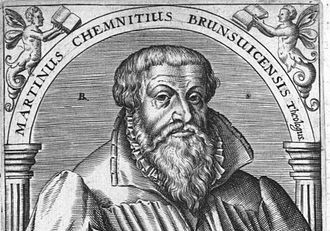
  • Chemnitz’s Homily Outline for Estomihi (Quinquagesima, Baptism of our Lord)

    Chemnitz’s Homily Outline for Estomihi (Quinquagesima, Baptism of our Lord)

    The following is a translation of Martin Chemnitz’s homily outline found in his postil for Estomihi, or Quinquagesima(Postilla, Volume I, pgs. 426–427). At Chemnitz’s time it was common for churches to observe the Baptism of our Lord on the final Sunday before Lent, which connects the Baptism of our Lord to His temptation (the Gospel reading for the First Sunday of Lent). Chemnitz cites all three versions of the Baptism of our Lord found in the synoptic gospels (Matthew 3:13–17; Mark 1:9–11; Luke 3:21–22). The Evangelical Lutheran Synod (ELS) still follows this tradition. In the ELS lectionary, the assigned Old Testament reading is Isaiah 42:1–7 and the Epistle is 1 Peter 3:18–22.

    Chemnitz’s Outline:

    “We will now thus explain this glorious and beautiful account that we may set forth these points:

    1. First, as this account reports, in what manner and in which form our Lord and Savior Jesus Christ was ordained and anointed to the office (Ampt) of Messiah, so that we can be certain of this when we recognize and accept Him as the Messiah, confess Him and hold to Him, that we therefore make no error, but rather receive in Him God’s grace and help, eternal life, and salvation.
    2. Second, what office (Ampt) Christ has, that He is anointed as the High Priest, King, and Prophet, and how He holds this office in heaven, and what counts there.
    3. Third, because Christ is proclaimed here as the only Messiah, and all men are commanded that they recognize Him as such, and ought to hear Him, so here we have this point, which is of the upmost importance for us, that we can know what we ought to hold concerning the doctrine of Christ (Lehre Christi) and everything that we find therein, namely, that it is the doctrine to which God the Father Himself has directed us, and in which the Holy Spirit is present, and He wants to be thereby efficacious so that heaven may be opened to us through it, and the way to eternal life may be prepared and readied.
    4. Fourth, next to the Word, we also have the most revered sacraments, to which we are directed and bound just as much as to the Word [i.e. Acts 2:42]. This account also teaches us further as to what we ought to hold concerning these sacraments, and what they count before God in heaven; but particularly, what concerns the Sacrament of Holy Baptism, which is chiefly dealt with here, what we ought to know about it, and what Christ has brought into our baptism through His baptism, and what He has confirmed [i.e., Matthew 3:15].
    5. Fifth and Last, how the holy Divine majesty has revealed Himself here, how we ought to recognize Him rightly according to His essence and will, to the end that we also ought to be certain of this, each for himself, that God wants to be gracious to us and is heartily pleased with us for the sake of Christ [i.e, Matthew 3:17].

    On these five points, we will now set forth the explanation of this beautiful and comforting account. The almighty God and Father of our Lord Jesus Christ grant us His Holy Spirit, grace, and blessing that we may not only understand this in a historical manner, but rather also may make use of it in a Christian manner through God’s grace.”