The following is my translation of the notes and useful applications for the Holy Gospel of Quinquagesima, Luke 18:31–43, as they are found in Das Weimarische Bibelwerk (1877). Square brackets indicate my own notes and additions. For the useful applications, I recommend the reader see this very helpful article by Dr. Benjamin T. G. Mayes.
V. A prophecy concerning Christ’s suffering and death. (v. 31–34)
VI. The history of [the healing] of a blind man. (v. 35–42)
Annotated Text
31. Now He took to Himself the twelve (the twelve apostles), and said to them, “Behold, * we are going (now on this journey) up to Jerusalem (because the time of My suffering has drawn near, I will also draw near to the determined place of My suffering), and all will1 be fulfilled that is written by the prophets concerning2 the Son of Man (about3 My suffering, death, and resurrection).
* Matthew 17:22ff. (Matthew 20:17; Mark 10:32)
1 * Soon now, when I this time, as the last time, shall take Myself there.” Previously when He had preached the same, he spoke only of it in general (see Matthew 16:21, 17:12–22, etc.).
2 Greek: “in” [There is no preposition in the Greek, but τῷ is in the dative case.]
3 * “through or with My…” [I wasn’t sure what this getting at.]
32. For He will be * handed over to the Gentiles (to Pilate, the Gentile governor, and his soldiers), and He will be mocked and shamed (kept in the most disgraceful and shameful way with words and deeds), and spit upon;
* Matthew 27:2
33. and they will scourge and kill Him, and the third day He will rise again.”
(Joshua 2:19)
34. * But they understood none of this, and the saying was hidden from them, and they did not know what it was that He had said (because the disciples, in the supposed worldly kingdom of Christ, had imagined pure joy and good days for themselves, they could not agree with Christ’s suffering, death, and resurrection).
* Luke 9:45
35. Now it happened, when He (Jesus) came near (on His journey) to Jericho,1 * a blind man sat on the way and he was begging.
* Matthew 20:29–30; Mark 10:46
1 * Before he had yet entered the city (Luke 19:1). But the like, as is usual, are found again at the conclusion (see Matthew 20:29).
36. Now when he heard the people that were passing by (and following Christ in heap), he inquired what this was (what the tumult that he heard signified).
37. Then they preached to him, “Jesus of Nazareth is passing over.”
38. And He called and said, “Jesus, you Son of David (You who are the Messiah and the Savior of the World, the one promised to David and born from his lineage according to the flesh), have mercy on me (help me out of pure grace and unmerited compassion)!”
39. But those passing by warned him that he should be silent. But he cried out much more, “You, Son of David, have mercy on me!”
40. Now Jesus stood still and called for him to be brought. Then when they brought him near to Him, He asked him,
41. and said, “What do you what me to do for you?” He (the blind man) said, “Lord, that I may see.”
42. And Jesus said to him, “Be seeing; * your faith has helped you.”
* Matthew 9:22 (Luke 17:19)
43. And immediately * he was seeing1, and followed Him, and praised God. And all the people who saw this praised God.
* Psalm 146:8
1 Greek: “saw again” [ἀνέβλεψεν] (for he was not born blind, as the one in John 9:1ff., but had lost his sight through an accident; the same also goes for v. 41).
Useful Applications
V. DOCTRINE: Concerning the joyfulness and desire of Christ to suffer and die for us, because He had previously known all His suffering, and nevertheless willingly went to Jerusalem where it would happen. (v. 31) VI. CORRECTION: That we ought to call upon Christ with all our heart for spiritual illumination as this blind man did for bodily illumination. (v. 40) COMFORT: Christ, the Light of the World, will not allow anyone to lack who does not willfully shut his eyes (as he testifies with this cure). (v. 41)
The following is my translation of the notes and useful applications for the Old Testament Reading of Christmas Eve (Midnight), Isaiah 9:2, 6–7, as they are found in Das Weimarische Bibelwerk (1877). Square brackets indicate my own notes and additions. For the useful applications, I recommend the reader see this very helpful article by Dr. Benjamin T. G. Mayes.
Note: The Lutheran Missal Project omits v. 3–5 from the reading.
I. A prophecy concerning Christ and the call of the Gentiles, what great joy will follow thereupon. (v. 2–3)
II. A description of the abolition of the Mosaic Law, and the spiritual peace, together with the ground on which it rests. (v. 4–7)
Annotated Text
2. The * people (Judah and Israel), who walked in darkness (who were stuck in great ignorance, unbelief, misery, and hardship on account of the enduring burden of war, especially during the times of the Maccabees), have seen a great Light (this great Light is the Lord Christ, who is the true Light who has come into the world, John 1:9, and in His coming has brought with Himself the light of grace and the saving knowledge of God as well as the light of joy and life), and over those who dwell in the land of darkness,1 it shines brightly.
* Isaiah 42:7; Matthew 4:16; Luke1:79 (Ephesians 5:14)
1 Hebrew: “the shadow of death,” cf. Luke 1:79
[Verses 3–5 are omitted by the Lutheran Missal Project.]
6. For1 to us (to the people of God first, but afterword to the Gentiles, and in this way to all men) a * Child is born, to us † a Son (namely, God’s only-begotten Son) is given, whose lordship is upon His shoulder (the burden of the work of the redemption of the human race and the governance of His Church lies upon Him; He bears the cross upon His shoulder in order to assemble for Himself a kingdom from the human race); and He is called2(He is in deed and truth, and is also proclaimed, extolled, and praised in the preaching of the Gospel, namely) ** wonderful (on account of His person and His office), Counselor (who has found counsel, how the fallen and lost human race can be counseled and helped who has revealed the counsel of God concerning our salvation in His Word, John 1:18, 15:15; and who can provide counsel in the greatest needs and also give believers the best and most lasting counsel, as to how they shall obtain a gracious God and be saved), Mighty, Champion (who, through His divine power, can overcome all things and bring them into the right; a mighty God, for God is therefore called “El” in Holy Scripture, because He is an almighty champion against whom nothing can stand), Eternal Father (who has obtained an eternal sonship for believers with God the Father through His merit), Prince of Peace (who to believers gives peace with God in heaven and in their consciences, Romans 5:1; Colossians 1:20);
1 Here follows an explanation of the previous saying, so that the source of all the joy of believers is now indicated more clearly in Christ.
* Luke 1:31ff., 2:7, 11
† John 3:17; Romans 8:3; Galatians 4:4
2 Hebrew: “They will call His name” (that is, “He will be,” see Isaiah 7:14)
7. so that His * lordship will be great (for the Jews and Gentiles will be brought under His spiritual kingdom), and † His peace will have no end, upon the throne of David and His kingdom (so that He will rule in eternity over the members of His kingdom in peace and unity; for the bodily kingdom of David was only a type of the spiritual and eternal kingdom of Christ); that He establish it and strengthen it with judgment and righteousness (in this life, the kingdom of Christ is established with judgment, when He overcomes the prince of this world, John 16:11, and judges and punishes all enemies of His kingdom; it is strengthen with righteousness when He bestows the righteousness which avails before God to the members of His kingdom and gives them justice against all enemies; and in eternal life, complete rest from all enemies will follow and the members of Christ’s kingdom will obtain eternal joy and salvation) from now until then in eternity (without end and ceasing). The zeal of the Lord of Sabaoth will do ** this.1(Christ’s burning love toward His Church, and His wrathful zeal against the devil, who has tempted men since the Fall.)
1 Hebrew: “From that time on” (when this kingdom will begin), “and until and as long as the world stands will the zeal of the Lord of Sabaoth do this” (He will continue it and bring it completion). Concerning the zeal of the Lord in love, see Isaiah 37:32; Song of Songs 8:6.
Useful Applications
[There are no useful applications for v. 2]
II. DOCTRINE: That the Son of God, who has been born true man, is the gracious King, Protector, and Savior of all believers. (v. 6–7)
The following is my translation of the notes and useful applications for the Old Testament Reading of the Fourth Sunday of Advent (Memento Nostri), Deuteronomy 18:15–19, as they are found in Das Weimarische Bibelwerk (1877). Square brackets indicate my own notes and additions. For the useful applications, I recommend the reader see this very helpful article by Dr. Benjamin T. G. Mayes.
III. A prophecy concerning the great prophet (Christ). (v. 15–19)
Annotated Text
15. A * Prophet, like me (and even much higher, indeed, the most excellent and highest Prophet)1will the Lord, your God, raise up (bring forth) for you, from you and your brothers (namely, the promised Messiah, true God and man), † to Him shall you listen (receive Him with true faith and follow Him. Luther: “Here another kind of preaching is clearly promised other than the preaching of Moses, which cannot be the Law which was sufficiently given through Moses; therefore, it must be the Gospel. And this Prophet is no one other than Jesus Christ Himself, who has brought such a new preaching on earth”).
* John 6:14; Acts 3:22, 7:37
† Psalm 2:12
1 † Through whom God, and through whose mediatorial office (indeed, a better reconciliation office), will establish a New Covenant, Jeremiah 31:31ff., as He had established [the Old Covenant] through my mediation (cf. Deuteronomy 18:18, 34:10). But concerning the Law of the Messiah, see Isaiah 2:2, 42:4, and 61:1ff.
16. Just as you then1 requested * of the Lord your God at Horeb (with the giving of the Law), on the day of (public general) assembly (of the Israelite people around the mountain), and said, ‘I will no longer hear the voice of the Lord, my God,’ and I will see no more the great fire (that burned on the mountain), that I not die (from terror and anxiety, but rather Moses shall recite the Word of the Lord to us).’
* Exodus 20:19; Hebrews 12:19 (Deuteronomy 9:10)
1 Hebrew: “indeed,” as you spoke of it previously, v. 17, so will it happen. (I will no longer speak with them such a terrifying manner, but rather in a loving manner.)
17. And the Lord said to me, “They have * spoken well (for without a Mediator there is no dealing with Me).”
* Deuteronomy 5:28
18. I will raise up for them a * Prophet like you (of such nature and such reputation, and of such glorious, indeed, far greater gifts and deeds) from their brothers (the Jewish people), and I will put My words ** in His mouth, and He1 shall speak all things to them which I have commanded to Him (He shall indicate My thinking to the people).
* John 1:45
† Hebrews 3:2ff, 12:24
** John 7:16, 8:26, 40
1 * He Himself, who is the Lord your God, v. 14, and not more in the fire, but rather in a friendly manner (see Isaiah 52:6; cf. Zephaniah 3:9; John 1:18; Matthew 17:5; etc.).
19. And whoever will not * hear My words, which He will speak in My name (but rather wantonly despise them and cast them to the wind), I will demand1 it of Him (I will attend to him with temporal and eternal punishment).”
* Matthew 17:5 (John 12:48)
1 † How? See Malachi 4:6. This is what is called the ban, which one still sees with one the eyes placed upon the Jews and the land of Israel on account of this dreadful misdeed (cf. Deuteronomy 32:43).
Useful Applications
III. CORRECTION: To receive the Word of the Great Prophet, Christ, willingly and follow Him in faithful obedience. (v. 15–19)
The following is my translation of the notes and useful applications for the Holy Gospel of the Ember Wednesday of Advent, Luke 1:26–38, as they are found in Das Weimarische Bibelwerk (1877). The same reading is also used for the Annunciation of Our Lord (March 25th). Square brackets indicate my own notes and additions. For the useful applications, I recommend the reader see this very helpful article by Dr. Benjamin T. G. Mayes.
III. The appearance of the angel before Mary. (v. 26–38)
Annotated Text
26. And in the sixth month1(after Elizabeth had become pregnant)2the angel Gabriel (Luke 1:11, 19) was sent by God into a city in Galilee, by the name of Nazareth,
1 Greek: “But in the sixth month” [Ἐν δὲ τῷ μηνὶ τῷ ἕκτῳ]
† See Luke 1:24, 36.
27. to a virgin, * who was betrothed (but not yet joined) to a man with the name Joseph, of the house (of the lineage) of David; and the virgin’s name was Mary (who also was born of the lineage of David).
* Luke 2:5; Matthew 1:18
28. And the angel came (in an assumed human and yet majestic form) unto her (into the house in which she dwelled in Nazareth, and into the chamber in which she was staying at that time) and said: “Hail to you, favored one (graced specially by God); the Lord is with you (He stands by you with His help and grace, and will especially do good to you), blessèd are you among women. (Luther: “That is ‘You highly-praised one’ in German,” the one whom everyone will praise highly and extol as blessèd, Luke 1:48, because God will endow you with a special blessing which has never befallen any woman.)
(Genesis 6:8; Judges 6:12)
29. But when she saw him, she was frightened over his saying and thought, “What kind of greeting is this?” (I am entirely unworthy of this greeting and unaccustomed to it.)
30. And the angel said to her, “Fear not, Mary, you1 have found grace with God. (Luther: “That is, you have a gracious God.”)
1 Greek: “For you” [γὰρ]
31. Behold,1 you * will (very soon) conceive in your body and give birth to a Son, whose name you shall call Jesus (whose name means so much as “Helper,” “Deliverer,” and “Savior,” Matthew 1:21),
* Isaiah 7:14ff. (Micah 5:3)
1 Greek: “And behold” (This little word and [καὶ] serves thus to explain what preceded)
32. He will * be called great (on account of the highness of His person, His office, His miracles, and His sitting at the right hand of God) and a Son of the Most High (the only-begotten, natural, and equally eternal Son of God the almighty Father; which He will be in fact, and will be recognized and known as the eternal Son of God), and God the Lord (His heavenly Father) will give Him the throne of His father David (He will exalt Him to His right hand according to His human nature and bestow upon Him the kingdom and the lordship over His Church, indeed, over all creatures. This kingdom of Christ was prefigured by the kingdom of King David, from whose lineage Christ was to be born according to His human nature, and was promised in particular to David, 2 Samuel 7:12; Psalm 132:11, 17; Mark 11:10).
* Isaiah 9:7 (Isaiah 54:5)
33. And He will be a King over the house of Jacob (over the Church and the congregation of the saints, assembled from Jews and Gentiles, which Church was prefigured through the lineage of the Patriarch Jacob) eternally, and * of His kingdom there will be no end (and therefore it will not be an earthly and temporal kingdom, as was David’s, but rather a spiritual, heavenly, and eternal kingdom).”
* Daniel 4:31, 7:14; Micah 4:7
(Psalm 45:7; Jeremiah 23:6; Daniel 2:44; Hebrews 12:28)
34. Then Mary said to the angel (not from unbelief, as previously did Zachariah, Luke 1:18, but rather with wonderment over this high mystery of the incarnation of the Son of God, that she shall be the mother of Him, and out of a heartfelt desire for more instruction), “How should this be (that I shall will conceive and give birth to the Messiah)? For I have known no man (that I should have cohabitated with in a married manner).”
35. The angel answered and said to her, * “The Holy Spirit will come over you (He will purify and sanctify the drops of blood from which the holy body of the Messiah will be built as a pure temple; and will also give you a special divine power, that you may become pregnant without the assistance of a man), and the power of the Most High (the first and only-begotten Son of God, who is Himself the “power of God,” 1 Corinthians 1:24) will overshadow you (and in an entirely special manner will pitch His dwelling in you, namely, by assuming true human nature in your virginal body, so that the incomprehensible, invisible light of His divine nature may be seen under the shadow of the received human nature); therefore also that † Holy One who will be born of you will be called God’s Son. (Because the Holy Spirit Himself will form the fruit of your womb and preserve it from all sinful defilement; indeed, even the eternal self-subsisting power of the heavenly Father, namely, the Son of God, will receive human nature from you and will unite Himself personally with it; therefore, you will carry such a glorious fruit of the womb and bring it forth into the world, who will not only be true man, but also, in the unity of His person, will be called and be the eternal only-begotten Son of God.)
* Matthew 1:18, 20
† Daniel 9:24 (Exodus 25:22, 40:34, 38; Numbers 7:89; Luke 9:33ff; Jeremiah 23:5–6)
36. And behold (receive this sign for the strengthening of your faith), Elizabeth (the wife of the old priest Zachariah), your friend (who is related to you by blood by way of maternal line, from the tribe of Judah), is also pregnant with a son in her old age, and it is now the sixth month, (it is now the sixth month that she is with child) she who in * public reproach was called barren (until now).
38. Now Mary said, “Behold, I am the maidservant of the Lord1(entirely given to the service and the will of God); let it be to me as you have said.” (These were words of faith, humility, and obedience.) And the angel parted from her.
1 Greek: “Behold, the Lord’s maidservant!” [ἰδοὺ ἡ δούλη κυρίου]
Useful Applications
III. DOCTRINE: Concerning the manifestly great mystery of godliness [see 1 Timothy 3:16], that the Son of God has become true man, was conceived by the Holy Spirit, and was born of the Virgin Mary. (v. 31–35)
The following is my translation of the notes and useful applications for the Second Reading (the Epistle Reading) of the Ember Wednesday of Advent, Isaiah 7:10–15, as they are found in Das Weimarische Bibelwerk (1877). Square brackets indicate my own notes and additions. For the useful applications, I recommend the reader see this very helpful article by Dr. Benjamin T. G. Mayes.
II. [Isaiah] deals with the sign which God offered to them, but which Ahaz did not want to request, on account of which the Lord punished him and named the sign, namely, the birth of Christ, or the consolation in the coming Immanuel. (v. 10–16)
Annotated Text
10. And the Lord spoke once more to Ahaz (through the prophet Isaiah), and said:
11. “Ask for a sign of the Lord, your God (to convince you that what I have now said is God’s Word and the truth), be it below in the depths, or above in the heights (whether it be here on earth or above in heaven, so shall it happen; for I am the almighty God, and nothing is impossible for me, Luke 1:37).
1 Hebrew: “turn yourself downward into the depth and ask, or turn yourself upward into the height” (You are free to demand a miraculous sign from wherever you want.)
12. But Ahaz said (from an unbelieving heart and with a hypocritical mouth), “I will not ask (hereby Ahaz despises all those things which the prophet had promised him by God’s command, and in order to whitewash his hypocrisy, he says), for I will not test the Lord (he points to Scripture and thereby mocks the prophet’s offer, as if it were contrary to God’s Word, since in Scripture it is forbidden to tempt God the Lord by demanding a sign, Deuteronomy 6:16. Now it is one thing to demand a sign out of unbelief or presumption, and at an importune moment, without need and without a command from God; but is another thing to accept a sign which God Himself offers in order to strengthen the faith of men in order to thank Him and in due obedience).
(Matthew 12:38; John 4:48)
13. Then he said (the prophet Isaiah), “Well then, here then you of the house of David: Is it a small thing for you to insult the people (the priest mocks and skins the subjects), that you must (out of the impulse of your wicked heart) also insult my God?1(in that you reject His Word and gracious promise and thereby want to make Him a liar, so much as it is within you).
1 Hebrew: “to cause trouble” (through so much futile offering and vain apologizing)
14. Therefore, the Lord Himself will give you a sign1: Behold, a * virgin2 shall conceive (which is above all nature and contrary to its ordinary course), and will give birth to a Son (who is Christ), whom they will call3† Immanuel (“God with us,” who is God and true man together in one person; who is the foundation of all the promises of God, 2 Corinthians 1:20, and is the faithful testimony of divine love and grace toward us men, Revelation 1:5).
* Matthew 1:23; Luke 1:31; Micah 5:2
† Isaiah 8:8, 10
1 A supernatural miracle, which although still in the future, was nevertheless an absolute truth among the Jews (see Genesis 3:12; 2 Kings 19:29; Matthew 12:39ff.). At the very least, the house of Judah and David had to be preserved until this Son was born.
2 This Hebrew word signifies a virgin according to its origin and established use. Otherwise, the matter could not have provided a miraculous sign.
3 To be called a name often signifies that very fact. [i.e., Christ is truly, not figuratively, “God with us.”] See Isaiah 1:26, 9:6, 56:7; Jeremiah 3:17; Zechariah 6:12, 8:3; Luke 1:25, etc.
15. He will eat butter and honey (He will be reared in such a common manner and way, as any other boy in the Jewish land), that He might know to reject evil and to choose the good (so long until He comes into His full age, and then can distinguish between good and evil, which happened during the time that He carried out His teaching office on earth, to which He was consecrated at His baptism through divine revelation, Matthew 3:16–17).1
* Hebrews 5:14 (Philippians 2:7)
1 * Until He comes to the years in which children learn to understand the distinction between good and evil.
16. For before * the boy (namely, Immanuel) learns to reject evil and to choose good (before He is yet to be born and increases in age and wisdom, Luke 2:40, 52)1the land which you dread (namely, the land of Syria and the ten tribes of Israel) will be forsaken by its two kings (for both Rezin and Pekah were slain before Ahaz had completed the fourth year of his reign [see 2 Kings 15:30, 16:9]).
* Isaiah 8:4 (v. 4)
1 * That is, before he comes to these years, or in a short time as a boy comes to His reason. Those who understand such words as concerning the small boy Shear-Jashub [Isaiah 7:3] standing there, to whom the prophet pointed with his finger, come even closer to the matter and to the shortness of the time.
Useful Applications
II. DOCTRINE: That the Son of God was conceived by the Holy Spirit and born of the Virgin Mary for our redemption. (v. 14)
The following is my translation of the notes and useful applications for the Old Testament of the Ember Wednesday of Advent, Isaiah 2:2–5, as they are found in Das Weimarische Bibelwerk (1877). Square brackets indicate my own notes and additions. For the useful applications, I recommend the reader see this very helpful article by Dr. Benjamin T. G. Mayes.
I. Isaiah deals with the future calling of the Gentiles to the Kingdom of Christ. (v. 1–5)
Annotated Text
1. This is that which Isaiah, the Son of Amoz, saw concerning Judah and Jerusalem. (The prophecy belongs to the New Testament.)
2. It shall come to pass in the latter time that the mountain where the house of the Lord (the Kingdom of Christ and God, where He will dwell and reveal Himself) shall certainly be higher (Luther: “that one no longer needs to run here and there, but rather will certainly find God,” namely, in the Christian Church, which is built upon Christ as the Rock, Matthew 16:18; the same is also called Mount Zion here because it was first assembled together in Jerusalem at the time of Christ and His apostles and then from there spread itself into all the world) than all mountains and be exalted over all hills (the Christian Church and the Kingdom of the Lord Messiah [Christ] will far excel all other kingdoms and will have a different and better condition than the Church of the Jewish people), and all the Gentiles will run1 to it (Luther: “as water runs with force and freely of itself”);
* Jeremiah 3:17; Micah 4:1 (Psalm 68:16–17)
1 Hebrew: “flow” (in heaps)
3. And1 many people will go forth and say, “Come, let us go to the mountain of the Lord, to the house of the God of Jacob, that He may teach us His ways, and that we may walk in his paths. For from Zion the Law will go forth, and the Lord’s Word from Jerusalem (the apostles will begin to preach the doctrine of the Gospel at Jerusalem and in the Jewish land, and from there spread it until the end of the world, Acts 1:8).
(Psalm 50:2; Psalm 110:2; Zechariah 8:23)
1 Hebrew: “For it will happen…” (This is an explanation of what preceded.)
4. And He (Christ, to whom His heavenly Father has given all judgment, John 5:22) will judge among the Gentiles and rebuke many people (He will convince them through the preaching of His Word that they have merited eternal damnation, and therefore admonish them that so that they may flee from such condemnation and be all the more eager and willing to accept His Gospel). Then they1 will make their * swords into plowshares and their spears into sickles (Luther: “or reaping hooks.” Jews and Gentiles will in Christ will have love and value for one another, and not, as previously, be hostile toward one another, rather they will have one heart, mouth, and mind according to the Gospel). For no people will2 lift up a sword against another, and they no longer learn war (They will no longer hold so stiffly to pagan idolatry, but rather will give themselves captive with their reason under the obedience of Christ, 2 Corinthians 10:5).
1 Hebrew: “for they shall” — (This is Christ’s doctrine of love from true faith, John 13:34ff.)
2 Hebrew: “shall” — ([At the same time,] lawful governmental war protection, which comes from love toward one’s own, still remains unchanged in times of need according to Romans 13:4)
5. Come now, you of the house of Jacob, let us * walk in the light of the Lord (Christ; that is, the converted Gentiles will admonish the Jews themselves to true recognition of God in Christ).
* John 8:12
Useful Applications
I. DOCTRINE: Concerning the universal call of the Gentiles to the Kingdom of Christ through the preaching of the Apostles. (v. 2–4)
The following is my translation of the notes and useful applications forthe Old Testament of the Third Sunday of Advent (Gaudete), Isaiah 40:1–8, as they are found in Das Weimarische Bibelwerk (1877). Square brackets indicate my own notes and additions. For the useful applications, I recommend the reader see this very helpful article by Dr. Benjamin T. G. Mayes.
I. A prophecy concerning the coming of the Messiah, and His forerunner, John the Baptist, what he will preach. (v. 1–11)
Annotated Translation
1. “Comfort (with these words God speaks to the prophets, apostles, and their true successors, the servants of Christ, who carry out the office of the New Testament, that they ought to kindly comfort the people of God with these words), comfort My people!” says your God.
2. “Speak * kindly with Jerusalem,1 and preach to her, that her hard service2(Luther: “the Divine Service in the Old Testament”) has an end (that the burdensome Divine Services and the arduous exercises in the manifold ceremonies of the Mosaic Law have come to an end, that they are also redeemed from the curse and bane of the Law, as well as from the various accusations of the conscience), for her misdeeds are forgiven3(for Christ’s sake), for she has received twofold (grace upon grace, John 1:16, Romans 5:20) from the hand of the Lord, for all4 her sins (Luther: “Namely, forgiveness of sins and freedom from the Law of Moses, that is, pure grace for sin, life for death,” etc.).
(Zephaniah 3:18; Daniel 9:24; Ephesians 5:2; Hebrews 9:8ff.)
1 Hebrew: “Speak to Jerusalem in her heart” (that is, preach to her what will be comforting to her. See Genesis 34:3, 50:21; Judges 19:3; Hosea 2:14; Zephaniah 3:9).
2 Hebrew: “Her hard (military) service” (her Divine Service, which she carried out in the army of God, the Israelite Church, according to the Levitical order, which was a hard yoke both in itself, and also on account of the frequent great judgments of wrath. See Acts 15:10; Deuteronomy 8:24ff.).
3 Hebrew: “reconciled” [i.e., propitiated], see Leviticus 1:4
4 Hebrew: “in” or “among all” — regardless of their greatness and number.
3. There is * a voice of a preacher in the wilderness (namely, John the Baptist, who began the New Testament with his preaching and teaching), ‘Prepare (through true repentance and correction) for the Lord (the Messiah, who is true God with the Father and the Holy Spirit) the way (that He may take up lodging in your hearts through true faith), make a level path in the field for our God (that He may enter in among you freely and unhindered).
* Matthew 3:3; Mark 1:3; Luke 3:4; John 1:23 (Malachi 3:1)
4.All valleys (all hearts that are oppressed by the burden of the Law) shall be exalted (be set right again through the preaching of the Gospel), and all mountains and hills (proud hearts and hypocritical work-saints) shall be made low (brought to the recognition of their sins, and their trust in their own works will be laid low in their hearts), and what is unlike shall be made even, and what is rough shall be made smooth (Christ will make everything fine and straight, in that all men must live by His grace alone and no one will have any advantage over the other, Acts 10:34–35);
(Isaiah 42:16; Zephaniah 3:11ff.)
5. for the glory of the Lord shall be revealed (in Christ and in all His works and miracles); and all flesh shall see it together (Jews and Gentiles, Colossians 3:11; Isaiah 66:23) for the mouth of the Lord has spoken (for Christ’s mouth is truly God’s mouth, therefore, whoever has heard Christ speak has heard God speak).
(Isaiah 52:6–10; John 1:14; 1 Timothy 3:16)
6. A voice says, “Preach!” (Christ will command His servants to preach.) And he (the servant of God) said, “What shall I preach?” (Answer, this:) “All * flesh is hay1(all men, as they are now born after the fall into sin, are sinful and mortal, also unfit for all good, and cannot stand before God’s judgment), and all its goods (Luther: “All good deeds or good living which reason can do and does”) are as flowers in the field (therefore, they only ought to seek their righteousness and salvation in Christ alone, who is proclaimed to them in the Gospel).
* Isaiah 51:12ff.; 1 Peter 1:24 (Matthew 6:30; James 1:10–11)
1 Hebrew: “grass;” compare Psalm 37:2, as well as v. 7 here.
7. The hay withers, the flower fades, for the Spirit of the Lord blows on them (when the Spirit of God tests the works of men who are not yet reborn, stirs their conscience, sharpens the Law, and thereby shines into the heart, then everything upon which they rely withers and falls apart, and all boasting lies down). Indeed, (all) the people are as hay (not only the wicked and godless people, but also the people of God are sinful, mortal, and perishable by nature).
8. The hay withers, the flower fades, but the * Word our God (through which we are born anew and reborn to eternal life) remains forever.
* Psalm 119:89; Luke 21:33; 1 Peter 1:25
9. Zion, you preacher (by this are to be understood the holy apostles, who first preached the Gospel in Jerusalem and in the Jewish land, but afterward had preached it in the entire world, Luke 24:47, Acts 1:8)1, go up onto a high mountain (that your voice may be heard far and wide); Jerusalem, you preacher, lift up Your voice with power, lift it up and fear not; say to the cities of Judah, “Behold, there is (Christ) your God (revealed in the flesh, 1 Timothy 3:16, who now Himself speaks with you in His assumed human nature, Isaiah 52:6).
(Matthew 10:27; Romans 10:18; Malachi 3:1)
1 † The Hebrew word generally means to proclaim a joyful message. See Isaiah 52:7.
10. For behold, the Lord YHWH (Christ, the Chief Shepherd of His Church, 1 Peter 5:4) comes with power1 (to content against the devil and everything that hinders and prevents us from salvation, and to cast out the prince of this world, John 12:31), and His arm is glorious (He will powerfully gather together a kingdom out of the human race in which He will rule with His Word and Spirit). Behold, His reward (His gift of grace, which He has acquired by His obedience and suffering) is with Him, and His * recompense (according to which He will do good to believers and will punish unbelievers) is before Him.
* Romans 2:6ff. (Isaiah 62:11; Revelation 22:12; 1 John 3:8)
1 Hebrew: alternatively, “against the powerful,” cf. Luke 11:21
11. He will shepherd His flock as * a Shepherd; He will gather the (tender, young) lambs together in His arms and carry them in His bosom, and lead the sheep mothers (He will faithfully tend the weak sheep1).
* John 10:11–12ff. (Psalm 23:2; Ezekiel 34:11–12, 23; Micah 5:3)
1 † Those who understand the “sheep mothers” as the faithful teachers come closer to the purpose and the metaphor.
Useful Applications
I. DOCTRINE: That we obtain forgiveness of sins, comfort, salvation, and blessedness from Jesus Christ through faith in His Holy Word. (v. 1, 2–10).
The following is my translation of the notes and useful applications of the Old Testament Reading for the First Sunday of Advent (Ad Te Levavi), Jeremiah 23:5–8, as they are found in Das Weimarische Bibelwerk (1877). Square brackets indicate my own notes and additions. For the useful applications, I recommend the reader see this very helpful article by Dr. Benjamin T. G. Mayes.
III. He sets before them in contrast [to this account of punishment (v. 1–4)], the prophecy concerning the true Helper and Savior Jesus Christ. (v. 5–8)
Annotated Text
5. “Behold, * the time (of the New Testament) is coming,” says the Lord, “that I will raise up for David (from his stem and descendants, according to My promise) † a righteous Branch (a Son); and He (namely, the Messiah) shall ** be a (spiritual) King, who will rule well, and establish justice and righteousness on earth (He will acquire perfect righteousness through His obedience and suffering,1 and appropriate it to the members of His kingdom through faith, and protect His Church against enemies).
1 † See Psalm 22:31–32; for He will be a help through an everlasting redemption, v. 6.
6. At that time * shall Judah (the Christian Church) be helped, and shall Israel (who is each true believer in Christ) dwell secure. And this will be His name (the Messiah’s), that one will call Him (in true faith), “The Lord (the true God), who is our righteousness” (who has brought us eternal righteousness, Daniel 9:24; who also has been made righteousness for us from God, 1 Corinthians 1:30; so that we might become in Him the righteousness which avails before God, 2 Corinthians 5:21).
7. Therefore, behold, * the time is coming,” says the Lord, “that one will no longer say, ‘As true as the Lord lives, who has led the children of Israel out of the land of Egypt (in a bodily manner),’
* Jeremiah 16:14–15
8. but rather, ‘as true as the Lord lives, who has led forth the seed of the house of Israel (in a spiritual manner according to this type), and has brought them out from the land of the north and from all the lands1 into which I had driven them, so that shall dwell in their own land.’”
1 † This teaches that the talk is of the general assembly of believers in the New Testament, John 10:16; Matthew 8:11; of which those from the north have been a prelude and a sample.
Useful Applications
III. DOCTRINE: That Christ the Son of God who has been sent form the heavenly Father into the world (signified through the true Branch of David), is the King of His believers, by whom they obtain righteousness and eternal salvation. (v. 5–6)
The following is my translation of the notes and useful applications for the Second Reading for the Feast of St. Michael and All Angels, Revelation 12:7–12, as they are found in Das Weimarische Bibelwerk (1877). Square brackets indicate my own notes and additions. For the useful applications, I recommend the reader see this very helpful article by Dr. Benjamin T. G. Mayes.
Notes
II. The Beginning of the Fourth Vision, in which two opposing parties are described, who have strong enmity against one another: the woman and the dragon; likewise, Michael and His angels on one side, and the dragon together with his angels on the other side. v. 19, 1–17.
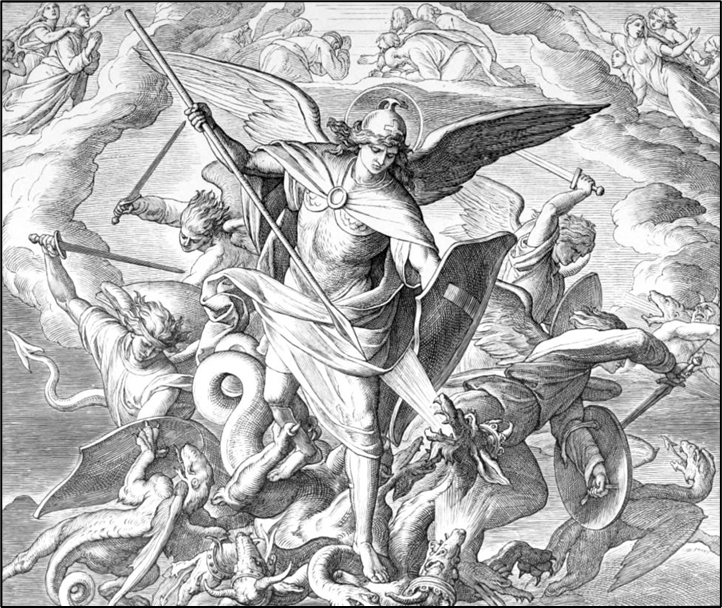
7. And there was a fight in heaven (in the Church-heaven here on earth; for after the devil, on account of his fall, has been cast out of the heaven of eternal glory, he may not come back into it again): * Michael and his angels fought with the dragon, and the dragon and his angels fought (This Michael is God’s Son, as it is explained in v. 10; He is, among other things, also called an angel for this reason, because in the protection of the Church, He carries out the office of an angel; otherwise, Michael is also the name of an archangel, Jude 9. But here Christ, the Son of God, is meant by this name, who is of one essence, one power, and one glory with God, His heavenly Father; for Michael means ‘Who is like God?’ And with this name the Holy Spirit directs us to the last chapter of the prophet Daniel, where it is proclaimed that in the last times, the great prince Michael shall arise, who stands for the holy people, Daniel 12:1. For since the dragon wants to attack the woman, that is, the true Church and the members of the spiritual body of Christ, so Christ takes His Church to Himself, and fights with His angels, by which not only the holy spirits in heaven are understood, but also all faithful teachers and preachers, against the dragon and his angels, by which not only the evil spirits who joined themselves to the devil and fell away from God are understood, but also the persecutors, the heretics, and all the scales of the hellish dragon). **
* Daniel 10:13, 21; 12:1.
** And: This battle is without doubt the blessed Reformation. If it were about the freedom of the Christian Church after the heathen persecutions [i.e., the legalization of Christianity in the Fourth Century], then one would have to seek it in the wars of Constantine the Great with Licinius, Maxentius, and so on.
8. And they did not win (for how could the devil overcome Christ, who is the power of God, 1 Corinthians 1:24? “The prince of this world is coming, and he has nothing in me,” says Christ to HIs disciples, John 14:30); also there was no more found to be a place for them in heaven (they were put to flight and cast out of heaven).
9. And the great dragon was cast out *, the old serpent (the evil enemy, who deceived our first parents through the serpent, Genesis 3:1, and has practiced his cunning and wickedness for a long time), who is called the Devil (the accuser, because he slanders God before men, Genesis 3:5, men before God, Job 1:9, and men against other men) and Satan (the adversary, because he is the enemy of God and men), who deceives the entire world (through his cunning and lies he deceives all those who allow themselves to be led by the spirit of the world, 1 Corinthians 2:12); and he was cast ** to the earth (by these words refers to the curse which God, after the fall of our first parents, pronounced upon the serpent: “Upon your belly you shall go, and dust you shall eat all the days of your life,” Genesis 3:14), and his angels were also *** cast out at that time (By this casting out of the devil from heaven it is signified that, after Christ through His death and resurrection had overcome the devil and taken power from him, Hebrews 2:14, He then, after His victorious resurrection, in which He stripped the principalities and the powers and made a show of them openly, and made a triumph out of them through Himself, Colossians 2:15, and after He sat down at the right hand of God, caused such obtained victory to be proclaimed in all the world, whereby the devil everywhere is driven out and trodden under the feet of the believers, Romans 16:20. “I saw Satan fall from heaven as lightning,” says Christ, Luke 10:18. Afterward, this overcoming and casting out took place at the time of Emperor Constantine the Great [in the Fourth Century], when the great persecutions ceased and peace was grated to the Church. In particular, this conflict and victory against the hellish dragon refers to our last times, when the kingdom of the antichrist and the doctrine of devils is attacked through the preaching of the Gospel, 1 Timothy 4:1, and are driven out of the Church-heaven; and this casting out will only fully happen on the Last Day, in which the dragon with his angels will be cast into the hellish pool, Revelation 20:14).
* Luke 10:18; John 12:31 (Revelation 20:2; Zechariah 3:1)
** Greek: “(Indeed), he was cast out,” or, “He was (I say) cast out”
*** Greek: “with him”
10. And I heard a great voice, which spoke in heaven, * “Now is the salvation, and the strength, and the kingdom, and the power of our God, His Christ ** (This is the triumph song and rejoicing of the true believers over this victory of the great prince Michael against the dragon, who in the same fight proved Himself to be an invincible hero and savior of His Church), because the accuser of our brethren has been cast out, *** who accuses them before God day and night.
* Revelation 11:15 (Job 1:9, 2:5; Zechariah 3:1)
** Greek: “Now has come (in powerful demonstrate made known and been revealed) the salvation and the power and the kingdom of our God, and the glory of His Christ (Anointed One).”
*** Greek: “is cast out (hurled down).”
11. And they * (the believers) have overcome ** him through the Lamb’s blood (because they firmly believed that Christ, through His suffering and the shedding of HIs blood, had overcome the devil for their good, and they set this victory in true faith against the devil’s accusation), and by the Word of their testimony *** (in that they remained steadfast in the confession of the Gospel, which is the testimony concerning Christ); and they have not loved their life even to death (their life was not so dear to them that in order to preserve it they would have denied Christ and His Word).
* Greek: “Also they themselves”
** Romans 8:37 (v. 17)
*** Concerning this, see Revelation 11:3.
12. Therefore *, rejoice you, you heaven, and those who dwell therein (all believers and elect of God, whose names are written in heaven, Luke 10:20, whose citizenship is in heaven, Philippians 3:20). But woe to those who dwell on the earth and on the sea (those who are minded toward earthly things, Philippians 3:19, who love the world and what is in the world, 1 John 2:15, since everything that is in the world, such as honor, riches, pleasure, power, etc., is unstable as the sea), for the devil has come down to you, and he has great wrath, and he knows that he has little time (because the time of the Judgement Day is near, in which he is to be cast into the hellish pool and will no longer exercise his malice upon the earth).
* Psalm 96:11
Useful Applications
II. COMFORT: That Christ Himself (who is signified by Michael) faithfully takes care of His believers in the militant church on earth and powerfully protects them against the devil and the antichrist, is depicted in this vision, v. 7–9.
The following is my translation of Martin Chemnitz’s homily for the Visitation of Mary (July 2nd) on Luke 1:39–56 as found in his Postilla (Volume III, pgs. 87–94). Square brackets indicate my own additions and notes. I have broken up some of the longer paragraphs for the sake of readability in English.
Chemnitz’s Gospel Text (Luke 1:39–56)
Now Mary arose in those days and went to the mountains at last (endelich), to the city of Judah, and came into the house of Zacharias and greeted Elizabeth. And it happened when Elizabeth heard the greeting of Mary, the child leapt in her womb; and Elizabeth was filled with the Holy Spirit, and she called out loudly and said, “Blessed (Gebenedeiet) are you among women, and blessed is the Fruit of your womb. And why has this come to me that the mother of my Lord should come to me? Behold, when I heard the sound of your greeting, the child leapt in my womb with joy. And blessed (Gottselig) are you, you who have believed, because there will be a fulfillment of what has been said to you by the Lord.”
And Mary said, “My soul extols the Lord, and my Spirit rejoices in God my Savior. For He has seen His humble maidservant (elende Magd); behold, from now on all children’s children shall praise me as blessed (selig). For He has done great things to me, He who is mighty, and holy is His name. And His mercy endures forever and ever upon those who fear Him. And He has exercised power with His arm, and He has scattered the proud in the mind of their heart. He has pushed the powerful from the thrones, and He has exalted the humble. The hungry He has filled with good things, and the rich He has left empty. He has remembered His mercy and helped His servant Israel, as He had spoken to our fathers, to Abraham and to his Seed forever.”
And Mary remained with her for three months, and thereafter she returned home again.
Explanation of This Gospel
On this feast day we have these accounts to consider, that after the angel Gabriel had announced the counsel of the Holy Trinity (den Rath der Heiligen Dreifaltigkeit) to the Virgin Mary, namely that she shall be a mother of the promised Seed of the woman [Genesis 3:15], in whom all the nations on earth shall be blessed; yet the good virgin at Nazareth had no one to whom she could have entrusted this, for she dared not to reveal it to her betrothed Joseph, for those from Nazareth were such people that one had a proverb about them: “What good can come from Nazareth?” (John 1[:46]); how she set out and at last went over the hill country, about twenty German miles (in die zwäntzig Teutscher Weil Wegs), to her old kinswoman (Gefreundin) Elizabeth, who lived in Bethlehem or at least not far from there, so that she might speak with her about these high matters. And after she had come to her, then our Lord God immediately revealed the conception of His Son with great wonders, and there the first joy of the New Testament began. For Elizabeth was filled with the Holy Spirit and not only spoke but cried out with a loud voice to Mary, “Blessed are you among women and blessed is the Fruit of your womb! And why has this come to me that the mother of my Lord should come to me?” The not yet born into the world John (Der noch nicht zur Welt geborne Johannes) danced and leapt for great joy that the Lord was present, of whom he shall be the forerunner [Malachi 3:1]. Mary sings for great joy, as the Holy Spirit awakened in her heart a glorious beautiful song of praise (Lobgesang), the beloved Magnificat.
On account of this history, we celebrate this present feast, so that we may learn how highly we ought to rejoice with all the saints when we desire to become partakers of the gifts of the New Testament. And just as now these persons thank the beloved God for this great benefit, that He has sent His Son into the flesh, so too we ought to come together today so that we may thank God for this great benefit, that He has revealed His Son in the Gospel, and when such is done by us, then we may rightly celebrate this feast, and without doubt, the Holy Spirit with His grace will be with us. But for now, we do not want to speak about the history, because such happens at other times, but rather we want to take for ourselves the glorious song of praise of Mary, in which she thanks God the heavenly Father with mouth and heart, praises and extols Him that He has now fulfilled with this deed what He had so often promised and pledged from the beginning of the world concerning the blessed Seed of the woman [Genesis 3:15].
Now it is very customary in the Old Testament that when God allows Himself to be recognized by the saints with special graces and benefits and when the Holy Spirit wanted to grasp the benefits of God so that they would never be forgotten but rather would be passed on to the descendants, that they framed such thanksgiving in short songs of praise, even as among us are there are songs and rhymes (Carmine und Reimen), so that they might be learned by others all the more easily, and this they called psalms or hymns (Psalmos oder Hymnos), such as the psalm which Moses had made and sung with the children of Israel when they passed through the Red Sea and our Lord God had cast Pharaoh along with all his [hosts] into the sea (Exodus 15[:1–19]). The like of which Miriam, the sister of Moses, did also together with the women who followed her in the ranks [Exodus 15:20–21]. Such a song of praise was also made by Hannah, the mother of Samuel, in which she thanks God that He heard her prayer and gave her a son (1 Samuel 2[:1–10]); Jonah in the belly of the whale (Jonah 2[:1–10]); the three men in the fiery furnace (Daniel 3[:28]); Judith after Holofernes had died (Judith 16[:1–17]); and Hezekiah, when he had become healthy again from his sickness (Isaiah 38[:9–20]). Here also belongs the entire Psalter of David in which many such psalms and songs of praise are found.
This custom (gebrauch) of thanking God with a song was also begun by Mary in the New Testament through the Holy Spirit, and this is the true Canticum novum, the “new song,” of which David often spoke, and of which Isaiah says in chapter 42[:10], “Sing to the Lord a new song!”, not as Moses had sung of a bodily redemption (einer leiblichen Erlösung), but rather of many great benefits of God and that it should resound to the ends of all the world. This song was first begun by Mary, and thereafter other saints have followed her, namely, Zachariah, the father of John the Baptist (Luke 1[:67–80]), and Simeon the great and learned man when he carried the child Jesus in his arms (Luke 2[:28–32]). Now the Apostle Paul says therefore that we who live in the New Testament ought to follow this example and “sing and make melody to the Lord in our hearts with psalms, and songs of praise, and spiritual songs” (Ephesians 5[:19]; Colossians 3[:16]), as then in the beginning of the Gospel it was a fine Christian custom that one gladly sang spiritual songs while working in the houses, but now people are almost ashamed of it, and many think it sounds much better when one hums a little soldier’s song (Reuterliedlein) or a street song (Gassenhauwer).
In other words, Chemnitz is referring to secular songs that were popular at the time.
Now, you may say: “I know it very well that I ought to praise and extol God for His benefits, I would gladly do it too, but I do not know what words I ought to use for that.” Look, if you are concerned about this, then Mary prescribes a formula for you here. If you follow it, you cannot err, for she bears within herself the Person in whom the fullness of the Godhead dwells bodily (Colossians 1[:19]). In addition, the Holy Spirit has come upon her and the power of the Most High has overshadowed her, as the angel Gabriel says (Luke 1[:35]). Therefore, this is without doubt the foremost of all Psalms (der allerfürnembste Psalm), because God the Father, Son, and Holy Spirit have worked it in her. And because this is so, it was ordained during the papacy that this Magnificat ought to be sung every day with great shouting, even though the words were not understood; indeed, no one one thought upon their meaning. But Mary says here, “I have not sung in that manner; indeed, I spoke with my mouth, but in such a manner that at the same time my soul extolled the Lord and my spirit rejoiced.” So also the Lord Christ declares in Matthew 13[:18–23] that when the seed of the divine Word ought to produce fruit, so one must not merely speak of it, but rather it must also be understood.
Therefore, we now want to pay attention to this so that we may also understand this song of praise, and so that we can thus sing after Mary and praise God with her.
[Sermon Outline]
Now this hymn of praise comprises of three parts in itself.
First, Mary thanks the blessed God for the benefits which He has particularly showed and demonstrated to her person, and teaches us what pertains to this, when our prayer and thanksgiving ought to be pleasing and acceptable to God.
Second, she goes at once as if out of her little chamber (Kämmerlein) into the whole world and among the great congregation (grosse Gemeine) of the people of God and declares that the benefits which God has shown to her, the mercy which she has befallen her, do not [only] remain with her, but endure forever and ever from one generation to the next so that the children’s children ought to enjoy the same.
Third, she teaches how we ought and must dispose ourselves if we intend to become partakers of the mercy of God, and what hinders the greater part of the world so that they do not enjoy the mercy of God, so that we ought to guard ourselves against it.
Concerning the First Part
The first part of this song of praise is a thanksgiving in which Mary thanks God for the benefits which have befallen her person in particular. Therein, she provides a formula for us as to how we ought to thank God for His benefits which we have already received from Him and which we still await according to His promise. For we know from God’s Word that it is not in our free choice whether we may thank God for His benefits or not, rather, God has seriously commanded us in the Second Commandment and such an offering is also very well pleasing to Him (Psalm 50[:14, 23]).
See Luther’s explanation to the Second Commandment in the Small Catechism.
However, our nature, alas, is so miserably corrupted through sin that we easily forget the benefits of God and seldom, rarely, or with little devotion thank Him for them; and even if we have already have a good will and intention to thank Him, so it is nevertheless done more with the mouth and not from the heart, as our Lord God complains about in the prophet Isaiah 29[:13], “This people draws near to me with its mouth and honors me with its lips, [but their hearts are far from me].”
Therefore, we ought to learn from Mary how one rightly thanks God for His benefits, how one ought to praise and extol Him that it may be acceptable to Him. Now Luke says that Mary indeed has praised God with her mouth and with her lips, because he writes, “And Mary said, etc.” [Luke 1:46] However, it did not happen so quickly for her as it does for us when we often say out of habit, “Praise and thanks be to God; God be praised!” yet meanwhile the heart knows nothing of it, indeed thinks of something else. Mary does not do so, but rather she says that her soul magnifies the Lord and her Spirit rejoices, etc. [Luke 1:46–47]. Without doubt, she took these words from the song of praise of her forefather David, who says in Psalm 103[:1], “Praise the Lord, O my soul, and all that is in me His holy name, etc.” The Apostle Paul divides the reborn man into three parts, namely, the body, soul, and spirit [1 Thessalonians 5:23]. By the body, he understands all the external, visible members (eusserliche, sichtbarliche). By the soul, however, all inner powers (alle innerliche Kräfft) and everything that stirs in a person’s heart, such as courage, mind, disposition, understanding, thoughts, and desires. By the spirit, he understands the new gifts which the Holy Spirit works in us and is not in us by nature (von Natur). “All of this,” says Mary, “rejoices and thanks God for His benefits, indeed, my soul not only praises God but exalts Him highly (as we Germans are accustomed to say when someone is praised, “He exalts him far too high!”). Thus, Mary says “My soul extols the Lord, and so highly that I want that the world would know it.” And this is one thing which belongs to right thanksgiving so that it be pleasing to God, namely, when not only the mouth speaks, but rather the heart and the soul also knows of it, the spirit is joyful and all that is within us, the “innermost part” (das innerste), as David says, praises the name of God [Psalm 103:1].
But whom ought we thank? Whom ought we exalt and praise when we have received all kinds of bodily and spiritual, temporal and eternal benefits? The ancients knew how it went in the papacy. When someone was stuck in misfortune, he would commend himself to this or that saint that he might help him, and when he had been helped, people would hang some images made of wax upon the dead idols as thanksgiving, etc. But what does Mary do? She says, “My soul extols—not a dead saint, not an angel, but rather—the Lord,” that is, the God who has revealed Himself in the Word, who says, “I am the Lord your God” [Exodus 20:2; Deuteronomy 5:6], etc. “And my Spirit rejoices in God my Savior, that God Himself has become my Savior,” that is, “I rejoice that God has sent His Son into the flesh, that He should be a Mediator and Savior.” And Mary makes a fine distinction of the persons in the single divine essence in that she mentions the Lord, God the Savior, and the Spirit.
But for what does she give thanks? Why does she rejoice? This is also worth marking, and indeed for this reason, for this is not truly to praise God rightly if one says in general (in gemein), “Praise and thanks be to God!”, but rather, when we recall what benefits God daily shows us, which we have not deserved, indeed, of which we are unworthy, and yet, the upright God shows them to us. Therefore, Mary says further, “My soul extols the Lord and my Spirit rejoices, because He has regarded His humble maidservant; behold, from now on, all children’s children will call me blessed.” [Luke 1:46–48] Mary looks upon the fact that Elizabeth had so highly praised her as one blessed among women [Luke 1:42], as even the angel Gabriel had done before [Luke 1:28], upon which she now says, “Dear Elizabeth, you should not extol me, nor praise me; rather, my soul extols the Lord who has regarded my humility,” as if she were saying, “Ah, what a poor, wretched person I am, and God has shown me such great grace above all womenfolk upon the entire earth. Truly, our God has a great house, and in that same house there are many daughters, many female friends who are adorned with great gifts; but where am I in that house? Indeed, I am not His daughter, nor His beloved friend, but rather I am a humble maid” (cf. 2 Timothy 2[:20]).
And this she also learned from her forefather David, who says in Psalm 86[:16], “Lord, I reckon myself not as a child, but rather as Your servant, and the son of Your maidservant.” Such humility is very pleasing to our Lord God, as we recently heard from the example of the prodigal son (Luke 15[:18–24]).
So now Mary says much in this way, “God did not look upon this, how worthy of the benefits I was or whether I had merited it, but rather He looked upon my humility.” For although she was born of royal lineage, nevertheless that same lineage had fallen very low, as Isaiah 11[:1] had prophesied, and Mary was forsaken by all her own, had to sit in poverty outside her fatherland at Nazareth, and was betrothed to a carpenter because of her poverty. Therefore, she now says, “Ah, my dear God, how is it that You have come to this, that You have not chosen other persons from the house of David who are much greater and holier than me, but rather You look upon this humble maidservant who is not worthy of it, who has also not merited it, and You look upon me thus that You do not show me some small mercy, but rather make me to be the mother of Your Son, my Savior; therefore, all children’s children shall call me blessed. Eve would gladly have been [the mother of Your Son], as would have Noah’s mother, the holy Sarah, and the godly Rebekah, but it could not happen for them, even though they are much holier than me; rather, You have looked upon me, a humble child. Should I not now rejoice that God has done such great things to me?”
See, this is what properly belongs to thanksgiving, namely, that we consider what great benefits the upright God has shown to us, how unworthy we are of them, and how ungrateful we have been found for them; and especially we ought to think upon God our Savior, upon the benefits of the Son of God. Then, it will be a right Deo gratias [“Thanks be to God!”].
And thus, Mary is now highly praised, as she says here, “All children’s children shall call be blessed, etc.” How then? Should one then worship her as the ‘Mother of Grace’ (Mutter der Gnaden), as happened in the papacy? Should we in our need take refuge in her? Is that to praise her rightly? “No!” she says her herself and teaches how she ought to be praised by all children’s children so that it may please God, namely, “For He who is mighty has done great things to me, and holy is His name.” [Luke 1:49]
See how truly beautiful this is! Should Mary therefore be praised as blessed because she can do great things, help in death’s need, protect against enemies? No! Rather, “He who is mighty has done great things to me, etc.” That is the praise which she wants to have is that one recognize and praise God’s grace in her, and that He alone be praised. “For not my name, but His name, who has done such great things to me, is alone holy and ought therefore to be praised and extoled forever” (Psalm 72[:18–19]; 113[:1–3]).
And this is the first part of this song of praise, from which we learn how one ought to thank God for His benefits so that it would be a pleasing offering to Him, namely, that first, we not only to praise God with our lips and mouth, but also with the soul and Spirit; second, that we ought to praise and extol no one other than the Lord our God in Christ Jesus our Savior (Colossians 3[:17]), for from His hands must all things come to us (John 3[:27]); and third, that we ought to consider what great benefits He has shown to us, of which we are unworthy and which we have not merited, and ought to praise and thank Him alone for them; that will make for a right beautiful Magnificat.
Concerning the Second Part
Now what does it concern us that God has done such great things for Mary? She may rightly rejoice, for she alone is the blessed one (die Gebenedeite) among women. This is true; but here Mary also turns to us and says, “God has begun it with me, but it shall not end with me. I am indeed alone the mother of the Blessed Seed (deß Gebenedeieten Samens), but [His] mercy shall not remain with me alone, but rather will endure always, forever and ever, from one generation to the next among those who fear Him.” See how Mary wants to have all of us in the ranks, as such is the nature and character of a right faith and prayer, that it also looks to others and takes them along with itself. Therefore, Mary grasps the Church of God at all times of the world and says, “His mercy endures always, from one generation to the next,” that is, she addresses those who currently live, who who had been before us, and those who live after us until the end of the world. For as the Apostle Paul says in Acts 17[:26–31], God has allowed all the races of men on the entire earth to come forth from one blood, and they all ought to become partakers of the mercy of God.
But Mary first looks upon the words of Elizabeth, who had said, “You are blessed among all women, etc.” “This is true,” says Mary, “but the blessing shall not remain with me alone, rather it shall also befall all the races of the earth.” Thereafter, she also looks upon the fleshly thoughts and judgement (die fleischliche Gedancken und Urtheil) of those who lived at that time. For because it is an extraordinary thing to be a bodily mother of the Son of God (eine leiblich Mutter deß Sohns Gottes), so many of them thought that as if because of this she would have more privilege or righteousness than others. Therefore, it is read among the Evangelists that they often spoke to the Lord Christ, “Behold Your mother is there, Your brothers, etc.” (Matthew 12[:47]; Luke 8[:20]). And one woman among the people said with a raised voice, “Blessed is the womb which has born You!” (Luke 11[:27]). As from this the invocation and all the worship that is rendered to Mary in the papacy has taken its origin.
But Mary clearly teaches here that the mercy [of God] shall not remain with her, but shall befall all the races on earth, that God would once again help His servant Israel, with whom it appeared as if it had been entirely rejected by God, and would allow [His] mercy to befall Abraham and his seed forever.
Therefore, not only shall the Jews enjoy it, for as Paul and John the Baptist teach, they are not all the children of Abraham who are born from the seed of Abraham and Jacob [Romans 9:6–13; Matthew 3:9], but rather those who believe with believing Abraham (Romans 4). For God has prepared this Savior for all peoples, as Simeon says (Luke 2[:31–32]), and God had sworn to Abraham that He would make him the father of many nations (Genesis 17[:5]), and that in his seed all the nations ought to be blessed (Genesis 12[:3]; 22[:18]). And this is the second part of this song of praise, from which we learn that not only Mary, but rather also that all races upon earth shall become partakers of the mercy of God according to His promise.
Concerning the Third Part
Now, since we are no different from Mary in the least, how then can we come to it so that we may become partakers of God’s mercy? We have heard that God looks upon men not according to their merit, but rather according to His mercy, and that He does not regard persons, but rather wants to let His mercy befall all generations on earth. May we then now live as we want, in fornication and wickedness? (Romans 1[:24–32]) Will God then still be merciful to us? This is not what Mary teaches in her Magnificat, but rather she looks upon this and considers what kind of persons they are who are gathered together in the house of Zachariah, namely, a poor young virgin, an old matron, an old mute and deaf priest Zachariah, and an unborn child. She compares these persons with the high priests Annas, Caiaphas, and the entire clergy, and at this she marvels, “Ah, how does it come about, how does it always happen that God sets His gracious eyes upon such a poor heap!” She means to say this is the reason, God indeed wants to allow His mercy to befall all men alike, but they do not all rightly dispose themselves (schicken sich) to it.
Now, indeed, we would all gladly partake of the mercy of God. Therefore, let us learn from Mary how we may come to it. Indeed, perhaps the manner is to difficult? “No!” says Mary, “I will show you in three words how one ought to dispose himself to it and also tell you in three words what one ought to guard against.”
God sits upon the throne of His majesty and glory and stretches out (if I may say so) two arms, and thereby does two kinds of things. With the one arm He exercises power, He scatters and casts down; with the other arm He exercises mercy, he lifts up the humble, helps those who fall, fills them with the rich goods of His house (Psalm 36[:9]). But who are these, and by what can one know them?
First, she says, “those who fear Him,” that is, when you do not cover your sin, do not lightly consider the wrath of God on account of sin, but rather fear God so that you hate evil (Proverbs 8[:13]) and turn away from evil (Proverbs 3[:7]); with such people, says Mary, “the mercy of God remains and endures.” [Luke 1:50]
Second, when you recognize and bewail your misery in which you are stuck on account of your sin, and say, “I have sinned, have mercy on me,” then God will have a gracious eye toward you (Psalm 113[:7–8]; 138[:6]). For because He has a strong powerful arm, your misery is never so great that He cannot help you out of it, for this is His work, that He holds those by the hand who are about to fall and raises up again all those who are cast down (Psalm 37[:24], 145[:14]).
Third, when you are hungry, that is, when you recognize that you cannot help yourself by your own ability, but rather are hungry for the righteousness and for the great Supper (dem grossen Abendmal) that God has prepared for those in Christ Jesus [Matthew 5:6], then He will fill you with His goods and make you a partaker of His mercy not only here in time (zeitlich), but also there in eternity (ewiglich).
This now is very easy, from which you can judge for yourself whether you can also partaker of the mercy of God which Mary so highly praises; namely, if you so dispose yourself to it that you fear God, recognize and bewail your misery, and are hungry for righteousness. “But if you do not find this in yourself,” says Mary, “then the Magnificat does not concern you, that God shows mercy to all generations on earth.”
But what hinders the greater part of the world from enjoying the mercy of God? Or from what ought I guard myself that might hinder me from enjoying it? Mary says, “God has a mighty arm and punishes three things that resist his mercy, namely, pride, violence, and riches. These are three little worms (drei Würmlein) that stab the heart.”
Now one could well understand this in a political manner (politice), for it is also true that God cannot tolerate pride. But Mary speaks of the pride that is in the mind of the heart (in deß Hertzen Sinne), which can also be present even when great external humility (eusserlich grosse Demut) is present. And such is pride when man is not content with that which God has commanded, he thinks it too lowly for him, institutes a new form of divine worship (Gottesdienst) outside of the Word of God, and alters what God Himself has instituted. This God cannot suffer. Such are the proud papists who shamelessly exalt themselves above God (2 Thessalonians 2[:4]).
Likewise, when someone does not take his reason captive under the obedience of Christ (2 Corinthians 10[:5]), but rather insists Scripture must yield to him, and if God will not give him an account of all things, then he says, “That is impossible. That cannot be. I will not accept that.” Such men of pride are all heretics.
Finally, those are also laden with this pride who knowingly continue in their sins against God’s Word. They could well leave them, but they do not want to. They allow themselves to be moved neither by the lovely promises of God nor His earnest threats. Such is a proud mind. All of these God scatters, that is, He gives them over to a perverted mind so that they fall from one sin into another (Romans 1[:28]), and they pay heed to no warning or admonition.
The second heap is the powerful who sit on high thrones, who have power; not as though all authority in itself were damnable, for it is from God (Romans 13[:1]), but rather because the powerful generally to not inquire after God, but despise His wrath, set their throne beside God’s throne, think they will endure and nothing will touch them (Isaiah 28[:14–15]). These God casts down from their thrones, as all the monarchies of the world testify.
The third heap is the rich who think they do not need God’s grace and mercy; they have so many good works that they can share them with others and sell them, or they rely on their uncertain riches (1 Timothy 6[:17]) and hold them as a god (Ephesians 6[:5]). To these God will not allow His mercy to befall, but rather “He will leave them empty,” says Mary. For the time will come when they will see that they lack the honor which they ought to have before God and that they must leave here naked and bare. Then, their riches will not follow them, but rather they will be left empty.
Behold, thus we have here how we ought and must dispose ourselves if we want to become partakers of the mercy of God, which has been promised forever to Abraham and to His Seed. Therefore, you should now examine yourself (selber prüffen) so that you can sing the Magnificat with joy.
[Conclusion and Summary]
We have spoken of this then in the simplest manner by God’s grace concerning the Magnificat, in which we have listened and heard:
First, how the highly praised virgin Mary extolled and praised with great praise God’s great unending goodness and mercy which He showed and testified in her unworthy person, and set it forth as an example so that we might not forget how much the Lord has also done for us and for each one of us, so that our soul and Spirit be stirred up in that manner and His praise always be in our mouth.
Second, that in her heartfelt thanksgiving she also sets forth and draws out the immeasurably great goodness and grace of God, which shall be spread out to all generations of the earth’s circle, as far as the dear sun shines, and that children’s children shall partake of it.
Finally, she also teaches us how we may become partakers of and enjoy the glorious mercies of God through His compassion which has been revealed and offered to the human race; and what hinders the greater part of the world so that they so shamefully exclude themselves from such unspeakable glory and riches of grace, or willfully despise them and pass by them as something contemptuous.
May the eternal Son of God, who has been given to us by the Father as wisdom, holiness, and righteousness [1 Corinthians 1:30], preserve us through His Spirit of truth and knowledge in such His light and saving Word unto eternal life. Amen.






 PATTERN OF SOUND WORDS