The following is my translation of Aegidius Hunnius’s introduction and sermon outline for the Holy Gospel of Quinquagesima (Luke 18:31–43) from his Postilla (Vol. I, pg. 288). Square brackets and footnotes are my own notes and additions.
Explanation of the Gospel
In today’s Gospel, a journey of the Lord Christ is described to us, when he undertook to go up from Galilee to Jerusalem shortly before the last Passover, in order to present Himself obediently to the heavenly Father as a pure sacrifice. And the Evangelists have written down with diligence what Christ spoke and did on this journey. For besides Luke, Matthew and Mark have also recorded this history in its parts and circumstances, who recall with diligence both the conversation the Lord Jesus had on the way with the disciples and what kind of divine miracle He worked on a poor blind man near Jericho, whom He made seeing at his humble and pleading prayer [see Matthew 20:17–19, 29–34; Mark 10:32–34, 46–52].
First, we will hear the Lord Christ’s prophecy concerning His impeding suffering and death. [v. 31–33]
Second, how the disciples received such preaching. [v. 34]
Third, concerning the sign He did on the blind man at Jericho. [v. 35–43]
The following is my translation of the notes and useful applications for the Holy Gospel for the Feast of All Saints, Matthew 5:1–12, as they are found in Das Weimarische Bibelwerk (1877). Square brackets indicate my own notes and additions. For the useful applications, I recommend the reader see this very helpful article by Dr. Benjamin T. G. Mayes.
I. An instruction for Christ’s disciples, that they, even though they will have a miserable appearance before the world, nevertheless are blessed before God. (v. 1–12)
Annotated Text
1. Now when He (Christ) saw the people (that they followed Him in heaps), He went up on a mountain (situated not far from the Sea of Galilee, Mark 3:7, 13) and sat down (in a somewhat elevated place), and His disciples came to Him (stood around Him).
2. And * He opened His mouth (He began to speak concerning high important matters deliberately and frankly), and spoke to them and said:
* Luke 6:20ff.
3. Blessèd are those (it is well for those), * who are spiritually poor ** (who recognize their spiritual poverty, that they lack the righteousness which counts before God, Romans 3:23, 25, and seek it only in and with Me through true faith), for the Kingdom of Heaven (heavenly joy and eternal life) are theirs (because they believe in me, they have eternal life, John 3:36, 1 John 5:13, and are blessèd in hope, Romans 8:24).
* Isaiah 57:15 (Revelation 3:17)
** Greek: Or, “Blessèd are the poor in the Spirit.” See Matthew 11:5; Luke 6:20, 24, which referred to the disciples of Christ, that even though they poor, saddened, miserable, and despised, they nevertheless ought to be certain that they are nevertheless blessèd in their God and have His gracious protection as well as a special gracious reward.
4. Blessèd are those, * who bear grief (who feel their spiritual poverty and misery in their hearts, that they have merited God’s wrath, as well as temporal and eternal punishment, and therefore are sorrowful, 2 Corinthians 7:10, and pray to God in faithful humility for grace and forgiveness of sins), for they shall be comforted (inwardly through the Word of the Gospel and through the Spirit of comfort).
* Psalm 126:5; Isaiah 61:2; Luke 6:21 (Matthew 11:5, 28)
5. Blessèd are the meek (who are neither hot-tempered nor hungry for revenge, nor who repay evil for evil, but rather overcome evil with good, Romans 12:17, 21), for they will * inherit the earth (they will not only have their livelihood with good rest according to God’s good pleasure, but also will inherit the new heaven and the new earth someday, Isaiah 66:22, 2 Peter 3:13, Revelation 21:1. Luther: “The world supposes to possess the earth and to protect that which is theirs when they exercise force, but Christ teaches that one possesses the earth with meekness”).
* Psalm 25:13, 37:11; Isaiah 60;21.
6. Blessèd are those * who are hungering and thirsting after righteousness (who have a heartfelt yearning desire for the true fully valid righteousness, which is the righteousness of faith in Christ and not the righteousness of works), for they shall besatisfied (richly fed in their soul; they shall obtain that same righteousness after which they have hungered and there in eternal life will be satisfied with all heavenly goods, so that they may neither hunger nor thirst eternally, Psalm 36:9, Revelation 7:16).
* Luke 6:21 (Isaiah 55:1; Psalm 17:15; John 6:35)
7. Blessèd are the * merciful (who allow the need of the neighbor to go to their heart and serve him according to all their ability), for they will (on the other hand) obtain mercy (not only with men, but rather also with God the Lord Himself).
* Proverbs 21:21; James 2:13
8. Blessèd are those * who are pure of heart (whose heart has been purified through faith in Christ, Acts 15:9, and who is minded toward God without hypocrisy and falsehood), for they will see God (they will see God someday face to face in heavenly joy, 1 Corinthians 13:2).
* Psalm 51:12; 1 John 3:2–3 (Psalm 24:4; Psalm 15:2)
9. Blessed are the * peacemakers (who not only live peaceably for themselves and who yield their right for the sake of the maintenance of peace, but rather also those who establish peace among others who have fallen into disunity. Luther: “The peacemakers are more that the peaceable, namely, they are those who make, promote, and maintain peace among others, as Christ has made peace for us with God”), for they will be called God’s children (be recognized as God’s children because they are minded as their heavenly Father, who is a God of peace and who delights in love, peace, and unity, Romans 15:33, 16:20; 1 Corinthians 14:33; Philippians 4:9; 1 Thessalonians 5:23; Hebrews 13:20).
* Hebrews 12:14; James 3:18
10. Blessèd are those who for the sake of * righteousness (for the sake of the truth and for the sake of the steadfast confession of the Gospel) are persecuted, for theirs is the Kingdom of Heaven (see v. 3).
* 1 Peter 3:14 (2 Timothy 2:12)
11. Blessèd are you, * when men shame you (when private persons slander and blaspheme you) and persecute you (when those who sit in public offices drive you out into misery, take away your possessions and goods, and even also seek after your life) and speak all kinds of evil against you (in that judges and witnesses attribute terrible vices and evil deeds to you before the court) on My account (for the sake of My name and My Word) **, when they lie about it (since it is nevertheless not true what they say of you).
* Luke 6:22; 1 Peter 4:14 (Proverbs 22:4)
** It is something other when a man is punished for the sake of his wickedness, see Jeremiah 2:19; Psalm 32:10.
12. Be joyful and comforted (do not become fainthearted over it, but rather take courage, indeed, rejoice over it from your heart, leap and spring for joy, that you have been counted worthy to suffer shame and hardship for My sake), you will be well rewarded in heaven (it will be repaid to you bountifully in that life, yet not from merit, but from pure grace, Romans 8:18), for (such is not something new, but rather) * in this way they had persecuted the prophets who were before you (in whom the promise of the gracious reward has already been fulfilled).
* James 5:10 (Acts 7:52; James 1:2)
Useful Applications
I. DOCTRINE: That those who are persecuted for the sake of Christ are blessèd people and will have a great reward in the Kingdom of Heaven. (v. 10–12)
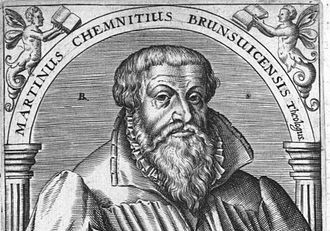
The following is my translation of Chemnitz’s homily for the First Sunday after Trinity on Luke 16:19–31 as found in his Postilla (Vol. II, pg. 280–87). Square brackets indicate my notes and additions. I have broken up some of the longer sentences and paragraphs for the sake of readability in English.
Explanation of the Gospel
Beloved in Christ the Lord,
Whoever wanted to demonstrate high art in this Gospel and had excessively inquisitive hearers (fürwitzige Zuhörer) whose ears itched for high questions, he would here have a good opportunity and reason to speak and to dispute subtly of such things which he himself would not understand and by which the hearers also would be bettered little, namely: what is the bosom of Abraham in which Lazarus is comforted, where it is to be found, and how Lazarus can be in the the bosom of Abraham, and how he can have a finger even though his body has not yet been raised to the joy of eternal life; likewise, what and where the place is where the rich man is tormented because he is not yet in the true hell (der rechten Hell) to which he will only come to on the Last Day, what the tongue is which he would gladly let him touch, what also the eyes are with which he saw Lazarus from afar even though his body is also not yet in the true condemnation (die rechten Verdammniß), but rather lies buried in the earth, also what is the chasm which is fixed between the two places. However Paul says in the first letter to the Corinthians in the fourteenth chapter that he would rather speak five words in the common [tongue] with his understanding in order that he might also instruct others rather than otherwise speak ten thousand words in tongues by which no one would be improved (1 Corinthians 14:19). Thus St. Paul elsewhere wills that one ought to arrange all things in the Church of God for edification and improvement [1 Corinthians 14:26, 40].
Homily Outline
Thus we also have here an explanation from the Lord Christ of a high difficult question, not that we might repent of our excessive inquisitiveness (Fürwitz), but that we may make use of it for edification (Erbauung), for warning (zur Warnung), and for comfort (Trost); and from this, the following three points are set forth in this text:
First, what sort of state or condition there is with the souls of the deceased righteous men and the godless [i.e., intermediate states].
Second, how we may can make use of this Gospel profitably for warning and comfort, both in prosperity and while under the cross (beid im Glück und im Creutz).
Third, why it is that the rich man is condemned and the poor man is saved, so that we may not err from the right way here along with the rich man, but rather may finally be comforted with Lazarus.
Concerning the First Point: [Intermediate States]
Thus, the first doctrine here in the Gospel concerns the state (Zustandt) of the blessed and the damned soul after a person’s death until the Last Day. For you know that on the Last Day, all the bodies of the dead will rise again and entire great crowd of all men will be divided from one another into two parts, some to the right hand of the Lord Christ, and some to the left hand. Those who are placed at the right hand will be directed to eternal life, but the godless at the left hand [will be directed] into eternal hellish fire (Matthew 25[:31–46]). But the question arises, how does it go now and how will it go when someone has died until the Final Judgment? The body is laid in the earth as we see and know before our eyes, but where does the soul remain? And such is not an unnecessary question, for the right answer to it has foundation in God’s Word and is useful for our betterment (Besserung). Now this is an old error of the Greeks which is also being stirred up again in our time, as though the soul of man, after his death, should sleep and neither understand, nor know, nor feel anything [i.e., “soul sleep”]. But Christ speaks here of a damned soul and of a blessed soul and He distinguishes between the godless rich man and the poor God-blessed Lazarus, as He will on the Last Day, and He says that after the death of pious Lazarus, his soul was carried by the angels into Abraham’s bosom [Luke 16:22], which is not yet the true place (der rechte Ort) of the perfect joy in eternal life, which Lazarus, along with all the elect, shall only fully come to on the Last Day. Likewise, He says that the soul of the rich man came to the place of torment (den Ort der Qual) [Luke 16:23], which is also called hell here [i.e., “Hades,” ᾅδῃ], and yet it is not yet the deepest hell (die tieffte Hell) into which the body and soul of the rich man shall only be cast into at the Final Judgment (Matthew 25[:46]).
Now the Lord Christ says that Lazarus followed in the footsteps of his father Abraham and had believed in the promise made to Abraham [cf. Romans 4], but in great misery, so that no one could have thought that God should know him or that any angel should take care of him, for he lay there before the rich man’s door despised and full of sores. And yet, the Scripture says that God has commanded His angels concerning him that they ought to bear him up in their hands (Psalm 91[:11–12]). When he dies, the little angels carry his soul into Abraham’s bosom, not as though it were so heavy, but rather Christ had wanted to demonstrate by this what a precious treasure the souls of the righteous are to God and how certain and true the comfort from the Psalm is that the holy little angels have been commanded to diligently watch over such a soul and to bear it up in their hands immediately. So then, his soul is thus carried into Abraham’s bosom, which the Ancients rightly explained in this way, as when a mother has been away for a long time and finally comes once again to the house and the little children run to her with joy and fall into her bosom and the mother joyfully receives them to herself and hugs them and kisses them.
I could not locate a source for this allusion.
In this way, Abraham is called the father of all believers, as is said in Romans 4. To him comes Lazarus, and he is gladly received by him into his bosom and is comforted, and yet, he is not yet at the true place of salvation (den rechten Ort der Seligkeit), but rather, as the Revelation of John says, they are gathered under the altar, where they rest and are comforted, clothed in white garments, as a sign and pledge of the consolation which will surely follow (Revelation 6[:9–11]). And because the joy is already so great, and yet it is not yet the true, eternal, perfect joy (der rechte ewige vollkommene Freud) which will only begin on the Last Day, thus Lazarus had to comfort himself with this further, that such future joy will also be all the more momentous and glorious. Beyond this, it makes this his joy even greater, that he sees the rich man sitting in the flames and in the torment, and then he thinks, “Thanks and praise be to God! For You have graciously preserved me so that I did not come to the place of torment, but rather here, where I am comforted, and still have this before me, that it will soon be even better with me.” And finally, this also makes him greatly rejoice, that he hears the chasm (die Klufft) is firmly fixed and he need not worry that he will be deprived again of such joy in eternity; as it sadly goes here in the world where we are poor sinners and we find ourselves daily in worry and danger with regard to the joy of eternal life because of our sin. in addition to this, it often happens that one rightly and piously begins in his Christianity so that he hopes he will inherit the joy of salvation in Christ, but he does not remain steadfast until the end, but falls away, and thereby is deprived of the joy. Similarly, even when a joyful moment and a good season comes to Christians in which they rejoice, so nevertheless it does not last long, bur rather, one cross soon follows after the other so that their joy is disturbed and taken away. Such, alas, is how it goes in this life. But there it shall be said, “The chasm is fixed” [Luke 16:26], and the salvation of the righteous is so guarded and assured that they cannot be damned nor come to the place of torment, to the rich man, even if they wanted to go down to him.
On the other hand, what is the state of the soul of the rich godless man after his death until the Last Day? To this the text answers: He is in hell. What is hell? A place of torment. Where then is such a place? Where is the bosom of Abraham? Is the one a place beneath us and the other a place above us? Answer: Where it is, we do not want to dispute, but (as St. Augustine says) we should pray to God that may come to the place where we are refreshed with poor Lazarus and by no means to the place of torment.
I looked at several of Augustine’s sermons, but could not find a quote to this effect.
But here, Christ wants to describe and depict the pain, anguish, and suffering of the damned in this parable for us. For because it is a spiritual torment (Geistliche Qual) which one cannot see with bodily eyes (mit leiblichen Augen), so Christ takes a likeness (or a parable, Gleichnuß) from bodily things so that we who are still living in the flesh can reflect upon the matter a little better, as if someone were lying in the midst of a flame of fire and desired only a single tiny drop of water to touch his tongue and yet it was denied to him. So the rich man also thinks here, “Ah! Could I not have but a little refreshment? Surely, there is not another living soul on earth, however poor he may be, who could not at least obtain a little drop of water with which to quench my thirst! Could not even so much be given to me?” “No,” says Abraham. “You have received your good in your life.” David says in the seventeenth Psalm, “God fills their belly with His good things, thereby they have their portion there” (Psalm 17[:14]). And Jeremiah says in the twelfth chapter, “They are fattened and prepared as sheep for the slaughter-bench” (Jeremiah 12[:3]). This is what is truly dreadful, that afterward, in hell, they ought not receive even a single little drop of water from the exuberant grace and the infinite goodness of God, with which they may moisten their tongue only but a little. And this rich man must also reflect upon this in addition: If the torment is already so great, what then will it be like on the Last Day? Thus, he not only has the present pain, but also this anxiety torments and afflicts him even more: “Ah! What then shall become of me when I shall hear this verdict on the Last Day: ‘Depart from me, you accursed, into the eternal hellish fire’?” (Matthew 25[:41]). Likewise, Peter says in 2 Peter 2[:4, 9] that “if God did not spare the angels… then He also knows how to reserve the unrighteous under punishment for the Day of Judgment to punish them.” Beyond this, he sees Abraham living in joy who also had been rich, but also devout and God-fearing, who had taken in and fed strangers and the poor [cf. Genesis 18:1–8]. He also sees poor Lazarus sitting in joy, whom he had previously not looked upon with a single eye, which makes his torment even greater for him because he sees the joy in others and must go without it entirely and in addition be tormented, just as hunger is more painful to someone and plagues him more when food is set before him that he may see it and yet not enjoy it [Psalm 112:9–10]. There the worm of his own conscience bites and gnaws at him so that he must think, “Ah! This is what you wanted to have! It is your own fault! You did not want to let yourself be warned!” Finally, he must hear with terror, “The chasm is fixed.” But here “a chasm” means a great wide fissure so that no one can cross over at all, as Abraham says, “There is such a chasm between us and you so that no one can come to the other, no one from you can come over to us here.” [Luke 16:26] By this it is given to him to understand that his torment will never cease in eternity nor come to an end and that he will not partake of any joy in eternity, not even in the least. This makes the torment even greater for him still. This is the first point concerning the condition of souls after a man’s death until the Last Day as it pertains to both the righteous and the godless.
This same doctrine is repeated by Chemnitz in his Examination of the Council of Trent, “So far as the middle order, state, or place is concerned [i.e., purgatory]—Scripture makes only two orders or places for human beings after this life: “He who believes and is baptized will be saved; but he who does not believe will be condemned” (Mark 16:16). “He who believes in Him is not condemned; he who does not believe is condemned already,” likewise, “He who believes in the Son has eternal life; he who does not obey the Son shall not see life, but the wrath of God rests upon him” (John 3:18, 36). Thus in Luke 16 only two places are assigned to souls departing from the body prior to the Last Judgment, a place of comfort and a place of torments. And indeed, a chasm is so firmly fixed immediately after death that no one is able to pass over from the place of torments to the place of comfort.” (Vol. III, pg. 312) See also the discussion in Johann Gerhard, On Death (Part One), Theological Commonplaces XXIX/1, § 159, pg. 230ff.
Concerning the Second Point: [Warning and Comfort]
Second, we here have to pay attention to this Gospel how we make may make use of it profitably for warning in prosperity and good days (zur Warnung in Glück und guten Tagen) and for comfort while under the cross and in misery (zum Trostim Creutz und Elendt). For we ought not dispute so meticulously about what is the bosom of Abraham, or the flame, or the place of torment, or the tongue, or the little drop of water. Even if we actually knew all such things, it would still not yet justified. But rather we ought to direct our thoughts as to how we might rightly make use of the narrative.
This happens thus: God distributes His goods here unequally—the one is rich, the other is poor; the one is healthy, the other is sick; the one is blessed, the other is miserable. Now God says that it shall go well for the righteous and evil for the godless, and yet, the opposite is found, as Solomon says in Ecclesiastes that the same happens to both, to the righteous as to the wicked (Ecclesiastes 9[:2]). Indeed, one often sees quite the opposite, that it goes well for the wicked and the pious are laden with the cross and misery, as is demonstrated plainly in this narrative. For there is a pious, God-fearing man whose name is Lazarus, and yet he does not have much good fortune. Indeed, he is poor and (like Job [see Job 2:7]) full of sore and boils so that he cannot work, and there is no one who would even give him the crumbs that he might satisfy himself. He is so despised that only the dogs have regard for him. On the other hand, there is a godless man who has no regard for God, who despises his neighbor and is stingy and unmerciful toward him, and yet he is rich, has good peaceful days, and lives always gloriously and in joy. And when things go contrary to expectation so that the pious are stuck in misfortune, the world mocks them and thinks they have no gracious God nor any help from the Lord (Psalm 3[:2]), yet, on the other hand, when everything happens fortunately for the godless, the world once again thinks that they sit in the bosom of God and there can be no lack for them. Indeed, the God-blessed themselves are often troubled by it also and they take offense at it, as David says, “I had almost let my foot slip.” (Psalm 73[:2]) And Jeremiah says, “Lord, I will not murmur against You; but nevertheless, I must pour out the thoughts of my heart into Your bosom. These are your children, whom you inflict with all misfortune, and on the other hand, you heap up your goods upon the godless—how can this be?” (~Jeremiah 12). And in Malachi and Psalm 73, the righteous complain, “Is it in vain that I wash my hands in innocence?” “It is in vain that one serves God, and what use is there that we keep His commandments?” “We cannot accept it that God acts thus.” (Psalm 73[:13]; Malachi 3[:14]).
But as Psalm 73 says, one must look to the end (sehe das Endt an), for in the end it is evident whom He has struck (Psalm 73[:17ff.]). Lazarus was indeed inflicted for a long time, but, finally, when he died, he was carried by the angels into Abraham’s bosom where he is refreshed in eternity. But where Satan preaches (Matthew 4[:9] and Luke 4[:7]), “Behold, all this I will give you if you fall down and pray to me” and someone thereupon prays to the devil and all is given to him, then the world says, “Oh, these are the blessed people! Happy is the people for whom it thus goes” (Psalm 144:5). However Christ says here, “Look to the end” (Sihe das Endt an), for it did not endure with this glutton. He finally died and came to hell, into the place of eternal torment, and had to hear, “You received your good things in your life” [Luke 16:25]. Let us consider this well, and truly strive after it, not that we may receive our goods here, but rather that the end may be good, so that we do not desire to give ourselves over to vain joy, merriment, and splendor. For when the end comes, then the splendid garments and well-living is then over. Where will we find ourselves then? In hell. Therefore, live in the fear of God (in der Furcht Gottes). If you are stuck under the cross, then be patient and think: “It will someday all come to the end.” Then, you shall be comforted in endless eternity.
Thus, we ought to learn to look to the end (auff das Ende sehen), both in fortune and misfortune. The Law of God says rightly, “It shall go well for the pious, and it shall go ill for the godless.” If such does not happen now in this life, then there is still another life existing where it can happen and will happen abundantly. Therefore, if someone in this life fears God, hears Moses and the prophets, and yet he lives amid a vain cross and opposition so that the lot of Lazarus befalls him, let him not take offense at it, but rather, let him comfort himself with the day the Lord will make when He shall be God’s own possession (Malachi 3[:17–18]). And, on the other hand, if you have fortune and riches, do not hang your heart on it, and do not forget God, for otherwise it will come to a wicked end, as with this rich man, as also Psalm 17, 37, and 73, Jeremiah 12 and [2] Maccabees 3 say. This is the second point: how we ought to make use of this narrative beneficially for warning in prosperity (zur Warnung in Glück) and for comfort under the cross (zum Trost im Creutz).
Concerning the Third Point: [The Way of Salvation]
The third [point] is nevertheless the foremost, [namely,] that we ought to learn wherein the rich man was lacking whereby he was condemned and by what it was made good for Lazarus that he had come into Abraham’s bosom so that we may follow such a right way with Lazarus and, indeed, not also go down to hell with the rich man. So now it stands thus that we ought not think it makes no difference how we live, that even if we die in unrepentance that God would nevertheless be gracious and we could be saved; or, as it was said in the papacy, that one might live a life however he wanted if only money were given for him and indulgence (Ablaß) granted to him, then he must be saved. “No,” says here the father of all believers [i.e., Abraham], “that is lacking.” Thus it is said that in this life we are on the way where we may be helped, but after death we are in the place where “the chasm is fixed” [Luke 16:26]. But here there are two ways. One leads upward to heaven, the other leads downward to hell. There now God steps forth through Moses and the Prophets and speaks to rich and poor. He calls, teaches, and warns, “Follow this path! Beware of that one! Hear Moses and the Prophets, so that you do not come to the place where the rich man is tormented, but rather to the place where Lazarus is refreshed.” Now, when God thus warns and admonishes, do they all follow then? Ah! Alas, no! And from this it is evident why the rich man is condemned. For the fact that he is rich and clothes himself honorably according to his estate (nach seinem Stande) and has a good cheerful little hour and takes delight in it is never the true cause of his condemnation (die rechte Ursach seiner Verdammnuß). After all, Abraham himself was also rich such that he had in his house about 400 men fit for battle [c.f., Genesis 14:14].
What then has condemned this rich man? Answer: This, that he led a godless life and did not hear Moses and the Prophets. How? Did he then know nothing of God or of Moses? Surely, he did. For when Abraham said, “They have Moses and the Prophets,” then he immediately understood what he meant and who they are. And that he calls Abraham “father” has this understanding: He was at his foundation godless and unmerciful, and he misused his temporal goods, and even so he deluded himself in the midst of it that he would not go to to the evil on account of it. Thus he led an external glorious appearance that he had Abraham as his father, or as we say, that he wanted to be regarded as a good Christian (für guten Christen). For he also lived thus that he had stolen from no one, cheated no one, had done some good with his own goods and lived well. In this case, he demonstrated better than the stingy misers who do not have the heart to touch their goods and do something good with them, for which there is punishment from God over them.
If then, he did not perish from this, what then was he lacking? Answer: This, as he himself confesses, “Then they will repent.” From this it follows that He had not repented; he had paid no regard to God, Moses, and the Prophets, even if he heard them externally (eusserlich). From this then followed the evil fruits: that he had the goods of the world and saw his brother suffer poverty and closed his heart to him (1 John 3[:17]); that he paid attention to the lust of the eyes (auff Augen Lust) and had clothed himself in purple beyond his estate (uber seinen Standt), which at that time only the kings wore; and was not cheerful every now and then, but rather had lived every day magnificently and in joys.
Surely, at times, a poor Levite or priest must have come to him and warned him, “Look! Thus says Moses! Thus says the Prophets! Thus you shall live! Thus you shall care for the poor and have compassion for them! Etc.” This he had not paid attention to, he did not believe it, he confesses to it. His brothers also do not believe. He thus let Moses and the Prophets keep calling and he followed his own head and gave himself over only to pleasure (Wollust). And now that he is in torment, he would indeed want that his brothers be warned. But Abraham says, “Ought they not know? After all, they have Moses and the Prophets.” “Yes,” he says, “I had them also, and yet I did not believe. They will not believe them either. Why ought they pay attention to Moses or to a poor Levite? But if someone were to rise from the dead, then they would finally believe.” But Abraham says that the preaching of Moses and the Prophets is the only means (das einige Mittel) through which God wills to be effective, to work faith unto salvation; not that the dead should rise and say how it is going with them, nor that they should preach from Moses and the Prophets, but rather that the servants of God (die Diener Gottes) ought to do it.
Whoever does not heed them, it goes for him as it did the rich man, such the account demonstrates. But we ought not leave this hanging between heaven and earth. Rather, let every rich man examine himself whether he also hears Moses and the Prophets and pays attention to them, or whether he also does too much with clothing and good living and is unmerciful toward his needy neighbor. By doing so, he makes it that the Levite with Moses and the Prophets must fall silent. For where one thus remains unrepentant, there the bitter lament of the ears (Ohrenflawer) finally follows: “Ah! If I had done that! Ah! If I had listened to Moses and the Prophets!” And Christ, who has the keys of hell and death, as it is written in St. John’s Revelation 1[:18], opens here a window into hell for us and shows us the rich man sitting in hell; He stretches with His long arm into hell itself and draws out a burning coal and shows it to us so that we may believe, warning us still of it through Moses, etc. “Yes,” says the rich man here, “I would indeed have believed God Himself, if He had warned me. I do not accuse him of lying, but that Levite was too lowly for me. If someone had risen from the dead, then I would have believed.” “No!” says Abraham, “That is not the means nor the way.” What then ought the rich do if they want to be saved? Read the first epistle to Timothy, “They ought not be proud, nor place their hope in uncertain riches, bur rather in the living God, etc.” (1 Timothy 6[:17–19]).
On the other hand, from what cause is Lazarus saved? How did he do it? Did his poverty or his afflictions save him? No, for it happens often that the poor conduct themselves in their poverty in such a way that they go do to the devil along with the rich. Rather, from what was said before it is easy to see, namely, he had heard Moses and the Prophets, thus that He had repented, acknowledged his sin and the wrath of God, and feared it, believed in the blessed Seed of Abraham [i.e., Christ], was reconciled to God, lived in a Christian manner, and when the cross and poverty befell him, he bore it with patience, and even though nothing came to him from the rich man’s door, he did not grumble, but was content even when a kindness happened to him from the dogs. Now when he dies, God shortens his cross and brings him to rest. As Dr. Martin Luther says on the first book of Moses [i.e., Genesis], we are much more blessed than the Fathers before the Flood, who had lived so long and bore their cross and burdens so long, whereas we, like Lazarus, are delivered from them soon and in but a few years. Therefore, be patient in such hope, remain in faith and true repentance, and do not grumble. It will be that your misery and sadness will soon be transformed into eternal joy.
The closest Luther quote I could find from the Genesis Lectures was the following: “Consequently, our temptations, crosses, and vexations are nothing in comparison with the temptations, crosses, and vexations of the fathers. Even though we, too, observe monstrous evils in the world, we do not observe them for long and for this reason are more fortunate; for we leave such a wicked generation more quickly. Noah observed his degraded grandsons for three hundred and fifty years, and how much misery do you suppose he experienced during this time? In respect to this share of misfortune Noah is surpassed by his godly son Shem, who lived for five hundred years after the Flood. Oh, what martyrs! All the generations of men should thoughtfully consider them and learn patience from their example. St. Peter declares about righteous Lot that his soul was distressed when he beheld the ungodly actions of the Sodomites (2 Peter 2:7). Simeon states about Mary that a sword would pierce through her soul (Luke 2:35). The saints cannot behold the wickedness of the world without intense grief. But these crosses of later generations are nothing in comparison with those of the holy fathers, who were compelled to behold the great perversity of the world for five hundred years and more. Therefore let us, too, patiently bear these sad sights and the darts of Satan (Eph. 6:16), which he drives into our hearts; for we should not expect our situation to be better than that of the holy fathers, although, as I have said, it is better in this respect that we have a shorter span of life.” (AE 2:216–17)
Thus is this parable (diß Gleichnuß) directed toward this necessary reminder: Because after this departure “the chasm is fixed” in such a way that one cannot come from one side to the other, and yet the way is still here that one may come to the place of rest and refreshment, therefore let each person strive after it and conduct himself in such a way that he indeed finds the right way (die rechten Weg) and learn from the account of the rich man and the poor Lazarus how the rich man could have found such a way so that he may guard himself against it and not follow after the rich man. Or, if he is also a poor Lazarus, how he ought then conduct himself so that he may come into the bosom of Abraham with poor Lazarus and be comforted.
To this end, may God the Father help us through the power of His Holy Spirit for the sake of His beloved Son, our Lord and Savior Jesus Christ. Amen.



 PATTERN OF SOUND WORDS