
The following is my translation of Martin Chemnitz’s homily outline for the Fifth Sunday after Trinity (Postilla, Vol. II, pg. 237). Chemnitz’s Gospel text is Luke 5:1–11. Square brackets indicate my own notes and additions. Curly brackets indicate marginal notes in the text. I have also broken up some of the longer paragraphs for the sake of readability.
Explanation of the Gospel
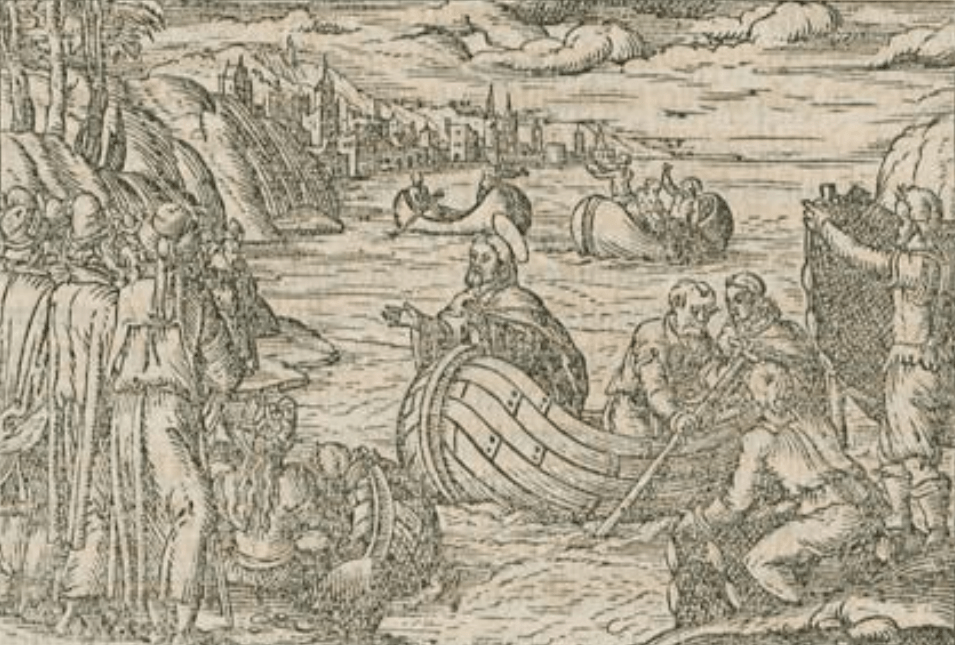
God the heavenly Father, who in Matthew 20 is liked by the Lord Christ to a house-father (Haußvater; [οἰκοδεσπότης]) calls and admonishes all His children and servants within His great household, that is, all men, that they should gladly and diligently hear the Word of God before everything else; and that they should continually exercise themselves in godliness (Gottseligkeit), and thereafter, diligently and faithfully attend to their work and promises them, in addition, that if they show themselves as His dear children and faithful servants, then He will give and bestow them a fitting livelihood in this world. And this Gospel shows that both of these points can very well stand next to one another, and indeed always ought to, namely, that [1] one serves God and then [2] attends to his work with diligence. For the four men who mentioned here were not godless fishermen, but rather when John the Baptist began to teach and to preach, these were the first who had received his sermon and followed it. Thereafter, when John saw Christ coming toward him and said, “Behold, this is the Lamb of God, who bears the sin of the world” (John 1:29, 36), Andrew reported it to his brother and said, “We have found the Messiah, for whom so long a time we have longed for” (John 1:41), and thus they followed him and when they had listened to Him for a long time, they returned again to their vocation (Beruf), for they had not yet been called (berufen) to the apostolic office (Apostelamt). But now when the Lord is preaching at the Sea of Gennesaret, they come to Him again, and after the sermon has been delivered, He commands them to work and says, “Now, at this very moment, launch out into the deep and cast out your nets” (Luke 5:4).
{Idleness has not been commanded by God.}
From this it is then to be seen that our Lord God by no means wants that a Christian man should entirely renounce all other earthly work so that he desire to undertake or do nothing other than perhaps singing in the church, etc. as was taught in the papacy and asserted that one may otherwise profane the spiritual estate and orders [i.e., monasteries]. Precisely for this reason, in John 6, when very many people were following after Him had the opinion that they would not need to work with Him and yet could have their sustenance, the Lord Christ did not consent that they should make him king, but rather left each one in his vocation (Beruff).
Even so it is portrayed here for us that a Christian ought to hold both together; he ought to gladly occupy himself with God’s Word persist in prayer for God’s blessing, and thereafter in order that he may also acquire daily bread it is said to him, “Go to work!,” as David also points in Psalm 128:2, “You shall feed yourself the work of your hand.” Thus, one must not tear apart or separate that which God the Lord wants to be carried on next to one another in His household, that is, that one must uphold and keep both the Seventh Commandment, in which work is included and commanded, as well as the Third Commandment concerning the Holy Day and the Divine Service (Gottesdienst). Peter must not only catch fish, but he must also learn Christ’s preaching, the Word of God, so that through the Word his toil and work may be sanctified and be blessed.
Chemnitz is alluding to Martin Luther’s explanation of the Third Commandment in the Large Catechism, § 91ff.
Thus, under the Seventh Commandment, our work can continually remind us of the Third Commandment, that we were not only created for work in this toilsome life, but rather, that we should bring to mind the gracious will of God and in the midst of our work comfort ourselves with the coming eternal joy, when after all our toil and work we come to rest and celebrate the eternal Sabbath, and thus shall have life and full satisfaction (John 10[:10]).
{Example}
Now this is often presented to his here and there in Holy Scripture with glorious sayings, but in today’s Gospel, it is presented to us with a beautiful living example. Peter, John, James, and Andrew had previously been with John in the wilderness and listened to him; thereafter, they also come to the Lord Christ, indeed, in this Gospel they hear His sermon. Now when they have heard the Word of God and the sermon is over, the Lord Christ says to them, “Go now back to work, make a cast,” and He Himself gives an instruction and command that they ought to again apply themselves in their vocation and usual work so that the Seventh and the Third Commandments thus be carried out alongside one another.
{Practice of this Doctrine}
Yet, one ought to carry this out, especially with respect to the Third Commandment, so that it not made only into an Opus Operatum, and one would think if only the work itself had been performed and churchgoing had taken place that it would then be enough even if one would never think of it even once afterward. Rather, one ought to undertake it as David says in the 119th Psalm, “Lord, Your statutes, or Your Word, are my counselors” (Psalm 119:24), that is, “everything that I hear and learn from Your Word, I use it thereafter in all my doing and refraining (thun und lassen), and Your glorious sayings, they are my closest advisors.”
{Christian Usage with Prayer for the Blessing of God}
Therefore, in former times it was customary in the Christian Church that one gathered together in the morning and called upon God so that He would give His blessing upon the work of the day. Likewise, in the evening, one gave thanks publicly to dear God for His protection. This is still also practiced among us, when, among other things, the ringing of the prayer bell at certain hours encourages people, even in the midst of work, to the fear of God and Christian prayer so that you begin and end your work with God’s Word, just as this account shows that after the sermon was heard the Lord said to Peter to cast out the net, and then, when the work was done, that they followed after Christ.
{Luther}
And this is described so simply and beautifully especially for this reason, so that, as Luther says elsewhere in his explanation of the Gospel in Matthew 8, that when the sea restless, then we ought to learn to say this proverb: “Christ is with me in the ship.” So you also ought to learn this proverb here, “Well then, Christ is with me in my ship, it is He who bids me to work when I have heard the sermon.” Just as He Himself first preached to this people and thereafter said to Peter that He ought to go out and catch fish, by this He reminds others that each one ought to return back to his vocation (Beruff).
See Luther’s homily for the Fourth Sunday after Epiphany, AE 76:287.
Homily Outline
This is the summary of this Gospel that herein this chief doctrine (Häuptlehr) is dealt with: how one ought to exercise oneself in the fear of God and in work. We now want to summarize the doctrine of this Gospel in these following points:
- How we ought to hear God’s Word dutifully and readily before all things.
- How we therefore ought to work according to God’s command.
- If perhaps the promised blessing of God does not follow from the work, how we ought to then conduct ourselves.
- When our Lord God gives His blessing so that your net encloses a great multitude, how you ought to use it with humility and thankfulness; or if your net obtains a tear in such great fortune and the ship wants to sink, how you then ought to conduct yourself.
- Finally, when Christ says, “Follow Me,” how one ought to forsake everything and follow Him as the One who catches us out of this world with the net of His Holy Gospel and receives us to Himself into His eternal kingdom.
Thus, you can make a house postil (Haußpostill) for yourself from this account, and apply this doctrine in Christian usage.
 PATTERN OF SOUND WORDS