Tag: Easter

  • Chemnitz’s Homily Outline for the Sixth Sunday after Easter (Dominica Exaudi)

    Chemnitz’s Homily Outline for the Sixth Sunday after Easter (Dominica Exaudi)

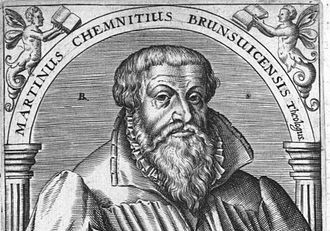
    The following is my translation of Martin Chemnitz’s Homily Outline for the Sixth Sunday after Easter (Dominica Exaudi) as found in his Postilla (Vol. II, pg. 210–11). Chemnitz’s Gospel reading is John 15:26–16:4. Square brackets indicate my own personal notes or additions.
    Chemnitz’s Homily Outline

    So that we may grasp something useful from this sermon, we want to divide this sermon into three points:

    1. First, we want to hear what is the correct Church and Congregation of God (die rechte Kirch und Gemeine Gottes), and how one can know this, namely, since the Spirit of truth testifies of Christ through the Word, in which the apostles have testified and preached concerning Christ [John 15:26–27]; where the testimony is now carried out, there is the Church of God and the congregation in which the Holy Spirit portions out the common goods which belong to all Christians (Wo das Zeugnuß nun geführet wirdt, da ist die Kirche Gottes, und die Gemeine, in welcher der heilige Geist die gemeinen Güter, darzu alle christen gehören, austheilet). Therefore, everyone ought to see to it that he is in incorporated (eingeleibt) into the Church and congregation and be found in it so that he may have these goods with which to comfort [himself] and to delight [in], [the goods] to which only Christians to have access.
    2. Second, Christ sets forth against this that it will not remain [the case] that this His Church and congregation will be in the world and that this testimony of the Holy Spirit of Christ will be carried out [without contest], but rather that the prince of this world will also have his congregation, to which he will send his own false apostles, who will not carry out the testimony of Christ, thereby leading the people away from Christ to eternal damnation, but instead will preach and proclaim the false and deception doctrine of the devil. Therefore, everyone ought to very much be on guard and watch himself so that he may not fall into that assembly (Versammlung); for those who are found therein will finally receive an evil ward (ein bösen Lohn) and will be judged along with their lord [i.e., the devil] to whom they confess themselves, and will be eternally condemned. Therefore, everyone ought to have a good foundation for his faith, so that he cannot be easily led astray.
    3. Third, this is something especially treated on this Sunday and is the chief doctrine (Häuptlehr) of today’s Gospel, of which we are reminded and ought to well mark, [namely,] that it will not only remain the case that the two kinds of churches and opposing doctrines will be carried out in the world, that the one will promote and defend this and the other will promote and defend [the contrary], and that each will hold to his own settled opinion (gefasseten Meinung); but rather, from this it will also follow that the wicked enemy and spirit of lies (Lügengeist) will set himself with all zeal and violence against those who carry out the testimony of the truth of Christ, and who remain steadfast and persist in the pure doctrine (der reinen Lehre), and hold onto it with zeal, and Satan will incite against these not only the godless and unbelieving people, but also those who want to be seen as the holiest and most eminent in the Kingdom of God and the Church of Christ, that they will oppose Christians with burning and murder (Brennen und Morden), which not everyone can endure so easily. Therefore, we ought to pray and petition that God would preserve us against such violence, give us heart and courage, so that we do not despair, nor allow ourselves to be terrified, but rather to remain steadfast in the right doctrine (der rechten Lehr), even if we ought to risk body and goods, honor and blood for its sake, and trust God who can protect us as long as He wills, and if we indeed ought to suffer on account of it, fall into danger and harm, that He wants to and can richly restore to us all things we have suffered (Allen den Schaden) in His own time.

    On these three points we want to direct what is to be dealt with in this Gospel in this Sermon. The Spirit of truth grant that we through His grace and power rightly learn and make use of it.
  • Chemnitz’s Homily Outline for the Ascension of Our Lord (Himmelfahrts Tage)

    Chemnitz’s Homily Outline for the Ascension of Our Lord (Himmelfahrts Tage)

    The following is my translation of Martin Chemnitz’s Homily Outline for the Ascension of Our Lord (Himmelfahrts Tage deß Herrn) as found in his Postilla (Vol. II, pg. 193). Chemnitz uses a composite text that includes Matthew 28:16–20, Mark 16:15–20, Luke 24:50–53, Acts 1:4–14, and 1 Corinthians 15:3–8. Square brackets indicate my own personal notes or additions.

    Chemnitz’s Homily Outline

    In order that such may be done all the better by us through God’s grace, so we want to direct this sermon in a simple way and thus grasp thus:

    1. First, that we take not of the accounts, how they have been described thus far by the evangelists and apostles, what the Lord had done during the forty days which He spend with His disciples after His resurrection before He ascended into heaven in a bodily manner (leiblich Weise), how He finally carried out the ascension on the fortieth day and had allowed it to be seen by His apostles and disciples, insofar as that He lifted His feet into the air from the Mount of Olives and thus ascended even higher until a cloud came and had placed itself between the sight of the apostles and the body of Christ and which shortly thereafter led Him to heaven. This shall be the first part.
    2. Second, we want to further search out from other places in Scripture how the holy fathers and prophets, in the Spirit, had looked through the clouds, and had become aware of this most-Christian and most powerful triumph which the Lord Christ has held in the air and in heaven at His ascension, the like of which has happened to no other potentate on earth; which thereafter also the Holy Spirit, when He was given to the apostles, had properly showed and revealed to them. Therefore, they have spoken and written so gloriously and powerfully about [Christs’s ascension] as the prophets in the Old Testament, that even Paul in his sermon, which He gives in Ephesians 4[:8] on this article [of the ascension], expressly refers to David and has taken from Psalm 68[:18] the words used and introduced concerning the ascension of Christ, so that one can see from it the unanimity of this doctrine among the saints (die Einhelligkeit dieser Lehr bei den Heiligen) in the Old and New Testaments.
    3. Third, how thereafter God the heavenly Father had further received His beloved Son into heaven, and set Him with great solemnity and glory upon the thrown of majesty (den Stul der Maiestät) and has given Him, according to His human nature (nach seiner menschlichen Natur), inexpressible majesty and glory. There, He is also preparing our place for us, that we, in His time, shall come to Him and be with Him in eternal joy and glory also, as He Himself is; and there He now intercedes (vertritt) for us with His heavenly Father, governs (regiert) and protects (beschützet) us on earth, preserves (erhält) us, and provides (versorget) for all our needs of body and soul.
    4. Fourth, how we ought to rightly make use of this doctrine of such a glorious ascension of Christ, so that we also can grasp from it enduring comfort and joy in our hearts.

    To these four points Your Grace (E. L.; an abbreviation for Eure Liebden) should now give attention and mark them in this sermon, and thus rightly learn to rightly understand this high article as it is set forth in Scripture according to such instruction; then, without doubt, the Holy Spirit will be present it it so that we can also understand the use of this doctrine and comfort which is contained herein.

  • Chemnitz’s Homily Outline for Fifth Sunday after Easter (Dominica Rogationum, Vocem Jucunditatis)

    Chemnitz’s Homily Outline for Fifth Sunday after Easter (Dominica Rogationum, Vocem Jucunditatis)

    The following is my translation of Martin Chemnitz’s Homily Outline for the Fifth Sunday after Easter (Dominica Rogationum, or, Vocem Jucunditatis) as found in his Postilla (Vol. II, pg. 176). Chemnitz’s gospel text is John 16:23b–33 (beginning from “Amen, Amen…” or “Most assuredly…”). Square brackets indicate my own personal notes or additions.

    Chemnitz’s Homily Outline for Rogate

    “Now in order that a pious Christian cannot falsely use (fälschen) this doctrine, so we want to divide it thus:

    1. First, we want to remember how much depends on it, that on prays and performs this divine service (Gottesdienst) with all diligence, and how therefore dear prayer has been in use and has remained in constant practice among all the saints and children of God at all times [e.g., Acts 2:42; Ephesians 6:18; Colossians 4:2; 1 Thessalonians 5:16–18].
    2. Second, that there is a great distinction in prayer, that not ever prayer is pleasing and acceptable to God [e.g., Isaiah 1:15]; how one therefore thus ought to take care that, above all things, he removes from the way everything that defiles and corrupts a prayer so that it does not become displeasing and abominable before God [e.g., Psalm 66:18; James 4:3].
    3. Third, then what all belongs to right prayer (rechten Gebett); how it must be directed on certain grounds, and to what the heart ought to look when one wants to pray so that God can be at peace with our prayer and may hear it and accept it, that we may thereby obtain that which we seek from God through it. Namely, that we first call upon the correct true God (den rechten wahren Gott) who is God the Father, Son, and Holy Spirit [Matthew 28:19]. Thereafter, how we ought to pay attention the causes (die Ursachen), which ought to move us to prayer, such as God’s will and command (Gottes will und Befehl) [1 John 5:14], our great present need (unsere fürstehende hohe Nicht) [e.g., Psalm 50:15], and the dear God’s kind promise and pledge (Verheissung und Zusage) that He will surely hear our prayer [e.g., Matthew 7:7; John 16:23–24].
    4. Lastly, how we ought to bring all of this together and into Christian use; how the heart ought to learn to exercise itself through prayer before God; how we ought to seek the eternal good (das ewig Gut) from God with full confidence and faith, and with what condition we ought to pray for daily bread and temporal need (tägliche Bordt und zeitliche Notturft).

    We want to handle these points briefly and simply in this sermon. May the dear God indeed grant that it may produce much fruit in us so that we may accustom ourselves and be diligent (uns gewehnen und befleissigen) to pray willingly, often, and with devotion (gern, oft, und mit Andacht).”

  • Chemnitz’s Homily Outline for the Fourth Sunday after Easter (Dominica Cantate)

    Chemnitz’s Homily Outline for the Fourth Sunday after Easter (Dominica Cantate)

    The following is my translation of Martin Chemnitz’s homily outline for the Third Sunday after Easter (Dominica Cantate) as found in his Postilla (Vol. II, pgs. 161–62). Chemnitz’s text is John 16:5–15. Square brackets indicate my own personal notes.

    Chemnitz’s Homily Outline:

    Now because this text seems to be a dark text which not everyone can easily grasp and understand, so we will deal with the doctrine briefly and simply which is prescribed to us herein:

    1. First, we will hear how in the Gospel Christ shows us that we ought to properly know what He has for a kingdom, and how He leads it, also what goods and jewels He distributes to us in His kingdom so that we do not imagine as if we chiefly ought to expect temporal prosperity, joy and pleasure in the kingdom of Christ, but rather that we turn away from our thoughts and know that Christ’s kingdom is a heavenly kingdom [John 18:36] and that He gives and distributes to us the eternal goods, so that we do not therefore set ourselves on things temporal (Zeitliche), but rather on things eternal (Ewige) [Colossians 3:2]; and how we ought to have our greatest pleasure and joy in this when we hear these this and concern ourselves with it, and thereafter strive that we might become partakers of these goods; but how naive and foolish we are that we do not particularly concern ourselves with it, but rather become sad over it when our fortune and wellbeing do not immediately begin in this life, which the Lord here rebukes in us.
    2. Second, it is also brought to our remembrance how the Son of God deals with us when He wants to bring us into the fellowship (Gemeinschafft) of His kingdom, that for this He uses the Preaching Office (Predigampt) through which the Holy Spirit is effective and works in us so that we also come into the kingdom of God and may become partakers of the goods which He has acquired for us, and how the Holy Spirit deals with us in this, namely that He teaches (lehret) us the right way through one comes into the kingdom of Christ, and if we fall short of the right way, that He at that point rebukes us (straffen) and teaches us to know our sin and our unbelief and that we lack the righteousness that is acceptable to God and that we do not trust in God from the heart, but rather that we fear the devil and the world more than we fear God; but when we recognize our lack and failure, then at that point He further comforts (trösten) us so that we do not despair on account of our sins, nor that we become distressed too much while under the cross.
    3. Third, what benefit it is for us that the Holy Spirit thus carries out His office (Ampt) by manner of teaching, by manner of rebuking, and by manner of comforting (Lehrweise, Straffweise, und Trostweise), namely that He leads us thereby into all truth, to the righteousness that is acceptable before God, and that He comes to help us in our weakness, comforts us while under the cross, and points us to the hope of the future eternal salvation.
  • Chemnitz’s Homily Outline for the Third Sunday after Easter (Jubilate)

    Chemnitz’s Homily Outline for the Third Sunday after Easter (Jubilate)

    The following is my translation of Martin Chemnitz’s homily outline for the Third Sunday after Easter (Dominica Jubilate) as found in his Postilla (Vol. II, pgs. 143). Chemnitz’s text is John 16:16–23a (ending with the phrase “On that day, you will ask me nothing”). Square brackets indicate my own personal notes.

    Chemnitz’s Homily Outline

    In order that we may take away something useful from this text, that we can make use of it for doctrine (Lehr), remembrance (Erinnerung), warning (Warnung), and comfort (Trost), so we want to parse this sermon in these two parts:

    1. First, how the Lord Christ in today’s Gospel says to His disciples and to all Christians literally and clearly that they ought to know that if they want to be children of God, the cross will by no means stay away, but rather it will certainly come upon them [e.g., Matthew 16:24; Acts 14:22]; therefore, one must learn this beforehand, while he is still outside of the cross, so that he may all the better prepare and gird himself to bear the cross with patience when it comes; and how we ought to rightly understanding the doctrine of the cross (die lehr von Creutz), how one ought to vies the cross, how one ought to judge it from God’s Word and not according to reason (Vernunfft), and how each one ought to bear his own cross, as God has laid it upon him, and be content with it, not looking to others to see whether or not it is lighter or heavier for them than for us [e.g. Galatians 6:4–5].
    2. Second, we want to hear what the Son of God has set before us in today’s Gospel for a beautiful and glorious comfort (ein schönen, herrlichen Trost) [John 16:20, 22], which we are to seek amid the cross (im Creutz) and by which we ought to sustain ourselves so that we do not become faint-hearted (or, discouraged, kleinmütig) and despair, but learn to remain still before God in patience and by God’s grace endure what God has sent upon us. For first, we know that it is God Himself who distributes this cross among His beloved children, that it comes from Him and from no other, that it is His desire (sein Lust) to hide His face from us at times [cf. Isaiah 54:8]. And second, [we know] that God does not act from a wrathful disposition (zornigen Gemüt), but rather from a Fatherly heart (vätterlichen Hertzen), that it may turn out for our best [Romans 8:28]. Furthermore, He says that it is only a small thing to do, that it is only a transitory thing (ein Ubergang), that it will not last forever, but only is as a moment (literally, “blink of an eye,” ein Augenblick) [cf. 2 Corinthians 4:16–18]. And lastly, that we ought to take comfort ourselves that all our sorrow and misery shall one day come to a good and desired end (zum guten und gewündschten Ende), when, after this life, we shall partake in eternal blessedness instead of the temporal cross.

    We will [now] deal with both parts of the text of today’s Gospel. May the dear God grant us all His Holy Spirit so that we may usefully grasp this reminder, doctrine, and comfort (Erinnerung, Lehr, und Trost) and make use of it in a Christian manner, and thus also learn to keep still before God and accept all things as love, whatever God will lay upon us according to His Fatherly will. [Amen]

  • Chemnitz’s Homily Outline for the Second Sunday after Easter (Dominica Misericordiae Domini)

    Chemnitz’s Homily Outline for the Second Sunday after Easter (Dominica Misericordiae Domini)

    The following is my translation of Martin Chemnitz’s homily outline for the Second Sunday after Easter (Dominica Misericordiae Domini) as found in his Postilla (Vol. II, pgs. 117–18). Chemnitz’s text is John 10:11–16, 26–30. As far as I know, the last few verses are not normally included in the reading for this Sunday and this may be unique to Chemnitz. Square brackets indicate my own personal notes.

    Chemnitz’s Homily Outline

    “In order that we may now deal with this doctrine so that we may grasp and retain something useful from it, we will deal with aforementioned text of today’s Gospel this time in four parts:

    1. First, we will hear how this Gospel speaks of the single Good Shepherd of whom the sheep are His own, who therefore takes care of them with such faithfulness that He lays down His life for them rather than allowing them to fall prey to the hellish wolf, and how herein the entire office (Ampt) of our beloved Lord and Savior Jesus Christ is described and grasped, and how we ought to learn to know and consider from this the faithfulness and and great love of the Lord Christ.
    2. Second, when we know this, that Christ is the only Good Shepherd, who has acquired and merited salvation for us, His little sheep (Schäflein), granting it also to us all together that we may become partakers together of these goods, therefore, He ordains (verordnet) in His stead (an seine Stat) other faithful pastors (Hirten) and caretakers of souls (Seelsorger), to whom he commits and entrusts His little sheep [see Ephesians 4:11ff.]; how they ought to conduct themselves in their office (Ampt), that they be found faithful and neither neglect nor lead astray the little sheep from the Lord Christ; and how they ought to lead and carry out their office with great diligence, that they remember that the time will come when they must give an account [Hebrews 13:17] to the Chief Shepherd (Ertzhirten) [1 Peter 5:4] on that day as to how they have carried out their office, and thus, how they ought to expect either reward or punishment according to what they have done.
    3. Third, how the devil also sends his apostles so that he may also enlarge his kingdom and draw away the little sheep of Christ to himself and snatch them, strangle them, and devour them. In order to do this, he makes use of false teachers, who with their lies and errors lead the people away from the pure doctrine onto an erring path and seduce them through scandalous examples so that they all turn aside from God’s ways and fall prey to the hellish wolf. Or when He cannot accomplish anything through such wolves in a place, then he makes use of the hirelings, who indeed conduct the teaching (Lehre) rightly, but do not make right use of the Keys of the Kingdom of Heaven1 [by] not rebuking false doctrine, not warning their little sheep of [false doctrine], not speaking to anyone concerning their sins, but rather they are concerned only that in their office they may have everyone’s favor and enjoy great benefit and pleasure from their hearers; how one ought to learn to recognize such wolves and hirelings so that he can guard himself and beware of them, because there is great danger and concern in this that such people deprive us of our salvation and blessedness.
    4. Fourth, concerning the little sheep, how thy ought to conduct themselves, how about all they ought to hold fast to their Shepherd, the Lord Christ, hear His voice, and follow Him, how they ought to listen to the preachers which Christ has ordained (geordnet) in His place (an seine Stat) and given to them, how they ought not to despise them, but rather to accept their teaching, how they ought to guard and beware of wolves and hirelings so that they are not led astray by them and thus delivered into the jaws of the hellish wolf; and what comfort they should have if they are and remain the little sheep of the Lord Christ, how they ought to comfort themselves already at this time that they will be pastured and be cared for with temporal and eternal pasture, that is, that they will have their necessities, and that they will be sustained through the saving nourishment of the divine Word and the most worthy Sacraments to eternal life, and thereafter, in the world to come, that they will have fullness and satisfaction.

    We will now deal with these four parts briefly. May the beloved God be richly among us with His Holy Spirit, grace, and blessing, and grant that we may rightly receive this teaching (Lehre) and heartfelt warning (Vermahnung) from our faithful Shepherd as obedient little sheep, and make Christian use of it. Amen.”

    Footnotes:

    1. See Chemnitz’s previous homily outline for the First Sunday after Easter (Dominica Quasimodogeniti). ↩︎
  • Chemnitz’s Homily Outline for the First Sunday after Easter (Dominica Quasimodogeniti)

    Chemnitz’s Homily Outline for the First Sunday after Easter (Dominica Quasimodogeniti)

    The following is my translation of Martin Chemnitz’s homily outline for the First Sunday after Easter (Dominica Quasimodogeniti) found in his Postilla (Vol. II, pgs. 89–90). Chemnitz’s text is John 20:19–31. Square brackets indicate my own personal notes.

    Chemnitz’s Homily Outline

    “Now in order that we may handle this doctrine in a useful manner, so we will set it forth in these points:

    1. First, here is described, because the Lord Christ had previously declared that He had to suffer and die and rise again, in order that He institute the preaching office (Predigamt) on earth: How He has instituted the preaching office (Predigamt), and how preachers and hearers ought to thereby be reminded how the preaching office must and ought to be carried out, that thereby everything happens in the name of Christ and in the stead of Christ (in Namen Christi… und an Christi statt), and what He gives to preachers and to hearers as a reminder (Erinnerung) and for doctrine (Lehre).
    2. Second, how the Lord did not only institute the preaching office (Predigampt) in general (ins gemein), but rather directed it that it ought to be carried out that it be (seien) the keys of the kingdom of heaven, by which the unrepentant are to have heaven closed to them and the repentant are to have heaven opened and unlocked to them. And how the preacher ought to carry out and use these keys. Also, what the hearers ought to think of the keys, how they ought to use the loosing key for consolation (Trost), but ought to use the binding key for warning (Warnung), and how they ought not think, ‘Why do I care whether heaven is being barred only by the preacher? What power (Macht) does he have?’ But rather we ought to consider what the Lord says here: that what the preacher does here is valid in heaven with our Lord God and is effective there [John 20:23].1
    3. Third, how no man of high or low station (Standts), ought to presume to hinder God in this order and not allow the preaching office (Predigamt) to take its course both in its teaching office (Lehrampt) as well as in its rebuking office (Straffampt).2 Because God wants to maintain this order (Ordnung), and thereby be efficacious and through this means allow His treasury to be opened so that from it all the treasures of God—which are God’s, which the Son of God has acquired and earned for us through His obedience, suffering, and death—may be brought forth and be distributed among us. And how, the devil therefore sets himself so opposed to this office (Ampt), and especially the rebuking office (Straffampt). Therefore, all Christians, preachers, political authorities, and hearers ought all the more strongly to uphold it, that this office may be carried out unhindered among them.

    We will now deal with these three points briefly in this sermon. To this end, the blessed God give us His Holy Spirit, that we may hear and learn fruitfully.”

    Footnotes:

    1. The reader should remember and consider the Small Catechism’s explanation of the Office of the Keys: “The Office of the Keys is that special authority which Christ has given to His church on earth to forgive the sins of repentant sinners, but to withhold forgiveness from the unrepentant as long as they do not repent.” ↩︎
    2. The rebuking office (Straffampt) is typically dealt with more explicitly on the Fifth Sunday after Easter because of John 16:8, “And when the Paraclete comes, He will convict/rebuke the world of sin, and of righteousness, and of judgment.” See Chemnitz, Postilla, Vol II. pgs. 166ff. See also Johann Gerhard, Theological Commonplaces, Vol. XXVI/2, § 270. ↩︎