The following is my translation of Aegidius Hunnius’s introduction and sermon outline for the Epistle of Quinquagesima (1 Corinthians 13:1–13) from his Postilla (Vol. I, pg. 276–77). Square brackets and footnotes are my own notes and additions.
Explanation of This Text
In [St. Paul’s] epistle to the Galatians we read, “Beloved in Christ the Lord, in Christ Jesus neither circumcision nor uncircumcision counts for anything, but rather faith which is active through love” [Galatians 5:6].1 With this short quote, the Holy Spirit teaches that Christians in the New Testament under Christ’s kingdom are such a free people, who are weighed down neither with circumcision nor other Mosaic laws and ordinances which belonged to the Levitical Divine Service (Gottesdienst), but rather are relieved and freed from all this through Christ; and that nothing further or more is laid upon them other than true faith and unfeigned brotherly love. These two parts hang upon one another in such a way that although faith alone in Jesus Christ justifies and saves, nevertheless, the same [faith], when it is upright is soon busy, effective and active through true love (on the other side, where it does not have to deal with God in man’s justification, but rather with the neighbor). Thus, after the abolition of the Mosaic ordinances, all of Christianity rests upon faith and love as the two chief pillars. It rests upon faith indeed as that which brings the sinner to righteousness before God’s judgment and grasps salvation in Christ Jesus; but it rests upon love as that which heartily loves God the Lord for the received grace of salvation and in common life does good to the neighbor through its praiseworthy works and beautiful fruits.
Since at other times faith is much and often dealt with, we will this time hear from St. Paul’s words concerning love.
First, how [love] is necessary, and how a Christian indeed may not go without it in his walk, life, and being.2 [v. 1–3]
Second, how the Holy Spirit through St. Paul pen depicts love in its nature and characteristics. [v. 4–7]
Third, how the same [love], above many other gifts and virtues remains and endures into eternity. [v. 8–10]
Hunnius’s entire introduction seems to be a reflection of what is said in the Epitome of the Formula of Concord: “We believe, teach, and confess that the contrition that comes before justification, and the good works that follow it, do not belong to the article of justification before God. Yet one is not to imagine a kind of faith that can exist and abide with, and alongside of, a wicked intention to sin and to act against the conscience. But after man has been justified through faith, then a true living faith works by love (Galatians 5:6). Good works always follow justifying faith and are surely found with it—if it is true and living faith [James 2:26]. Faith is never alone, but always has love and hope with it [1 Corinthians 13:13].” (FC Ep III.11) ↩︎
Concerning the necessity of good works (or love), see FC SD IV.7–12. ↩︎
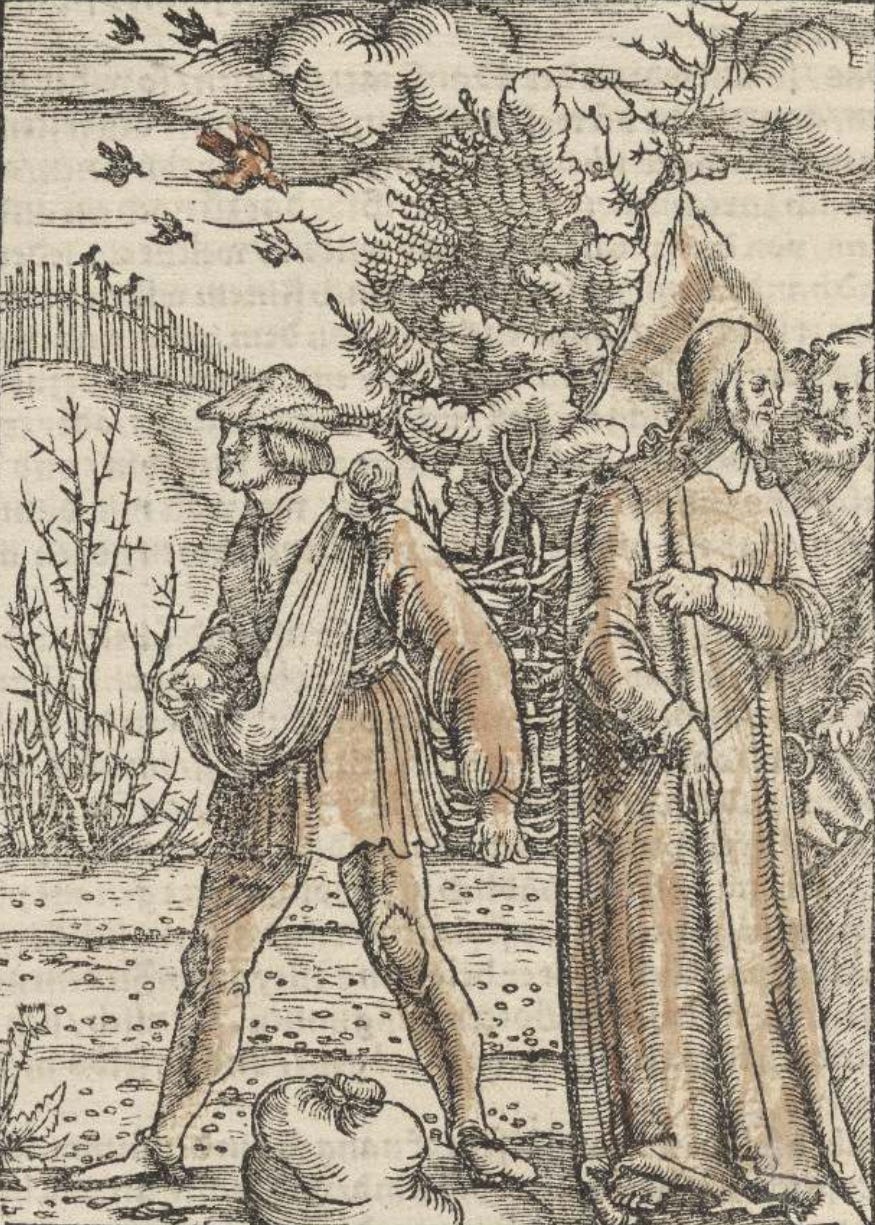
Here is another brief translation of Johannes Brenz’s sermon outline for the Gospel of Sexagesima (Luke 8:4–18) as found in his Postilla (pg. LXIIII).
Artwork found in Brenz’s Postilla (1556), pg. LXIIII
Summary of this Gospel
In this Gospel, we learn:
First, that the doctrine of the Gospel is not the cause of all misfortune and evil, but rather Satan and our sin.
Second, what Christ’s doctrine is, namely, concerning the Kingdom of God.
Third, that our unbelief and malice are a cause that we cannot understand the Gospel.
Fourth, the hearers of the Gospel are dealt with, namely, that there are four kinds.
The first are those who according to the Gospel remain knaves (Buben) as before; and here is taught how these ought to conduct themselves so that they do not perish.
The second are those who receive the Gospel with joy, but as soon an evil wind comes, they have no faith; how these may be preserved is also taught alongside.
The third are those who because of anxiety, sustenance, or the riches of this world cannot grasp the Gospel; how these should act so that they may come to eternal life is also indicated.
The fourth are those who hear the Gospel and keep it, who will be saved.
Fifth, it is also taught how there is no estate higher before God and of more worth than another.
Last, that the Gospel, where it is preached, does not depart without fruit.
The following is my translation of the notes and useful applications for the Old Testament Reading of Sexagesima, Isaiah 55:10–13, as they are found in Das Weimarische Bibelwerk (1877). Square brackets indicate my own notes and additions. For the useful applications, I recommend the reader see this very helpful article by Dr. Benjamin T. G. Mayes.
III. Consolation in the power of the divine Word, what it will work in the repentant. (v. 10–13)
Annotations
10. For just as the rain and the snow fall from heaven and do not return from there, but rather water the earth (very richly), and make it fruitful and increase so that it gives seed to sow and bread to eat;
11. Thus shall the * Word, which proceeds from My mouth also be. It shall neither return to Me empty, but rather do what pleases Me, and shall succeed in that for which I sent it (shall nevertheless be effective at all times in the hearts of certain men).
* Acts 12:24 (1 Corinthians 2:4ff.)
12. For you shall set out in joy (from your spiritual captivity), and be led in peace (into your heavenly eternal Fatherland).1The mountains and hills shall exult with glory before you, and all the trees in the field will clap with their hands (all creatures shall themselves, as it were, rejoice with you).
1 Hebrew: “be brought to this (to the Church of Christ as a gift of the Lord; see Isaiah 18:7).”
13. The fir will grow instead of the thornbushes, and the myrtle instead of the briars (the Gentiles, who were unfruitful, withered thornbushes and briars before their conversion shall be made fruitful through the Word of the Gospel and through the Holy Spirit for all good works); and it shall be a name and eternal sign for the Lord that shall never be eradicated (the call of the Gentiles and the salvation of the Church will bring redound to the eternal praise and glory of the divine name, and also be a mark of the power and saving truth of the Gospel).
(Isaiah 41:19; Matthew 16:18)
Useful Applications
III. DOCTRINE: Concerning the abundant power of the preached Word of God in the conversion and salvation of men. (v. 10–11) CONSOLATION: That God will not withdraw from His Church until the end of the world. (v. 13)
The following is my translation of the notes and useful applications for the Holy Gospel of Septuagesima, Matthew 20:1–16, as they are found in Das Weimarische Bibelwerk (1877). Square brackets indicate my own notes and additions. For the useful applications, I recommend the reader see this very helpful article by Dr. Benjamin T. G. Mayes.
I. An explanation of the nearest preceding words [from v. 15], “There are many who are first, etc.,” with a parable of the laborers. (v. 1–16)
Annotated Text
1. “The 1kingdom of heaven is like a House-father, who went out (first thing) in the morning to hire laborers into * His vineyard. (In this parable, by the kingdom of heaven is understood the estate of the Church of God, or the kingdom of grace here on earth, not only with regards to the call of God into the Church, but also the transfer of men out of the kingdom of grace into the kingdom of glory and majesty. By the house-father is understood God the Lord, the heavenly House-Father, John 15:1, who immediately from the beginning of the world has called men into vineyard of His Church through the preaching of His Word and continues this calling until the end of the world in such a form that at different times of the world He calls men to His Church and kingdom of grace.)2
1 Greek: “For…” [γάρ] — One should note here this little word, which provides the occasion [v. 15] and the key to the parable, which most German editions have omitted.
* Matthew 21:33 (Isaiah 5:1ff.)
2 † In particular, He calls at all times laborers as stewards (that is, teachers) into His vineyard of the Christian Church, whom He does not allow to labor vainly, but rather He kindly divides His gifts, bodily benefits and provisions, necessary relief, internal consolation, and the like in His order and measure.
2. And when He came to agreement with the laborers for a groschen[1](concerning the value of a groschen, see Matthew 18:28) for a day (when He made a promise to those who had been called by Him into the spiritual vineyard that their labor shall not remain unrewarded), He sent them into His vineyard (to carry out their labor in it according to estate and calling of each person).
[1] A groschen was a silver coin that was often issued as part of a daily wage. The Greek word here is denarius (δηναρίου).
3. And He went out (by this going out is signified that God, out of the hidden light of His majesty, as it were, has stepped forth and revealed Himself in His Word) around the third hour (when it was already three hours of the day) and He saw others in the market (in this world) standing idly (who had not yet come into the spiritual vineyard of the Church, and therefore, were not rightly serving God),
4. and He said to them, ‘You go out (as the previous workers who were called before you) into the vineyard; I will give to you what is right (I will thus make it with you that you should have no cause to complain about me, as if I wanted to allow myself to be worked for and served for free).’
(1 Corinthians 15:58)
5. And they went out. Once more, He went around the sixth and ninth hour (the sixth hour is the time of midday, the ninth hour is the time of vespers, three hours before the setting of the sun) and did likewise in this manner (He called those whom He saw standing idly in the market, likewise to go into the vineyard in order to work).
6. But around the eleventh hour (when only one hour was remaining until sunset, John 11:9) He went out and found others (by which the Gentiles can be understood, as those who were called in the last part of the world) standing idly and said to them, ‘Why are you standing here idly the entire day?’
7. They said to Him, ‘No one has hired us.’ He said to them, ‘You also go out into the vineyard, and whatever is right, shall become you.’ (cf. v. 4)
8. Now when it had become evening (),1 the Lord of the vineyard (the heavenly House-Father, who is Lord over all) said to His Steward (to Christ, His Son, whom He has set as Lord over His house, Hebrews 3:6), ‘Call the laborers and give to them the wage and begin with the last, until the first (thus, that you give to each a groschen, to the last as well as to the first).’
1 † Others understand by the evening not precisely the end of the world, but rather the time of the promised reward of grace in general; since some, especially the reward-seeking Jews, according to the nature of their special covenant shall receive only a temporal reward, but others, [namely,] the right-believing in Christ from the Jews and Gentiles shall receive the eternal reward of grace by faith, according to God’s promise, certainly, but none from merit.
9. When they came who were hired around the eleventh hour, they each received a groschen.
10. But when the first came, they thought they would receive more (because they had labored longer in the vineyard); and each of them also received his groschen. (By those who were hired around the eleventh hour are understood those who at the preceding calling willingly entered into the vineyard of the Christian Church, labored faithfully therein, and in their labor did not look to the reward, but rather to the goodness of the heavenly House-Father and to His promise. In particular, this refers to believing Gentiles, who do not rely upon their own righteousness and upon the merit of their works, but only upon the grace of God in Christ. By the first are understood those men who indeed followed the call, came into the fellowship of the Church of God, and labored therein; but only sought the reward, and therefore relied upon the merit of their works and in their hearts exalted themselves over the laborers of grace. In particular, this pertains to the Jews who were called to the Kingdom of God first, that is, before the Gentiles; but they sought to establish their own righteousness, Romans 10:3, and placed the trust of their hearts in the merit of their works. These receive their groschen, that is, the promised reward, which they have already received in this life in the manifold temporal blessings, Matthew 6:2; but they neither have any share in the eternal reward, nor anything for which to hope.)
11. And when they received it, they murmured (from impatience and seeking a better reward) against the House-Father (who, in their opinion, maintained no equity).
(Luke 15:28ff.)
12. And they said, ‘These last have only labored for an hour, and you have made them equal to us who have born the burden and heat of the day (having labored throughout the entire day with great hardship).’
13. But He answered and said to one among them (namely, one who elevated himself before others), ‘My friend, I have done you no injustice. Did you not agree with Me for a groschen?
14. Take what is yours and go away. But I will give to these last just as I gave to you. (This must not be understood as if even the murmuring work-saints, who build and presume upon their own merit, will obtain eternal life, since by the groschen is not to be understood precisely eternal life, but rather, in general every kind of reward, whether it be here temporally in this, or there eternally in that life; and thus indeed these murmuring work-saints also receive their reward, namely, temporal blessing, but not the eternal reward in heaven.)
15. * Or do I not have the right to do what I want with that which is Mine? (Should it be forbidden to Me to deal with that which is My own, and which no one can earn from me, according to My gracious will?) Do you therefore see askew (are you therefore so resentful and envious), that I am so kind (free-giving)?’
* Romans 9:21
16. Thus (all servants of God, especially Church ministers, should not to look for temporal gain, honor, and the like in their work, much less should they envy others; but rather, in faithful and honest purpose toward God’s promise, they ought to persevere in their duty and call with true godliness, so that they do not deprive themselves of God’s grace and eternal blessing with pride, envy, and murmuring. For) the * last (the laborers of grace, who rely only on God’s grace and do not insist upon their merit) will be the first (will be preferred to the first), and the first (those who are murmuring work-righteous men) willbe the last (that is, will be rejected). For many (that is, all, all men) are called (through the Word to the Church of God); but few (reckoned contrary to the great heap of the damned) are chosen (by God to eternal life because they seek righteousness and eternal life not only and solely in the grace of God and in Christ, but rather in the merit of their own works and exalt themselves over others).”
* Matthew 19:30, 22:14 (Mark 10:31; Luke 13:30)
Useful Applications
I. CORRECTION: That we, by impatience and grumbling, shall not overcome [or become master of] God in His governance and in the rewarding of good, but rather ought to leave everything to His holy will and allow ourselves to be content with that which He bestows upon us with thanksgiving. (v. 11–15)
The following is my translation of the notes and useful applications for the Holy Gospel of the First Sunday after Epiphany, Luke 2:41–52, as they are found in Das Weimarische Bibelwerk (1877). Square brackets indicate my own notes and additions. For the useful applications, I recommend the reader see this very helpful article by Dr. Benjamin T. G. Mayes.
I. A report, how Christians ought to give themselves entirely to God the Lord, live according to this commandment, and keep themselves from the godless world. (v.1–2)
II. Some rules concerning various good works which one chiefly ought to pay heed to in private matters toward one another. (v. 3–21)
Annotated Text
1. I admonish you,1(you my) beloved brothers, through the mercy of God (which He has shown you in His Son Christ Jesus, the only Savior and Mediator), that you (as spiritual priests) * that you give (present) your bodies (and souls) as a sacrifice that is living (not taken from slaughtered animals, but rather made alive through the Holy Spirit), holy (sanctified through Christ’s blood) and pleasing to God (through faith), which (sacrifice) is your rational (arranged according to the Word of God, and grounded upon the many benefits previously adduced) worship (such a worship, which is moved from a heart enlightened and indwelt by the Holy Spirit, and not consisting in external Levitical ceremonies, but rather is carried out in the Spirit and in truth, John 4:23. Luther: “St. Paul here calls all sacrifices, works, and worship irrational when they happen without faith and the knowledge of God”).
1 Greek: “Therefore” (or “according to such”) [οὖν]. This is a little word of conclusion whereby Paul derives special Christian duties from the doctrine of justification by faith as he did in general in Romans 6:1ff; cf. 2 Corinthians 6:1ff.
* Romans 6:13; 1 Thessalonians 4:3 (1 Peter 2:5)
2. And do not conform yourselves to this world (do not be minded as the children of the world who only strive after how they may please men and at the same time place God’s favor away from their eyes), but rather be changed * through the renewal of your mind (put on a different mind than the children of the world have; give room and place to the Holy Spirit that He may renew your understanding and heart more and more through the renewal of the Divine image), that you may prove (recognize and learn) † that which is the good, the pleasing, and the perfect will of God (as He has revealed it to us in His Word, according to which your spiritual sacrifices offered in Christ to God are pleasing to Him).
3. For I say through the grace which has been given to me (as an apostle of Christ), to each among you, that no one ought to consider himself more than is fit for him to consider (that no one think of himself too highly out from pride); but rather that he consider himself with moderation (remain within his limits, and not ascribe to himself to much, nor entangle himself in things too high), each, according to * God has divided the measure of faith (according to as God has distributed to each His saving knowledge and His gifts).
* 1 Corinthians 7:17, 12:11; Ephesians 4:7
4. For in like manner, as we have many members in * one body, but not all members have one business (or performance);
* 1 Corinthians 12:2; Ephesians 4:25
5. in this way we who are many are * one body in Christ (who is the Head in this spiritual body); but among one another (under this Head) is one (a true believer) a member of the other.
* 1 Corinthians 12:27 (1 Corinthians 10:17)
6. And * has various gifts (gifts of grace, in particular the ability to serve others) according to the grace (gracious distribution, Ephesians 4:7ff.), which has been given to us.
* 1 Corinthians 12:4 (1 Peter 4:10)
Useful Applications
I. CORRECTION: That we ought to give ourselves entirely to God, with our body and soul, as a living, holy, and pleasing sacrifice, through the rejection of the godless world and through the renewal of the Holy Spirit. (v. 1–2) [There are no applications for v. 3–6.]
The following is my translation of the notes and useful applications of the Epistle Reading for the First Sunday of Advent (Ad Te Levavi), Romans 13:11–14, as they are found in Das Weimarische Bibelwerk (1877). Square brackets indicate my own notes and additions. For the useful applications, I recommend the reader see this very helpful article by Dr. Benjamin T. G. Mayes.
III. An admonition in general to holiness and innocence of life. (v. 11–14)
Annotated Text
11. And because we know such, namely, the time, that is now the our to stand up (to awake) from * sleep (the sleep of sin and fleshly security, as we ought to all the more be diligent in love toward the neighbor and other Christian virtues); since † our salvation is now nearer (after we have fully come to know Christ from His Gospel and are now rescued from the terrible darkness of ignorance and of an impious life) than when we believed1(when we first began to grasp faith from the Gospel);
* Ephesians 5:14; 1 Thessalonians 5:6–7
† 2 Corinthians 6:2; Hebrews 6:9
1 Greek: “And this (let us do all the more diligently), as those who know well the present time (namely) that it is the hour when we already ought to have risen from sleep, since salvation (the blessèd use of the divine means of grace) is now nearer to us than when we (first) believed.” (The light of the Gospel breaks through more and more.)
12. The * night is (as of now) passed by (the time of ignorance, when you did not yet know Christ, the true light, but rather were stuck in the darkness of unbelief, idolatry, and other terrible sins, has gone away), but the day (of salvation, which is the bright revelation of the Gospel, and the light of the saving knowledge of Christ) has come;1 so let us2 cast off the works of darkness (the gross sins in which to which those are inclined who still are stuck in the darkness of ignorance, error, and idolatry, to which also the prince who rules in the darkness of this world drives men, Ephesians 6:12, which sins are committed in darkness and finally plunge into eternal darkness), and put on the armor of light (the Christian virtues which are the beautiful garment of the day that adorns a converted man, with which one can also strive against the devil and the evil lusts of the flesh).
1 Greek: “The night (of the former corruption among Jews and Gentiles, etc.) is far spent (so that it will now soon come to its end), but that day (the public knowledge of God also among the Gentiles) has drawn near.”
2 Greek: “now”[δὲ] (from this cause, see Romans 12:1)
13. Let us walk honorably (in discipline and respectability, as is befitting) as in the day, * not in gluttony1 and drunkenness (for those who are drunk, are drunk at night,” 1 Thessalonians 5:7), not in bed chambers (lustfulness) and unchastity (bold, shameless living), not in † strife and envy;
* Luke 21:34; Ephesians 5:18
† James 3:14 (Galatians 5:16; 1 Peter 2:11)
1 † For what is contained under the Greek word κώμοις, see Galatians 5:21.
14. But be adorned in the Lord Jesus Christ (not only through true faith, Galatians 3:27, but also through a pious walk, in which He has lit the way before you. “Let the Spirit of Christ, who dwells in you, rule and lead you, and put on the new man,” Ephesians 4:24; Colossians 3:10), and watch after the body, yet in such a way that it not become wanton1(Maintain in the watching of the body such measure with eating and drinking that you do not thereby indulge the evil lusts of the sinful flesh to fulfill them, Galatians 5:16; 1 Peter 2:11. Luther: “Do not torture the body beyond its strength with unbearable holiness, watching, fasting, freezing as the hypocrites do”).
(Colossians 2:23; 1 Corinthians 9:27)
1 Greek: However, “the care (nurture) of the flesh (of the body)” is not directed toward the end that you promote its (wild) desires (arouse them or provide fodder or feed for them).
Useful Applications
III. WARNING: Concerning gluttony, drunkenness, unchastity, strife, envy, etc., which are works of darkness by which one plunges himself into the eternal darkness of hell (v. 12–13). DOCTRINE: Children of the light walk thus in the light the more it shines upon them; but whoever does not do so, makes it known that he still lives and lies in darkness (v. 12–14).
The following is my translation of the notes and useful applications for the Old Testament reading for the Eighteenth Sunday after Trinity, Deuteronomy 10:12–21, as they are found in Das Weimarische Bibelwerk (1877). Square brackets indicate my own notes and additions. For the useful applications, I recommend the reader see this very helpful article by Dr. Benjamin T. G. Mayes.
III. How Moses, on the mountain, got the opportunity to admonish the people, and what the character of that reminder was. (v. 10–22)
Annotated Text
12. “Now Israel, what * does the Lord, your God require of you (in gratitude for all such great benefactions), than that you fear the Lord, your God (and guard yourself, that you do not provoke Him with sins), that you walk in all His ways (in His commandments), and love Him (above all creatures), ** and serve the Lord, your God (as a testimony of true love) with all your heart and will all your soul (without hypocrisy, in such a way that you do not think, speak, strive after, do, or begin anything that is not pleasing to this true God);
* Micah 6:8
** Deuteronomy 6:5; Matthew 22:37.
13. that you keep the commandments of the Lord and His laws, which I give to you today so that it go well with you (that you may be showed with all kinds of goods and rich blessings)!
14. Behold, * heaven and the heaven of heaven (the highest heaven) and earth and everything that is in it belong to the Lord, your God (as the almighty and the all-rich Creator, Ruler, Preserver, and Lord of all things).
* 1 Kings 8:27
15. Nevertheless * He had delight only in your fathers (when there nevertheless were very few of them, and in addition when they were despised before the world), that He loved them (was mercifully disposed toward them), and He elected their seed (their descendants) after them, (namely,) you over all people (because this grace was granted to no other people on earth, for He received you as His peculiar people [cf. 1 Peter 2:9]), ** as it stands today (as it is evident and before our eyes that such has also been granted by Him alone).
* Deuteronomy 7:6, 9:29
** Deuteronomy 4:38 (Exodus 19:5)
16. Therefore, * circumcise now (in a spiritual manner) the foreskin of your heart (lay aside the old man, and put to death the sinful lusts and wicked cravings of the flesh [cf. Ephesians 4:22]), and do not * be further stiff-necked (against God and His commandment).
17. For the Lord, your God, is * a God of all gods (over the angels, over the magistrates, and whatever otherwise is called gods), and Lord over all lords (in all the world, who have received all their lordship and authority as a fief from this Lord); a great God (in power), mighty (indeed, almighty) and terrible (of whom all creatures must be afraid), who ** does not consider the person (and those of great reputation in the world), and does not take any bribe (to pervert justice or refuse to punish evil on account of it);
18. and who executes justice (He helps and stands by) for orphans (for the fatherless and motherless children) and widows (who are otherwise despised and forsaken by everyone), and loves * the stranger (protects, defends, and provides for them), that He gives them food and clothing.
* Psalm 146:9; Exodus 22:21
19. Therefore, you shall also * love the stranger (help protect and provide for them; also receive them faithfully according to this example of your God); for you were also strangers in the land of Egypt (since it pleased you well when people deal with you in a friendly manner, in the same manner you ought now rightly also do to other strangers).
* Exodus 22:21ff.
20. You shall fearthe * Lord, your God (you shall dread to sin before Him); you shall serve Him (demonstrate all kinds of submission and honor according to His Word), you shall hang on to Him (with heartfelt trust and pure love), and ** shall swear in His name (affirm and confirm the truth upon the demand of the magistrate).
* Deuteronomy 6:13ff.
** Psalm 63:12 (Matthew 4:10; Luke 4:8)
21. He is your boast (the One whom you shall praise and boast of continually; in whom you only have to boast, that He is your gracious Father) and your God (your highest good), who has done for you (in your congregation) such great and terrible things (in Egypt and in the wilderness), which your eyes have seen.“
(Exodus 15:2)
Useful Applications
III. CORRECTION: That we ought to circumcise ourselves spiritually, that is, suppress the sinful lusts within us, and lead a new life (v. 16–20).
The following is my translation of Martin Chemnitz’s homily for the Eighth Sunday after Trinity as found in his Postilla (Vol. II, pgs. 369–92). Chemnitz uses a composite text based on Matthew 7:15–27 and Luke 6:43–49. Square brackets indicate my own notes and additions whereas curly brackets indicate marginal notes present in the original text. Please note that this page is a work in progress.
Gospel Text
Forthcoming.
Explanation
Forthcoming.
{Division of the Sermon}
This is thus the summary of this Gospel, whose explanation we now want to pay attention to in these four points.
First, that we want to see to this, how the Lord Christ does not vainly make this earnest admonition (Vermahnung) to the Church and the congregation (an die Kirche und Gemeine) that they ought to watch themselves when they have and hear God’s Word taught clearly and purely, that they also then ought to remember that the time could come when they could be robbed again of this precious treasure so that we are not scandalized when we see that it still goes on today that where the pure doctrine and Church of Christ is, there the devil also has a chapel there and wants to bring in his false lying-doctrine (LügenLehre) among the people.
Second, that we not only ought to know that false teachers will arise at all times and trouble the Church of God and presume to seduce Christians with their false doctrine, but rather that He also earnestly and diligently admonishes us that we ought to beware of them and fear them, so that we also not be led into an error through them.
Third, because the false teachers can cleverly cover their knavery and deceit, we must therefore learn to recognize them so that we may beware of them and not be deceived and led astray by them so easily. How we ought not concern ourselves with the external sheep’s clothing (eusserlichen Schafpeltz), but rather ought to look at their fruits and mark them, what they say and teach, and from what fruit the tree bears, take judgement of each preacher (Prediger).
Finally, fourth and last, when we now have God’s Word clearly and purely and God has preserved us from false doctrine, and allows His Word to be preached to us without any falsification (Verfälschung), that we nevertheless ought not think that it is now enough and we need nothing more because we hear God’s Word, make use of the sacraments, pray, and call upon God our Lord, and lead a fine external appearance before the world; rather, that we should then look closely that we do not deceive ourselves, do not fall into security (Sicherheit) and let it remain only with the hearing of the Word and external exercises (äusserlichen Ubungen), but that we ought to be diligent to conduct ourselves according to God’s Word in our lives and do the will of God the heavenly Father, and thus may not be only mouth-Christians (Maulchristen) and hypocrites, but rather true Christians and doers of the word, and not only hearers.
Your grace ought to now pay attention to these four points in this sermon, and thereby grasp simply and finely grasp the right use of this Gospel.





 PATTERN OF SOUND WORDS