Tag: Gospel of John

  • Quotes from the Lutheran Church Fathers for John 1:19–28

    John 1:20 – He confessed, and did not deny, but confessed, “I am not the Christ.”

    “John persisted in his calling and faithfully carried out the task to which God had appointed him; he bore witness to Christ the Lord and directed the people away from himself to Christ. The Jews should have paid heed to his testimony, taken it to heart, and realized that John was bearing witness to Christ and not to himself, especially since he declared unequivocally (John 1:20): “I am not the Christ [we shall return to these words later], but I have been sent to witness to Him. I am shouting and proclaiming that He is the Light and the Life of man, full of grace and truth.” John was commissioned to point to this Christ and to lead all mankind to Him, so that he might induce all who were dead in sin and sitting in darkness and the shadow of death (Luke 1:79) to come to Him, to believe in Him, to be animated and illumined by Him, and thus to become partakers of His grace and truth. For this was the purpose of Christ’s incarnation, death, and resurrection, that all believers in Him might be justified and saved.”

    (Martin Luther, Sermons on the Gospel of St. John, AE 22:126)

    John 1:21 – And they asked him, “What then? Are you Elijah?” He said, “I am not.” “Are you the Prophet?” And he answered, “No.”

    “[The question arises:] In what sense does this same [John the] Baptist deny that he is a prophet (John 1:21), even though he was considered as and honored with the title “prophet,” not only by his father Zechariah (Luke 1:76) but also by all the people of Israel (Matthew 14:5; Mark 11:32)? We respond: Some people take the question of the messengers from Jerusalem as referring to the outstanding prophet promised in Deuteronomy 18:18. However, because they had already asked John if he was the Christ, the question of whether he was that great prophet would have been repeated uselessly. You see, it could be said only about the Messiah that He was that outstanding prophet who had promised through Moses, unless we wanted to say that those messengers and the Sanhedrin of Jerusalem had completely erred from the true meaning of this prophecy, something that anyone who notices their stupidity and blindness would easily believe. Some respond by saying that John denied that he was a prophet because Christ said he was greater and more excellent than the prophets. Some claim that when John denies that he is a prophet, he was regarding the fact that he is not one of the prophets of the Old Testament, about whom it was said in Matthew 11:13, “For all the prophets prophesied until John.” Some claim that the messengers asked and John replied about Elisha, who himself had ordered Naaman to be dipped in the waters. Some thing that John denied that he was a prophet because of his humility, even though he truly was a prophet. Some people suspect that John refused to accept the honor of prophet because he was not undertaking a duty of the political office, which the prophets in the Old Testament used.

    But it is more simple to respond that John adjusted his response to the question of the messengers. They were asking him if he was a prophet, that is, if he was one of those ancient prophets, long dead already, who had been recalled to life through a Pythagorean transmigration of souls. You see, Elias Levita testifies in Thisbi that the Jewish leaders at that time had embraced the idea of the transmigration of souls, something we also conclude from the words of Herod (Matthew 14:1; Mark 6:14), where he makes this judgment about Christ: “John the Baptist has risen from the dead. That is why these powers are at work in Him.” However, the sense of the question is revealed especially from what comes before it. They are asking whether he is a prophet in the same sense as they ask whether he is Elijah. But they are asking if he is Elijah in this sense: Is he that Elijah, the Tishbite, who was carried into heaven by a fiery chariot and whose return in his own person they were awaiting, according to the misunderstood prophecy in Malachi 4:5? Therefore they are also asking him if he is a prophet in this sense: Is he one of the ancient prophets recalled to life by a divine miracle? This we conclude very clearly form the words of Luke 9:7–8, “Now Herod the tetrarch heard all that Christ was doing, and he was perplexed because it was said by some that John had been raised from the dead, by some that Elijah had appeared, and by the others that one of the ancient prophets had risen.” Therefore John had first denied that he was Elijah in that sense in which the messengers had asked if he was Elijah in his own person, even though the angel (Luke 1:17) and Christ Himself (Matthew 11:14) call him “Elijah” in a different sense: because he went ahead of that Messiah in the spirit and power of Elijah. In the same way, he denies that he is a prophet in that sense in which the messengers had asked him if he was a prophet, that is, one of the ancient prophets brought back to life, even though in a different sense he truly was a prophet: a herald of repentance and righteousness, the forerunner of the Messiah, a minister of the New Testament, etc.”

    John 1:23 – He said, “I am the voice of one crying out in the wilderness, ‘Make straight the way of the Lord,’ as the prophet Isaiah said.” (Isaiah 40:3)

    “This is an answer which no learned, wise, and holy man can endure, and John must literally be possessed of the devil and be a heretic. Only sinners and fools think him a holy, godly man; give way to his crying; and make room for the Lord, removing the obstacles from His way. The others, however, throw logs, stones, and dirt in His way; they even kill both the forerunner and the Lord Himself for daring to say such things to them. Why? John tells them to prepare the way of the Lord. That is to say, they do not have the Lord nor His way in them. What do they have then? Where the Lord is not, nor His way, there must be man’s own way, the devil, and all that is evil.”

    “Is it not a wrong and strange way of speaking when [John] says, “I am the voice of one crying”? How can a man be a voice? He ought to have said, “I am one crying with a voice”! But that is speaking according to the manner of the Scriptures. God told Moses: Aaron “shall be your mouth” (Exodus 4[:16]); that is, he will speak for you. Job says, “I was an eye to the blind and a foot to the lame” (John 29[:15]). Similarly, we say in German about a miser that gold is in his heart, and money in his life.

    So here “I am the voice of one crying” means: “I am one who cries and have received my name from my work. Just as Aaron is called a mouth because of his eloquence, I am a voice because of my crying.” And that which in Hebrew reads “the voice of one crying” would be translated into Latin and German as a “a crying voice.” In the same way, Paul speaks of “the poor of the saints” instead of “the poor saints” (Romans 15[:26]), and of the “mystery of godliness” instead of “the godly mystery” (1 Timothy 3[:16]). Just as when I say “the language of the Germans,” I would say better “the German language.” So here “a voice of one crying” means “a crying voice.” The Hebrew tongue speaks this way much more.”

    “The ministry of the Word is that of God Himself, which he Himself wants to carry out through ordained means and instruments in His church… as John the Baptizer says in John 1:23, “I am the voice of one crying in the wilderness,” which Luther renders thus: Ich bin eine Stimme eines Rufers (I am a voice of a crier), in order to indicate that it is another who is crying through John.”

    “In Exodus 4:14–16, it is recorded that when God the Lord wanted to send Moses to lead the children of Israel out of Egypt through him, that He assigned his brother Aaron for him…

    In this account, Moses is a prototype of our Lord Christ; Aaron, however, is a prototype for John the Baptist. For just as Moses and Aaron were the two most prominent men in the Old Testament, so also Christ and John are the most prominent in the New Testament.

    Just as Moses was sent to rescue the nation of Israel from Egypt and to give them the Law, so also Christ was sent by the Father “to give His life as an ransom for many” (Matthew 20:28); and to bring forth from the bosom of the Father the teaching of the Gospel (John 1:18)…

    Like Aaron, who was born from the tribe of Levi, who went out with joy to meet his brother Moses and spoke to the people all that the Lord, through Moses, commanded him to say, as well as giving testimony that Moses truly had been sent by God as a physical savior; so also in the same manner John—who was also born from the tribe of Levi—went out with great joy to meet his cousin, Christ; and, as he heard the voice of the Bridegroom, he greatly rejoiced over it (John 3:29). By the command of God, he also spoke to the people and testified about Christ that He was the only Mediator and Savior, the true Light and the Little Lamb of God who bears the sins of the world (John 1:29).”

    “The fact that John says here he is a voice of a preacher and baptizes with water, he thereby teaches us that he and other preachers of God the Lord make available their voices and their hands for preaching and for administration of the holy Sacraments. it is God the Lord, however, who is speaking through them, admonishing, and administering the holy Sacraments. “For God exhorts through us,” as St. Paul says in 2 Corinthians 5:20 and again in 2 Corinthians 13:3, “Christ is speaking through me.” … That’s why we should not look at the person of the preacher but rather at God’s working and power. “So, it is neither he who sows, nor he who waters some, but rather God the Lord who provides the growth and thriving success” (1 Corinthians 2:7).

    “The sound of trumpets beautifully expresses the condition and office of the ministry. You see, they should “lift up their voices like trumpets and declare to the people their transgressions” (Isaiah 58:1). The trumpet gives off no sound by itself; rather, someone must blow into it. So also ministers speak by the Holy Spirit (Matthew 10:20). They are “the voices of one crying” (John 1:23). The trumpet presents a very clear tone, which people can hear from a distance. So also the sound of truth resounds a very long way.”

  • Notes and Useful Applications for John 1:19–28 from Das Weimarische Bibelwerk (1877)

    The following is my translation of the notes and useful applications for the historic Holy Gospel of the Fourth Sunday of Advent (Memento Nostri), John 1:29–28, as they are found in Das Weimarische Bibelwerk (1877). Square brackets indicate my own notes and additions. For the useful applications, I recommend the reader see this very helpful article by Dr. Benjamin T. G. Mayes.

    II. Several testimonies of John concerning Christ. (v. 15–34)

    Annotated Texts

    19. And * this is the (exceptional, and most noteworthy, before other sermons and confessions concerning Christ) testimony of John, when the Jews (the entire high court, or the great council of the Jewish people, 2 Chronicles 19:8) sent from Jerusalem (several from their midst, namely) priests and Levites (those whose office it was to preserve the divine doctrine and to instruct the people concerning the true knowledge of God and the Messiah, Malachi 2:7), that they might ask him, “Who are you?” (What is the nature of your person and office? And by what authority do you teach and baptize? And are you perhaps the promised Messiah, long awaited by our people, who will deliver us from Roman yoke?)

    * John 5:33

    20. And he confessed, and did not deny; and he confessed (He spoke the pure truth freely and openly, and said), * “I am not the Christ (the Messiah, whom you consider and hold me to be, Luke 3:15; John 5:35; Acts 13:25).

    * John 3:28

    21. And they asked him, “What then? Are you Elijah?” (the Tishbite, who was taken up to heaven with fiery horses and chariots, 2 Kings 2:11, and who, according to the prophecy of the prophet Malachi, as it is understood by our forefathers, will come again in his own person before the Messiah appears? Malachi 4:5) He said, “I am not.” (with regard to the person of Elijah, according to which He will remain in heaven eternally; however, with regard to the likeness and equality with Elijah, then John the Baptist was precisely that same Elijah of whom the prophet Malachi speaks in the place mentioned, as the Lord Christ Himself later explains, Matthew 11:14; 17:11). “Are you * a prophet?” (A man of God raised up and sent by Him in a special manner, to proclaim to the people of Israel either liberation from the Roman power, or something else that is important?) And he answered, “No.”1

    * Deuteronomy 18:15; Matthew 16:14

    1 † That [St. John the Baptist] was not a basic prophet, but indeed more than a prophet, Christ Himself testifies (see Matthew 11:9).

    22. Then they said to him, “What (and who) are you then? (Tell us plainly) so that we may give an answer (can give a thorough report) to those who have sent us (v. 19). What do you say concerning yourself (and what do you claim to be)?

    23. He said, * “I am a voice of one (calling or) preaching in the wilderness (I have been sent by God for this, that I should call out and preach here in the wilderness outside of the city, and that I should speak to the people and admonish them earnestly and zealously to repentance): ‘Straighten (o you children of men who want to be redeemed from eternal death and be eternally blessed, make plain and even) the way of the Lord (prepare yourselves, that you may receive the Messiah in true faith, and that He may come to you and dwell with you in grace),’ as the prophet Isaiah had said (concerning this my office long ago).

    * Isaiah 40:3; Matthew 3:3; Mark 1:3 (Luke 3:4)

    24. And those who were sent, they were of the Pharisees (concerning this order among the Jews, see Matthew 3:7).

    25. And they asked him and said to him, “Why then do you baptize if you are neither the Christ, nor Elijah, nor a prophet?” (Baptizing or sprinkling men with water of purification belongs to the Messiah, as such has been prophesied of Him, Ezekiel 36:25; Zechariah 13:1. Because you, according to your own statement, are neither the Messiah, nor even Elijah, or a prophet; why then do you undertake to baptize people in such great quantities and at the same time say that this is done for the purification of sins and for forgiveness of sins, Mark 1:4; Luke 3:3)

    26. John answered them and said, * “I baptize (as a servant) with water (as has been commanded me by God, v. 33, for the forgiveness of sins, which the Lord Himself works through me, as His unworthy servant or servants baptism, as a salvific means and instrument); but He (the same Lord whom I prepare serve and prepare the way for) is walking1 in the midst of you (has already begun to carry out His teaching office among you), whom you do not know (yet are not wanting to receive as the true Messiah, this is the One will baptize with the Holy Spirit and with fire, Matthew 3:11; Luke 3:16).

    * Matthew 3:11; Mark 1:7–8; Luke 3:16 (Acts 1:15, 11:16)

    1 Greek: “standing (already) in the midst of you” [μέσος ὑμῶν ἕστηκεν]

    27. This * is He who will come after me, who was before me (v. 15), so that I am not worthy that I should loose his shoe straps (that I might be His least servant, because He is not only true man, but rather also true God and the only-begotten Son of God).

    * John 3:26 (Acts 13:25)

    28. These things (this exceptional testimony and confession of John concerning Christ) happened at Bethabara (Luther: “or, Beth-bara, Judges 7:24,” whose name means so much as a place of passing over, because one could go over the Jordan at that place), beyond the Jordan, * where John was baptizing (because at that same place there were always many people coming and going).

    * John 10:40

    Useful Applications

    [There are no useful applications listed for v. 19–28.]

    II. DOCTRINE: That Christ (according to His office) is the Lamb of God, who bears the sin of the world, that is, He is our propitiatory sacrifice before God, through whose merit we obtain forgiveness of sins and eternal life through faith, as the sacrificial lambs were types during the time of the Old Testament. (v. 29)

  • Notes and Useful Applications for John 4:47–54 from Das Weimarische Bibelwerk (1877)

    The following is my translation of the notes and useful applications for the Holy Gospel for the Twenty-First Sunday after Trinity, John 4:47–54, as they are found in Das Weimarische Bibelwerk (1877). Square brackets indicate my own notes and additions. For the useful applications, I recommend the reader see this very helpful article by Dr. Benjamin T. G. Mayes.

    II. How Jesus was received in Nazareth and in other places, and also how the royal official’s son was freed from the fever. (v. 43–54)

    Annotated Text

    47. And there was a royal official (a distinguished servant in the house of Herod the tetrarch, who nevertheless was considered a king by the common man and thus was called a king, Matthew 14:1, 9; Mark 6:14), whose son lay sick in Capernaum. This one heard that Jesus came (He had learned that Jesus had come) from Judea in Galilee, and he went to Him (to Cana, about five miles’ way), and he asked Him that He come down (go with him to Capernaum) and help his son, for he was sick unto death (therefore, he also supposed that Christ would have to be present himself for so dangerous an illness, and that he could not perform this work of healing if he were absent, much less raise him from the dead if he should die).

    48. And Jesus said to him: * “If you do not see signs and wonders, ** then you will not believe (“You Jews believe no more than you see. If I go with you, you suppose that I could help your son; but what kind of faith is that?” To believe rightly means not to doubt at all about that which one does not see, Hebrews 11:1, and to ground oneself in the omnipotence and goodness of God insomuch that he can and will help, even above and against all sense and reason).

    * John 2:18; 1 Corinthians 1:22

    ** behold presently with your own eyes. The answer is aimed at the request to come down in v. 47 and agrees with Matthew 9:18.

    49. The royal official said (further, in the weakness of his faith) to Him, “Lord, come down, before my child dies (otherwise, Your presence will be in vain).

    50.  Jesus said to him, “Go (at this My Word, to which you shall attach firm faith), * your son (has not died as you think, but) lives (through the divine power of this My Word, and when you come home, you will find him alive and well).” The man believed the Word that Jesus spoke to him, and he went (in certain confidence that the Lord’s Word would come to pass; therefore, he also did not hurry home all at once, to which he could have come that same evening if he had wanted, but rather remained overnight on the way).

    * 1 Kings 17:23

    51. And while he was going (further, on the next day), his servants met him, proclaimed it to him and said, “Your son lives (and is completely alive, healthy, and strong).”

    52. Then he investigated from them the hour in which it had become better with him. And they said to him, “Yesterday, around the seventh hour (according to our time, around 1 PM in the afternoon) the fever left him.”

    53. Then the Father realized (and heard precisely) that it was (exactly) around the hour in which Jesus had said to him, “Your son lives (v. 50).” And he (as now he had been fully convinced of the divine miraculous power of Christ) believed along with his entire household (his wife, children, and household servants were brought through to true faith in Christ. And some hold that this royal official’s wife was Joanna, who is mentioned in Luke 8:3, and that she is called the wife of Chuza, the steward of Herod, who followed the Lord and ministered to Him from her own possessions).

    (Acts 16:32, 18:8)

    54. This is now the second sign that Jesus did when He came from Judea into Galilee. (The first is described in John 2:7ff.)

    Useful Applications

    II. DOCTRINE: What faith or heartfelt confidence in Christ’s Word and promise has for power and might is testified by the royal official (v. 50–53). DOCTRINE: But how the Lord Jesus often uses many wondrous preparations and arrangements to awaken and to strengthen faith is seen from both stories (v. 16–54).

  • Notes and Useful Applications for John 8:31–36 from Das Weimarische Bibelwerk (1877)

    The following is my translation of the notes and useful applications for the alternate Gospel Reading for the Commemoration of the Lutheran Reformation (Reformation Day), John 8:31–36, as they are found in Das Weimarische Bibelwerk (1877). Square brackets indicate my own notes and additions. For the useful applications, I recommend the reader see this very helpful article by Dr. Benjamin T. G. Mayes.

    II. A discussion with the Jews concerning the office of Christ, concerning the true freedom of the children of Abraham and their characteristics, as well as concerning the divinity of Christ. (v. 12–58)

    Annotated Text

    31. Then Jesus now said to the Jews who believed in Him, “If * you (steadfastly) remain in My Speech (and My Words remain in you, John 15:7), so you are My true disciples (those to whom the end of faith, eternal salvation, will be gifted).

    * John 7:17; 15:10, 14.

    32. And you will know the truth (have the faith of God’s elect, the knowledge of the truth according to godliness, in the hope of everlasting life, Titus 1:1–2), and the truth (such blessed knowledge of salvation, which consists in the forgiveness of sins, Luke 1:77) * will make you free (from slavery to sin, John 8:34, and from eternal death, John 8:51).”

    * John 8:36ff. (Romans 6:13; Galatians 5:1; 1 Peter 2:16)

    33. Then they answered Him (namely, the others who were still unbelieving Jews, who were mixed with those believers), “We are Abraham’s seed, *  we have never been anyone’s slaves (bondsmen) at anytime (The Jews said this out of lying presumption and a proud mind, for in truth the situation was something much different, as is known from the histories). ** How can You say then, ‘You shall be free?’”

    (Matthew 3:9; Jeremiah 2:14)

    * Greek: “and” – (By the former, they boast of a free origin, but with one, they boast of a free estate.)

    ** Nevertheless, it could also be that those who lived at that time and spoke with Christ had wanted it to be understood only of themselves, as those who were indeed subjects of the Emperor, but who were not slaves and still lived according to their own laws.

    34. Jesus answered them and said, “Truly, truly, I say to you, * whoever sins (whoever lets sin reign in his mortal body, gives obedience to its lusts, and gives his members over to sin as instructions of unrighteousness, Romans 6:12–13), he is sin’s slave (and is free concerning righteousness, whose end is eternal death, Romans 6:20–21).

    * Romans 6:16, 20; 2 Peter 2:19; 1 John 3:8.

    35. However, the * slave (as it goes in common life) does not remain eternally in the house (in this way also whoever is a slave of sins and a bondsman of the devil, 1 John 3:8, 2 Timothy 2:26; and such a one who remains stiff-necked without repentance has no part nor inheritance in the house of God and in the eternal kingdom of heaven, John 14:2, even though he finds himself among the external heap of the congregation of God); the Son (that is, God’s) remains (in the same house of God) eternally (and with Him those also remain therein, who hold fast the confidence and the boast of hope until the end, Hebrews 3:6).

    * Genesis 21:10

    36. So now, if the Son * makes you free (through the heavenly truth, John 8:32), so you will be truly (and eternally) free (from sin, death, and hell).”

    * Romans 6:18, 22; 1 Corinthians 7:22, Galatians 5:1 (Romans 8:2)

    Useful Applications

    [There are no applications listed for v. 31–36 in the text. AJB]

  • Chemnitz’s Homily Outline for the Feast of the Holy Trinity (Heilige Dreifaltigkeit)

    Chemnitz’s Homily Outline for the Feast of the Holy Trinity (Heilige Dreifaltigkeit)

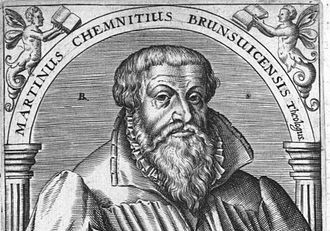
    The following is my translation of Martin Chemnitz’s homily outline for Holy Trinity Sunday, as found in his Postilla (Vol. II, pg. 273). Chemnitz’s Gospel text is John 3:1–15, although the reader will notice that Chemnitz preaches on the mystery of the Trinity in general and not so much the text. His homily is more topical and systematic than exegetical. Square brackets indicate my own notes and additions.

    Chemnitz’s Explanation and Outline

    Beloved in Christ the Lord,

    This is a particularly high feast in which the right knowledge of God is dealt with, so far as God has revealed it to in His Word and as much as is necessary for us to know for salvation. However, it is thus crudely called “threefoldness” (Dreifaltigkeit) as if a threefold God (dreifältiger Gott) or a threefoldness (Dreifaltigkeit) were in the Divine essence (Göttlichen Wesen), although there is no such threefoldness (Dreifaltigkeit). Therefore, it would be better to call it “Trinity” (Dreieinigkeit) or “Threeness” (Dreiheit) because in the Divine essence there is one singular God (ein einger Gott) and yet three distinct persons (drei unterschiedene Personen).

    With this doctrine, it is not enough that we name God, for the Jews and the heathen do that also, but rather we must thus found our faith upon God’s Word and rightly know God as He has thus revealed Himself so that we separate ourselves from Jews, Turks [i.e., Muslims], and heathen who either believe in many gods [i.e., polytheism] or confess only one person in the Godhead [i.e., the Jews]; for, against both, the Scripture reports to us differently as is seen in other passages besides this text, which is one of the foremost in the New Testament. For God had promised in the Old Testament that, when the Messiah would come into the world, God would put His Word into His mouth (Deuteronomy [18:18]), and such Word was to begin in Jerusalem and go forth from Zion (Isaiah 2[:3]). Therefore, the Evangelist John, with particular diligence, also recorded the Lord Christ’s first sermon which He gave at night to Nicodemus, in which is summarized, with beautiful and lovely words, the summary and the right core of the doctrine in the Gospel concerning the forgiveness of sins and the true saving faith; that this account [John 3:1–15] is indeed worthy that one diligently hear and consider it.

    Now, for this reason [the doctrine of the Trinity] has been appointed to be dealt with on this day, because it is not in our liberty to decide what and how we are to think of God, because it says in Jeremiah 10[:10–11] and Psalm 79[:6] that God pours out His wrath upon the heathen who do not know Him. Likewise, in John 17[:3] that “This is eternal life, that they know You, that You alone are the true God, and the one You have sent, Jesus Christ.” And in John 5[:23], “Whoever does not honor the Son does not honor the Father who sent Him.” And 1 John 5[:12], “Whoever does not have God the Son does not have the Life.” And Isaiah 53[:11], “By His knowledge will He, My Servant, the Righteous One, make many righteous.” And John 14[:17], “The world cannot receive the Holy Spirit because it does not see Him and does not know Him.” And Romans 8[:9], “Those who do not have the Spirit of Christ are not Christ’s, and they do not belong to Him.” From such and similar passages it is evident how much is dependent upon the right knowledge of God.

    However, we ought not to sharply dispute concerning the Divine essence, but rather learn to know, honor, and call upon God and the persons of the Godhead from and according to the articles of creation, redemption, and sanctification, because otherwise it is not a life-giving knowledge (lebendigmachendes Erkenntniß). Therefore, this text, which can rightly and well serve us, is now appointed not for a sharp dispute as to how the persons are distinguished internally in their essence, but rather for the simple knowledge of God from the articles of faith (schlechten Erkenntniß Gottes, auß den Artickeln deß Glaubens).

    Now, this doctrine consists in the following five points:

    1. First, that truly there is one God over all creatures, who governs all of them.
    2. Second, that there is not many gods, but rather only one singular God.
    3. Third, that in the same singular Divine essence there are three persons: Father, Son, and Holy Spirit.
    4. Fourth, how such persons are distinguished [from one another].
    5. And then fifth and last, how the knowledge of God is presented to us in His works in the articles of creation, redemption, and sanctification from which we can thereby make use of it all the better.

  • Chemnitz’s Second Homily Outline for Pentecost Midday (John 14:15–31)

    Chemnitz’s Second Homily Outline for Pentecost Midday (John 14:15–31)

    The following is my translation of Martin Chemnitz’s outline for the second homily for Pentecost as found in his Postilla (Vol. II, pg. 234). The first homily explanation and outline on the history of Pentecost (Acts 2) can be found here. Chemnitz’s reading is John 14:15–31. Square brackets indicate my own notes and additions.

    Chemnitz’s Explanation and Homily Outline

    This morning your grace has heard of this feast which we now celebrate and keep holy, and how we maintain our Pentecost against the Pentecost of the Old Testaments, and ought to thereby compare [our Pentecost] with it so that this feast may become all the more dear to us. Thereafter we dealt with the account and explained its circumstances from which we have heard much fine doctrine and admonition (Erinnerung).

    After this, we now want to deal with this second part which belongs to this feast for ourselves, namely, as it pertains to the doctrine which ought to be dealt with on this feast. Now your grace has heard that this is the chief doctrine (Hauptlehre) of this feast, that in these three days the entire third article of our Christian faith is explained by us; as today, the first part, “I believe in the Holy Spirit;” the second part, “one holy Christian Church, the congregation of saints” on this upcoming Tuesday; and the third part, “I believe in the forgiveness of sins, and an eternal life” tomorrow.

    So we want to now take the first part of the third article [of the Apostles’ Creed] for ourselves and explain it in the manner of the Catechism (auff Catechismus Art), that:

    1. First, we want to hear how we can grasp the doctrine of the person and of the office of the Holy Spirit (die Lehre von der Person und von der Ampt deß heiligen Geists) accurately and usefully.
    2. Second, how and through which means (Mittel) the Holy Spirit comes to us and is given to us, namely, through the Word, the Sacraments, and prayer.
    3. Third, to what end we need the Holy Spirit, and what He creates and works in us.
    4. Fourth, how we ought to examine ourselves as to whether we also have the Holy Spirit [~2 Corinthians 13:5], and how we can come to be certain of it, what are the marks (Merckzeichen) [of the Holy Spirit] whereby one knows the Holy Spirit and can know that He dwells in our hearts.
    5. And then lastly, how each person ought to conduct himself, so that if He has the Holy Spirit, He does not lose Him again, that He does not grieve Him [Ephesians 4:30], nor drive Him from himself.

    This we now want to briefly deal with in this sermon.

  • Chemnitz’s Homily Outline for the Sixth Sunday after Easter (Dominica Exaudi)

    Chemnitz’s Homily Outline for the Sixth Sunday after Easter (Dominica Exaudi)

    The following is my translation of Martin Chemnitz’s Homily Outline for the Sixth Sunday after Easter (Dominica Exaudi) as found in his Postilla (Vol. II, pg. 210–11). Chemnitz’s Gospel reading is John 15:26–16:4. Square brackets indicate my own personal notes or additions.

    Chemnitz’s Homily Outline

    So that we may grasp something useful from this sermon, we want to divide this sermon into three points:

    1. First, we want to hear what is the correct Church and Congregation of God (die rechte Kirch und Gemeine Gottes), and how one can know this, namely, since the Spirit of truth testifies of Christ through the Word, in which the apostles have testified and preached concerning Christ [John 15:26–27]; where the testimony is now carried out, there is the Church of God and the congregation in which the Holy Spirit portions out the common goods which belong to all Christians (Wo das Zeugnuß nun geführet wirdt, da ist die Kirche Gottes, und die Gemeine, in welcher der heilige Geist die gemeinen Güter, darzu alle christen gehören, austheilet). Therefore, everyone ought to see to it that he is in incorporated (eingeleibt) into the Church and congregation and be found in it so that he may have these goods with which to comfort [himself] and to delight [in], [the goods] to which only Christians to have access.
    2. Second, Christ sets forth against this that it will not remain [the case] that this His Church and congregation will be in the world and that this testimony of the Holy Spirit of Christ will be carried out [without contest], but rather that the prince of this world will also have his congregation, to which he will send his own false apostles, who will not carry out the testimony of Christ, thereby leading the people away from Christ to eternal damnation, but instead will preach and proclaim the false and deception doctrine of the devil. Therefore, everyone ought to very much be on guard and watch himself so that he may not fall into that assembly (Versammlung); for those who are found therein will finally receive an evil ward (ein bösen Lohn) and will be judged along with their lord [i.e., the devil] to whom they confess themselves, and will be eternally condemned. Therefore, everyone ought to have a good foundation for his faith, so that he cannot be easily led astray.
    3. Third, this is something especially treated on this Sunday and is the chief doctrine (Häuptlehr) of today’s Gospel, of which we are reminded and ought to well mark, [namely,] that it will not only remain the case that the two kinds of churches and opposing doctrines will be carried out in the world, that the one will promote and defend this and the other will promote and defend [the contrary], and that each will hold to his own settled opinion (gefasseten Meinung); but rather, from this it will also follow that the wicked enemy and spirit of lies (Lügengeist) will set himself with all zeal and violence against those who carry out the testimony of the truth of Christ, and who remain steadfast and persist in the pure doctrine (der reinen Lehre), and hold onto it with zeal, and Satan will incite against these not only the godless and unbelieving people, but also those who want to be seen as the holiest and most eminent in the Kingdom of God and the Church of Christ, that they will oppose Christians with burning and murder (Brennen und Morden), which not everyone can endure so easily. Therefore, we ought to pray and petition that God would preserve us against such violence, give us heart and courage, so that we do not despair, nor allow ourselves to be terrified, but rather to remain steadfast in the right doctrine (der rechten Lehr), even if we ought to risk body and goods, honor and blood for its sake, and trust God who can protect us as long as He wills, and if we indeed ought to suffer on account of it, fall into danger and harm, that He wants to and can richly restore to us all things we have suffered (Allen den Schaden) in His own time.

    On these three points we want to direct what is to be dealt with in this Gospel in this Sermon. The Spirit of truth grant that we through His grace and power rightly learn and make use of it.

  • Chemnitz’s Homily Outline for Fifth Sunday after Easter (Dominica Rogationum, Vocem Jucunditatis)

    Chemnitz’s Homily Outline for Fifth Sunday after Easter (Dominica Rogationum, Vocem Jucunditatis)

    The following is my translation of Martin Chemnitz’s Homily Outline for the Fifth Sunday after Easter (Dominica Rogationum, or, Vocem Jucunditatis) as found in his Postilla (Vol. II, pg. 176). Chemnitz’s gospel text is John 16:23b–33 (beginning from “Amen, Amen…” or “Most assuredly…”). Square brackets indicate my own personal notes or additions.

    Chemnitz’s Homily Outline for Rogate

    “Now in order that a pious Christian cannot falsely use (fälschen) this doctrine, so we want to divide it thus:

    1. First, we want to remember how much depends on it, that on prays and performs this divine service (Gottesdienst) with all diligence, and how therefore dear prayer has been in use and has remained in constant practice among all the saints and children of God at all times [e.g., Acts 2:42; Ephesians 6:18; Colossians 4:2; 1 Thessalonians 5:16–18].
    2. Second, that there is a great distinction in prayer, that not ever prayer is pleasing and acceptable to God [e.g., Isaiah 1:15]; how one therefore thus ought to take care that, above all things, he removes from the way everything that defiles and corrupts a prayer so that it does not become displeasing and abominable before God [e.g., Psalm 66:18; James 4:3].
    3. Third, then what all belongs to right prayer (rechten Gebett); how it must be directed on certain grounds, and to what the heart ought to look when one wants to pray so that God can be at peace with our prayer and may hear it and accept it, that we may thereby obtain that which we seek from God through it. Namely, that we first call upon the correct true God (den rechten wahren Gott) who is God the Father, Son, and Holy Spirit [Matthew 28:19]. Thereafter, how we ought to pay attention the causes (die Ursachen), which ought to move us to prayer, such as God’s will and command (Gottes will und Befehl) [1 John 5:14], our great present need (unsere fürstehende hohe Nicht) [e.g., Psalm 50:15], and the dear God’s kind promise and pledge (Verheissung und Zusage) that He will surely hear our prayer [e.g., Matthew 7:7; John 16:23–24].
    4. Lastly, how we ought to bring all of this together and into Christian use; how the heart ought to learn to exercise itself through prayer before God; how we ought to seek the eternal good (das ewig Gut) from God with full confidence and faith, and with what condition we ought to pray for daily bread and temporal need (tägliche Bordt und zeitliche Notturft).

    We want to handle these points briefly and simply in this sermon. May the dear God indeed grant that it may produce much fruit in us so that we may accustom ourselves and be diligent (uns gewehnen und befleissigen) to pray willingly, often, and with devotion (gern, oft, und mit Andacht).”

  • Chemnitz’s Homily Outline for the Fourth Sunday after Easter (Dominica Cantate)

    Chemnitz’s Homily Outline for the Fourth Sunday after Easter (Dominica Cantate)

    The following is my translation of Martin Chemnitz’s homily outline for the Third Sunday after Easter (Dominica Cantate) as found in his Postilla (Vol. II, pgs. 161–62). Chemnitz’s text is John 16:5–15. Square brackets indicate my own personal notes.

    Chemnitz’s Homily Outline:

    Now because this text seems to be a dark text which not everyone can easily grasp and understand, so we will deal with the doctrine briefly and simply which is prescribed to us herein:

    1. First, we will hear how in the Gospel Christ shows us that we ought to properly know what He has for a kingdom, and how He leads it, also what goods and jewels He distributes to us in His kingdom so that we do not imagine as if we chiefly ought to expect temporal prosperity, joy and pleasure in the kingdom of Christ, but rather that we turn away from our thoughts and know that Christ’s kingdom is a heavenly kingdom [John 18:36] and that He gives and distributes to us the eternal goods, so that we do not therefore set ourselves on things temporal (Zeitliche), but rather on things eternal (Ewige) [Colossians 3:2]; and how we ought to have our greatest pleasure and joy in this when we hear these this and concern ourselves with it, and thereafter strive that we might become partakers of these goods; but how naive and foolish we are that we do not particularly concern ourselves with it, but rather become sad over it when our fortune and wellbeing do not immediately begin in this life, which the Lord here rebukes in us.
    2. Second, it is also brought to our remembrance how the Son of God deals with us when He wants to bring us into the fellowship (Gemeinschafft) of His kingdom, that for this He uses the Preaching Office (Predigampt) through which the Holy Spirit is effective and works in us so that we also come into the kingdom of God and may become partakers of the goods which He has acquired for us, and how the Holy Spirit deals with us in this, namely that He teaches (lehret) us the right way through one comes into the kingdom of Christ, and if we fall short of the right way, that He at that point rebukes us (straffen) and teaches us to know our sin and our unbelief and that we lack the righteousness that is acceptable to God and that we do not trust in God from the heart, but rather that we fear the devil and the world more than we fear God; but when we recognize our lack and failure, then at that point He further comforts (trösten) us so that we do not despair on account of our sins, nor that we become distressed too much while under the cross.
    3. Third, what benefit it is for us that the Holy Spirit thus carries out His office (Ampt) by manner of teaching, by manner of rebuking, and by manner of comforting (Lehrweise, Straffweise, und Trostweise), namely that He leads us thereby into all truth, to the righteousness that is acceptable before God, and that He comes to help us in our weakness, comforts us while under the cross, and points us to the hope of the future eternal salvation.
  • Chemnitz’s Homily Outline for the Third Sunday after Easter (Jubilate)

    Chemnitz’s Homily Outline for the Third Sunday after Easter (Jubilate)

    The following is my translation of Martin Chemnitz’s homily outline for the Third Sunday after Easter (Dominica Jubilate) as found in his Postilla (Vol. II, pgs. 143). Chemnitz’s text is John 16:16–23a (ending with the phrase “On that day, you will ask me nothing”). Square brackets indicate my own personal notes.

    Chemnitz’s Homily Outline

    In order that we may take away something useful from this text, that we can make use of it for doctrine (Lehr), remembrance (Erinnerung), warning (Warnung), and comfort (Trost), so we want to parse this sermon in these two parts:

    1. First, how the Lord Christ in today’s Gospel says to His disciples and to all Christians literally and clearly that they ought to know that if they want to be children of God, the cross will by no means stay away, but rather it will certainly come upon them [e.g., Matthew 16:24; Acts 14:22]; therefore, one must learn this beforehand, while he is still outside of the cross, so that he may all the better prepare and gird himself to bear the cross with patience when it comes; and how we ought to rightly understanding the doctrine of the cross (die lehr von Creutz), how one ought to vies the cross, how one ought to judge it from God’s Word and not according to reason (Vernunfft), and how each one ought to bear his own cross, as God has laid it upon him, and be content with it, not looking to others to see whether or not it is lighter or heavier for them than for us [e.g. Galatians 6:4–5].
    2. Second, we want to hear what the Son of God has set before us in today’s Gospel for a beautiful and glorious comfort (ein schönen, herrlichen Trost) [John 16:20, 22], which we are to seek amid the cross (im Creutz) and by which we ought to sustain ourselves so that we do not become faint-hearted (or, discouraged, kleinmütig) and despair, but learn to remain still before God in patience and by God’s grace endure what God has sent upon us. For first, we know that it is God Himself who distributes this cross among His beloved children, that it comes from Him and from no other, that it is His desire (sein Lust) to hide His face from us at times [cf. Isaiah 54:8]. And second, [we know] that God does not act from a wrathful disposition (zornigen Gemüt), but rather from a Fatherly heart (vätterlichen Hertzen), that it may turn out for our best [Romans 8:28]. Furthermore, He says that it is only a small thing to do, that it is only a transitory thing (ein Ubergang), that it will not last forever, but only is as a moment (literally, “blink of an eye,” ein Augenblick) [cf. 2 Corinthians 4:16–18]. And lastly, that we ought to take comfort ourselves that all our sorrow and misery shall one day come to a good and desired end (zum guten und gewündschten Ende), when, after this life, we shall partake in eternal blessedness instead of the temporal cross.

    We will [now] deal with both parts of the text of today’s Gospel. May the dear God grant us all His Holy Spirit so that we may usefully grasp this reminder, doctrine, and comfort (Erinnerung, Lehr, und Trost) and make use of it in a Christian manner, and thus also learn to keep still before God and accept all things as love, whatever God will lay upon us according to His Fatherly will. [Amen]