The following is my translation of the notes and useful applications of the Holy Gospel for the Wednesday of Populus/Filia Zion (the Second Week of Advent), Matthew 11:11–15, as they are found in Das Weimarische Bibelwerk (1877). Square brackets indicate my own notes and additions. For the useful applications, I recommend the reader see this very helpful article by Dr. Benjamin T. G. Mayes.
II. A glorious testimony of Christ concerning John [the Baptist]. (v. 7–15)
Annotated Text
11. “Truly, I say to you, * among all those born of women (according to the common course of nature), there is not one (anyone) who has arisen who (on account of his office) is greater (more eminent) than John the Baptist; but Hewho is the Least (indeed, smaller) in the Kingdom of Heaven (in the Kingdom of God. Luther: “This is Christ,” who has humiliated himself to the lowest point) is greater than him (for He is not only true man, but also true God in unity of person, who is not only a Prophet and Teacher, but rather also the Mediator, Redeemer, and Savior; He is not the friend of the Bridegroom, as John, but rather is the Bridegroom Himself, John 3:29).
* Luke 7:28
12. Now from the days of John the Baptist (from the time in which he began to carry out his office) until now, the Kingdom of Heaven suffers violence (the Kingdom of God is preached through the Gospel, and everyone pressed into it with force, Luke 16:16. The people receive the Gospel with great zeal, as one takes a city by force. Luther: “The consciences, when they perceive the Gospel, press toward it, so that no one can resist them.”), and the violent (the repentant sinners, who in true faith stand against the temptations through the power of the Spirit, crucify the wicked lusts of the sinful flesh [Galatians 5:24], and contend gallantly) snatch it to themselves (they press themselves into the Kingdom of Heaven, from which it sufficiently appears that John had accomplished great benefits through his teaching and baptizing).1
(Matthew 21:31–32)
1 Greek: Alternatively, “The Kingdom of Heaven presses in with force, and (everyone, Luke 16:16, also) uses force (or have used force up to this point—evil people, tax collectors, soldiers, sinners, indeed, even the Gentiles press into it with force, and) snatch it to themselves (make themselves partakers of it with great zeal, and in this go before the high priests, the scribes, and the Pharisees).”
13. For all the prophets and the Law had prophesied (that Christ shall come) until John (who pointed to Christ being present).
14. And, if you are willing to receive it (and believe it) * he (John) is Elijah, who is to come (He is the one of whom the prophet Malachi had prophesied that He shall come in the Spirit and power of Elijah before the coming of the great and terrible day of the Lord).
* Malachi 4:5; Matthew 17:12 (Mark 9:13; Luke 1:17)
15. He who has ears to hear, let him hear (mark this and take it to heart, and do not wait with the Pharisees for Elijah the Tishbite to come again on earth in his own person again, or otherwise for the Kingdom of Heaven to appear with worldly pageantry).”
* Mark 7:16 (Luke 8:8)
Useful Applications
II. DOCTRINE: That Christ is the least in the Kingdom of Heaven, and yet at the same time greater than John (who is esteemed by Christ as the greatest among all men); He is the least according to His humanity in the state of humiliation, He is the greatest according to His eternal divinity. (v. 11)
The following is my translation of the notes and useful applications of the Holy Gospel for Wednesday of Ad Te Levavi, Matthew 3:1–6, as they are found in Das Weimarische Bibelwerk (1877). Square brackets indicate my own notes and additions. For the useful applications, I recommend the reader see this very helpful article by Dr. Benjamin T. G. Mayes.
John, the Preacher in the Wilderness, by Julius Schnorr von Carolsfeld
I. Concerning the person of John the Baptist, as to what constituted his office, doctrine, food, and clothing. (v. 1–4), and II. Concerning the great influx of the people to John, and how he on such occasion preached against the hypocrisy of the Jews. (v. 5–12)
Annotated Text
1. At that time1(when Christ was almost thirty years old, in the fifteenth year of the reign of Tiberius, when Pilate was the Roman governor, and Annas and Caiaphas were high priests, Luke 3:1–2, but the Lord Jesus still kept Himself at Nazareth) * came (appeared or emerged) John (a son of the priest Zachariah, who had begotten him with his old housewife Elizabeth, Luke 1:24, 57) the Baptist (who is called thus on account of the baptism which he carried out at God’s command at the beginning of the New Testament) and he preached (called out with a loud voice) in the wilderness of the Judean land (in a place of the land in Judea, located by the Jordan, not far from Jericho, Luke 3:3; a place called “the plain of the wilderness,” 2 Samuel 17:16, 22, because there was much forest and mountains there and thus it was inhabited less than other places, although several cities were located in that same place, in which Zachariah, John the Baptist’s father, dwelt, Luke 1:39–40. Luther: “This ought to be a certain sign that the Messiah was coming when they heard one preaching not in the temple at Jerusalem, nor in the [Pharisaical] schools, but rather in the wilderness, who preached in this manner: ‘The Lord is coming,’ as John had done.”).2
1 Greek: “Now” [δὲ]
* Mark 1:4; Luke 3:3
2 † This wilderness was a region of land in the Jewish mountains, Luke 1:39, 80, where the Word of the Lord first came to John, Luke 3:2. From that same region he went forth until he came to the Jordan.
2. And he said, * “Repent (turn yourselves from your godless way of life); the Kingdom of Heaven (that is, the time of grace, when God Himself appears in Christ on earth and draws men away from trust in their own righteousness, in Levitical external worship, and fleshly thinking, and, on the other hand will establish a spiritual Kingdom through faith in the hearts of men) has come near (The prophecies of the prophets concerning the Kingdom of the Messiah are now fulfilled; for He has appeared and will soon enter His office with the public preaching of the Gospel, in which He will offer the grace of God, the forgiveness of sins, and eternal salvation to all men and will impart it to the who truly repent and believe, and will also win such treasures and benefits for them through His obedience, suffering, and death).”
* Matthew 4:17 (Mark 1:15)
3. And1 he (John the Baptist) is the one of whom the Prophet Isaiah * had spoken, saying: “A voice of a preacher (a voice calling) in the wilderness (saying thus): ‘Prepare for the Lord (the coming Messiah, who is our righteousness, Jeremiah 23:6) the way (clear out of the way the filth of errors and the great logs of misdeeds through true knowledge of sins and heartfelt contrition over them; adorn the way with the fervent longing for the grace of God with true faith in the promised and now appeared Messiah with the earnest intent of amendment and with all kinds of Christian virtues; just as one clears all hindrances and filth out of the way when a king or a prince intends to make his entrance and adorns the way with tapestries, grass, and trees [cf. Matthew 21:8]), and make His paths straight2(so that the heart may not be lifted up through spiritual pride nor be made crooked and uneven through hypocrisy, because without true repentance, His gospel cannot be received and grasped and hearts in a fruitful manner).
1 Greek: “For he” [or, “for in this way,” οὗτος γάρ]
* Isaiah 40:3 (Mark 1:3; Luke 3:4; John 1:23)
2 Greek: “footpaths” (where He wants to teach, preach, walk, and be received)
4. Now John had a * garment of camel’s hair (a meagre, hairy, rough garment prepared from coarse camel’s hair, in which form the prophet Elijah was also clothed in the Old Testament, 2 Kings 1:8, for “He will go before Him [the Lord] in the spirit and power of Elijah,” Luke 1:17, and was the true Elijah who was to come, Malachi 4:5 and Matthew 11:14; thus [John] also wanted by his clothing to be compared to [Elijah]) and a leather girdle around his loins (the like of which Elijah also wore); his food was locusts (which was a different kind of locust than those we have, and which the common poor people in the eastern lands were accustomed to using for food, both fresh and dried in smoke; the Jews also were allowed to eat them, Leviticus 11:22, yet, it was a humble, disdained food) and wild honey (honey of wild bees, which was not as good and sweet as other honey;1 because John was a preacher of repentance, so he also wanted to lead a hard and strict life, both in his food and also in his clothing).
* 2 Kings 1:8; Mark 1:6 (Matthew 11:8, 18; 1 Samuel 14:27)
1 † Some understand here the flowing sap of date and fig trees, which is also called honey among the Hebrews and was found in the region of Jericho as well as near the Jordan. But it is better that one remains with the more common meaning of “wild honey.”
5. Then went out to him the city (the inhabitants of the city) of Jerusalem and the entire Jewish land all lands (the people from all the cities and villages of the Jewish land and of the surrounding neighboring regions, such as Galilee, Perea, Trachonitis, etc.) at the Jordan.
(Luke 3:7)
6. And they allowed themselves to be baptized by him in the Jordan and they confessed their sins (They acknowledged their guilt before God, and confessed publicly that they were poor sinners and then humbly asked God for forgiveness; thereafter, John admonished them that they ought to believe in Christ, the Messiah and Savior of the world, who had now appeared, and afterwards baptized them for the forgiveness of sins by God’s command, Luke 3:3).
Useful Applications
I. CORRECTION: That the foremost purpose of all Church teachers in their office ought to be to teach concerning repentance as did John. (v. 2).
[There are no useful applications listed for verses 5–6.]
The following is my translation of the notes and useful applications of the Holy Gospel of the First Sunday of Advent (Ad Te Levavi), Matthew 21:1–11, as they are found in Das Weimarische Bibelwerk (1877). Square brackets indicate my own notes and additions. For the useful applications, I recommend the reader see this very helpful article by Dr. Benjamin T. G. Mayes.
I. The advent of Christ to Jerusalem. (v. 1–11)
Annotated Text
1. When * they (Christ and His disciples together with the people that followed Him) now drew near to Jerusalem, and came to (opposite of) Bethphage (and Bethany, Luke 19:29) to the Mount of Olives, 1 Jesus sent two disciples,
* Mark 11:1; John 12:12
1 Greek: “And when” [Καὶ ὅτε]
2. and He said to them, “Go into the town which lies before you (into the market which lies opposite you, Luke 19:30) and immediately (when you come into it) you will find a donkey tied up and a colt with it (also bound, on which no man has yet sat, Luke 19:30); loose it and bring it to Me. (For what purpose the Lord Christ intended to use this beast of burden He had not yet indicated to the disciples; but He was intent to hold His royal entry into the city of Jerusalem previously proclaimed by the Prophet.)
3. And if someone should say something to you (and ask: ‘Why are you doing this?’ Mark 11:3; ‘Why do you loose the donkey and the colt?’ Luke 9:31), then say: ‘The Lord has need of it (for His service); and immediately he will allow it (to follow) you (and send them).”
4. Now all this happened that it would be fulfilled what had been said through the prophet (Zechariah), when he said:
5. “Say * to the daughter (the inhabitants) of Zion (of the city of Jerusalem, whose highest part was built upon Mount Zion; however, thereby is understood the Israelite Church): ‘Behold, your (heavenly soul-) †King comes to you (that He might have mercy on you and help you; thus, be for your good before others) meek (humble and lowly), and riding upon a donkey and upon a colt, the load-bearing donkey.” (Christ first rode upon the donkey and afterwards He sat Himself on the colt upon which He rode into the city. By the donkey is signified the Jews, the burden-bearing people; by the untamed colt, the Gentiles.)
* Zechariah 9:9ff.; John 12:15
† Psalm 24:8 (Isaiah 62:11)
6. The disciples went out (from willing obedience, and they found it as He had said; for they found the colt tied at the door, outside at the crossroads, and they loosed it. But as they were loosing the colt, certain ones who were standing there said to them, “What are you doing, that you are loosing the colt?” Mark 11:4–5. And its lords said to them, “Why are you loosing the colt?” Luke 19:33. But they said to them as Jesus had commanded them, “The Lord has need of it,” and they allowed it, Mark 11:6.) and (those who were sent) did, as Jesus had commanded them.
7. And they brought the donkey and colt (to Jesus), and laid their * garments thereupon (so that He might ride all the more gently) and set Him thereupon (They cast their garments upon the colt, and He sat upon it, Mark 11:7. But such, what had been prophesied by Zechariah and what otherwise happened here, His disciples did not understood beforehand, but when Jesus was glorified, then they remembered that such has been written concerning Him and that they had done such things to Him, John 12:16).
* 2 Kings 9:13; Mark 11:7–8
8. Now many people1 spread their garments on the way (Such they did out of reverence toward this new King, as the like happened to Jehu, 2 Kings 9:13.); others2 cut down branches (green boughs) from the trees and strew them on the way (to adorn Him, to bear witness to their joy, and to confess Christ as a peace-rich and victory-rich king. And many people who had come to the feast, when they heard that Jesus had come to Jerusalem, they took palm branches and went out to meet Him, John 12:12–13. And as He came near and descended the Mount of Olives, the whole heap of His disciples began to praise God joyfully with a loud voice on account of all the deeds they had seen, Luke 19:37.).
(1 Maccabees 13:51)
1 Greek: “most of the people” (who partly came along from Jericho, Matthew 20:29, partly had already come to Jerusalem for the feast and who went out to meet Him out of amazement concerning the raising of Lazarus).
2 Greek: “but” [δὲ]
9. But the (remaining common) people, who went before and followed after, cried out and said, “Hosanna (Luther: “In German, ‘Hosanna’ means ‘Ah, help!’ or ‘Ah, give good fortune and salvation!’—that is what we wish for.”) to the Son of David (to this new King, born of the lineage of David. The Jews had taught their children that when the Messiah would someday present Himself, they should receive Him with these words of the kingly prophet David; thus, because they heard that Jesus of Nazareth wanted to have His entry as the promised Messiah and the King of His Church, they had received Him in such a form)!1Blessèd is He who comes (as a King) in the name of the Lord (sent by God to His people, that He should be a King of Israel, John 12:13; “Blessed be the kingdom of our father David!” Mark 11:10.)! Hosanna in the highest! (You Son of David who are in the highest, that is, a heavenly King and true God, help us. “Peace be in heaven and glory in the highest!” Luke 19:38. And some of the Pharisees in the crowd said to Him, “Master, rebuke Your disciples.” But He answered and said to them, “I say to you, if these should be silent, then the stones would cry out,” Luke 19:39–40.)
(Matthew 23:39)
1 † Ordinarily, this formula from Psalm 118:25 was used at the Feast of Tabernacles. But the Jews also spoke it at other times on joyful occasions. See 1 Maccabees 13:51; 2 Maccabees 10:6; etc.
10. And when He had entered into Jerusalem, the entire city was stirred up (frightened and became distressed) and said (all the inhabitants of that city were frightened and said), “Who is this (who comes riding into the city with such a multitude of people and to whom one wishes good fortune as to a king)?”
11. But the People said, “This is the (famous) Jesus, * the prophet from Nazareth (who was conceived and raised up in Nazareth, Matthew 2:23; Luke 2:51) of Galilee (which city of Nazareth lies in Galilee. But the Pharisees said among one another, “You see that you are achieving nothing. Behold, all the world is running after Him,” John 12:19.).
* Luke 7:16; John 1:45
Useful Applications
I. DOCTRINE: That all things which happened at the time of the revelation of Christ in His received humanity were preached beforehand by all the prophets of the Old Testament, shown here by the citation of the prophet Zechariah concerning the entry of Christ into Jerusalem upon a donkey and a colt. (v. 4–5)
The following is my translation of the notes and useful applications for the Holy Gospel for the Twenty-Seventh Sunday after Trinity, Matthew 25:1–13, as they are found in Das Weimarische Bibelwerk (1877). Square brackets indicate my own notes and additions. For the useful applications, I recommend the reader see this very helpful article by Dr. Benjamin T. G. Mayes.
I. The parable of the ten virgins. (v. 1–13)
Annotated Text
1. Then (when Christ comes to hold the judgment) 1 the Kingdom of Heaven (the estate of those who publicly confess themselves to [be part of] the Church of God and to the Gospel) will be like ten2virgins, who 3 took their lamps (presented themselves externally as Christians) and went out to meet the Bridegroom (Christ).
1 Or, much more in the last times and with reference to His second coming.
2 † A number of which was commonly required at solemn Jewish ceremonies.
3 * Invited as guests for a wedding, which in those lands was for the most part held in the evening.
2. But five of them were foolish (by which those are to be understood who do not deal wisely in their Christianity and who do not let their salvation be a matter of true seriousness to themselves), and five were wise (by which those are to be understood who are upright Christians, who are understanding what the will of the Lord is, Ephesians 5:17, and who fulfill it in deed).
(2 Timothy 3:5; Revelation 14:4)
3. The foolish took their lamps; however, they did not take oil along with themselves 1(they did not have true saving faith and Christian virtues, but rather were only hypocrites).2
1 In separate vessels, to refill their lamps in the case of a longer delay.
2 † Here, the oil is the grace of the Holy Spirit (Psalm 45:8), which is mediated by the Word and Sacraments, which works faith, love, and all good in men, and which prepares their hearts in the grace of God for willing and joyful service.
4. But the wise took oil in their vessels along with their lamps (also well provided with oil). (Luther: “The lamps without oil are good works without faith, which must all be quenched. The vessel of oil however is faith in the conscience in the grace of God, which does good works that endure.”)
5. Now, when the Bridegroom was delayed (with His coming), they * all became drowsy and slept (in such a form that they did not wait with due care for the coming of Christ).
* James 3:2
6. But, at midnight (when they least expected it) there was a cry (through the sound of the trumpet): “Behold, the Bridegroom comes; go out to meet Him!”
[For the trumpet sound, see Matthew 24:31; 1 Corinthians 15:52]
7. Then * all those virgins rose and trimmed their lamps (they prepared their lamps and poured oil into them).
* Luke 12:36ff.
8. But the foolish said to the wise, “Give us some of your oil, for our lamps are quenched.”
9. Then the wise answered and said, “Not so, so that there may not be a lack for us and you. But go away to the merchants and buy for yourselves (buy where you want, we have nothing left over for you. Luther: “But just as here none gives the oil to another, so also must each believe for himself”).
10. And when they went out to buy, the Bridegroom came, and those who were ready * went in with Him to the wedding (into the joy of eternal life), and the door was shut (so that no one could come in anymore).
* Revelation 19:7
11. Finally, the other virgins also came and * said, “Lord, Lord (they repeated this word ‘Lord’ from hypocritical hearts, Matthew 7:22; Luke 6:46), open to us!”
* Luke 13:25ff.
1 * Or also, from all too-late recognition of the majesty of Christ, Isaiah 45:23; Philippians 2:10–11
12. But He answered and said, “Truly, I say to you, * I do not know you (I regard you not; you do not belong to My wedding, for you had the time of grace, and when you ought to have sought the oil of true faith working through love, you did not pay attention to it; and now it is too late).
* Matthew 7:23; Psalm 1:6
1 * I cannot recognize you, with your fruitless behavior, as the companions of My bride.
13. Therefore, * watch (be prepared at all times), for you neither know the day nor the hour in which the Son of Man will come. (In the following parable [i.e., the Parable of the Talents, Matthew 25:14–30], Christ reminds us that each person ought to righty use and employ the gifts God has imparted to him during the time of his [earthly] life, so that on the Last Day, he may receive a reward for his faithfulness and diligence, yet by grace. But it is to be understood with this parable, that Christ will deal with us in this manner.)
* Matthew 24:42; Mark 13:33ff.; Luke 21:36 (Revelation 16:15)
Useful Applications
I. CORRECTION: That we ought to be watchful at all times in faith and remain in preparedness (which is signified by the oil and the burning lamps of the virgins), so that we meet the heavenly Bridegroom spiritually when He appears in His glory for judgment, and so that we do not neglect the time of grace according to the likeness of the foolish virgins. (v. 1–13)
The following is my translation of the notes and useful applications for the Holy Gospel for the Twenty-Second Sunday after Trinity, Matthew 18:21–35, as they are found in Das Weimarische Bibelwerk (1877). Square brackets indicate my own notes and additions. For the useful applications, I recommend the reader see this very helpful article by Dr. Benjamin T. G. Mayes.
III. Peter’s conversation with Christ concerning brotherly reconciliation, and the parable belonging to it concerning the wicked servant. (v. 21–35)
Annotated Text
21. Then Peter came to Him (to Christ) and said, “Lord, how often must I then (according to Your admonition, Luke 17:3) forgive my brother (my neighbor and fellow Christian), who sins against me? Is seven times enough?”1
1 Greek: alternatively, “How often may my brother sin again me, so that I must forgive him? May it perhaps happen as many as seven times? (Peter must have thought so many times would be enough.)
22. Jesus said to him, “I say to you, not seven times, but seventy times seven (that is, as often as he offends you and asks you for forgiveness, you ought to be willing and ready to forgive him).
(Luke 17:4)
23. Therefore, the Kingdom of Heaven is like a king (The estate of the Church of God here upon earth can very justifiably be compared to a great and mighty king), who wanted to reckon with his servants (to inspect the income and expenditure of his servants, in order to learn how they have managed his goods).
24. And as he began to reckon, one came before him, who owed him ten thousand pounds (A talent or pound is estimated at six hundred crowns; therefore, ten thousand pounds thus makes six million crowns, or six tons of gold).
25. Now when he had nothing with which to repay, the Lord commanded him to be sold and his wife and his children and all that he had, and (from the redeemed gold) payment to be made. (For in previous times, the debtors who could not pay were sold along with all those who belonged to them into servitude, in order that his debt might be repaid from the money that had been obtained from them to the creditor.)
26. Then the servant fell down and prayed to him (that out of great humility he fell at his feet) and said, “Lord, have patience with me; I will repay you all.”
27. Then the Lord of the servant pitied him, released him freely (that neither he nor his wife nor his children might be sold), and also forgave him the debt (from pure meekness and goodness).
28. Then that same servant went out 1 and found a fellow servant who owed him a hundred pennies (A denarius or a penny is valued at one Schreckenberger, as we call it; ten denarii are reckoned approximately at one crown, and thus a hundred pennies make ten crowns); and he grabbed him and choked him (he grabbed him by the neck so that he might have strangled him) and said, “Pay me what you owe me!”
1 Greek: “But” [δὲ] (This little word already reveals the abomination of ingratitude.)
29. Then his fellow servant fell down (at his feet), and pleaded with him and said, “Have patience with me (do not press me so hard), I will repay you all (in time).
30. But he did not want to (wait with patience for the payment), but rather went and threw him (allowed him to be thrown) into prison, until he should repay what he owed.
31. But when his fellow servants saw such, then were very troubled and they came and brought everything before their Lord (they recounted to Him in an orderly manner), what had happened.
32. Then his Lord demanded him before Him and said to him, “You wicked servant (you ungrateful spiteful fellow), all this (great) debt I have remitted to you, because you prayed to me.
33. Should not * you also have had compassion upon your fellow servant, as I myself had compassion upon you?”
* Matthew 5:7; James 2:13
34. And his Lord was angry and delivered him to the tormentors (that they should cast him into prison and torment him therein, and also let him remain stuck in prison), 1 * until he should repay all that he owed Him (which could never have, for it was impossible for him to repay such a great sum).2
1 † For when bondservants had committed a great crime, they were not only thrown into prison, but rather also kept therein in harsh conditions.
* Matthew 5:26
2 Since he had forfeited the former forgiveness, and on the contrary had brought forth his old sins anew and approved them. See Ezekiel 33:12.
35. In this way * My heavenly will also do to you (He will punish you in a similar form), if each of you does not forgive his brother his faults (everything with which he offended him) from your hearts.”
* Mark 11:25–26 (Matthew 6:15)
Useful Applications
III. WARNING: Concerning irreconcilableness and mercilessness toward the neighbor, which is a sin that will be punished with the eternal torment of hell. (v. 33–35); DOCTRINE: Whereby all previously obtained forgiveness shall not help if one falls back again into the old sin or into a new sin. (v. 33–35)
The following is my translation of the notes and useful applications for the Holy Gospel for the Eighteenth Sunday after Trinity, Mark 22:34–46, as they are found in Das Weimarische Bibelwerk (1877). Square brackets indicate my own notes and additions. For the useful applications, I recommend the reader see this very helpful article by Dr. Benjamin T. G. Mayes.
IV. The last discourse of Christ with the Pharisees concerning the greatest commandment in the Law and concerning the Messiah. (v. 34–46)
Annotated Text
34. But when the Pharisees heard that He had stopped up the mouth of the Sadducees (thus that they could no longer answer Him nor rebuke His speech), they gathered together (namely, the Pharisees).
35. And * one among them, a scribe, (who had heard them as they questioned one another, and saw that He had answered them finely; meanwhile, he came forward when the others were gathering together and taking counsel, and asked Him, Mark 12:28, and) tested Him (in the beginning, he had brought forth his question to Christ with a wicked intent, but afterward the Holy Spirit changed his heart), and said,
* Luke 10:25.
36. “Master, which is the foremost commandment (before all) in the Law (that we ought to keep and to fulfill before all things? The scribe wants to say this much: Because a resurrection of the dead will follow and another life exists after this one, as you have rightly answered the Sadducees, therefore the question now is, which is the foremost commandments that one must keep before all others if one wants to inherit eternal life)?
37. But Jesus (answered and) said to him, (The foremost commandment before all commandments is this: “Hear, O Isarel, the Lord, our God, is one singular God,” Mark 12:29, and) * “’You shall love God (the only true God), Your Lord, with all your heart and all your soul and all your mind (and with all your powers, Mark 12:30).’
*Mark 12:30ff. (Deuteronomy 6:4–6; Luke 10:27)
38. This is the foremost and greatest commandment (as the foundation of what follows, if it should be upright).
39. But the second is like it (because God the Lord wants this commandment to be kept just as much as the first; also because both commandments require not only an external obedience, but rather also a inward obedience, and because no one can rightly love God unless he also loves his neighbor, 1 John 4:20–21; finally, because the transgression of the commandment concerning love of the neighbor is just as reprehensible as the transgression of the commandment concerning the love of God): ‘You shall love your neighbor (all those who need your help) as you yourself (thus, that you show them all the love, friendship, and kindness, which you desire, so that it may happen to you from others. There is no other greater commandment than this, Mark 12:31ff.).’
* Leviticus 19:28; Luke 10:27; Romans 13:9; Galatians 5:14; James 2:8; Colossians 3:14.
40. On these two commandments hang (is grasped or summed up, Romans 13:9) the entire Law and the Prophets (what Moses and the Prophets require of a man when they deal with the doctrine of the Law; they also can neither be sufficiently understood, nor rightly applied for the salvation of souls if one does not recognize from them our incapability to fulfill the Law and how necessary the Mediator is, who fulfills in us the righteousness that is demanded by the Law, Romans 8:3–4. And the scribe said to Him, “Master, You have truly spoken correctly; for there is one God, and there is none other besides Him; and to love Him with all the heart and with all the mind, and with all the soul, and with all powers and love one’s neighbor as oneself, this is more than bread offerings and all sacrifice.” But when Jesus saw that He had answered reasonably, He said to him, “You are not far from the Kingdom of God.” And no one dared to question Him further, Mark 12:32–34).”
41. Now when the Pharisees were with one another, they asked Jesus (when He taught in the temple, Mark 12:35),
(Matthew 22:34)
42. and said, “What do you think concerning the Christ (what do you hold concerning the promised Messiah)? * Whose Son is He (from which stem and race will He be born when He comes?)?” They said, “David’s” (from the lineage of David, according to the divine promise).
(Luke 20:41)
* He led them there in order to show that the discussion is not settled with the Law, but rather that the knowledge of Christ and His person, as well as His office is necessary above all in the Kingdom of God.
43. He (answered and) said to them (“How do they say, the scribes, that Christ is David’s Son?” Mark 12:35, Luke 20:41): “How then does David call Him in the Spirit (through the Holy Spirit, Mark 12:36, that is, through the inspiration of the Holy Spirit) a Lord, when He says (in the book of the Psalms):
44. * “The Lord (God the Father) has said to my Lord (to Christ, His Son, who is my lord and my God): ‘Sit at My right hand (reign with Me in like majesty, power, and glory, 1 Corinthians 15:25; Hebrews 1:3, 8:1; Ephesians 1:20), until I place Your enemies as a footstool for Your feet (until I fully subject these to you on the Last Day. Then, David indeed calls Him his Lord, Mark 12:37).’”
* Psalm 110:1; Mark 12:37; Luke 20:42; Acts 2:34; Hebrews 1:13 (Hebrews 10:13).
45. So now, if David (the mighty king, who acknowledge no higher lord on earth, but rather only the true God in heaven) calls Him a Lord, whose Son then is He? (Christ does not deny that the Messiah will be David’s son according to His human nature, but rather He wants to give the Pharisees the knowledge that He will also be David’s Lord, according to His divine nature.)
46. And * no one could answer Him a word (nor show the correct understanding and basis of this Davidic saying, because they did not know the Messiah rightly from the Holy Scripture, but rather held Him to be a mere man who would see a worldly kingdom on earth), ** and also no one dared to ask Him a question from the day forward (They tested Him with crafty questions. And many people heard Him gladly, Mark 12:37. But that Christ wanted to conclude all His sermons and miracles with this conversation concerning the Law and the Gospel, thereby He showed that everything contained in Holy Scripture can and ought to be drawn into these two chief points, namely, to the Law and the Gospel, Isaiah 8:20, John 1:17, Romans 11:32).
* Luke 14:6.
** As the interpretation of the Jews today, [applying it] to Abraham, sounds truly wretched.
Useful Applications
IV. DOCTRINE: Christ is David’s Son and Lord, both as true man and as true God (v. 42–45). DOCTRINE: Whoever is lacking in this knowledge, is and remains with a legalistic nature and in darkness (v. 42–46).
The following is my translation of the notes and useful applications for the Holy Gospel for the Nineteenth Sunday after Trinity, Matthew 9:1–8, as they are found in Das Weimarische Bibelwerk (1877). Square brackets indicate my own notes and additions. For the useful applications, I recommend the reader see this very helpful article by Dr. Benjamin T. G. Mayes.
Notes
I. The History of the Paralyzed Man (v. 1–8)
1. Then He (the Lord Christ) entered into the boat (in which He had come from Capernaum into the regions of the Gergesenes, Matthew 8:18, 28) and crossed over again and came into His own city (Luther: “Capernaum,” where He had rented a house, and stayed there during the Passover, Matthew 4:13, 11:23, 17:24; John 2:12).
2. And behold, there * they (four of them) brought to him a paralyzed man (Luther: “whom had been afflicted by paralysis, the small or half stroke”) who was laying on a bed (He could neither move nor stir on account of his sickness. They sought a way how they might bring him in and lay him before Him; and when they could not come to Christ in any other way on account of the great multitude of people, and also could not find a place in which they could bring him in, they climbed onto the roof, where He was, and uncovered it, and let him down through the tiles with the little amongst their midst before Jesus, Mark 2:4, Luke 5:19). Now when Jesus saw their faith (understand not only the faith of the bearers, ** but also of the paralytic man himself; for if he had not believed in a saving way and at the same time with trust in Christ’s mediating office, Christ would not have forgiven his sins, nor called him son), He said to the paralyzed man, “Be comforted (and be of good courage), My son, your sins (which make you anxious in your heart) are forgiven you (Thus Christ begins His cure with the soul, because all bodily illnesses come from sin, and because the health of the body without the health of the soul is of little usefulness).”
* Mark 2:1ff. Luke 5:18 (Luke 7:50; Acts 9:33)
** Their faith came to the aid of the sick man, to promote the healing of his body in love, as far as it was possible.
3. And behold, some among the scribes (and the Pharisees, those who were sitting there and heard such) said amongst themselves (thought in their hearts), “This one (Jesus from Nazareth) blasphemes God (in that He ascribes to Himself such authority, which belongs only to God; for who can forgive sins except God alone? Luke 5:21).”
(Luke 7:49)
4. But when Jesus saw their thoughts (He knew immediate in His spirit that they thought thus within themselves, therefore), He said, “Why do you think such wicked things in your hearts (in that you falsely accuse me of blasphemy of God within yourselves, when that which I do nevertheless is my office)?
(Zechariah 8:17)
5. Which is easier (according to outward appearance and the judgement of reason), to say (to the paralyzed man), “Your sins are forgiven,” or to say, “Stand up (take up your bed) and walk?” (You think in your hearts: If I truly could forgiven this paralytic his sins in fact and truth, then I would also have been able to make him whole as well; but because this had not happened, so that is also lacking [i.e., I have not actually forgiven his sins].)
6. But so that you know (and see in fact) that the Son of Man has the authority (and indeed from His own power) to forgive sins (and that the forgiveness of sins is powerful, which I have declared to this paralytic man, and in truth has come upon him; well then I will thus make this man well before your eyes, therefore),” He then said to the paralytic, “ (I say to you,) Stand up, take up your bed (upon which you have had to lie ill and sick for very long time), and go home.”
(John 5:8; Acts 9:34)
7. And (immediately) he stoodup (so that all who those present saw, and he lifted up the little bed upon which he had lain) and went home (and praised God).
8. And the people that saw (this miracle) marveled and praised God, who had given such authority to men (they praised God, that He had sent them such a prophet who forgives sins and who could heal diseases which by nature are incurable. “All those were astonished who heard and saw this, and they were filled with fear and said, ‘We have seen extraordinary things today, and we have never seen such before,” Mark 2:12, Luke 5:26).
(Luke 7:16ff.; 1 Thessalonians 5:18)
Useful Applications
I. DOCTRINE: Christ’s true and eternal divinity shines forth from the fact that He searches out men’s hearts, forgives sins (which belongs to God alone), and heals incurable diseases (v. 2–7).
The following is my translation of Martin Chemnitz’s homily for the Eighth Sunday after Trinity as found in his Postilla (Vol. II, pgs. 369–92). Chemnitz uses a composite text based on Matthew 7:15–27 and Luke 6:43–49. Square brackets indicate my own notes and additions whereas curly brackets indicate marginal notes present in the original text. Please note that this page is a work in progress.
Gospel Text
Forthcoming.
Explanation
Forthcoming.
{Division of the Sermon}
This is thus the summary of this Gospel, whose explanation we now want to pay attention to in these four points.
First, that we want to see to this, how the Lord Christ does not vainly make this earnest admonition (Vermahnung) to the Church and the congregation (an die Kirche und Gemeine) that they ought to watch themselves when they have and hear God’s Word taught clearly and purely, that they also then ought to remember that the time could come when they could be robbed again of this precious treasure so that we are not scandalized when we see that it still goes on today that where the pure doctrine and Church of Christ is, there the devil also has a chapel there and wants to bring in his false lying-doctrine (LügenLehre) among the people.
Second, that we not only ought to know that false teachers will arise at all times and trouble the Church of God and presume to seduce Christians with their false doctrine, but rather that He also earnestly and diligently admonishes us that we ought to beware of them and fear them, so that we also not be led into an error through them.
Third, because the false teachers can cleverly cover their knavery and deceit, we must therefore learn to recognize them so that we may beware of them and not be deceived and led astray by them so easily. How we ought not concern ourselves with the external sheep’s clothing (eusserlichen Schafpeltz), but rather ought to look at their fruits and mark them, what they say and teach, and from what fruit the tree bears, take judgement of each preacher (Prediger).
Finally, fourth and last, when we now have God’s Word clearly and purely and God has preserved us from false doctrine, and allows His Word to be preached to us without any falsification (Verfälschung), that we nevertheless ought not think that it is now enough and we need nothing more because we hear God’s Word, make use of the sacraments, pray, and call upon God our Lord, and lead a fine external appearance before the world; rather, that we should then look closely that we do not deceive ourselves, do not fall into security (Sicherheit) and let it remain only with the hearing of the Word and external exercises (äusserlichen Ubungen), but that we ought to be diligent to conduct ourselves according to God’s Word in our lives and do the will of God the heavenly Father, and thus may not be only mouth-Christians (Maulchristen) and hypocrites, but rather true Christians and doers of the word, and not only hearers.
Your grace ought to now pay attention to these four points in this sermon, and thereby grasp simply and finely grasp the right use of this Gospel.
The following is my translation of Martin Chemnitz’s explanation and homily outline for the Sixth Sunday after Trinity (Postilla, Vol. II, pgs. 348–50). Chemnitz’s Gospel text is Matthew 5:20–26. Square brackets indicate my own notes and additions. Curly brackets indicate marginal notes in the original text. I have also broken up some of the larger paragraphs for the sake of readability.
Gospel Text – Matthew 5:20–26
Jesus said to His disciples, “Unless your righteousness is better than the scribes and the Pharisees, you will never come into the kingdom of heaven. You have heart that it was said to those of old, “You shall not murder, but whoever murders, he shall be liable to judgment.” But I say to you, Whoever is angry with his brother will be liable to judgment. Whoever says to his brother, “Racha!” [i.e. empty-head], will be liable to the council. Whoever says, “You fool!”, will be liable to the hellish fire. For if you are offering your gift at the altar, and there remember that you have something against your brother, so leave your gift there before the altar, and go to him and be reconciled with your brother, and then come and offer your gift. Be well-disposed (wilfertig) toward your brother quickly, because you are still on the way with him in order that your adversary not hand you over to the judge, and the judge hand you over to the servants, and you are thrown into the dungeon. I tell you, truly, you will never come out from there until you have paid the last mite (Heller).”
Explanation
{Summary of the Doctrine of This Gospel}
In this text we have the explanation of the Fifth Commandment, how we ought to rightly understanding what the meaning of this word is when it says, “You shall not murder.” Now you often hear that the Gospels are so divided that one can therein can set forth the Christian doctrine and teach it to the common man. Now since the Law and the Gospel are the chief parts of Christian doctrine, the ancients [i.e., the Church fathers] have thus ordained it that on Sundays they ordinarily teach the Law and the Gospel. So we now we have hear the explanation of the Fifth Commandment, and not the entire Law altogether. Why is it then useful and good that one learn the Law? And why is it good that the correct understanding of the Law is urged in the Church? John thus distinguishes between the Law and the Gospel: “The Law was given through Moses, but grace through Jesus Christ.” [John 1:17] Now since the preaching of the Gospel properly belongs to the office of Christ, what need is there, then, that the Law be urged?
Christ Himself shows here in this Gospel why the one who shall teach the Gospel must first preach the Law. This is now the reason: The Pharisees thought that they could be saved through their good works. They asked nothing about the Gospel because they thought, “If we can be saved through ourselves when we do much as is possible for us, then what need do we have of Christ?” This stood in the way so that Christ could not teach the Gospel without the Law, therefore, Christ takes up the Law first.
Another error still hindered Christ so that He could not teach the Gospel. Christ had now preached the Gospel an entire year. Now there were many people who thus understood it: “If [the Gospel] has the meaning that God does not forgive sin on account of merit, but solely for the sake of CHRIST’S merit, why should we then ask about the Law? Let it thunder freely! We have nothing to do with it!” As CHRIST says, “I have not come to abolish the Law. This is not the meaning [of the Gospel]. I have come to fulfill the Law. Therefore, it is not the same whether the Law is kept or not kept. I say to you, before heaven and earth should pass away, it shall not happen that a single letter or tittle pass away from the Law which is not thus fulfilled.” [Matthew 5:18]
{Use of the Doctrine of the Law for Our Time}
Thus now that Christ had a reason that He wanted to preach the Gospel, so He had to first make the way through the Law. This reason applied at that time, so does one now have the reason that he should also preach the Law? Pay attention to the entire world and to all men, and then you will see that we have much more reason than Christ to urge the Law.
{Against the Papists}
One one side, we have the papacy. The Papists allow it to become sour for themselves, live strictly, etc., then they say that they thereby merit forgiveness of sins. When much is said of the Gospel, it does not strike them where the path has not been first made through the Law, that no one can become righteousness and be saved through the Law.
{As Well as the Evangelicals}
And pay attention also to those who hold to and confess themselves to the doctrine of the Gospel, and then you will see how greatly it is also necessary for them that this preaching of the law remain in practice among them next to the Gospel. For many think thus, “The Gospel holds these both against one another, that God is indeed angry because of sin; however the Gospel says, ‘Do not ask about that. Do not concern yourselves with it. God is merciful, who has given His Son for our sins, it is now all good.” In this opinion, many people go on their way and heap up sin day to day and yet still want to be saved nonetheless.
However the people that do this misuse the Gospel as a cover for shame (Schandideckel), and this is not its use. Therefore, one ought always to preach and teach the Law next to the Gospel and what is meant by this, that God in the law is an enemy of sin (der Sünde feindt ist), and makes Himself known otherwise and is friendly toward us in the Gospel, and allows His wrath to fall and speaks grace to those who repent, believe, and lead a new life. For a Christian must be able to distinguish this, and “He is a good theologian,” says Luther, “who properly knows and understands the distinction between both of these doctrines, the Law and the Gospel.” Whoever does not consider this distinction or reflect on it, also goes away in security and brings God’s judgement upon his neck.
This reminder serves to this end, that each person may know what the use of the doctrine of the Law is for us, and how we ought to rightly understand it. Therefore, certain commandments of the law are interpreted and explained by Christ in order that one can understand from it the right understanding of the doctrine of the entire Law.
{Division of the Sermon}
In order that we may deal with this Gospel in a useful manner, so we want to lay out its doctrine briefly and simply in these points, and divide this sermon into three parts:
That in this Gospel Christ teaches how the Law shows us what kind of righteousness we have through Christ. Likewise, how the Law shows directs us from our own works to Christ’s works and merit.
How here the right understanding and use of the Fifth Commandment, and under it, the entire Law, is shown to us; how a Christian, who has now become righteous ought to make use of the Law unto true repentance (rechter Buß) so that he may remain in right faith with Christ.
What ought to move and cause us that we gladly reconcile with our neighbor and do not delay reconciliation for a long time, and how we are to be good-willed and well-disposed toward this.
We will now divide the sermon briefly into these three points, and deal with them in a simple manner.
Concerning the First Part
{Concerning the True Righteousness Which Counts Before God}
The Lord Christ begins in today’s Gospel by saying, “Unless your righteousness is better than the Pharisee’s righteousness, you will not come into the Kingdom of Heaven” (Matthew 5:20). Here, you hear that Christ is speaking of such a righteousness that is necessary for us unto salvation, through which we come into the Kingdom of Heaven. And He lays out this righteousness through the explanation of the Law. He shows what sort of righteousness it must be through which we ought to be saved.
{The Pharisee’s Opinion}
The Pharisees were of the opinion that they would be saved, all their heart and mind were set on it; so now they took the Law unto themselves, they were zealous for it, as much as they could, they allowed it to become sour for themselves. Nevertheless they clearly saw that they could not keep the Law entirely and ward off all wicked sinful desires and inclinations toward evil, nor control their wicked thoughts. But that this is still not the perfect keeping of the Law, our Lord here shows this to them in the actual explanation and exposition of the Fifth Commandment and several others in the following text. Thus, by this He takes away from them all their thoughts and false delusions which they had previously imagined. For they thought thus: “It is indeed true that God says in the Fifth Commandment that a man ought not be angry; however, how can a man entirely refrain from this, that he should nevermore be moved to anger? So, this is also one of the lesser sins (der geringen Sünde), God does not ask much about it if a man only takes care that he does not kill his neighbor with his fist. Whatever other transgressions happen alongside this against the Fifth Commandment, God is surely at peace with it, He does not want to deal so strictly with us if we only do so much as is possible for us and bring it as far as we can; and by this, we merit eternal life.”
These were the thoughts of the Pharisees and the scribes which they built and founded their salvation upon; if one meant good and did what he could, then God must be at peace with him, especially if he guarded himself against great sins and vices, then that would be entirely enough.
{Christ’s Position}
However, Christ will not let this be good enough for them; rather, He says, “Unless your righteousness is better than that of the Pharisees, then you cannot go into the Kingdom of Heaven” (Matthew 5:20). For this is the meaning of the Ten Commandments, they want to be kept pure and perfectly; if the least thing, even a tittle, is lacking, then all the rest counts for nothing. Indeed, even if were possible for a man to keep the entire Law except for the least letter, then a man cannot thereby be saved. The reason is this: God did not give His Law in such a way that He says, ‘Whoever keeps some of it and as much as he can, he is excused even if he cannot keep all of it perfectly.’ Rather, it says, “Whoever does not keep all that is written in the Law, he is cursed and condemned.” Therefore, the Apostles St. James says, “If anyone keeps the entire Law and sins in one point, he is guilty of all of it” (James 2[:10]).
Indeed, dear Lord God, who then can be righteous if God deals so strictly with us? “No one,” says Paul, “if He deals so strictly with us” (Galatians 3[:10]; Romans 2). For God demands a perfect obedience, indeed He deals so strictly and demands such a strict obedience from us that it is impossible for even one to keep and fulfill it all. And whoever does not keep it perfectly as God has commanded, he is cursed.
{To What End the Law Ought to be Preached}
Now to what end does this doctrine serve when it is presented to us so earnestly that it brings us to despair when we hear that God demands that which is impossible for us to keep in His Law and says that if we do not do it perfectly, then we shall be condemned? Does not such a doctrine bring nothing other except despair? Answer: No, that is not God’s intent, that thereby He should seek such a thing. Rather this is directed to this that it ought to drive us and direct us away from our merit and works to another ground upon which we should build our salvation; and that we should dismiss the Pharisees and scribes who allow it to be sour for themselves and suppose they will thereby be saved. However, the Law says, “It is lacking in you, you cannot do it. There is no one who can keep the Law.” It is certainly true that you do not kill with your fist; yet, you still sin against the Fifth Commandment with thoughts and words when you hate your neighbor and transgress against him with words and say, “You fool.” And when you do this, then you are guilty of the hellish fire. For the Law demands a perfect obedience of anyone who wants to be saved otherwise through the Law. The righteousness of the Pharisees will not avail us, there must be a better righteousness [Matthew 5:20]. But where, then do I obtain this righteousness? We do not find it in ourselves, but rather a mercy seat (ein Gnadenstul) has been set before us, namely, Jesus Christ (Romans 3[:25–26]; 1 Corinthians 1[:30]). There we find the righteousness which is perfect and endures before God.
The word for mercy seat in Greek is ἱλαστήριον. “God set forth [Christ] as a mercy seat (ἱλαστήριον) by His blood” (Romans 3:25) . It is a reference to the mercy seat which was placed upon the ark of the covenant in the Old Testament (see Exodus 25:17–22). The blood of sacrificed animals in the OT was placed upon the mercy seat to make atonement before God (e.g., Leviticus 16:13–19).
{What is the True Righteousness}
What kind of righteousness is this then? There are many people who fall into this opinion as if it were such a righteousness that because God has given us His Son that it now has the meaning as if God said, “I have indeed said in the Law ‘You shall not murder; you shall not commit adultery; etc.,’ but now I want to let go of all of it; I will not even think of sin anymore.” So many of us understanding this article concerning righteousness. But Christ leads us to another ground on this from which one can see what is the meaning of this article. And the ground comes from the Law. And now Christ thus says, “I have come to give you life; but I have not come for this purpose: to abolish the Law, that God no longer ask whether or not the Law is kept.” No, the Law must be fulfilled, and it is laid out as such, just as Paul precisely explains in Galatians 3 and in Romans 3. Therefore, you ought to know that not only is the one who murders guilty, but also whoever says to his brother “Fool!” is guilty of the hellish fire; whoever says “Racha!” [i.e., empty-head] is liable to the council. God has written this with His finger; it cannot be changed. All of it must be fulfilled if you want to be saved through the Law. Now Christ has come that He give us the righteousness which God demands of us in the Law. For we could not obtain such a righteousness from ourselves. What now has Christ done? Did He say, “This shall not longer be in force”? No. The Father says of Him, “You are in the stead of man. There it is written, “Cursed is the man who does not keep everything that is written in the Law” [Deuteronomy 27:27]; whoever acts against it, he is guilty of the hellish fire. You must bear this, if man is to be saved otherwise.” For the Law cannot fail. It is God’s eternal unchangeable will. Therefore, you should not think thus: “God will no longer pay attention to sin.” No! Everything must be fulfilled which has been written. Because we cannot do this, God therefore sent His Son who has fully satisfied the Law, and we are justified for His sake because He has fulfilled the Law.
One must mark this well, for whoever does not pay attention here cannot comport himself in this matter, but rather falls into such thoughts: “Well, God is indeed the enemy of sin, but now that His Son has come, He has let His wrath fall away and no longer upholds the Law.” Those who think this way fall into security (Sicherheit); but we must stand fast upon this ground: It is impossible that a tittle of the Law ought remain unfulfilled. It must all be fulfilled, but we cannot do it. Therefore, the Son of God has come who has taken the Law upon Himself and fulfilled it; and for His sake, because He has fulfilled all of it, we are also righteous. Thus, the Law drives us away from our own righteousness to another righteousness. The Law must be fulfilled, but we cannot fulfill it; therefore, Christ comes in our stead and fulfills the entire Law that we thus might obtain eternal righteousness.
{Conclusion of the First Part}
This is the first part that we ought to mark in this sermon, namely, that the Lord Christ did not only preach the Gospel to His hearers, but rather also the Law. He thereby remove this delusion from the hearts of the people so that they do not think that God has now allowed His law to fall away because He has given His Son to as Redeemer of the world, and that now each man may do whatever he wants and that it would in no way harm him. CHRIST has paid for all sin and made full satisfaction. Likewise, the LORD says that this is not its meaning. The Law is the unchangeable will of God, and it must remain and must be fulfilled. When the Pharisees then come and say, “Behold, we do the Law and keep it; we our diligent that we conduct ourselves obediently in our whole life and conduct to it as much as possible. Thus, we will be justified through works of the Law, right?”
“Yes,” says CHRIST, “If you could keep it perfectly, then that would be something, then you would be saved by it, but there it is lacking and it fails you. For if you already do as much as is possible for you, and live externally according to the Law and guard yourselves against gross actual sin—murder, manslaughter, adultery, fornication, and the like—yet, you nevertheless have evil desire and inclination in your heart, then you still have evil thoughts and words which are contrary to God’s Law. Therefore, if your obedience is not perfect, then you cannot thereby stand before God. You must look for a better righteousness.” Where does a man find this? “Christ has made righteousness for us by God.” (1 Corinthians 1[:30]. See that you lay hold of Him, then you shall be saved through Him. This is the first doctrine.
Concerning the Second Part
{Explanation of the Fifth Commandment}
Forthcoming.
Concerning the Third Part
Forthcoming.
{Conclusion of the Sermon}
These are the three parts of doctrine that we ought to maintain from this sermon.
What is the true righteousness which counts before God, how we ought to rightly know and learn this from the Law and the Gospel.
Concerning the right understanding of the Law of God, that it is not enough that one does something, but rather that one must entirely keep it.
How one ought not live in envy and hatred (Neid und Hassz), but rather be well-disposed toward reconciliation in order that God also forgive us our deficiencies and errors (Mängel und Fehl).
The following is my translation of Martin Chemnitz’s homily on Matthew 16:13–19 for the Feast of St. Peter and St. Paul as found in his Postilla (Vol. III, pgs. 80–86). Square brackets indicate my own notes and additions. I have broken up some of the longer paragraphs for the sake of readability.
Gospel Text – Matthew 16:13–19
Then came Jesus into the region of the city Caesarea Philippi and asked His disciples and said, “Who do the people say that the Son of Man is?” They said, “Some say you are John the Baptist, others that You are Elijah, some that You are Jeremiah or one of the Prophets.” He said to them, “Who do you say then that I am?” Them Simon Peter answered and said, “You are the Christ, the Son of the living God.” And Jesus answered and said to him, “Blessed are you, Simon, Son of Jonah, for flesh and blood has not revealed this to you, but rather My Father in heaven. And I say to you: You are Peter, and upon this rock I will build my congregation (Gemeine), and the gates of hell shall not over power it. And I will give you the keys of heaven. Everything that you will bind on earth, that shall also be bound in heaven; and everything which you loose on earth, that shall also be loosed in heaven.”
Explanation of This Gospel
Dear friends, it is prescribed in our Christian church order (Kirchen Ordnung) that, even though the feasts of the holy Apostles were abolished at the time of the Reformation of the Gospel (from serious consideration so that the people might not become weary of listening to the sermon, because we are always concerned that we might do too much of the good and that far too many feast days may gibe rise to idleness and sin), yet so that the remembrance of the beloved Apostles might not entirely perish, thereby the preachers ought to maintain their customary lections on the days when the Apostle’s feast falls and present the Gospel of the Apostles to the people so that the people here and learn what the Apostles’ doctrine, faith, and confession concerning Christ were, and how the Apostles are presented to us as a model which all Christians must follow.
This is a reference to the Church Order for Braunschweig–Wolfenbüttel (1569), which has been published as Vol. 9 of Chemnitz’s Works (2015). See the discussion on special festivals or feast days to be kept during the year and the schedule for workdays, pgs. 95–98.
Therefore, because we have today the feast of the two apostles Peter and Paul, which are the foremost among the other Apostles (Paul among the heathen, but Peter among the Jews, Galatians 2[:7]), I have now wanted to take for myself the text of the Gospel, which has been ordained from of old to be read on this day, because it is a very glorious comforting text, indeed, it is a epitome (Ausbundt) and one of the foremost accounts which St. Matthew has written and which contains many glorious doctrines, all of which, we nevertheless cannot deal with in a single hour as necessary, but rather we only want to speak of the foremost with God’s help.
And at the beginning as it per pertains to the accounts of these two Apostles, I will not explain them at full length, but rather we must give attention properly to the chief doctrines (häuptlehren).
Now this day is therefore called the Feast of Peter and Paul because of an ancient belief that these two foremost apostles whom our Lord God had especially used for the f0rth-planting (Fortplantzung) and dissemination (Außbreitung) of the doctrine of the Gospel more than the other [apostles] (the one being Peter among the Jews and other being Paul among the Gentiles), after they had come to the end of their use appointed by God, they care reported to have come together at Rome during the time of the Tyrant Nero and there, on the same day, were put to death by the command of Emperor Nero for the sake of the confession of the Gospel, and thus they honored God the Lord with their death and confirmed the truth of the Gospel.
There is a marginal note citing Nicephorus’s Ecclesiastical History, Book 2, Chapter 34 (Patrologia Graeca Vol. 41, pgs. 841–46) for the source of this account. Eusebius also speaks of the martyrdom of Peter and Paul in his Ecclesiastical History, Book II, Chapter XXV (see NPNF2 Vol. 1, pgs. 128–30). Eusebius cites a passage recorded by Dionysius, bishop of Corinth (ca. 171 AD), which says, “You have thus by such an admonition bound together the planting of Peter and of Paul at Rome and Corinth. For both of them planted and likewise taught us in our Corinth. And they taught together in like manner in Italy, and suffered martyrdom at the same time.”
St. Peter, as a foreigner [to Rome], was terribly martyred for he was hanged on a cross by the Emperor Nero, according to the twenty-first chapter of John [21:18], yet in such a form that his head was turned downward and his feet were turned upward because he had requested it. For he himself said, “I am not worthy that I ought to be hanged or bound to the cross in the manner of form of my Lord and Master.” Therefore, as he looked up from the earth toward heaven, he reminded himself and comforted himself in the midst of martyrdom that he would soon come to his beloved Lord and live with Him in eternal joy.
There is a marginal note citing Jerome’s Lives of Illustrious Men, Chapter I (see NPNF2 Vol. 3, pg. 361) which speaks of the manner of Peter’s crucifixion.
But Paul, because he was a Roman citizen (Acts 22[:25–29]), enjoyed Roman freedom, and was granted the favor [of being beheaded] with the sword after he had been in the preaching office (im Predig Ampt) for 37 years. God the Lord thus had ordained that since they had preached the same Gospel, they also should confess the same in unity (einhelliglich) in one place and testify to it with their blood, so that no one might think that Peter had preached another and different Gospel than Paul, which had already begun [to be said] during the time of the Apostles (Acts 15; Galatians 2). Therefore it happened according to the wonderous counsel of God that they who had taught faithfully in far remote lands for many long years finally must shed their blood for the sake of that same doctrine. For previously they had once become offensive, when Peter acted hypocritically with the Jews [Galatians 2:11–14] and wanted to impose a burden upon the heathen contrary to God’s command [Acts 15:10]. Therefore, he was harshly rebuked by St. Paul, who withstood him before his eyes [Galatians 2:11].Yet, they did not become disunited (Uneins) over it so that one had fallen away from the other, but rather, Peter acknowledged his error and afterwards always spoke very honorably about St. Paul and called him his brother and shortly before his death, he commended the epistles of Paul very diligently to his hearers (2 Peter 3[:15–16).
Though not cited, the ministry and martyrdom of Paul is also recorded by Jerome in his Lives of Illustrious Men, Chapter V (see NPNF2 Vol. 3, pgs. 362–63).
For this reason also the text from Matthew 16[:13–19] is the appointed text ordained by the ancients for this day, because therein St. Peter makes his confession concerning the person and office of the Lord Christ (der Person und Ampt deß Herrn Christi), which is the foundation of the entire Evangelical doctrine, upon which the Church of Christ must be built if it is to otherwise stand against the will of the devil and all hellish gates [Matthew 16:18].
However, as it usually happens that the best and and most exquisite passages in the Scripture must be used so that Satan may smear his filth upon them, thus it has (alas) gone with this passage, through which Satan has stirred up a great terror in the Church, as though in this Gospel, the Pope in Rome had been given the authority that he alone ought to be the head of the Church and have power to loose and to change everything Christ had ordained and taught, and that the keys were solely given to the Pope alone, so that when the Lord Christ says, “I want it thus,” the Pope has the authority to change such and substitute something other, whereas even though, as we shall soon hear, the Lord Christ speaks in this place of quite different matters.
Division of the Sermon
Now that we may learn thereby something useful from this Gospel, we want to pay attention to these points:
First, that Christ examined His disciples what the people held about Him, and what the disciples believed about Him [Matthew 16:13–15]. From this we then have to learn that there have always been unequal and various opinions concerning Christ in the Church, even among those who are not apparent enemies of the Church but who want to be seen as friend and as allies of a single confession; and how each individual must be certain of his faith.
Second, the answer of Peter in the name of all the Apostles (die Antwort Petri im Namen aller Aposteln), in which he summarizes the true doctrine concerning the person and office of the Lord Christ (der Person und Ampt de- Herrn Christi) [Matthew 16:16], and from which such faith comes, namely, not from flesh and blood, but rather from the Holy Ghost, and what reward Peter has from it, “Blessed are you, etc.” [Matthew 16:17ff.]
Third, how does it go for them who have the promise of their salvation in this life? “The gates of hell set themselves against them, but they shall not overpower them” [Matthew 16:18]; and this shall be their comfort: They have a great treasure, which Christ has laid up for the His bride the Church, namely, the keys of the kingdom of heaven (die Schlüssel zum Himmelreich) [Matthew 16:19].
Concerning the First Point
At the beginning it is described in this Gospel how the Lord, when He undertook His final journey, He came to the end of the Jewish land, at the boundary of the Gentiles, to the place where the Jordan [River] springs forth, and where Philip [the Tetrarch] the Son of Herod [the Great] had built a city to honor the Emperor Tyberius.
When the Lord Christ is now alone there with His disciples, He turns to them and says, “Beloved disciples, you know that I have preached for three years and have diligently carried out my office. You have also seen that My labor has not entirely been in vain, for many people have followed Me who have heard my sermons diligently and eagerly, so that they have even followed me at times up to the sea and have pressed upon me so hard that I even had no room on the land, but rather had to teach from the boat (as we will then hear again in more than eight days), and that I often have not even had time to eat a meal (Luke 14, etc.).”
“Likewise, how they also have continually followed Me, as far as into the wilderness, and they entirely forgot themselves so that they also had not taken anything to eat with them [Matthew 15:32].”
“Likewise, you yourselves, My apostles, come among the people and more than me, and they speak with you more willingly than with Me. Report to me, then, what do the people say about Me? Who should the Son of Man be, and what is the belief about Me of those people who so gladly hear Me?” [Matthew 16:15] For Christ is not speaking of the Pharisees and His other enemies who persecuted Him and His Gospel and called Him a deceiver, swindler, and insurrectionist, rather He asks about those who followed Him, who are His hearers, what they say about Him, who He is. Thereupon, the Apostles answer, “Lord the people who see Your miracles and hear Your preaching, they do not speak the same about You, but their opinions are very unlike, and they hold that You are no common man (kein gemeiner Mann), but either John the Baptist, or Elijah, or Jeremiah, or one of the old prophets, etc. And so it comes to this, that they confess that You are more than a common man, or even perhaps [more than] a prophet, and they say that Your miracles bear witness to this, and that You preach in such a way that you can stir the heart of the people.” As we also read that Herod, when he heard about Christ, He came to it that He said, “Truly, He is John the Baptist, He who had performed no miracles, after His death, He is now doing such deeds by which He administers His office with even greater renown” (Mark 6[:14, 16]).
Behold, there are so many varying opinions of men concerning Christ, even those who want to be regarded as Christ’s disciples. Thus, one holds this, the other holds that concerning Christ, and all of that according to where their reason leads. No one, however, believes this, that Jesus of Nazareth is the true Messiah, for they think that He is far too meagre and poor for that, that He ought to be the King of the Jews, because they had imagined that the Messiah would be a worldly king, but rather they hold Him to be a pious man, as a remarkable Prophet.
From this we now are first to learn that it has always been customary that among those who boast themselves to be members of the true Church there are many kinds of delusions and opinions (mancherlei Wahn und Meinungen) concerning religion, as we see here that the opinions concerning Christ are very unlike. The Pharisees maintain He is a rascal; His hearers however only as an excellent teacher, but even they do not all agree, because one makes this of Him, the other makes that of Him. In sum, there is no unity concerning the matter. It has never been, nor will there ever be any lasting unity concerning this until the Last Day, as this examination bears witness. In the first Church, the godless Cain set himself against Adam, Eve, and Abel, and took a distinct religion into his hands [Genesis 4]. Noah and Shem had the whole world against them, likewise Ham. Against Abraham, Isaac, and Jacob were Ishmael and Esau. The godless priests had spoken against Joseph and Moses in Egypt. When Elijah preached in Israel, there were the priests of Baal. The false prophets rebelled against the prophet Jeremiah. Against Isaiah and the other prophets, there were the godless kings and almost the entire Jewish people. The Lord Christ was opposed by the high priests, the Pharisees, and the foremost among the people. The entire world set itself against the Apostles, as is written in the Acts of the Apostles. In summary, there has never been unity in the true religion; rather, the pure doctrine of the Gospel has always had its adversaries. And we ought to mark this well, so that we do not take offense when we see, as in our time, after the Gospel has once again been clarified and purified, that there are so many and contrary opinions among those who call themselves Evangelical and confess themselves to an Augsburg Confession. For we see that this happened even at the time of the Lord Christ when He taught in the Church with His own mouth, the one whom the Father had given a learned tongue (Isaiah 50[:4]). He who is the Son of God, when He had preached, nevertheless did not have a single consistent opinion among His hearers concerning the Christ. Therefore, we ought not take wonder that even now there is no concord (Eintracht) among the Evangelicals. For we can have no better Church than the one the Son of God had, in which there were various opinions concerning Christ. Indeed, one wanted to make Him Elijah, another wanted to make Him into another prophet, and that all those who judge Christ according to flesh and blood are on the path of error (Irrwege), as even [the Pharisees] in John 8.
But here we also have a necessary reminder. When we see that so many diverse sayings in vogue concerning Christ and His Word, what then should we do? We not act as many are heard saying, “To which party should I hold? The one teaches this, the other teaches that.” Likewise, “I will wait until the learned are one among themselves concerning the matter, and then I will hold to the best party. In the meantime, I will watch the spectacle and give no approval to any party.”
Or that I would think this when disputes arise in religions matters: “What does that concern me? That’s priestly quarreling (Pfaffengezäncke), it doesn’t concern me!” No! Rather, when such unlike opinions arise in the Church, we ought to think that Christ is always saying, “You see various opinions arising concerning this or that article. But what does it concern you? Do you also take this to heart? What do you say to it? What is your faith?” And then we ought not throw ourselves about so carelessly now to this party, now to that party, as our flesh and blood prompts us and as it seems to be good to our reason, but rather according to what the heavenly Father has revealed to us in the Word, and by which He divides the battle.
This, now is the first point: In the Church there has always been conflict, and this is stirred up not only by the enemies and persecutors [of the Church], but also by those who want to be regarded as friends [of the Church], and who confess themselves to one doctrine. And when we see that it goes so, that we ought not take offense, but rather think that it has often happened before and it will indeed remain until the end of the world. Now what ought we to do when we note and see this? Namely, we ought not strike into the wind and say, “What does it concern me? Let the priests bite and devour with one another about it until they become weary.” By no means! Rather, we ought to know the Lord Christ asks every single one individually, “What do you believe? What is your confession?” etc.
Concerning the Second Point
Second, in this Gospel we have a fine doctrine, when so many kinds of opinions and views arise concerning Christ and His office, which, then, is the correct true faith? What ought we believe concerning Him? And from where does such faith cum, and what is its reward? Behold, dear friends, such will now be taught us in this second point by Saint Peter and the Lord Christ. For Peter gives the answers in the name of the other Apostles together, not from flesh and blood, but rather from the revelation of God the heavenly Father through the Holy Spirit, he makes a glorious confession and says, “You, who call Yourself a Son of Man, are at the same time also a Son of the living God.” [Matthew 16:16]
In these words is contained the summary of the entire Evangelical doctrine, all the preaching of Christ, prophets, and the apostles concerning the person, office, and benefits of Christ (Person, Ampt, und Wolthaten Christi).
Here, you hear concerning the person of Christ (der Person Christi) that the Lord Christ calls Himself the “Son of Man” (Menschen Sohn) as Christ thus accustomed to be called in the Scripture (Daniel 7[:13–14]; Psalm 8[:4]). Likewise, the Scripture is accustomed to call those “children of men” (Menschen Kinder) who have no particular reputation before the world, but rather those who are common people (gemeine Leute). However, those who are of reputation the Scripture calls “sons of the mighty” (Söhne der Helden) [Psalm 29:1, 89:6, etc.]. Therefore, Christ calls Himself here the “Son of Man” according to His humiliation (Nidrigung), as one who is of no reputation and is meagre before the world. Concerning this, St. Paul speaks in Philippians 2[:5–8]. This is now one nature in the person of Christ, and so much so that in this respect, namely that Christ was truly a Son of Man, there is no distinction between Christ, Pharisees, scribes, and all Jews. Indeed, the hearers of the Lord Christ held even greater concerning Him, that He was not only a Son of Man, that is, a common man, but also a prophet, and indeed one of the foremost, as even Herod held concerning Him that He was John the Baptist, of whom it is said that he is the greatest among all men [Matthew 11:11].
However, is it enough that one knows Christ is a true man and indeed a prophet? Indeed, the Turks believe the very same thing to this day, who say that He is a great prophet. Nicodemus also believed this concerning Christ (John 3), as well as the woman from Samaria (John 4), and many others. However, this is not enough. This is not yet the true and perfect knowledge of the Lord Christ. Indeed, that Christ is true man is the first thing that one must know for our comfort, namely, that He assumed human nature on our behalf, that in the same [nature] He made satisfaction for the Law in our place (Galatians 4), which was impossible for us (Romans 8), and that He made satisfaction for our sins in the assumed human nature (Isaiah 53), and gave us power to become children of God (John 1[:12]), who were by nature children of wrath (Ephesians 2[:3]). Of this we must first be certain, that Christ is true man, and indeed a Son of Man, that is, one such who was despised for us (Isaiah 53[:3]; Philippians 2).
However beyond this we must also know and believe this concerning Christ, of which Peter here says, “You are the Son of the living God” [Matthew 16:16], that Christ is not only true man, but also true God, namely, the eternal Son of the true and living God. And indeed, not in the way that believers are the adopted children of God (John 1[:12]), but that He is the natural Son of God (der natürliche Sohn Gottes), begotten from the essence and nature of the Father from eternity, of equal power, majesty, and honor with God the heavenly Father. Thus, in Psalm 2[:7], the Father says, “You are My Son, today I have begotten You.”
This is the second point that belongs to the person of Christ, that we believe Christ is the true and natural Son of God. In John 1[:14], He is called the only-begotten Son (der eingeborne Sohn). In Isaiah 9[:6], He is called a child who shall be born and God. In Romans 9[:5], Saint Paul says that He is “God over all.” In John 20[:28], Thomas says, “My Lord and my God!” Therefore, we must believe and maintain concerning the person of Christ our Lord as it is briefly summarized in our [Small] Catechism, that Christ is “true God begotten of the Father in eternity, and also true man born of the virgin Mary.” But whoever does not see Christ thus, though otherwise he might hold Christ quite honorably, so he nevertheless does not have a true saving knowledge of Christ unless it be that He confesses with Saint Peter, “You are the Son of the living God.” [Matthew 16:16]
Thereafter, concerning the Office of the Lord Christ, Peter says, “You are the Christ,” that is, the Anointed One [i.e., Messiah]. Now, in the Old Testament, it was customary to anoint only kings and high priests. Now since Peter gives Him the name, that he calls Him an Anointed One, he thereby testifies that He has been anointed by God as our High Priest and King, who, as the true High Priest, shall offer Himself on the altar of the cross for the human race (sich selber auff dem Altar deß Creutzes opffern sol für das Menschliche Geschlecht), and that He will be our eternal Mediator, Intercessor, and Reconciler before God, without end. Likewise, He shall be our eternal King, who will rule and protect us through the Word against our enemies, sins, death, devil, hell, and all kinds of evil. This is one of the points of this Gospel, the doctrine and confession of St. Peter concerning the person, office, and benefits of the Lord Christ. And in this way we must also maintain and believe concerning Christ, His person and Office, as the Scripture also speaks of this in other places concerning the office and benefits of Christ. Acts 4:12, “There is no salvation in no other, nor is there any other name given among men, by which we ought to be saved.” 1 Corinthians 1[:30], “Christ has been made wisdom, righteousness, sanctification, and redemption for us by God.” 1 John [2:1], “Little children, do not sin, etc.”
Here now is the question, from where does such faith and confession come to St. Peter, and what is its reward, or what follows from such faith and confession? The Lord Christ gives an answer to both. For when Peter makes His confession so gloriously, Christ says, “Blessed are you, Simon Son of Jonah, for flesh and blood has not revealed this to you, but My Father in heaven.” [Matthew 16:17] Here you hear how we come to such a confession of Christ, namely, not from flesh and blood, not from our wisdom and understanding, but rather from the grace, power, and working of the Holy Spirit, as also Saint Paul speaks of this in 1 Corinthians 12[:3], “No one can call Jesus Lord, except through the Holy Spirit.” And Christ also clearly sets is forth in John 6[:44], “No one can come to Me, unless the Father draws him.”
Therefore, if we want to know Christ correctly, we must pray God the heavenly Father that He enlighten, rule, and rekindle our hearts through the Holy Spirit that through Him we may be brought to this most holy wisdom, to know and confess the Lord Jesus as the Son of the living God and as the Savior of the entire world. Thus, David prays concerning this in Psalm 143[:10], “May Your good Spirit lead me on level ground.” For whoever does not have the Spirit of Christ does not belong to Him. But those who are led by the Holy Spirit, these are the children of God (Romans 8[:14]).
In addition, Christ shows what the reward (Belohnung) shall be for the recognition and confession of the person, office, and deeds of the Lord Christ in these words, “Blessed are you, Simon Son of Jonah,” that is, “You are indeed Simon, and you are a Son of Jonah (or John), and by your first birth you are guilty of eternal damnation. However, because you are born again through water and Spirit [John 3:5] and through the worthy Holy Spirit, in your heart the true faith has been kindled, and so you are now a blessed man (ein seliger Mensch), you have forgiveness of your sins, you have been enlivened and set free from the power of Satan, death, and hell, you are a child of eternal life.” Behold, this is the end of the true knowledge of Christ our Lord. John 17[:3], “This is eternal life, etc.” Isaiah 53[:11], “Behold, My servant of righteousness shall make many righteous by His knowledge, etc.” In Acts 16[:30–31], Paul and Silas give counsel to the jailer to his question, what he should he do in order to be saved. He should believe in the Lord Christ, and so he and his household will be saved. This we must mark well against the Papists and the work-saints (Werckheiligen) who base our salvation upon this or that work. For Christ does not say here to Peter that He is saved through the keeping of the Law of Moses or through this or that work; but rather only in that He knows, believes, and confesses that Jesus is the Son of the living God, upon which his and all men’s salvation stands and rests. So much for the second point.
It seems that Luther may have coined the term “work-saints” (Werckheiligen). It appears as early in 1520 in Freedom of the Christian (AE 31:363). Here is an example from a sermon in 1525 for St. Matthias’ Day: “In Luke Christ says to his disciples, “Fear not little flock, for it is your Father’s good pleasure to give you the kingdom” [Luke 12:32]. This the hypocrites and work-saints cannot stand; in fact it makes them furious, raving mad that the foolish and the simple, the publicans and known sinners should go into the kingdom of God before them, and they, with all their holiness and beautiful, fine, glittering works, be excluded.” (AE 51:127)
Concerning the Third Point
Concerning the third point we will now speak briefly, what those are to expect who remain and persevere in the doctrine and confession of the Gospel concerning Christ, namely, the gates of hell will rise up against them, the devil will exercise and use all his power and force against them, and will attempt to overcome them, as is dealt with on the Sunday of Exaudi how the devil and all that is in the world rise up against the Church of Christ and grieve and persecute the Christians (which may be taken from that place).
However, the consolation is added to it, that although the devil will storm against the Church of Christ, he will not be able to overcome it, for it is built upon a strong foundation (ein starck Fundament) and has a firm certain ground (einen festen gewissen Grundt), which is Christ Himself (Ephesians 2[:10]), whom God Himself has laid and ordained as the cornerstone (Eckstein) (Psalm 118[:22]; 1 Corinthians 3[:11]), who the devil must indeed leave lying and let remain unshaken. And whoever builds on this foundation (Ephesians 2[:20]), he has built upon such a rock (Felsen), that he can defend himself against all the assaults of the devil (aller Anfechtung des Teuffels), and stand against them as a house that has been grounded and built upon a good foundation (Matthew 7[:24–27]; Luke 6[:46–49]).
This we ought to use for remembrance and comfort. For remembrance, that we ought to know, confess, and also believe concerning Christ that He is God’s Son and our brother, the Christ and the Anointed One of the Lord, whom God has given as Savior that we might be saved through Him. So we have nothing more certain than this, that the devil himself along with all the gates of hell will assault us and will besiege us fiercely, and that this will not remain unfulfilled. But, on the other hand, we ought to comfort ourselves with this, even if the world were full of devils, and they wanted to devour us, that we nevertheless do not need to be afraid of him so greatly, for however terrifying he presents himself, he nevertheless does us no harm, for he is judged, etc. We are so firmly built, that He must indeed leave us in peace.
This is clearly a reference to Luther’s A Mighty Fortress. Perhaps it was sung during the service. More likely, Chemnitz is drawing upon language that his congregation would know well.
And upon this, Christ promises the keys of heaven to Peter and the other Apostles, that they shall have the power to bind and to loose sins on earth, and that what they thus do and perform in their office according to God’s order and will (in ihrem Ampt nach Gottes Ordnung), that such shall count and be effective in heaven. And just as here Christ promises it to the Apostles, so He later handed it over and conferred it to them after His resurrection (John 20[:21–23]), as such is dealt with on Sunday of Quasimodogeniti, the eighth day after Easter. This is a brief [summary] of the third point, because this doctrine is dealt with more thoroughly at other times.
Conclusion
Thus, your grace has heard these three points in this sermon:
First, how in all times there is disputing concerning Christ, His person, and His office and that unity is never reached concerning it, but that one person holds this opinion, the other holds that opinion. Yet, how every Christian must strive that he be certain of his faith, and not allow himself to be misled by other strange opinions.
Second, how each should briefly grasp the sum of the doctrine of the Gospel concerning the person and office of Christ, as Peter does here.
Third, what danger there is when one remains and perseveres in such confession; but also on the other hand what comfort there is, that the tribulation and the world will storm against us in vain and must let us indeed remain, because we have a good firm foundation and ground for our faith, which, if we remain steadfast and persevere, will bring us to eternal life and blessedness (Seligkeit).





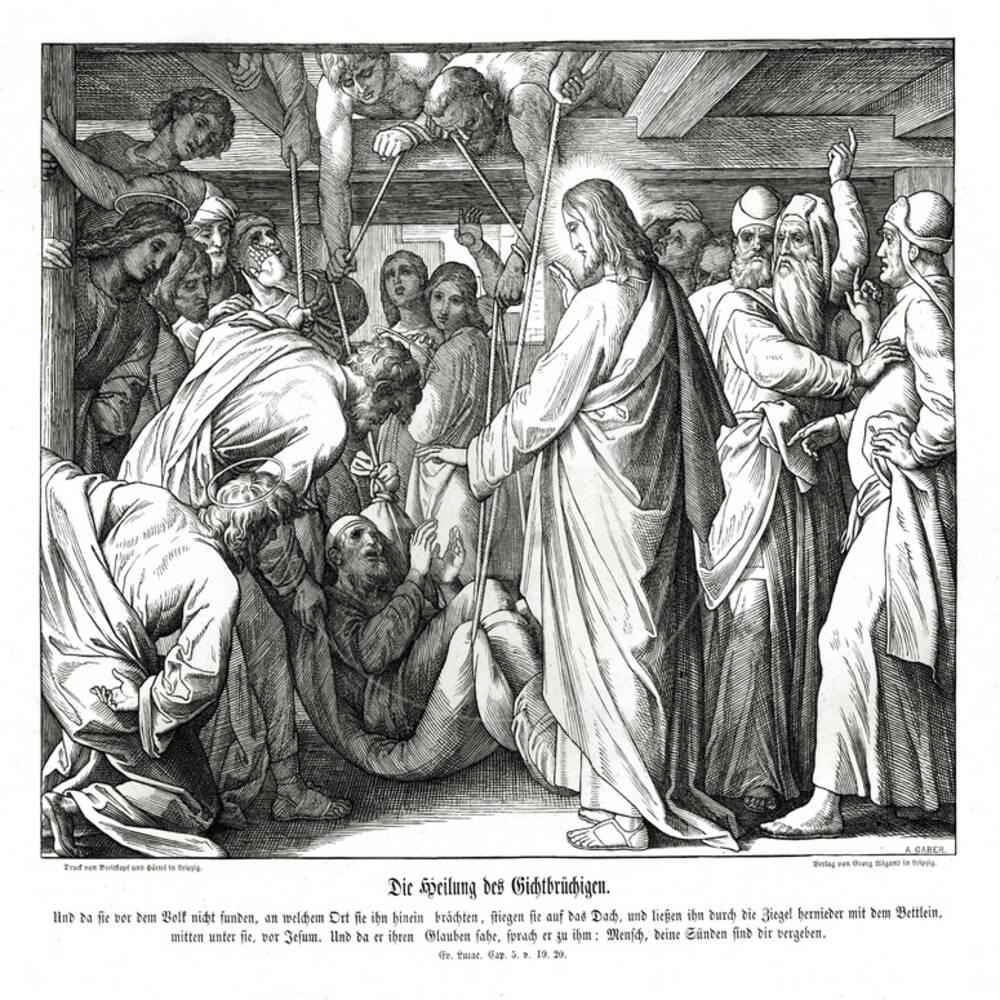

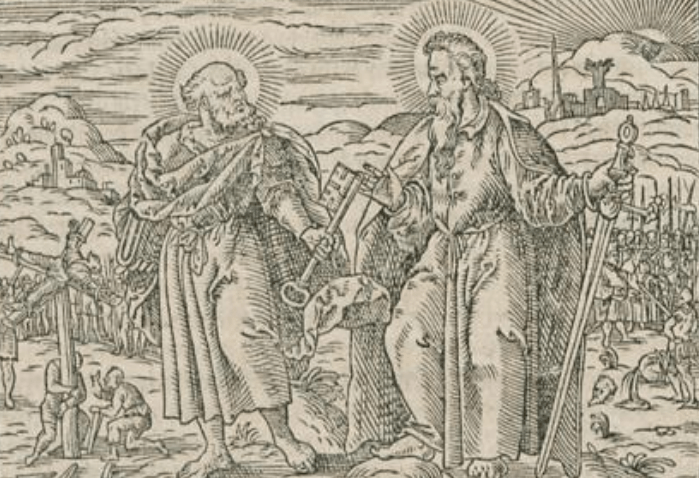
 PATTERN OF SOUND WORDS