The following is my translation of Aegidius Hunnius’s introduction and sermon outline for the Holy Gospel of Quinquagesima (Luke 18:31–43) from his Postilla (Vol. I, pg. 288). Square brackets and footnotes are my own notes and additions.
Explanation of the Gospel
In today’s Gospel, a journey of the Lord Christ is described to us, when he undertook to go up from Galilee to Jerusalem shortly before the last Passover, in order to present Himself obediently to the heavenly Father as a pure sacrifice. And the Evangelists have written down with diligence what Christ spoke and did on this journey. For besides Luke, Matthew and Mark have also recorded this history in its parts and circumstances, who recall with diligence both the conversation the Lord Jesus had on the way with the disciples and what kind of divine miracle He worked on a poor blind man near Jericho, whom He made seeing at his humble and pleading prayer [see Matthew 20:17–19, 29–34; Mark 10:32–34, 46–52].
First, we will hear the Lord Christ’s prophecy concerning His impeding suffering and death. [v. 31–33]
Second, how the disciples received such preaching. [v. 34]
Third, concerning the sign He did on the blind man at Jericho. [v. 35–43]
The following is my translation of the notes and useful applications for the Holy Gospel of Quinquagesima, Luke 18:31–43, as they are found in Das Weimarische Bibelwerk (1877). Square brackets indicate my own notes and additions. For the useful applications, I recommend the reader see this very helpful article by Dr. Benjamin T. G. Mayes.
V. A prophecy concerning Christ’s suffering and death. (v. 31–34)
VI. The history of [the healing] of a blind man. (v. 35–42)
Annotated Text
31. Now He took to Himself the twelve (the twelve apostles), and said to them, “Behold, * we are going (now on this journey) up to Jerusalem (because the time of My suffering has drawn near, I will also draw near to the determined place of My suffering), and all will1 be fulfilled that is written by the prophets concerning2 the Son of Man (about3 My suffering, death, and resurrection).
* Matthew 17:22ff. (Matthew 20:17; Mark 10:32)
1 * Soon now, when I this time, as the last time, shall take Myself there.” Previously when He had preached the same, he spoke only of it in general (see Matthew 16:21, 17:12–22, etc.).
2 Greek: “in” [There is no preposition in the Greek, but τῷ is in the dative case.]
3 * “through or with My…” [I wasn’t sure what this getting at.]
32. For He will be * handed over to the Gentiles (to Pilate, the Gentile governor, and his soldiers), and He will be mocked and shamed (kept in the most disgraceful and shameful way with words and deeds), and spit upon;
* Matthew 27:2
33. and they will scourge and kill Him, and the third day He will rise again.”
(Joshua 2:19)
34. * But they understood none of this, and the saying was hidden from them, and they did not know what it was that He had said (because the disciples, in the supposed worldly kingdom of Christ, had imagined pure joy and good days for themselves, they could not agree with Christ’s suffering, death, and resurrection).
* Luke 9:45
35. Now it happened, when He (Jesus) came near (on His journey) to Jericho,1 * a blind man sat on the way and he was begging.
* Matthew 20:29–30; Mark 10:46
1 * Before he had yet entered the city (Luke 19:1). But the like, as is usual, are found again at the conclusion (see Matthew 20:29).
36. Now when he heard the people that were passing by (and following Christ in heap), he inquired what this was (what the tumult that he heard signified).
37. Then they preached to him, “Jesus of Nazareth is passing over.”
38. And He called and said, “Jesus, you Son of David (You who are the Messiah and the Savior of the World, the one promised to David and born from his lineage according to the flesh), have mercy on me (help me out of pure grace and unmerited compassion)!”
39. But those passing by warned him that he should be silent. But he cried out much more, “You, Son of David, have mercy on me!”
40. Now Jesus stood still and called for him to be brought. Then when they brought him near to Him, He asked him,
41. and said, “What do you what me to do for you?” He (the blind man) said, “Lord, that I may see.”
42. And Jesus said to him, “Be seeing; * your faith has helped you.”
* Matthew 9:22 (Luke 17:19)
43. And immediately * he was seeing1, and followed Him, and praised God. And all the people who saw this praised God.
* Psalm 146:8
1 Greek: “saw again” [ἀνέβλεψεν] (for he was not born blind, as the one in John 9:1ff., but had lost his sight through an accident; the same also goes for v. 41).
Useful Applications
V. DOCTRINE: Concerning the joyfulness and desire of Christ to suffer and die for us, because He had previously known all His suffering, and nevertheless willingly went to Jerusalem where it would happen. (v. 31) VI. CORRECTION: That we ought to call upon Christ with all our heart for spiritual illumination as this blind man did for bodily illumination. (v. 40) COMFORT: Christ, the Light of the World, will not allow anyone to lack who does not willfully shut his eyes (as he testifies with this cure). (v. 41)
The following is my translation of the notes and useful applications for the Holy Gospel for the Twenty-First Sunday after Trinity, John 4:47–54, as they are found in Das Weimarische Bibelwerk (1877). Square brackets indicate my own notes and additions. For the useful applications, I recommend the reader see this very helpful article by Dr. Benjamin T. G. Mayes.
II. How Jesus was received in Nazareth and in other places, and also how the royal official’s son was freed from the fever. (v. 43–54)
Annotated Text
47. And there was a royal official (a distinguished servant in the house of Herod the tetrarch, who nevertheless was considered a king by the common man and thus was called a king, Matthew 14:1, 9; Mark 6:14), whose son lay sick in Capernaum. This one heard that Jesus came (He had learned that Jesus had come) from Judea in Galilee, and he went to Him (to Cana, about five miles’ way), and he asked Him that He come down (go with him to Capernaum) and help his son, for he was sick unto death (therefore, he also supposed that Christ would have to be present himself for so dangerous an illness, and that he could not perform this work of healing if he were absent, much less raise him from the dead if he should die).
48. And Jesus said to him: * “If you do not see signs and wonders, ** then you will not believe (“You Jews believe no more than you see. If I go with you, you suppose that I could help your son; but what kind of faith is that?” To believe rightly means not to doubt at all about that which one does not see, Hebrews 11:1, and to ground oneself in the omnipotence and goodness of God insomuch that he can and will help, even above and against all sense and reason).”
* John 2:18; 1 Corinthians 1:22
** behold presently with your own eyes. The answer is aimed at the request to come down in v. 47 and agrees with Matthew 9:18.
49. The royal official said (further, in the weakness of his faith) to Him, “Lord, come down, before my child dies (otherwise, Your presence will be in vain).”
50. Jesus said to him, “Go (at this My Word, to which you shall attach firm faith), * your son (has not died as you think, but) lives (through the divine power of this My Word, and when you come home, you will find him alive and well).” The man believed the Word that Jesus spoke to him, and he went (in certain confidence that the Lord’s Word would come to pass; therefore, he also did not hurry home all at once, to which he could have come that same evening if he had wanted, but rather remained overnight on the way).
* 1 Kings 17:23
51. And while hewas going (further, on the next day), his servants met him, proclaimed it to him and said, “Your son lives (and is completely alive, healthy, and strong).”
52. Then he investigated from them the hour in which it had become better with him. And they said to him, “Yesterday, around the seventh hour (according to our time, around 1 PM in the afternoon) the fever left him.”
53. Then the Father realized (and heard precisely) that itwas (exactly) around the hour in which Jesus had said to him, “Your son lives (v. 50).” And he (as now he had been fully convinced of the divine miraculous power of Christ) believed along with his entire household (his wife, children, and household servants were brought through to true faith in Christ. And some hold that this royal official’s wife was Joanna, who is mentioned in Luke 8:3, and that she is called the wife of Chuza, the steward of Herod, who followed the Lord and ministered to Him from her own possessions).
(Acts 16:32, 18:8)
54. This is now the second sign that Jesus did when He came from Judea into Galilee. (The first is described in John 2:7ff.)
Useful Applications
II. DOCTRINE: What faith or heartfelt confidence in Christ’s Word and promise has for power and might is testified by the royal official (v. 50–53). DOCTRINE: But how the Lord Jesus often uses many wondrous preparations and arrangements to awaken and to strengthen faith is seen from both stories (v. 16–54).
The following is my translation of the notes and useful applications for the Holy Gospel for the Nineteenth Sunday after Trinity, Matthew 9:1–8, as they are found in Das Weimarische Bibelwerk (1877). Square brackets indicate my own notes and additions. For the useful applications, I recommend the reader see this very helpful article by Dr. Benjamin T. G. Mayes.
Notes
I. The History of the Paralyzed Man (v. 1–8)
1. Then He (the Lord Christ) entered into the boat (in which He had come from Capernaum into the regions of the Gergesenes, Matthew 8:18, 28) and crossed over again and came into His own city (Luther: “Capernaum,” where He had rented a house, and stayed there during the Passover, Matthew 4:13, 11:23, 17:24; John 2:12).
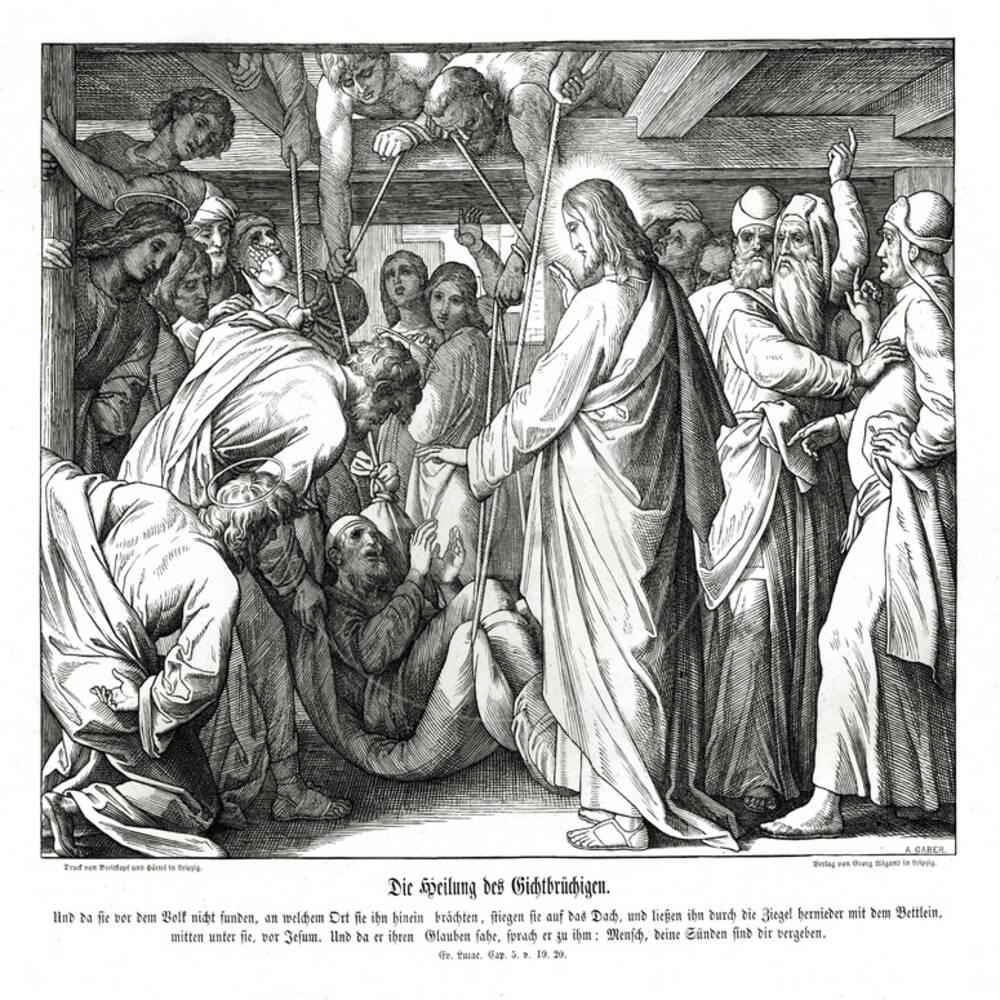
2. And behold, there * they (four of them) brought to him a paralyzed man (Luther: “whom had been afflicted by paralysis, the small or half stroke”) who was laying on a bed (He could neither move nor stir on account of his sickness. They sought a way how they might bring him in and lay him before Him; and when they could not come to Christ in any other way on account of the great multitude of people, and also could not find a place in which they could bring him in, they climbed onto the roof, where He was, and uncovered it, and let him down through the tiles with the little amongst their midst before Jesus, Mark 2:4, Luke 5:19). Now when Jesus saw their faith (understand not only the faith of the bearers, ** but also of the paralytic man himself; for if he had not believed in a saving way and at the same time with trust in Christ’s mediating office, Christ would not have forgiven his sins, nor called him son), He said to the paralyzed man, “Be comforted (and be of good courage), My son, your sins (which make you anxious in your heart) are forgiven you (Thus Christ begins His cure with the soul, because all bodily illnesses come from sin, and because the health of the body without the health of the soul is of little usefulness).”
* Mark 2:1ff. Luke 5:18 (Luke 7:50; Acts 9:33)
** Their faith came to the aid of the sick man, to promote the healing of his body in love, as far as it was possible.
3. And behold, some among the scribes (and the Pharisees, those who were sitting there and heard such) said amongst themselves (thought in their hearts), “This one (Jesus from Nazareth) blasphemes God (in that He ascribes to Himself such authority, which belongs only to God; for who can forgive sins except God alone? Luke 5:21).”
(Luke 7:49)
4. But when Jesus saw their thoughts (He knew immediate in His spirit that they thought thus within themselves, therefore), He said, “Why do you think such wicked things in your hearts (in that you falsely accuse me of blasphemy of God within yourselves, when that which I do nevertheless is my office)?
(Zechariah 8:17)
5. Which is easier (according to outward appearance and the judgement of reason), to say (to the paralyzed man), “Your sins are forgiven,” or to say, “Stand up (take up your bed) and walk?” (You think in your hearts: If I truly could forgiven this paralytic his sins in fact and truth, then I would also have been able to make him whole as well; but because this had not happened, so that is also lacking [i.e., I have not actually forgiven his sins].)
6. But so that you know (and see in fact) that the Son of Man has the authority (and indeed from His own power) to forgive sins (and that the forgiveness of sins is powerful, which I have declared to this paralytic man, and in truth has come upon him; well then I will thus make this man well before your eyes, therefore),” He then said to the paralytic, “ (I say to you,) Stand up, take up your bed (upon which you have had to lie ill and sick for very long time), and go home.”
(John 5:8; Acts 9:34)
7. And (immediately) he stoodup (so that all who those present saw, and he lifted up the little bed upon which he had lain) and went home (and praised God).
8. And the people that saw (this miracle) marveled and praised God, who had given such authority to men (they praised God, that He had sent them such a prophet who forgives sins and who could heal diseases which by nature are incurable. “All those were astonished who heard and saw this, and they were filled with fear and said, ‘We have seen extraordinary things today, and we have never seen such before,” Mark 2:12, Luke 5:26).
(Luke 7:16ff.; 1 Thessalonians 5:18)
Useful Applications
I. DOCTRINE: Christ’s true and eternal divinity shines forth from the fact that He searches out men’s hearts, forgives sins (which belongs to God alone), and heals incurable diseases (v. 2–7).



 PATTERN OF SOUND WORDS