The following is my translation of Aegidius Hunnius’s introduction and sermon outline for the Holy Gospel of Sexagesima (Luke 8:4–15) from his Postilla (Vol. I, pg. 266). Square brackets and footnotes are my own notes and additions.
Explanation of the Gospel
This sermon, as it is presented to us in the parable just read, the Son of God has spoken not only for Himself, but rather has also commanded it to His hearers with special diligence, when He cried out and said, “Whoever has ears to hear, let him hear!” [Luke 8:8] With this saying, as with the sound of a mighty trumpet, He awakens sleeping hearts to diligent attentiveness, seriousness and devotion for the hearing of His sermon, because there such matters are handled upon which the well-being and salvation of all the world depends, since once again, He describes the occasion of the high works of God and His Kingdom upon earth in parabolic way and opens the mystery of how it happens that not all hearers of the Word are converted and improved unto eternal life.
So then, let us present out hearts and ears, and indeed examine with a wakeful mind what God’s Son, our Lord and Teacher Jesus Christ has taught and preached to us concerning these important points. Let us not listen superficially, as the people did, who after hearing the parable, withdrew again without any investigation after spiritual understanding.1 Rather, let us persevere in the sermon of Christ with His disciples until we have heard the explanation from His mouth and have made use of it.2
1. First, we will hear the parable recounted in itself [v. 4–8].
2. Second, we will hear how the disciples desire that the parable might be explained to them and that Christ offers Himself to this end [v. 9–10].
3. Third and last, we will consider and contemplate the explanation of Christ [v. 11–15].
“Every poor sinner should therefore attend to the Word, hear it attentively, and not doubt the Father’s drawing. For the Holy Spirit will be with His Word in His power, and will work by it. That is the Father’s drawing. The reason why not all who hear the Word believe, and some are therefore deeply condemned, is not because God had begrudged them their salvation. It is their own fault. They have heard the Word in such a way as not to learn, but only to despise, blaspheme, and disgrace it. They have resisted the Holy Spirit, who through the Word wanted to work in them, as was the case at the time of Christ with the Pharisees and their followers.” (FC SD XI.77–78) ↩︎
Note the italicized portion: “The preacher’s planting and watering and the hearer’s running and hearing would both be in vain and no conversion would follow it if the power and effectiveness of the Holy Spirit were not added [1 Corinthians 3:6–7]. The Spirit enlightens and converts hearts through the Word preached and heard. So people believe this Word and agree with it. Neither preacher nor hearer is to doubt this grace and effectiveness of the Holy Spirit. They should be certain that when God’s Word is preached purely and truly, according to God’s command and will, and people listen attentively and seriously and meditate on it, God is certainly present with His grace.” (FC SD II.55) ↩︎
Here is another brief translation of Johannes Brenz’s sermon outline for the Gospel of Sexagesima (Luke 8:4–18) as found in his Postilla (pg. LXIIII).
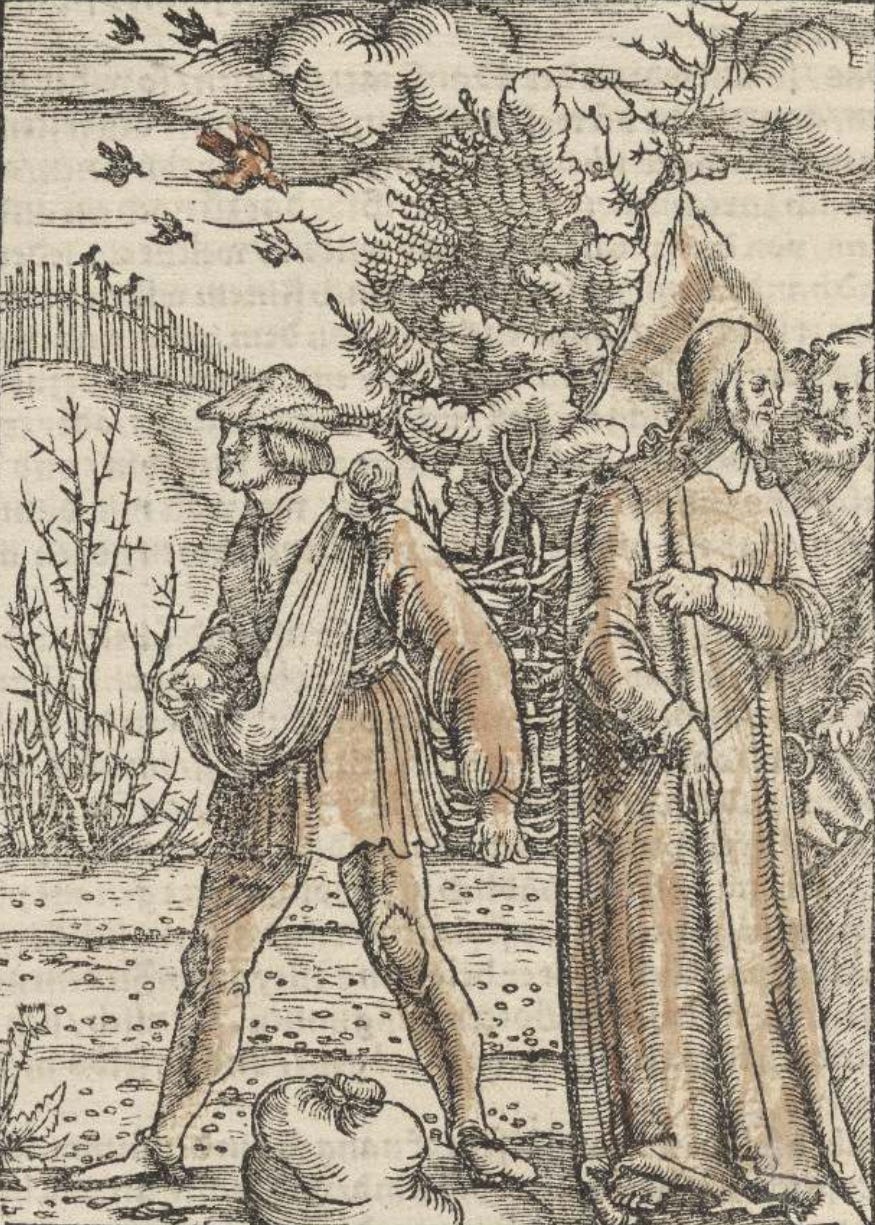
Artwork found in Brenz’s Postilla (1556), pg. LXIIII
Summary of this Gospel
In this Gospel, we learn:
First, that the doctrine of the Gospel is not the cause of all misfortune and evil, but rather Satan and our sin.
Second, what Christ’s doctrine is, namely, concerning the Kingdom of God.
Third, that our unbelief and malice are a cause that we cannot understand the Gospel.
Fourth, the hearers of the Gospel are dealt with, namely, that there are four kinds.
The first are those who according to the Gospel remain knaves (Buben) as before; and here is taught how these ought to conduct themselves so that they do not perish.
The second are those who receive the Gospel with joy, but as soon an evil wind comes, they have no faith; how these may be preserved is also taught alongside.
The third are those who because of anxiety, sustenance, or the riches of this world cannot grasp the Gospel; how these should act so that they may come to eternal life is also indicated.
The fourth are those who hear the Gospel and keep it, who will be saved.
Fifth, it is also taught how there is no estate higher before God and of more worth than another.
Last, that the Gospel, where it is preached, does not depart without fruit.
The following is my translation of the notes and useful applications for the Epistle Reading of the Transfiguration of our Lord, 2 Peter 1:16–21, as they are found in Das Weimarische Bibelwerk (1877). Square brackets indicate my own notes and additions. For the useful applications, I recommend the reader see this very helpful article by Dr. Benjamin T. G. Mayes.
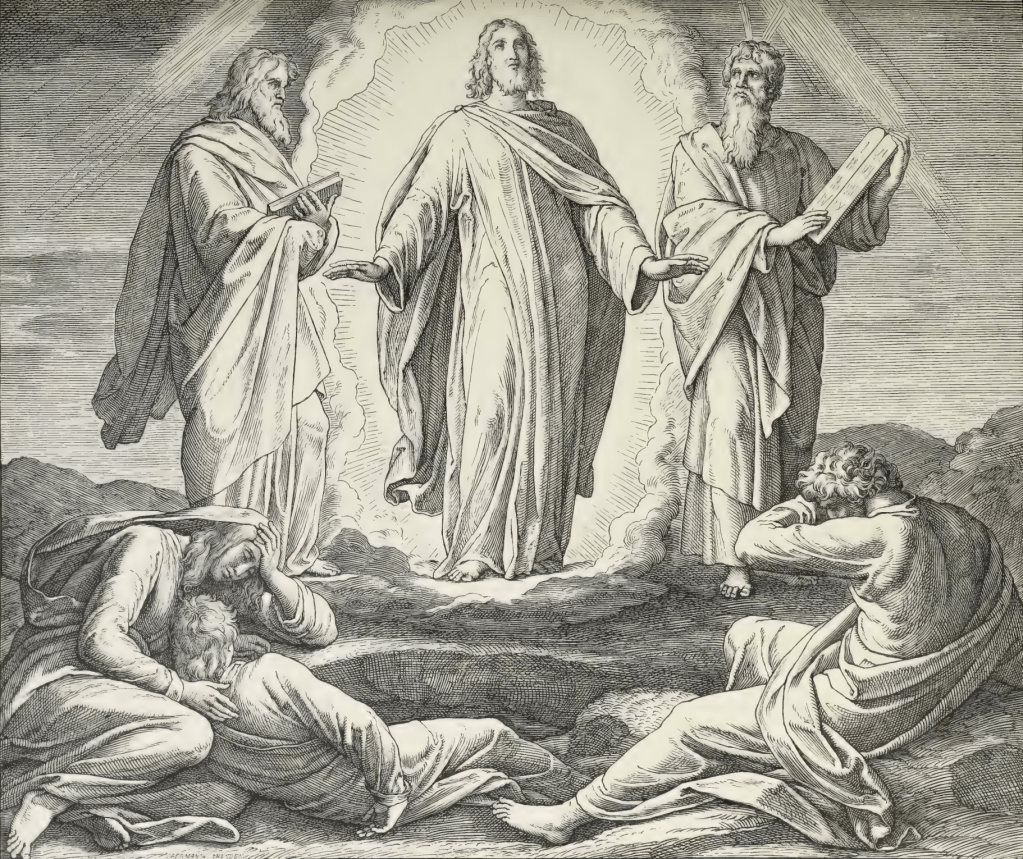
The Transfiguration of Jesus, by Julius Schnorr von Carolsfeld
IV. A new admonition to pure apostolic doctrine. (v. 16–21)
Annotated Text
16. For we (I and other apostles) have not followed * clever fables (cleverly devised poems), when we had proclaimed † the power and coming1 of our Lord Jesus Christ (how He will one day come for judgment in power and glory); but rather we have seen His glory (and divine majesty) ourselves;
*1 Corinthians 1:17
† 1 Corinthians 2:4 (John 1:14)
1 Greek: present (that He now shines in reality as the Savior of the world)
17. when1 He (in His transfiguration) received honor and praise from God the Father through a (clear and audible) voice that came2 to Him from the great Glory, “This is My (only-begotten, own, and) beloved Son, in whom I have good pleasure (whom I not only love in a fatherly way, but rather, for His sake, also have good pleasure in all who believe in Him, Ephesians 1:6).”
* Matthew 3:17, 17:1–5; Luke 9:35 (Matthew 12:18)
1 Greek: “For when…” [γὰρ]
2 Greek: “and such a voice came to Him…” [φωνῆς ἐνεχθείσης αὐτῷ τοιᾶσδε]
18. And we (I and my fellow apostles James and John) have heard this Voice which was came from heaven,1 * when we were with Him on the holy mountain (which, on account of this divine revelation, is called the holy mountain, Exodus 3:5).
1 Greek: “So we (ourselves) also have heard this voice (clearly), when it resounded from heaven” [καὶ ταύτην τὴν φωνὴν ἡμεῖς ἠκούσαμεν ἐξ οὐρανοῦ ἐνεχθεῖσαν]
* Matthew 17:5 (Luke 9:35ff.)
19. We have1 a firm (even more firm than the aforementioned revelation on the mountain and the divine Voice which was heard there, namely, a) prophetic Word (contained in the Scriptures of the Old Testament inspired by God, through which the doctrine of Jesus Christ and His righteousness, which comes through faith, is manifestly attested, Romans 3:21), and you do well that you pay heed to it (and diligently search therein, John 5:39, Acts 17:11) as to * a light, which here (together with the doctrine of the Gospel contained in the New Testament in the apostolic Scriptures, 2 Peter 3:15–16) shines in a dark place (in this poor mortal life, which in comparison to the future eternal life is a true land of darkness and gloom, Job 10:21),2 until the day (of the full radiance and the glorious light of eternal life) dawns and the Morningstar (Christ Jesus, Revelation 22:16) rises in your hearts (when there will be no more night, and one will not need a lamp or the light of the sun because God the Lord Himself will illumine the elect, Revelation 22:5).3
1 Greek: “We also have” [καὶ ἔχομεν] (namely, beyond the first vision mentioned)
* Psalm 119:105; 2 Corinthians 4:6
2 Or, “in your soul,” which without this light is darkness by nature.
3 This may also be a description of the dawn, that is, the believing knowledge of Christ that appears to us here and always is increased in divine grace, upon which the full day of eternal life follows. See Isaiah 8:20.
20. And that you should know this first (first of all), that no prophecy in Scripture (thus recorded in Holy Divine Scripture) happened from one’s own interpretation1(which a man spins and devises from his own mind, but rather, the interpretation of the prophetic prophecy must be taken from Holy Scripture itself);
(Romans 12:7; 2 Timothy 3:16)
1 Greek: Alternatively, “As you know above all (as a foundational principle of your faith), that no prophecy contained in (Holy) Scripture comes from one’s own resolution (or the arbitrary will of men).” [τοῦτο πρῶτον γινώσκοντες ὅτι πᾶσα προφητεία γραφῆς ἰδίας ἐπιλύσεως οὐ γίνεται]
21. For no prophecy ever (contained in Holy Scripture) was ever brought about from the will of men; rather, the * holy men of God (the holy prophets) spoke (of divine mysteries), being driven † by the Holy Spirit. (Therefore, just as Holy Scripture did not flow forth from human reason, but is inspired by God, 2 Timothy 3:16, so also must the correct interpretation of prophetic Scripture not be spun from human reason, but rather must arise from the Holy Spirit, who, just as He is the origin of Holy Scripture, must also be its most certain interpreter.)
* Wisdom 7:27
† Acts 28:25 (2 Samuel 23:2; Acts 2:16; 1 Peter 1:11)
Useful Applications
IV. CORRECTION: To pay attention to the prophetic Holy Scriptures, to hold them high and of worth, and also to follow them in faith and life as a light bestowed by God. (v. 19) * COMFORT: Because the Holy Scripture is not man’s Word, but rather is God’s Word, so we ourselves can rely upon it in life and death. (v. 20–21)
The following is my translation of the notes and useful applications for the alternate Gospel Reading for the Commemoration of the Lutheran Reformation (Reformation Day), John 8:31–36, as they are found in Das Weimarische Bibelwerk (1877). Square brackets indicate my own notes and additions. For the useful applications, I recommend the reader see this very helpful article by Dr. Benjamin T. G. Mayes.
II. A discussion with the Jews concerning the office of Christ, concerning the true freedom of the children of Abraham and their characteristics, as well as concerning the divinity of Christ. (v. 12–58)
Annotated Text
31. Then Jesus now said to the Jews who believed in Him, “If * you (steadfastly) remain in My Speech (and My Words remain in you, John 15:7), so you are My true disciples (those to whom the end of faith, eternal salvation, will be gifted).
* John 7:17; 15:10, 14.
32. And you will know the truth (have the faith of God’s elect, the knowledge of the truth according to godliness, in the hope of everlasting life, Titus 1:1–2), and the truth (such blessed knowledge of salvation, which consists in the forgiveness of sins, Luke 1:77) * will make you free (from slavery to sin, John 8:34, and from eternal death, John 8:51).”
* John 8:36ff. (Romans 6:13; Galatians 5:1; 1 Peter 2:16)
33. Then they answered Him (namely, the others who were still unbelieving Jews, who were mixed with those believers), “We are Abraham’s seed, * we have never been anyone’s slaves (bondsmen) at anytime (The Jews said this out of lying presumption and a proud mind, for in truth the situation was something much different, as is known from the histories). ** How can You say then, ‘You shall be free?’”
(Matthew 3:9; Jeremiah 2:14)
* Greek: “and” – (By the former, they boast of a free origin, but with one, they boast of a free estate.)
** Nevertheless, it could also be that those who lived at that time and spoke with Christ had wanted it to be understood only of themselves, as those who were indeed subjects of the Emperor, but who were not slaves and still lived according to their own laws.
34. Jesus answered them and said, “Truly, truly, I say to you, * whoever sins (whoever lets sin reign in his mortal body, gives obedience to its lusts, and gives his members over to sin as instructions of unrighteousness, Romans 6:12–13), he is sin’s slave (and is free concerning righteousness, whose end is eternal death, Romans 6:20–21).
* Romans 6:16, 20; 2 Peter 2:19; 1 John 3:8.
35. However, the * slave (as it goes in common life) does not remain eternally in the house (in this way also whoever is a slave of sins and a bondsman of the devil, 1 John 3:8, 2 Timothy 2:26; and such a one who remains stiff-necked without repentance has no part nor inheritance in the house of God and in the eternal kingdom of heaven, John 14:2, even though he finds himself among the external heap of the congregation of God); the Son (that is, God’s) remains (in the same house of God) eternally (and with Him those also remain therein, who hold fast the confidence and the boast of hope until the end, Hebrews 3:6).
* Genesis 21:10
36. So now, if the Son * makes you free (through the heavenly truth, John 8:32), so you will be truly (and eternally) free (from sin, death, and hell).”
The following is my translation of the notes and useful applications for the Old Testament Reading for the Eighth Sunday after Trinity, Jeremiah 23:16–29, as they are found in Das Weimarische Bibelwerk (1877). Square brackets indicate my own notes and additions. For the useful applications, I recommend the reader see this very helpful article by Dr. Benjamin T. G. Mayes.
IV. A repetition of the rebuking sermon, where Jeremiah recounts at length the sins of the false shepherds and how God will punish them. (v. 9–32)
Annotated Text
16. So says the Lord (the God) of Sabaoth: * “Do not listen to the words of the (hypocritical) prophets, who prophesy to you (only peace and good). They deceive you (with such caressing sermons), for they preach to you a vision of their own heart (what they themselves have thought), and not from the mouth of the Lord.
* Jeremiah 6:14, 14:14, 27:14–15
17. They say to those who blaspheme me * (to all idolatrous and wicked sinners, when they ought to admonish them to repentance): ‘The Lord has said, “It will go well for you.”’ And to all those ** who walk according to the darkness of their heart, they say: ‘No misfortune will come upon you’ (but they lead themselves and the people astray).”
* Hebrew: “despise.” (Even if it did not happen outright, this nevertheless was the fruit of the inappropriate comfort amidst ruling wickedness.)
18. For * who has stood in the council of the Lord, who has seen and heard His Word? (Who has told them what they so audaciously prattle? I know nothing of it.) Who has understood and heard His Word? (They or I? Is it not so that the Lord has not sent them? The result will show it, for…)
* Romans 11:34ff. (Isaiah 40:13ff.)
19. Behold, a * storm (misfortune and punishment) of the Lord shall come with fury (will come with great power upon them), and a terrible tempest will fall upon the head of the godless.
* Jeremiah 30:23; Psalm 11:6
20. And * the Lord’s wrath (kindled over them) will not cease, until He does and carries out what He has in His mind; afterward (when these things come to pass, and still even more perfect at the time of the New Testament), you will learn it. (Who as correctly preached and prophesied? I, who preach God’s wrath and punishment, or they, who only preach peace? For so says the Lord concerning them:)
* Jeremiah 30:24
21. “I * did not send the (imagining) prophets, yet they ran (and they prophesied); I did not speak to them (that it shall go well for the Jews), yet they prophesied (no misfortune would come upon them).
* Jeremiah 14:14ff. (27:15, 29:9)
22. For if they (would have) remained in My council * (revealed by Me for the salvation of men, which is true repentance and faith in the promised Messiah, Acts 20:21, 27), and had preached My ** words to My people, then they*** (my people) would have turned from their wicked nature and from their wicked life. (They would have zealously admonished them to conversion. Luther: “God’s Word converts; every other doctrine misleads, etc.” Do they think then that because I am in heaven that I do not know their deeds on earth?)
* That is, the order of grace, according to which repentance and true faith are included together with all the promises.
** 1 Peter 4:11 (Jeremiah 27:18; Luke 24:47)
*** Hebrew: “then they would have — preached to my people, and they – would have admonished them to repent.” (For to preach repentance, especially when corruption has taken root is the sign of a true prophet.)
23. “Am I not a God who is near (and sees all),” says the Lord, “and not a God who is far? (And who does not know what you teach and do? Luther: “They are so secure and brazen, as if I did not see their false doctrine and wicked life.”)”
(Acts 17:27)
24. “Do you think that someone * can hide himself secretly so that I cannot see Him?” says the Lord; “Do I not fill heaven and earth?” (Not with such an extension, but rather with such omnipresence that not even a little room may be named where I would not be present, yet as an immeasurable spirit, John 4:24) says the Lord.
25. “I hear well that * the (hypocritical) prophets (so dangerously) preach and falsely prophesy (teach) in My name (of which they boast in a seductive manner) and say, ‘I have dreamed, I have dreamed! (The Lord has revealed it to me in a dream.)
* Hebrew: “which”
26. When will the (false) prophets cease, who falsely prophesy and prophesy the deceit of their heart, *
Hebrew: “How long will it continue (in this way)? Does it then stand with these these prophets (in their hearts and pleasure, Ezekiel 13:2) that they preach lies? Or are they prophets to set forth the deceit of their hearts?”
27. and who want * (gladly that it be brought so far in religion) that my people should forget my name (of the Lord) for their dreams (through their prophecies, which they say, that I have revealed to them in a dream), which one preaches to another, just as (in previous times) their fathers forgot my name for Baal?
(Judges 3:7ff.)
* Hebrew: “who then want”
28. A (false) prophet who has dreams preaches (in spite of everything) dreams (Luther: “Let him leave My name in peace, and not say that it is My Word what he dreams, but rather that it is his own word and have his own name.”); but whoever has My Word (that I have placed in his mouth), let him preach My Word correctly. (And let him see to it well that such not be mixed with false doctrine and human ordinances * , for) How do chaff (false doctrine) and wheat (my Word, the heavenly nourishment for the soul) go together?” says the Lord (“The power of my Word is quite different and higher than what breaks forth in their prophesy”).
(Ezekiel 20:39; 1 Peter 4:11)
* as well as set forth the complete order of salvation (see v. 22).
29. Is * My Word not as a (powerful and piercing) fire (which kindles, purifies, and cleanses the hearts of the godly),” says the Lord, and as a (strong) hammer, whichsmashes (the hard) rocks (that is, the stiff-necked and hardened consciences of the godless)? (In that they are powerfully convicted and overcome by My Word.)
* Hebrews 4:12 (Luke 24:32)
Useful Applications
IV. DOCTRINE: That the hearts of men are struck through the preached word (as the spiritual hammer) and are broken for true repentance (v. 29).
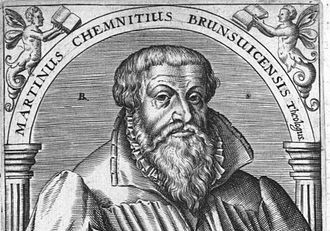
The following is a translation of Martin Chemnitz’s sermon outline found in his postil for Sexagesima (Postilla, Volume I, pgs. 399–400). The Gospel reading is Luke 8:4–18. Square brackets indicate my own notes and additions.
Division of the Sermon (pgs. 399–400)
“This is the summary and content of this parable, which the Lord Christ himself has shown such understanding for us. Now, that we may thereby learn something useful from it, we will summarize it in these five points:
First, how the Lord comes to this parable, and how he thereby reminds us into which great misery we have fallen through the Fall of our first parents, and what God the Almighty does with us, so that He might restore us from such misery and corruption of our [human] nature, and bring us again to righteousness; how to this end He uses the noble seed of His Word, thereby sowing it into our hearts, and making good again whatever was corrupted in them; and from where the Word has such power.
Second, how everyone who considers himself to be saved should let this be a warning to him, that he should not despise the Word through which God solely accomplishes this, because the Lord says here, that He will strike the despisers of the Word with blindness, and because they will not receive the truth, He will never let them come to it. Therefore, how preachers ought to diligently admonish their hearers that they guard themselves against the despising of the Word, and each one remember that He is not to stop up his ears to God’s Word, but rather “gladly hear and learn it.” [cf. Luther’s Explanation of the Third Commandment in the Small Catechism]
Third, if we are now not despisers [of God’s Word], that we are are then to further learn how we ought to rightly prepare ourselves to hear the Word of God in order that we may hear it with fruit, and what we ought to guard ourselves against lest the seed be thereby hindered so that it not come into fruition.
Fourth, how we ought to apply ourselves diligently that we might be a good field (Acker) and bring forth good fruit, and everything that belongs to it: that one must hear the Word, grasp it in his heart, understand it, retain it in his heart, and bring forth fruit with patience.
And then finally, how each one should take the parable for himself, go through it, and examine himself, how he finds himself, by what he is struck, so that he might use it for his benefit, and thus conduct himself so that he does not let God work on him in vain, since He intends good for us from the heart.
If we thus make use with the parable in such a way and make use of it for ourselves, then we can use it usefully and fruitfully, and therefore we will deal with these points in an orderly manner.”



 PATTERN OF SOUND WORDS