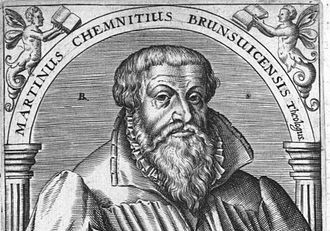
The following is a translation of Chemnitz’s outline for Holy/Maundy Thursday (“Green Thursday,” Gründonnerstag) as found in his Postilla (Vol. I, pg. 648). Chemnitz uses a composite text from Matthew 26:20–39, Mark 14:12–25, Luke 22:7–20, and 1 Corinthians 11:23–29. The text in parentheses comes from the original text. I have added additional text in square brackets to aid the reader.

Chemnitz’s Outline:
“This present day, which we call Good or Green Thursday (guten oder den grünen Donnerstag), has at all times been honorably, commendably, and Christianly observed in the holy Christian Church of the New Testament, and it observes this not out of frivolity or custom, but because of the remarkable history and great deeds which the Son of God, our dear Lord and Savior Jesus Christ, accomplished on this day.
- For first, the Lord Christ today had eaten the passover lamb (Osterlamb), according to the Law and order of God (nach Gottes Gesetz und Ordnung) [Exodus 12], and according to the manner and custom of the Old Testament, and thereby bid farewell (Valete gegeben) to Moses and the entire Old Testament [see Hebrews 8:13].
- Second, He immediately thereafter instituted, ordained, and established the New Testament of His body and blood, which He gives us to eat and to drink in His Supper (in seinem Abendmal), that we thereby be reminded of His death [1 Corinthians 11:26], and by this means be assured that we also ought to enjoy His suffering and death (seines Leidens und Sterbens geniessen) for the forgiveness of our sin and the assurance of our salvation.
So we will now briefly deal with these two parts and see what we have therein for instruction (Lehr), necessary reminder and warning (Erinnerung und Warnung), as well as constant comfort (Trost), and how we can apply them usefully.”
 PATTERN OF SOUND WORDS