Tag: Holy Trinity

  • Notes and Useful Applications for Matthew 17:1–9 from Das Weimarische Bibelwerk (1877)

    The following is my translation of the notes and useful applications for the Holy Gospel of the Transfiguration of our Lord, Matthew 17:1–9, as they are found in Das Weimarische Bibelwerk (1877). Square brackets indicate my own notes and additions. For the useful applications, I recommend the reader see this very helpful article by Dr. Benjamin T. G. Mayes.
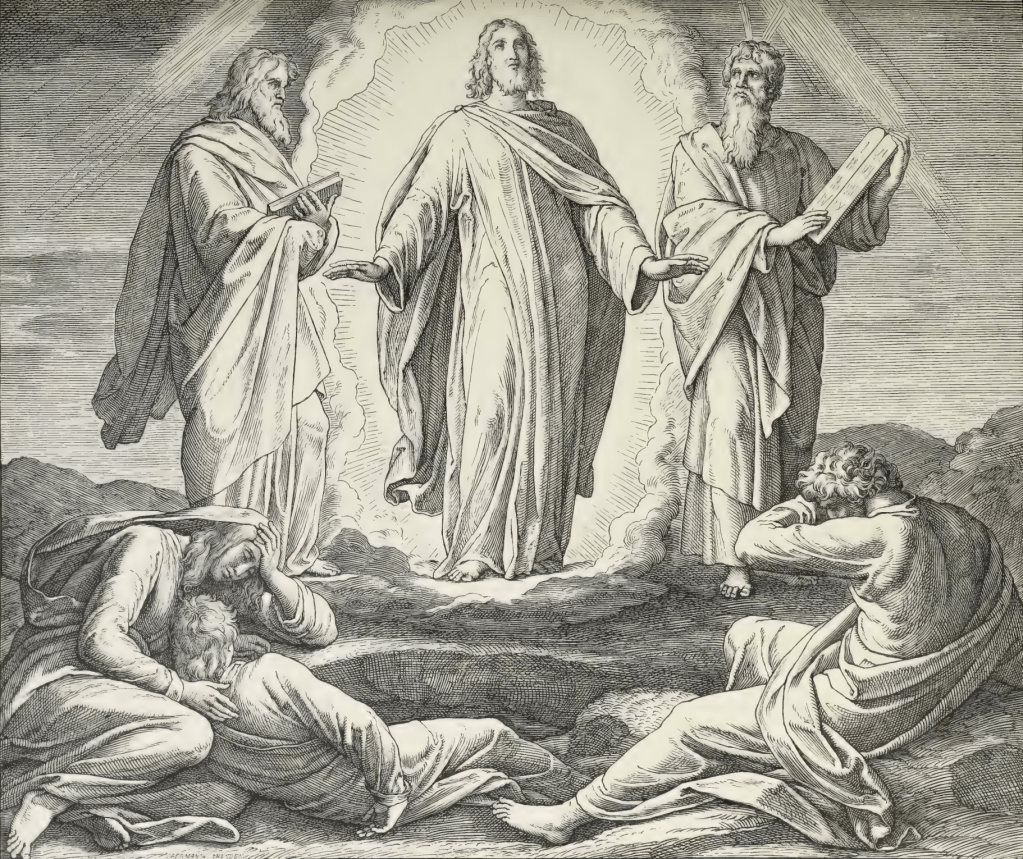
    The Transfiguration of Jesus, by Julius Schnorr von Carolsfeld

    I. The history of the transfiguration of Christ on Mount Tabor. (v. 1–8)
    II. The conversation of Christ with His disciples concerning the future Elijah. (v. 9–13)

    Annotated Text

    1. And after * six days (In Luke it says, “And it came to pass about eight days after these sayings,” [Luke 9:28]. For there had been six days between the time Jesus spoke these words at the end of the nearest preceding chapter and afterwards on the eighth day this Transfiguration followed), Jesus took to Himself Peter and James and John, his (James’s) brother (which three He likewise afterwards took to Himself  when He wanted to go to His suffering in the garden of the Mount of Olives, Matthew 26:37, to indicate that those who have much of the suffering of Christ are also richly comforted through Christ, 2 Corinthians 1:5), and lead them (specially alone from other people, and went with them) to a high mountain (called Tabor, situated in Galilee,1 to which He withdrew to pray, and when He prayed, the form of His face was altered, Luke 9:28–29).

    * Mark 9:2 (Luke 9:28)

    1 † Or as others hold, “Panium, near Caesarea Philippi.” Peter calls it simply “the holy mountain” [τῷ ἁγίῳ ὄρει], 2 Peter 1:18.

    2. And (He) was * transfigured before them (He was transfigured before them, Mark 9:2, in such a way that He received an entirely different form, He allowed them to see a glance of His heavenly, peculiar Majesty and glory, which was communicated to Him according to His human nature by virtue of the personal union, so that they would be guarded against the offense of the cross of Christ), and His face shown as the sun, and His clothes were white (and gleamed) as light (they became bright and very white as the snow, in such a way that no fuller on earth can make them so white, Mark 9:3).

    * John 1:14; 2 Peter 1:16–17

    3. And behold, there appeared to them (two men bodily, who were) Moses and Elijah, who (appeared in radiance and) spoke with Him (concerning the departure [τὴν ἔξοδον] which He was to fulfill at Jerusalem, that is, concerning His suffering. As Moses and the prophets had prophesied of Christ in their writings, John 5:39, 5:46, Acts 10:43, so also Moses thus speaks here with Christ, as well as Elijah in the name of the all the prophets, and give Him testimony, that He is the Messiah and Savior of the world).

    4. But Peter (and those who were with Him were full of sleep; but when they awoke, they saw His radiance and the two men standing with Him. And it came to pass when they were departing from Him, Luke 9:32–33, Peter began) answered and said to Jesus, “Lord (and Rabbi, Mark 9:5, that is, Master, Luke 9:33), it is good to be1 here (for this transfiguration of Christ and this bodily conversation which Moses and Elijah held with Christ was a foretaste and prefiguration of the joy of eternal life); if you would like, then I will make three huts here, one for you, one for Moses, and one for Elijah (but he did not know what he was saying, for they were confused, Mark 9:6).

    1 Greek: “It is something (truly) beautiful (and pleasant), that we are here (in such a pleasurable bright light).” [καλόν ἐστιν ἡμᾶς ὧδε εἶναι]

    5. Then while He was thus still speaking, behold, there (came and) overshadowed them a luminous cloud (so that they were surrounded by it and were terrified when the cloud covered over them). And behold, a Voice (namely, the heavenly Father, fell) from the cloud (which) said (concerning Jesus Christ), * “This is My beloved (only-begotten) Son (whom I have begotten from eternity out of My essence), in whom I have good pleasure, whom you ought to hear (that you believe what He says to you and do what He commands you. Thus there is found here once more a glorious revelation of the most-holy Trinity: the Father allows His voice to beard from heaven, the Son stands in His transfiguration on the mountain, the Holy Spirit, who enlightens the hearts of men, reveals Himself in a bright cloud).”

    * Matthew 3:17ff.; 2 Peter 1:17

    6. When the disciples heard this, they fell (from fear) on their faces, and were very terrified (because they could not bear God’s majesty).

    7. But Jesus came to them, * touched them (strengthened and comforted them) and said, “Stand up, and do not be afraid.”

    * Daniel 8:18, 10:10

    8. Now then they lifted up their eyes (and looked around themselves, Mark 9:8, and while such a Voice occurred, Luke 9:36, they found and) they saw no one (with them), except Jesus alone (Moses and Elijah had disappeared again).1

    1 * Or rather had entered the bright cloud, Luke 9:35.

    9. And when they descended from the mountain, Jesus commanded them and said, “You shall tell no one this vision (this revelation of My glory) until the Son of Man is raised from the dead (for Christ at that time was still in the state of His humiliation, and wanted that He should suffer and die beforehand before He entered into His glory, Luke 24:26. But afterward, after Christ’s resurrection and ascension, both apostles Matthew and Peter not only proclaimed such, but rather also recorded it in their Scriptures. The disciples have followed such a command, as is fitting; for Luke reports of them when he says, “And they were silent and proclaimed nothing to anyone in those days as to what they had seen,” Luke 9:36).

    * Matthew 16:20

    Useful Applications

    I. DOCTRINE: Christ’s transfiguration according to His humanity on the mountain is a picture of the glory and transfiguration of the bodies of believers as they will be in the resurrection of the dead and in eternal life (v. 1–2)

  • Notes and Useful Applications for Matthew 3:13–17 from Das Weimarische Bibelwerk (1877)

    The following is my translation of the notes and useful applications for the Holy Gospel of the Baptism of Our Lord (Wednesday of the First Sunday after Epiphany), Matthew 3:13–17, as they are found in Das Weimarische Bibelwerk (1877). Square brackets indicate my own notes and additions. For the useful applications, I recommend the reader see this very helpful article by Dr. Benjamin T. G. Mayes.

    III. The history of the Baptism of Christ. (v. 13–17)

    Annotated Text

    13. At that time came Jesus from Galilee (from Nazareth, where He had been reared by His parents, Luke 2:51) to the Jordan to John (He did not send for Him and demand him to come to Him as His servant, but rather went Himself to him), that He might allow Himself to be baptized by him. (For although Christ had no need of baptism for His own person because He was altogether without sin [Hebrews 4:15], yet because He had laid upon Himself our sin, John 1:29, He also wanted for our sake to allow Himself to be baptized in order to drown our sin in the Jordan, indeed, to cast it into the depth of the sea, Micah 7:19, and sanctify the Jordan and all waters through contact with His holy and life-giving flesh for our saving baptism. )

    (Mark 1:9; Luke 3:21)

    14. But John opposed Him (He by no means wanted to allow it) and said, “I indeed need to be baptized (and washed of sin through Your blood and Your Holy Spirit) by You (as the lesser by the greater), and you come to me (that I should baptize You, when you are the Lord, the Creator, the Holy One, and Righteous One, but I am the servant, the creature, the sinner, and the unrighteous one)?

    15. But Jesus answered and said to him, “Let it thus be (in the present estate of my humiliation) now (that I be baptized by you); in this way it befits us to fulfill all righteousness (it befits Me, as the ordained Mediator, that I not only acquire and bring back again the lost perfect righteousness to the human race through My suffering and death, Daniel 9:24, 1 Corinthians 1:30, 2 Corinthians 5:21, but also that I sanctify the means ordained by God through which that same righteousness is offered to men and is appropriated to faith, among which is also the Sacrament of Holy Baptism; therefore, it befits Me to accept baptism, but you to impart it to Me.1 Luther: “All righteousness is fulfilled when we renounced all our righteousness and honor so that God only is regarded as the One who is righteous and who makes believers righteous. John does this when He lays aside His own righteousness and wants to be baptized and justified by Christ as a sinner. Christ also does this when He does not take up His own righteousness and honor, but rather allows Himself to be baptized and put to death, as any other sinner”).” Then he allowed it to Him (then John obeyed Christ so that he baptized Him).

    (Matthew 5:17; Galatians 4:4; Philippians 2:8)

    1 † The baptism of Christ was a part of His mediatorial office, according to which He also voluntarily submitted Himself to this will of His Father according to Zechariah 6:13, and thereby He presented a new pledge of His further, not yet carried out, perfect obedience; consequently, He brought about for us men all the gracious good pleasure of God, in particular the divine power of the ordained means of grace, above all, Holy Baptism, Psalm 40:9.

    16. And when Jesus was baptized, immediately He went up from the water (for at Christ’s baptism such admonition and teaching were not necessary which John was accustomed to use with other baptizands); and behold, then the heaven opened up over Him (it was seen that the heaven parted over Christ, and a bright luminous beam descended from heaven upon Christ to indicate that He is a Teacher from God who has come down from heaven, John 3:2, who through His mediatorial office would open heaven, Ephesians 1:10, and that the door of heaven is also opened to us through Holy Baptism, 1 Peter 3:21). And John saw (in this light) the Spirit of God (the Holy Spirit, the third person in the Godhead), as a dove (in bodily form as a dove, which is not a natural dove and also is not the mere external form of a dove, but rather a special creature of the Holy Spirit like a dove),1 descending and upon Him (Christ) coming (and also remaining upon Him, not as if Christ previously had previously not been partaking of the Holy Spirit; but rather, through this external descent, the inward dwelling of the Holy Spirit was indicated, that He received the Spirit not according to measure, but rather in the highest fullness, John 3:34, and that He is the one who baptized with the Holy Spirit, John 1:33).

    (Mark 1:10; Luke 3:22; John 1:32)

    1 * And thus, this description is not to be understood only as a likeness to a gradually falling cloud.

    17. And behold, a (distinguished, clear, and majestic) * voice (God the Father) from heaven spoke down (allowed itself to be heard from the same light), “This is My beloved Son, (whom I have begotten from eternity from My own essence according to His divinity, Psalm 2:7, and whom I now present to the entire world, especially to My people Israel, as their Savior in a personally assumed human nature and in the freely undertaken form a servant [Philippians 2:7])1 in whom I have good pleasure (through whom I will fulfill My gracious will of redemption of the human race, and in whom, My beloved Son, I will love all who believe in Him, Ephesians 1:6).”

    * Matthew 17:5; Mark 1:11, 9:7 (Matthew 12:18; 1 Peter 1:17; Colossians 1:13; Isaiah 42:1)

    1 † For there is no doubt that all this happened publicly and before many people who were present.

    Useful Applications

    III. DOCTRINE: Concerning the highly praised Holy Trinity, which is revealed here publicly: God the Father through the voice from heaven, God the Son in His assumed humanity, according to which He received baptism, and of which the Father said, “This is My beloved Son, etc.,” and God the Holy Spirit in the visible form of a dove. (v. 16–17) COMFORT: O blessed water-bath which the Son of God has sanctified in Himself! (v. 15ff.) COMFORT: Yet, even more comforting is this, that the Father also assures us of His good pleasure in Him. (v. 17)