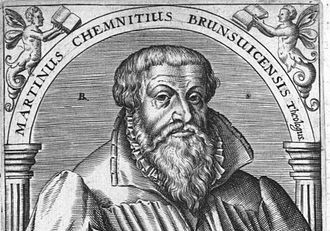
The following is my translation of Martin Chemnitz’s homily for the Visitation of Mary (July 2nd) on Luke 1:39–56 as found in his Postilla (Volume III, pgs. 87–94). Square brackets indicate my own additions and notes. I have broken up some of the longer paragraphs for the sake of readability in English.

Chemnitz’s Gospel Text (Luke 1:39–56)
Now Mary arose in those days and went to the mountains at last (endelich), to the city of Judah, and came into the house of Zacharias and greeted Elizabeth. And it happened when Elizabeth heard the greeting of Mary, the child leapt in her womb; and Elizabeth was filled with the Holy Spirit, and she called out loudly and said, “Blessed (Gebenedeiet) are you among women, and blessed is the Fruit of your womb. And why has this come to me that the mother of my Lord should come to me? Behold, when I heard the sound of your greeting, the child leapt in my womb with joy. And blessed (Gottselig) are you, you who have believed, because there will be a fulfillment of what has been said to you by the Lord.”
And Mary said, “My soul extols the Lord, and my Spirit rejoices in God my Savior. For He has seen His humble maidservant (elende Magd); behold, from now on all children’s children shall praise me as blessed (selig). For He has done great things to me, He who is mighty, and holy is His name. And His mercy endures forever and ever upon those who fear Him. And He has exercised power with His arm, and He has scattered the proud in the mind of their heart. He has pushed the powerful from the thrones, and He has exalted the humble. The hungry He has filled with good things, and the rich He has left empty. He has remembered His mercy and helped His servant Israel, as He had spoken to our fathers, to Abraham and to his Seed forever.”
And Mary remained with her for three months, and thereafter she returned home again.
Explanation of This Gospel
On this feast day we have these accounts to consider, that after the angel Gabriel had announced the counsel of the Holy Trinity (den Rath der Heiligen Dreifaltigkeit) to the Virgin Mary, namely that she shall be a mother of the promised Seed of the woman [Genesis 3:15], in whom all the nations on earth shall be blessed; yet the good virgin at Nazareth had no one to whom she could have entrusted this, for she dared not to reveal it to her betrothed Joseph, for those from Nazareth were such people that one had a proverb about them: “What good can come from Nazareth?” (John 1[:46]); how she set out and at last went over the hill country, about twenty German miles (in die zwäntzig Teutscher Weil Wegs), to her old kinswoman (Gefreundin) Elizabeth, who lived in Bethlehem or at least not far from there, so that she might speak with her about these high matters. And after she had come to her, then our Lord God immediately revealed the conception of His Son with great wonders, and there the first joy of the New Testament began. For Elizabeth was filled with the Holy Spirit and not only spoke but cried out with a loud voice to Mary, “Blessed are you among women and blessed is the Fruit of your womb! And why has this come to me that the mother of my Lord should come to me?” The not yet born into the world John (Der noch nicht zur Welt geborne Johannes) danced and leapt for great joy that the Lord was present, of whom he shall be the forerunner [Malachi 3:1]. Mary sings for great joy, as the Holy Spirit awakened in her heart a glorious beautiful song of praise (Lobgesang), the beloved Magnificat.
On account of this history, we celebrate this present feast, so that we may learn how highly we ought to rejoice with all the saints when we desire to become partakers of the gifts of the New Testament. And just as now these persons thank the beloved God for this great benefit, that He has sent His Son into the flesh, so too we ought to come together today so that we may thank God for this great benefit, that He has revealed His Son in the Gospel, and when such is done by us, then we may rightly celebrate this feast, and without doubt, the Holy Spirit with His grace will be with us. But for now, we do not want to speak about the history, because such happens at other times, but rather we want to take for ourselves the glorious song of praise of Mary, in which she thanks God the heavenly Father with mouth and heart, praises and extols Him that He has now fulfilled with this deed what He had so often promised and pledged from the beginning of the world concerning the blessed Seed of the woman [Genesis 3:15].
Now it is very customary in the Old Testament that when God allows Himself to be recognized by the saints with special graces and benefits and when the Holy Spirit wanted to grasp the benefits of God so that they would never be forgotten but rather would be passed on to the descendants, that they framed such thanksgiving in short songs of praise, even as among us are there are songs and rhymes (Carmine und Reimen), so that they might be learned by others all the more easily, and this they called psalms or hymns (Psalmos oder Hymnos), such as the psalm which Moses had made and sung with the children of Israel when they passed through the Red Sea and our Lord God had cast Pharaoh along with all his [hosts] into the sea (Exodus 15[:1–19]). The like of which Miriam, the sister of Moses, did also together with the women who followed her in the ranks [Exodus 15:20–21]. Such a song of praise was also made by Hannah, the mother of Samuel, in which she thanks God that He heard her prayer and gave her a son (1 Samuel 2[:1–10]); Jonah in the belly of the whale (Jonah 2[:1–10]); the three men in the fiery furnace (Daniel 3[:28]); Judith after Holofernes had died (Judith 16[:1–17]); and Hezekiah, when he had become healthy again from his sickness (Isaiah 38[:9–20]). Here also belongs the entire Psalter of David in which many such psalms and songs of praise are found.
This custom (gebrauch) of thanking God with a song was also begun by Mary in the New Testament through the Holy Spirit, and this is the true Canticum novum, the “new song,” of which David often spoke, and of which Isaiah says in chapter 42[:10], “Sing to the Lord a new song!”, not as Moses had sung of a bodily redemption (einer leiblichen Erlösung), but rather of many great benefits of God and that it should resound to the ends of all the world. This song was first begun by Mary, and thereafter other saints have followed her, namely, Zachariah, the father of John the Baptist (Luke 1[:67–80]), and Simeon the great and learned man when he carried the child Jesus in his arms (Luke 2[:28–32]). Now the Apostle Paul says therefore that we who live in the New Testament ought to follow this example and “sing and make melody to the Lord in our hearts with psalms, and songs of praise, and spiritual songs” (Ephesians 5[:19]; Colossians 3[:16]), as then in the beginning of the Gospel it was a fine Christian custom that one gladly sang spiritual songs while working in the houses, but now people are almost ashamed of it, and many think it sounds much better when one hums a little soldier’s song (Reuterliedlein) or a street song (Gassenhauwer).
In other words, Chemnitz is referring to secular songs that were popular at the time.
Now, you may say: “I know it very well that I ought to praise and extol God for His benefits, I would gladly do it too, but I do not know what words I ought to use for that.” Look, if you are concerned about this, then Mary prescribes a formula for you here. If you follow it, you cannot err, for she bears within herself the Person in whom the fullness of the Godhead dwells bodily (Colossians 1[:19]). In addition, the Holy Spirit has come upon her and the power of the Most High has overshadowed her, as the angel Gabriel says (Luke 1[:35]). Therefore, this is without doubt the foremost of all Psalms (der allerfürnembste Psalm), because God the Father, Son, and Holy Spirit have worked it in her. And because this is so, it was ordained during the papacy that this Magnificat ought to be sung every day with great shouting, even though the words were not understood; indeed, no one one thought upon their meaning. But Mary says here, “I have not sung in that manner; indeed, I spoke with my mouth, but in such a manner that at the same time my soul extolled the Lord and my spirit rejoiced.” So also the Lord Christ declares in Matthew 13[:18–23] that when the seed of the divine Word ought to produce fruit, so one must not merely speak of it, but rather it must also be understood.
Therefore, we now want to pay attention to this so that we may also understand this song of praise, and so that we can thus sing after Mary and praise God with her.
[Sermon Outline]
Now this hymn of praise comprises of three parts in itself.
- First, Mary thanks the blessed God for the benefits which He has particularly showed and demonstrated to her person, and teaches us what pertains to this, when our prayer and thanksgiving ought to be pleasing and acceptable to God.
- Second, she goes at once as if out of her little chamber (Kämmerlein) into the whole world and among the great congregation (grosse Gemeine) of the people of God and declares that the benefits which God has shown to her, the mercy which she has befallen her, do not [only] remain with her, but endure forever and ever from one generation to the next so that the children’s children ought to enjoy the same.
- Third, she teaches how we ought and must dispose ourselves if we intend to become partakers of the mercy of God, and what hinders the greater part of the world so that they do not enjoy the mercy of God, so that we ought to guard ourselves against it.
Concerning the First Part
The first part of this song of praise is a thanksgiving in which Mary thanks God for the benefits which have befallen her person in particular. Therein, she provides a formula for us as to how we ought to thank God for His benefits which we have already received from Him and which we still await according to His promise. For we know from God’s Word that it is not in our free choice whether we may thank God for His benefits or not, rather, God has seriously commanded us in the Second Commandment and such an offering is also very well pleasing to Him (Psalm 50[:14, 23]).
See Luther’s explanation to the Second Commandment in the Small Catechism.
However, our nature, alas, is so miserably corrupted through sin that we easily forget the benefits of God and seldom, rarely, or with little devotion thank Him for them; and even if we have already have a good will and intention to thank Him, so it is nevertheless done more with the mouth and not from the heart, as our Lord God complains about in the prophet Isaiah 29[:13], “This people draws near to me with its mouth and honors me with its lips, [but their hearts are far from me].”
Therefore, we ought to learn from Mary how one rightly thanks God for His benefits, how one ought to praise and extol Him that it may be acceptable to Him. Now Luke says that Mary indeed has praised God with her mouth and with her lips, because he writes, “And Mary said, etc.” [Luke 1:46] However, it did not happen so quickly for her as it does for us when we often say out of habit, “Praise and thanks be to God; God be praised!” yet meanwhile the heart knows nothing of it, indeed thinks of something else. Mary does not do so, but rather she says that her soul magnifies the Lord and her Spirit rejoices, etc. [Luke 1:46–47]. Without doubt, she took these words from the song of praise of her forefather David, who says in Psalm 103[:1], “Praise the Lord, O my soul, and all that is in me His holy name, etc.” The Apostle Paul divides the reborn man into three parts, namely, the body, soul, and spirit [1 Thessalonians 5:23]. By the body, he understands all the external, visible members (eusserliche, sichtbarliche). By the soul, however, all inner powers (alle innerliche Kräfft) and everything that stirs in a person’s heart, such as courage, mind, disposition, understanding, thoughts, and desires. By the spirit, he understands the new gifts which the Holy Spirit works in us and is not in us by nature (von Natur). “All of this,” says Mary, “rejoices and thanks God for His benefits, indeed, my soul not only praises God but exalts Him highly (as we Germans are accustomed to say when someone is praised, “He exalts him far too high!”). Thus, Mary says “My soul extols the Lord, and so highly that I want that the world would know it.” And this is one thing which belongs to right thanksgiving so that it be pleasing to God, namely, when not only the mouth speaks, but rather the heart and the soul also knows of it, the spirit is joyful and all that is within us, the “innermost part” (das innerste), as David says, praises the name of God [Psalm 103:1].
But whom ought we thank? Whom ought we exalt and praise when we have received all kinds of bodily and spiritual, temporal and eternal benefits? The ancients knew how it went in the papacy. When someone was stuck in misfortune, he would commend himself to this or that saint that he might help him, and when he had been helped, people would hang some images made of wax upon the dead idols as thanksgiving, etc. But what does Mary do? She says, “My soul extols—not a dead saint, not an angel, but rather—the Lord,” that is, the God who has revealed Himself in the Word, who says, “I am the Lord your God” [Exodus 20:2; Deuteronomy 5:6], etc. “And my Spirit rejoices in God my Savior, that God Himself has become my Savior,” that is, “I rejoice that God has sent His Son into the flesh, that He should be a Mediator and Savior.” And Mary makes a fine distinction of the persons in the single divine essence in that she mentions the Lord, God the Savior, and the Spirit.
But for what does she give thanks? Why does she rejoice? This is also worth marking, and indeed for this reason, for this is not truly to praise God rightly if one says in general (in gemein), “Praise and thanks be to God!”, but rather, when we recall what benefits God daily shows us, which we have not deserved, indeed, of which we are unworthy, and yet, the upright God shows them to us. Therefore, Mary says further, “My soul extols the Lord and my Spirit rejoices, because He has regarded His humble maidservant; behold, from now on, all children’s children will call me blessed.” [Luke 1:46–48] Mary looks upon the fact that Elizabeth had so highly praised her as one blessed among women [Luke 1:42], as even the angel Gabriel had done before [Luke 1:28], upon which she now says, “Dear Elizabeth, you should not extol me, nor praise me; rather, my soul extols the Lord who has regarded my humility,” as if she were saying, “Ah, what a poor, wretched person I am, and God has shown me such great grace above all womenfolk upon the entire earth. Truly, our God has a great house, and in that same house there are many daughters, many female friends who are adorned with great gifts; but where am I in that house? Indeed, I am not His daughter, nor His beloved friend, but rather I am a humble maid” (cf. 2 Timothy 2[:20]).
And this she also learned from her forefather David, who says in Psalm 86[:16], “Lord, I reckon myself not as a child, but rather as Your servant, and the son of Your maidservant.” Such humility is very pleasing to our Lord God, as we recently heard from the example of the prodigal son (Luke 15[:18–24]).
So now Mary says much in this way, “God did not look upon this, how worthy of the benefits I was or whether I had merited it, but rather He looked upon my humility.” For although she was born of royal lineage, nevertheless that same lineage had fallen very low, as Isaiah 11[:1] had prophesied, and Mary was forsaken by all her own, had to sit in poverty outside her fatherland at Nazareth, and was betrothed to a carpenter because of her poverty. Therefore, she now says, “Ah, my dear God, how is it that You have come to this, that You have not chosen other persons from the house of David who are much greater and holier than me, but rather You look upon this humble maidservant who is not worthy of it, who has also not merited it, and You look upon me thus that You do not show me some small mercy, but rather make me to be the mother of Your Son, my Savior; therefore, all children’s children shall call me blessed. Eve would gladly have been [the mother of Your Son], as would have Noah’s mother, the holy Sarah, and the godly Rebekah, but it could not happen for them, even though they are much holier than me; rather, You have looked upon me, a humble child. Should I not now rejoice that God has done such great things to me?”
See, this is what properly belongs to thanksgiving, namely, that we consider what great benefits the upright God has shown to us, how unworthy we are of them, and how ungrateful we have been found for them; and especially we ought to think upon God our Savior, upon the benefits of the Son of God. Then, it will be a right Deo gratias [“Thanks be to God!”].
And thus, Mary is now highly praised, as she says here, “All children’s children shall call be blessed, etc.” How then? Should one then worship her as the ‘Mother of Grace’ (Mutter der Gnaden), as happened in the papacy? Should we in our need take refuge in her? Is that to praise her rightly? “No!” she says her herself and teaches how she ought to be praised by all children’s children so that it may please God, namely, “For He who is mighty has done great things to me, and holy is His name.” [Luke 1:49]
See how truly beautiful this is! Should Mary therefore be praised as blessed because she can do great things, help in death’s need, protect against enemies? No! Rather, “He who is mighty has done great things to me, etc.” That is the praise which she wants to have is that one recognize and praise God’s grace in her, and that He alone be praised. “For not my name, but His name, who has done such great things to me, is alone holy and ought therefore to be praised and extoled forever” (Psalm 72[:18–19]; 113[:1–3]).
And this is the first part of this song of praise, from which we learn how one ought to thank God for His benefits so that it would be a pleasing offering to Him, namely, that first, we not only to praise God with our lips and mouth, but also with the soul and Spirit; second, that we ought to praise and extol no one other than the Lord our God in Christ Jesus our Savior (Colossians 3[:17]), for from His hands must all things come to us (John 3[:27]); and third, that we ought to consider what great benefits He has shown to us, of which we are unworthy and which we have not merited, and ought to praise and thank Him alone for them; that will make for a right beautiful Magnificat.
Concerning the Second Part
Now what does it concern us that God has done such great things for Mary? She may rightly rejoice, for she alone is the blessed one (die Gebenedeite) among women. This is true; but here Mary also turns to us and says, “God has begun it with me, but it shall not end with me. I am indeed alone the mother of the Blessed Seed (deß Gebenedeieten Samens), but [His] mercy shall not remain with me alone, but rather will endure always, forever and ever, from one generation to the next among those who fear Him.” See how Mary wants to have all of us in the ranks, as such is the nature and character of a right faith and prayer, that it also looks to others and takes them along with itself. Therefore, Mary grasps the Church of God at all times of the world and says, “His mercy endures always, from one generation to the next,” that is, she addresses those who currently live, who who had been before us, and those who live after us until the end of the world. For as the Apostle Paul says in Acts 17[:26–31], God has allowed all the races of men on the entire earth to come forth from one blood, and they all ought to become partakers of the mercy of God.
But Mary first looks upon the words of Elizabeth, who had said, “You are blessed among all women, etc.” “This is true,” says Mary, “but the blessing shall not remain with me alone, rather it shall also befall all the races of the earth.” Thereafter, she also looks upon the fleshly thoughts and judgement (die fleischliche Gedancken und Urtheil) of those who lived at that time. For because it is an extraordinary thing to be a bodily mother of the Son of God (eine leiblich Mutter deß Sohns Gottes), so many of them thought that as if because of this she would have more privilege or righteousness than others. Therefore, it is read among the Evangelists that they often spoke to the Lord Christ, “Behold Your mother is there, Your brothers, etc.” (Matthew 12[:47]; Luke 8[:20]). And one woman among the people said with a raised voice, “Blessed is the womb which has born You!” (Luke 11[:27]). As from this the invocation and all the worship that is rendered to Mary in the papacy has taken its origin.
But Mary clearly teaches here that the mercy [of God] shall not remain with her, but shall befall all the races on earth, that God would once again help His servant Israel, with whom it appeared as if it had been entirely rejected by God, and would allow [His] mercy to befall Abraham and his seed forever.
Therefore, not only shall the Jews enjoy it, for as Paul and John the Baptist teach, they are not all the children of Abraham who are born from the seed of Abraham and Jacob [Romans 9:6–13; Matthew 3:9], but rather those who believe with believing Abraham (Romans 4). For God has prepared this Savior for all peoples, as Simeon says (Luke 2[:31–32]), and God had sworn to Abraham that He would make him the father of many nations (Genesis 17[:5]), and that in his seed all the nations ought to be blessed (Genesis 12[:3]; 22[:18]). And this is the second part of this song of praise, from which we learn that not only Mary, but rather also that all races upon earth shall become partakers of the mercy of God according to His promise.
Concerning the Third Part
Now, since we are no different from Mary in the least, how then can we come to it so that we may become partakers of God’s mercy? We have heard that God looks upon men not according to their merit, but rather according to His mercy, and that He does not regard persons, but rather wants to let His mercy befall all generations on earth. May we then now live as we want, in fornication and wickedness? (Romans 1[:24–32]) Will God then still be merciful to us? This is not what Mary teaches in her Magnificat, but rather she looks upon this and considers what kind of persons they are who are gathered together in the house of Zachariah, namely, a poor young virgin, an old matron, an old mute and deaf priest Zachariah, and an unborn child. She compares these persons with the high priests Annas, Caiaphas, and the entire clergy, and at this she marvels, “Ah, how does it come about, how does it always happen that God sets His gracious eyes upon such a poor heap!” She means to say this is the reason, God indeed wants to allow His mercy to befall all men alike, but they do not all rightly dispose themselves (schicken sich) to it.
Now, indeed, we would all gladly partake of the mercy of God. Therefore, let us learn from Mary how we may come to it. Indeed, perhaps the manner is to difficult? “No!” says Mary, “I will show you in three words how one ought to dispose himself to it and also tell you in three words what one ought to guard against.”
God sits upon the throne of His majesty and glory and stretches out (if I may say so) two arms, and thereby does two kinds of things. With the one arm He exercises power, He scatters and casts down; with the other arm He exercises mercy, he lifts up the humble, helps those who fall, fills them with the rich goods of His house (Psalm 36[:9]). But who are these, and by what can one know them?
First, she says, “those who fear Him,” that is, when you do not cover your sin, do not lightly consider the wrath of God on account of sin, but rather fear God so that you hate evil (Proverbs 8[:13]) and turn away from evil (Proverbs 3[:7]); with such people, says Mary, “the mercy of God remains and endures.” [Luke 1:50]
Second, when you recognize and bewail your misery in which you are stuck on account of your sin, and say, “I have sinned, have mercy on me,” then God will have a gracious eye toward you (Psalm 113[:7–8]; 138[:6]). For because He has a strong powerful arm, your misery is never so great that He cannot help you out of it, for this is His work, that He holds those by the hand who are about to fall and raises up again all those who are cast down (Psalm 37[:24], 145[:14]).
Third, when you are hungry, that is, when you recognize that you cannot help yourself by your own ability, but rather are hungry for the righteousness and for the great Supper (dem grossen Abendmal) that God has prepared for those in Christ Jesus [Matthew 5:6], then He will fill you with His goods and make you a partaker of His mercy not only here in time (zeitlich), but also there in eternity (ewiglich).
This now is very easy, from which you can judge for yourself whether you can also partaker of the mercy of God which Mary so highly praises; namely, if you so dispose yourself to it that you fear God, recognize and bewail your misery, and are hungry for righteousness. “But if you do not find this in yourself,” says Mary, “then the Magnificat does not concern you, that God shows mercy to all generations on earth.”
But what hinders the greater part of the world from enjoying the mercy of God? Or from what ought I guard myself that might hinder me from enjoying it? Mary says, “God has a mighty arm and punishes three things that resist his mercy, namely, pride, violence, and riches. These are three little worms (drei Würmlein) that stab the heart.”
Now one could well understand this in a political manner (politice), for it is also true that God cannot tolerate pride. But Mary speaks of the pride that is in the mind of the heart (in deß Hertzen Sinne), which can also be present even when great external humility (eusserlich grosse Demut) is present. And such is pride when man is not content with that which God has commanded, he thinks it too lowly for him, institutes a new form of divine worship (Gottesdienst) outside of the Word of God, and alters what God Himself has instituted. This God cannot suffer. Such are the proud papists who shamelessly exalt themselves above God (2 Thessalonians 2[:4]).
Likewise, when someone does not take his reason captive under the obedience of Christ (2 Corinthians 10[:5]), but rather insists Scripture must yield to him, and if God will not give him an account of all things, then he says, “That is impossible. That cannot be. I will not accept that.” Such men of pride are all heretics.
Finally, those are also laden with this pride who knowingly continue in their sins against God’s Word. They could well leave them, but they do not want to. They allow themselves to be moved neither by the lovely promises of God nor His earnest threats. Such is a proud mind. All of these God scatters, that is, He gives them over to a perverted mind so that they fall from one sin into another (Romans 1[:28]), and they pay heed to no warning or admonition.
The second heap is the powerful who sit on high thrones, who have power; not as though all authority in itself were damnable, for it is from God (Romans 13[:1]), but rather because the powerful generally to not inquire after God, but despise His wrath, set their throne beside God’s throne, think they will endure and nothing will touch them (Isaiah 28[:14–15]). These God casts down from their thrones, as all the monarchies of the world testify.
The third heap is the rich who think they do not need God’s grace and mercy; they have so many good works that they can share them with others and sell them, or they rely on their uncertain riches (1 Timothy 6[:17]) and hold them as a god (Ephesians 6[:5]). To these God will not allow His mercy to befall, but rather “He will leave them empty,” says Mary. For the time will come when they will see that they lack the honor which they ought to have before God and that they must leave here naked and bare. Then, their riches will not follow them, but rather they will be left empty.
Behold, thus we have here how we ought and must dispose ourselves if we want to become partakers of the mercy of God, which has been promised forever to Abraham and to His Seed. Therefore, you should now examine yourself (selber prüffen) so that you can sing the Magnificat with joy.
[Conclusion and Summary]
We have spoken of this then in the simplest manner by God’s grace concerning the Magnificat, in which we have listened and heard:
- First, how the highly praised virgin Mary extolled and praised with great praise God’s great unending goodness and mercy which He showed and testified in her unworthy person, and set it forth as an example so that we might not forget how much the Lord has also done for us and for each one of us, so that our soul and Spirit be stirred up in that manner and His praise always be in our mouth.
- Second, that in her heartfelt thanksgiving she also sets forth and draws out the immeasurably great goodness and grace of God, which shall be spread out to all generations of the earth’s circle, as far as the dear sun shines, and that children’s children shall partake of it.
- Finally, she also teaches us how we may become partakers of and enjoy the glorious mercies of God through His compassion which has been revealed and offered to the human race; and what hinders the greater part of the world so that they so shamefully exclude themselves from such unspeakable glory and riches of grace, or willfully despise them and pass by them as something contemptuous.
May the eternal Son of God, who has been given to us by the Father as wisdom, holiness, and righteousness [1 Corinthians 1:30], preserve us through His Spirit of truth and knowledge in such His light and saving Word unto eternal life. Amen.
 PATTERN OF SOUND WORDS