The following is my translation of the notes and useful applications for the Holy Gospel of the Transfiguration of our Lord, Matthew 17:1–9, as they are found in Das Weimarische Bibelwerk (1877). Square brackets indicate my own notes and additions. For the useful applications, I recommend the reader see this very helpful article by Dr. Benjamin T. G. Mayes.
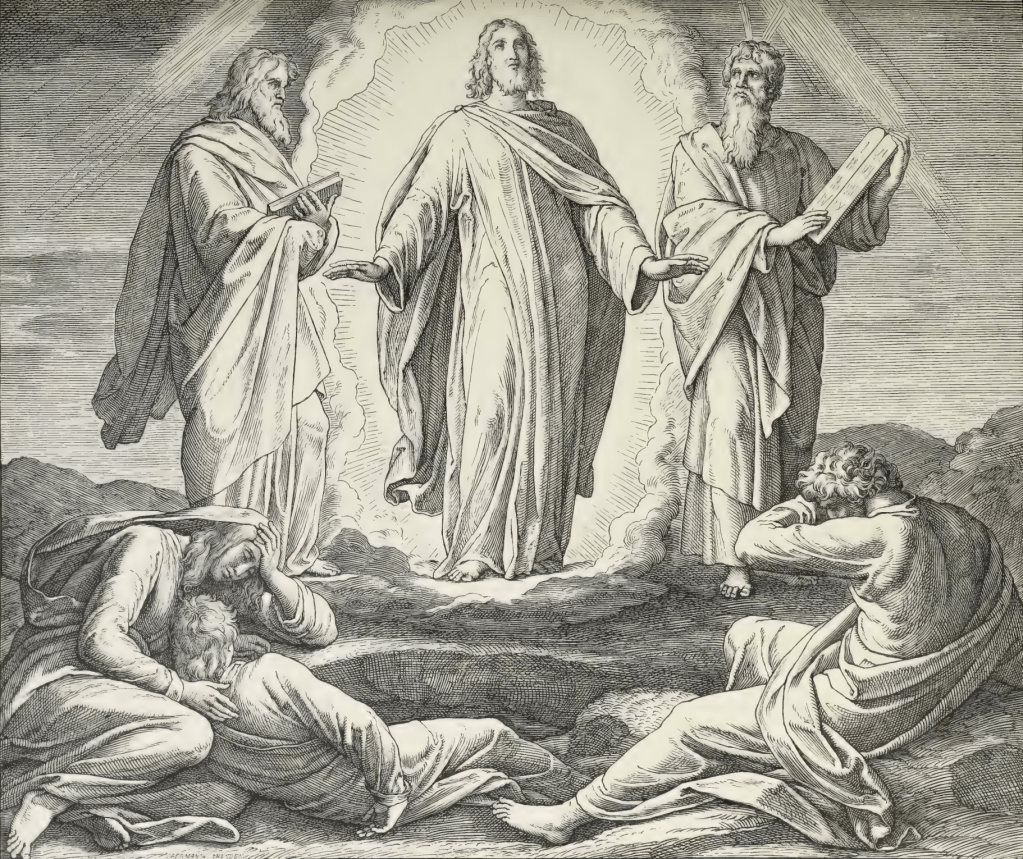
I. The history of the transfiguration of Christ on Mount Tabor. (v. 1–8)
II. The conversation of Christ with His disciples concerning the future Elijah. (v. 9–13)
Annotated Text
1. And after * six days (In Luke it says, “And it came to pass about eight days after these sayings,” [Luke 9:28]. For there had been six days between the time Jesus spoke these words at the end of the nearest preceding chapter and afterwards on the eighth day this Transfiguration followed), Jesus took to Himself Peter and James and John, his (James’s) brother (which three He likewise afterwards took to Himself when He wanted to go to His suffering in the garden of the Mount of Olives, Matthew 26:37, to indicate that those who have much of the suffering of Christ are also richly comforted through Christ, 2 Corinthians 1:5), and lead them (specially alone from other people, and went with them) to a high mountain (called Tabor, situated in Galilee,1 to which He withdrew to pray, and when He prayed, the form of His face was altered, Luke 9:28–29).
* Mark 9:2 (Luke 9:28)
1 † Or as others hold, “Panium, near Caesarea Philippi.” Peter calls it simply “the holy mountain” [τῷ ἁγίῳ ὄρει], 2 Peter 1:18.
2. And (He) was * transfigured before them (He was transfigured before them, Mark 9:2, in such a way that He received an entirely different form, He allowed them to see a glance of His heavenly, peculiar Majesty and glory, which was communicated to Him according to His human nature by virtue of the personal union, so that they would be guarded against the offense of the cross of Christ), and His face shown as the sun, and His clothes were white (and gleamed) as light (they became bright and very white as the snow, in such a way that no fuller on earth can make them so white, Mark 9:3).
* John 1:14; 2 Peter 1:16–17
3. And behold, there appeared to them (two men bodily, who were) Moses and Elijah, who (appeared in radiance and) spoke with Him (concerning the departure [τὴν ἔξοδον] which He was to fulfill at Jerusalem, that is, concerning His suffering. As Moses and the prophets had prophesied of Christ in their writings, John 5:39, 5:46, Acts 10:43, so also Moses thus speaks here with Christ, as well as Elijah in the name of the all the prophets, and give Him testimony, that He is the Messiah and Savior of the world).
4. But Peter (and those who were with Him were full of sleep; but when they awoke, they saw His radiance and the two men standing with Him. And it came to pass when they were departing from Him, Luke 9:32–33, Peter began) answered and said to Jesus, “Lord (and Rabbi, Mark 9:5, that is, Master, Luke 9:33), it is good to be1 here (for this transfiguration of Christ and this bodily conversation which Moses and Elijah held with Christ was a foretaste and prefiguration of the joy of eternal life); if you would like, then I will make three huts here, one for you, one for Moses, and one for Elijah (but he did not know what he was saying, for they were confused, Mark 9:6).
1 Greek: “It is something (truly) beautiful (and pleasant), that we are here (in such a pleasurable bright light).” [καλόν ἐστιν ἡμᾶς ὧδε εἶναι]
5. Then while He was thus still speaking, behold, there (came and) overshadowed them a luminous cloud (so that they were surrounded by it and were terrified when the cloud covered over them). And behold, a Voice (namely, the heavenly Father, fell) from the cloud (which) said (concerning Jesus Christ), * “This is My beloved (only-begotten) Son (whom I have begotten from eternity out of My essence), in whom I have good pleasure, whom you ought to hear (that you believe what He says to you and do what He commands you. Thus there is found here once more a glorious revelation of the most-holy Trinity: the Father allows His voice to beard from heaven, the Son stands in His transfiguration on the mountain, the Holy Spirit, who enlightens the hearts of men, reveals Himself in a bright cloud).”
* Matthew 3:17ff.; 2 Peter 1:17
6. When the disciples heard this, they fell (from fear) on their faces, and were very terrified (because they could not bear God’s majesty).
7. But Jesus came to them, * touched them (strengthened and comforted them) and said, “Stand up, and do not be afraid.”
* Daniel 8:18, 10:10
8. Now then they lifted up their eyes (and looked around themselves, Mark 9:8, and while such a Voice occurred, Luke 9:36, they found and) they saw no one (with them), except Jesus alone (Moses and Elijah had disappeared again).1
1 * Or rather had entered the bright cloud, Luke 9:35.
9. And when they descended from the mountain, Jesus commanded them and said, “You shall tell no one this vision (this revelation of My glory) until the Son of Man is raised from the dead (for Christ at that time was still in the state of His humiliation, and wanted that He should suffer and die beforehand before He entered into His glory, Luke 24:26. But afterward, after Christ’s resurrection and ascension, both apostles Matthew and Peter not only proclaimed such, but rather also recorded it in their Scriptures. The disciples have followed such a command, as is fitting; for Luke reports of them when he says, “And they were silent and proclaimed nothing to anyone in those days as to what they had seen,” Luke 9:36).
* Matthew 16:20
Useful Applications
I. DOCTRINE: Christ’s transfiguration according to His humanity on the mountain is a picture of the glory and transfiguration of the bodies of believers as they will be in the resurrection of the dead and in eternal life (v. 1–2)

 PATTERN OF SOUND WORDS