Here is my translation of Johannes Brenz’s summary of the Holy Gospel for Quinquagesima (Luke 18:31–43) as found in his Postilla (pg. LXIX). Square brackets and footnotes are my own notes and additions.
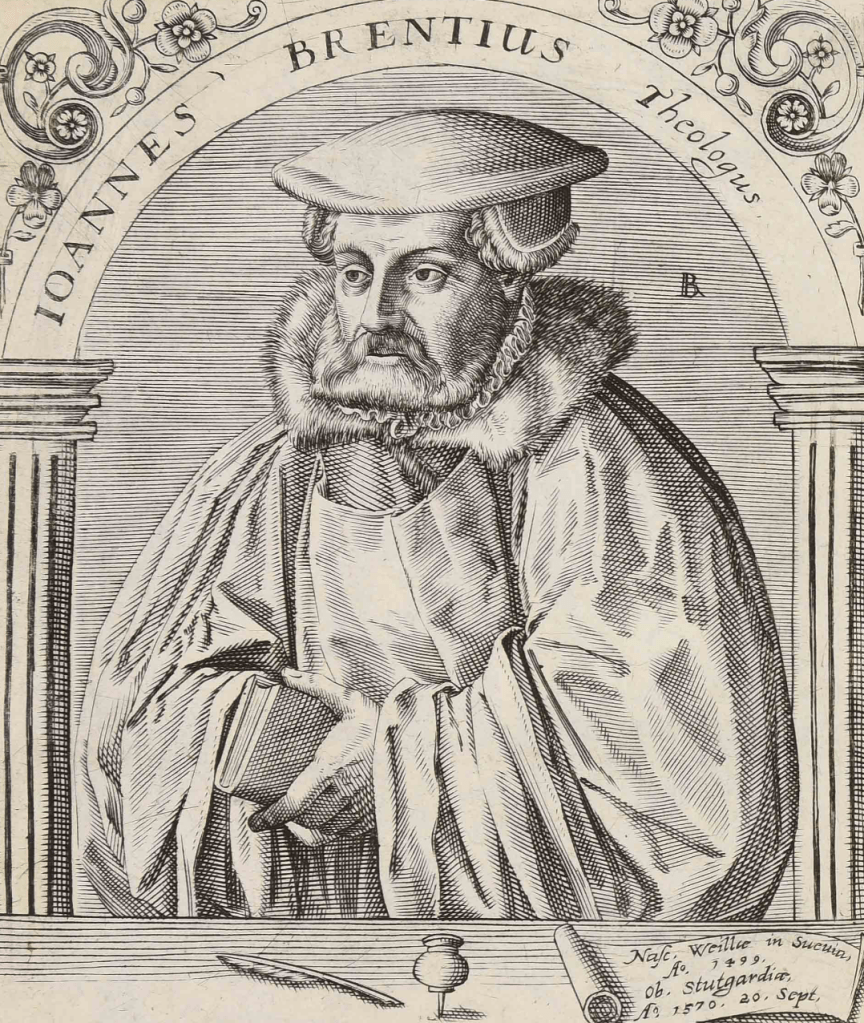
Summary of This Gospel
In this Gospel we learn:
- First, where all the prophecy of the prophets has looked for the most part, and in which places Holy Scripture deals with the suffering and resurrection of our Lord Jesus Christ. [v. 31–33]
- Second, to this end, the Gospel is not a new doctrine. [v. 31–33]
- Third, why Christ preached concerning His suffering. [v. 31–33]
- Fourth, that human reason darkens the bright clear truth in such a way that man cannot see it. Likewise, why the weakness of the apostles is held before us, namely, that we learn to know ourselves and give God alone the honor. [v. 34]
- Fifth, the blind beggar is dealt with, where it is to be noted how the Law of the Jews at that time was no longer observed.1 Also, that one ought not turn away the hand from any needy person, so that God may bless us. [v. 35–43]
- Sixth, why tribulations are sent to us, namely, not only on account of our sins, but also that God’s work and glory may be revealed in us. [v. 42–43]
- Seventh, the blind man teaches us how we ought to grasp onto Christ, whom we ought to follow in every trial (Anfechtung). [v. 35–43]
- Later in the sermon (pg. LXXII), Brenz will cite Deuteronomy 15[:7–11], Leviticus 19[:9–10], and Deuteronomy 14[:28–29] to show Israel’s obligation to care for the poor. Many places from the prophets could also have been cited which speak about Israel despising the poor (e.g., Isaiah 3:14–15, Ezekiel 22:29, etc.). ↩︎
 PATTERN OF SOUND WORDS