The following is my translation of the notes and useful applications for the Holy Gospel of the Second Sunday after Epiphany, John 2:1–11, as they are found in Das Weimarische Bibelwerk (1877). Square brackets indicate my own notes and additions. For the useful applications, I recommend the reader see this very helpful article by Dr. Benjamin T. G. Mayes.
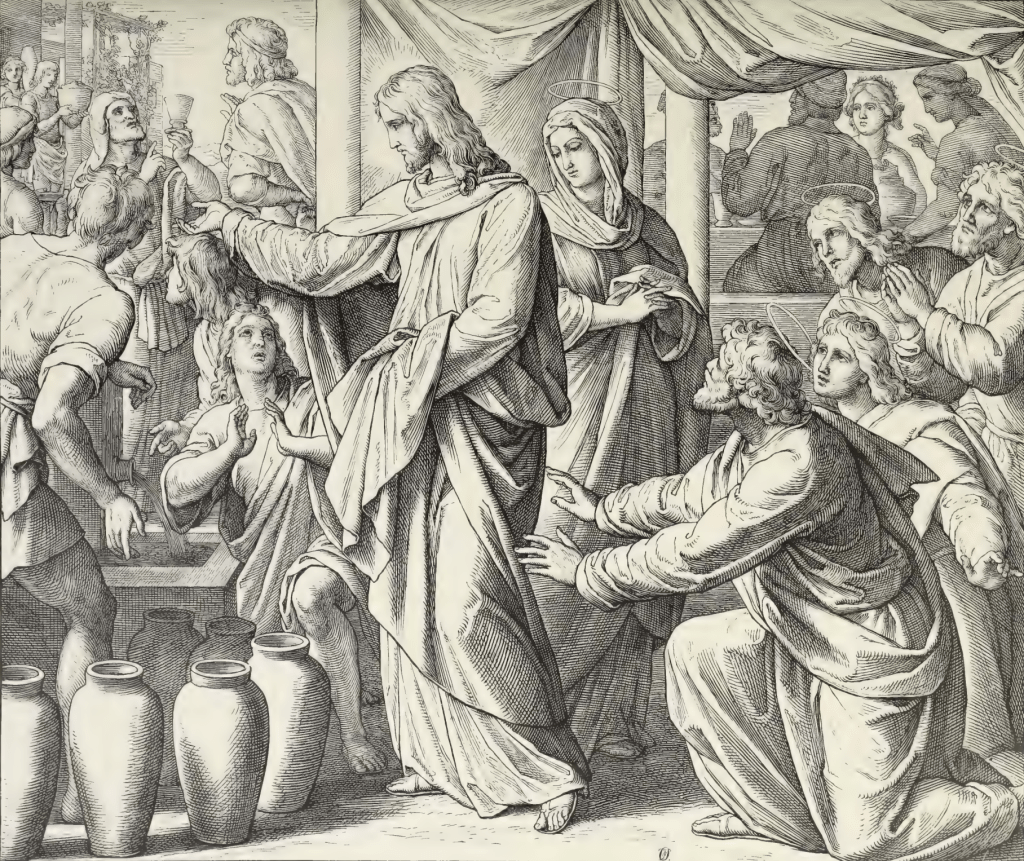
I. The history of the wedding at Cana. (v. 1–11)
Annotated Text
1. And on the third day (after Jesus had gone into Galilee, John 1:43, and had spent two days on the way) there was a wedding at Cana in Galilee, and the mother of Jesus was there (perhaps as a related kinswoman).
2. Now Jesus and His disciples (who were mentioned in John 1[:35–51]) were also invited to the wedding (therefore, they were also present there. With His presence, Christ not only wanted to demonstrate His affability, but rather, by His very first miracle, He also wanted to honor the married estate as the first ordinance of God among men and the most excellent picture of the communion of Christ with His Church and teach that marriage ought to be held in honor by all, and the marriage bed ought to be kept undefiled, Hebrews 13:4.).
3. And when the wine had been used up (because the supply was meagre on account of the poverty of the newly married couple), the mother of Jesus said (from good intention and care, but at an inopportune time, and also with a certain timidity, worry, and faint-heartedness) to Him, “They have no wine (They do not have enough wine; therefore, prove yourself as an almighty and miracle-working Lord in this emergency).”
4. Jesus said to her, “Woman, what * have I (in such a work that concerns My office) to do with you? My hour is not yet come (I know well how and when I shall help).”
* 2 Samuel 16:10 (Matthew 12:48)
5. His mother (was assured by these words, that her Son Jesus would prove Himself helpful at the right time, and) said to the servants, * “Whatever He (this my Son) says to you, do it (even though it may seem illogical to you).”
* Genesis 41:55
6. Now there were set there six stone water jars (large containers or tubs)1, according to the manner of * Jewish purification (from which the Jews, according to old custom and according to the ordinances of the fathers, were accustomed not only to wash and purify their hands, but rather also the dishes, cups, and other vessels many times), and in each of them were two or three measures. (Luther: “Metreta in Greek [μετρητὰς]; two metreta make about one Eimer[2] of wine among us .”)
1 * Or also “immovable troughs,” as one calls them in some places.
* Mark 7:3
[2] An “Eimer” was perhaps around 56.5 liters.
7. Jesus said to them (to the servants and waiters, John 2:5), “Fill the water jars with water.” And they filled them until them up to the top.
8. And He said to them (after He had changed the water into wine by His divine power), “Draw [some] now (into your vessels), and bring it to the master of the feast1 (to taste it, so that he might let it be served afterward to the guests). And they brought it (to him, as the Lord commanded them).
1 * To “the steward of the feast,” who was chosen at times by lot. Today one might say “the host.”
9. But when the master of the feast tasted the wine which has become water and did not know from whence it (such a fine wine kept until now) came (but the servants who had drawn the water knew) (and they did not immediately tell it to the master of the feast, to have him test it as to what he would say about it), the master of the feast called the bridegroom,
10. and said to him, “(How should I understand this?) Everyone gives (at his appointed banquet and celebration) the good wine first, and when they (the guests) have become drunk (have enjoined themselves a little and drunk for merriment), then the inferior; (but) You (on the other hand) have kept the good wine until now (which seems strange to me.” However, there is no doubt that afterward the master of the feast with all the other attendees came to know the truth of this miracle of Christ.)
11. This is the first sign (visible miracle), that Jesus did (after He had begun His preaching office), that happened at Cana in Galilee; and He revealed (thereby) His (until now completely hidden under the form of a servant) glory (glory as of the only-begotten Son of the Father, John 1:14, of which He only allowed a single ray to shine forth, as the sun does at time from the clouds). And His disciples believed in Him (their faith in Him as the now appeared Messiah was thereby markedly strengthened).
Useful Applications
I. DOCTRINE: That the Lord Christ Himself, together with His mother and disciples, was at a wedding in Cana in Galilee, redounds to the married estate a particularly great honor, that it is a holy well-pleasing estate to God. (v. 1–2)
 PATTERN OF SOUND WORDS