Tag: Matthew

  • Notes and Useful Applications for Matthew 11:11–15 from Das Weimarische Bibelwerk (1877)

    The following is my translation of the notes and useful applications of the Holy Gospel for the Wednesday of Populus/Filia Zion (the Second Week of Advent), Matthew 11:11–15, as they are found in Das Weimarische Bibelwerk (1877). Square brackets indicate my own notes and additions. For the useful applications, I recommend the reader see this very helpful article by Dr. Benjamin T. G. Mayes.

    II. A glorious testimony of Christ concerning John [the Baptist]. (v. 7–15)

    Annotated Text

    11. “Truly, I say to you, * among all those born of women (according to the common course of nature), there is not one (anyone) who has arisen who (on account of his office) is greater (more eminent) than John the Baptist; but He who is the Least (indeed, smaller) in the Kingdom of Heaven (in the Kingdom of God. Luther: “This is Christ,” who has humiliated himself to the lowest point) is greater than him (for He is not only true man, but also true God in unity of person, who is not only a Prophet and Teacher, but rather also the Mediator, Redeemer, and Savior; He is not the friend of the Bridegroom, as John, but rather is the Bridegroom Himself, John 3:29).

    * Luke 7:28

    12. Now from the days of John the Baptist (from the time in which he began to carry out his office) until now, the Kingdom of Heaven suffers violence (the Kingdom of God is preached through the Gospel, and everyone pressed into it with force, Luke 16:16. The people receive the Gospel with great zeal, as one takes a city by force. Luther: “The consciences, when they perceive the Gospel, press toward it, so that no one can resist them.”), and the violent (the repentant sinners, who in true faith stand against the temptations through the power of the Spirit, crucify the wicked lusts of the sinful flesh [Galatians 5:24], and contend gallantly) snatch it to themselves (they press themselves into the Kingdom of Heaven, from which it sufficiently appears that John had accomplished great benefits through his teaching and baptizing).1

    (Matthew 21:31–32)

    1 Greek: Alternatively, “The Kingdom of Heaven presses in with force, and (everyone, Luke 16:16, also) uses force (or have used force up to this point—evil people, tax collectors, soldiers, sinners, indeed, even the Gentiles press into it with force, and) snatch it to themselves (make themselves partakers of it with great zeal, and in this go before the high priests, the scribes, and the Pharisees).”

    13. For all the prophets and the Law had prophesied (that Christ shall come) until John (who pointed to Christ being present).

    14. And, if you are willing to receive it (and believe it) * he (John) is Elijah, who is to come (He is the one of whom the prophet Malachi had prophesied that He shall come in the Spirit and power of Elijah before the coming of the great and terrible day of the Lord).

    * Malachi 4:5; Matthew 17:12 (Mark 9:13; Luke 1:17)

    15. He who has ears to hear, let him hear (mark this and take it to heart, and do not wait with the Pharisees for Elijah the Tishbite to come again on earth in his own person again, or otherwise for the Kingdom of Heaven to appear with worldly pageantry).”

    * Mark 7:16 (Luke 8:8)

    Useful Applications

    II. DOCTRINE: That Christ is the least in the Kingdom of Heaven, and yet at the same time greater than John (who is esteemed by Christ as the greatest among all men); He is the least according to His humanity in the state of humiliation, He is the greatest according to His eternal divinity. (v. 11)


  • Notes and Useful Applications for Matthew 21:1–11 from Das Weimarische Bibelwerk (1877)

    The following is my translation of the notes and useful applications of the Holy Gospel of the First Sunday of Advent (Ad Te Levavi), Matthew 21:1–11, as they are found in Das Weimarische Bibelwerk (1877). Square brackets indicate my own notes and additions. For the useful applications, I recommend the reader see this very helpful article by Dr. Benjamin T. G. Mayes.

    I. The advent of Christ to Jerusalem. (v. 1–11)

    Annotated Text

    1. When * they (Christ and His disciples together with the people that followed Him) now drew near to Jerusalem, and came to (opposite of) Bethphage (and Bethany, Luke 19:29) to the Mount of Olives, 1 Jesus sent two disciples,

    * Mark 11:1; John 12:12

    1 Greek: “And when” [Καὶ ὅτε]

    2. and He said to them, “Go into the town which lies before you (into the market which lies opposite you, Luke 19:30) and immediately (when you come into it) you will find a donkey tied up and a colt with it (also bound, on which no man has yet sat, Luke 19:30); loose it and bring it to Me. (For what purpose the Lord Christ intended to use this beast of burden He had not yet indicated to the disciples; but He was intent to hold His royal entry into the city of Jerusalem previously proclaimed by the Prophet.)

    3. And if someone should say something to you (and ask: ‘Why are you doing this?’ Mark 11:3; ‘Why do you loose the donkey and the colt?’ Luke 9:31), then say: ‘The Lord has need of it (for His service); and immediately he will allow it (to follow) you (and send them).

    4. Now all this happened that it would be fulfilled what had been said through the prophet (Zechariah), when he said:

    5. “Say * to the daughter (the inhabitants) of Zion (of the city of Jerusalem, whose highest part was built upon Mount Zion; however, thereby is understood the Israelite Church): ‘Behold, your (heavenly soul-) King comes to you (that He might have mercy on you and help you; thus, be for your good before others) meek (humble and lowly), and riding upon a donkey and upon a colt, the load-bearing donkey.” (Christ first rode upon the donkey and afterwards He sat Himself on the colt upon which He rode into the city. By the donkey is signified the Jews, the burden-bearing people; by the untamed colt, the Gentiles.)

    * Zechariah 9:9ff.; John 12:15

    † Psalm 24:8 (Isaiah 62:11)

    6. The disciples went out (from willing obedience, and they found it as He had said; for they found the colt tied at the door, outside at the crossroads, and they loosed it. But as they were loosing the colt, certain ones who were standing there said to them, “What are you doing, that you are loosing the colt?” Mark 11:4–5. And its lords said to them, “Why are you loosing the colt?” Luke 19:33. But they said to them as Jesus had commanded them, “The Lord has need of it,” and they allowed it, Mark 11:6.) and (those who were sent) did, as Jesus had commanded them.

    7. And they brought the donkey and colt (to Jesus), and laid their * garments thereupon (so that He might ride all the more gently) and set Him thereupon (They cast their garments upon the colt, and He sat upon it, Mark 11:7. But such, what had been prophesied by Zechariah and what otherwise happened here, His disciples did not understood beforehand, but when Jesus was glorified, then they remembered that such has been written concerning Him and that they had done such things to Him, John 12:16).

    * 2 Kings 9:13; Mark 11:7–8

    8. Now many people1 spread their garments on the way (Such they did out of reverence toward this new King, as the like happened to Jehu, 2 Kings 9:13.); others2 cut down branches (green boughs) from the trees and strew them on the way (to adorn Him, to bear witness to their joy, and to confess Christ as a peace-rich and victory-rich king. And many people who had come to the feast, when they heard that Jesus had come to Jerusalem, they took palm branches and went out to meet Him, John 12:12–13. And as He came near and descended the Mount of Olives, the whole heap of His disciples began to praise God joyfully with a loud voice on account of all the deeds they had seen, Luke 19:37.).

    (1 Maccabees 13:51)

    1 Greek: “most of the people” (who partly came along from Jericho, Matthew 20:29, partly  had already come to Jerusalem for the feast and who went out to meet Him out of amazement concerning the raising of Lazarus).

    2 Greek: “but” [δὲ]

    9. But the (remaining common) people, who went before and followed after, cried out and said, “Hosanna (Luther: “In German, ‘Hosanna’ means ‘Ah, help!’ or ‘Ah, give good fortune and salvation!’—that is what we wish for.”) to the Son of David (to this new King, born of the lineage of David. The Jews had taught their children that when the Messiah would someday present Himself, they should receive Him with these words of the kingly prophet David; thus, because they heard that Jesus of Nazareth wanted to have His entry as the promised Messiah and the King of His Church, they had received Him in such a form)!1 Blessèd is He who comes (as a King) in the name of the Lord (sent by God to His people, that He should be a King of Israel, John 12:13; “Blessed be the kingdom of our father David!” Mark 11:10.)! Hosanna in the highest! (You Son of David who are in the highest, that is, a heavenly King and true God, help us. “Peace be in heaven and glory in the highest!” Luke 19:38. And some of the Pharisees in the crowd said to Him, “Master, rebuke Your disciples.” But He answered and said to them, “I say to you, if these should be silent, then the stones would cry out,” Luke 19:39–40.)

    (Matthew 23:39)

    1 † Ordinarily, this formula from Psalm 118:25 was used at the Feast of Tabernacles. But the Jews also spoke it at other times on joyful occasions. See 1 Maccabees 13:51; 2 Maccabees 10:6; etc.

    10. And when He had entered into Jerusalem, the entire city was stirred up (frightened and became distressed) and said (all the inhabitants of that city were frightened and said), “Who is this (who comes riding into the city with such a multitude of people and to whom one wishes good fortune as to a king)?”

    11. But the People said, “This is the (famous) Jesus, * the prophet from Nazareth (who was conceived and raised up in Nazareth, Matthew 2:23; Luke 2:51) of Galilee (which city of Nazareth lies in Galilee. But the Pharisees said among one another, “You see that you are achieving nothing. Behold, all the world is running after Him,” John 12:19.).

    * Luke 7:16; John 1:45

    Useful Applications

    I. DOCTRINE: That all things which happened at the time of the revelation of Christ in His received humanity were preached beforehand by all the prophets of the Old Testament, shown here by the citation of the prophet Zechariah concerning the entry of Christ into Jerusalem upon a donkey and a colt. (v. 4–5)

  • Notes and Useful Applications for Matthew 11:12–19 from Das Weimarische Bibelwerk (1877)

    The following is my translation of the notes and useful applications for the Epistle Reading for the Commemoration of the Lutheran Reformation (Reformation Day), Romans 3:19–28, as they are found in Das Weimarische Bibelwerk (1877). Square brackets indicate my own notes and additions. For the useful applications, I recommend the reader see this very helpful article by Dr. Benjamin T. G. Mayes.

    II. A glorious testimony by Christ of John. (v. 7–15)

    III. A complaint of Christ over the ingratitude of the Jewish people, and a sharp threat. (v. 16–24)

    Annotated Text

    12. Now from the days of John the Baptist (from time on after he began to exercise his office) until now the Kingdom of God suffers force (the Kingdom of God is preached through the Gospel, and everyone presses into with force, Luke 16:16. The people receive the Gospel with great zeal, as one takes a city with force. Luther: “When consciences perceive the Gospel, they press toward it so that no one can hinder them”); and the forceful (the repentant sinners, who in true faith resist temptations through the power of the Spirit, crucify the wicked lusts of the flesh, and contend valiantly) seize it for themselves (press themselves into the Kingdom of Heaven; from which it sufficiently appears that John had wrought great benefit through his teaching and baptizing).*

    * Greek: alternatively, “The Kingdom of Heaven presses in with power, and (everyone, Luke 16:16, also) those who use  force (or have done so until now, including wicked people, tax collectors, soldiers, sinners, indeed even the Gentiles press into it with force), seize it for themselves (they make themselves partakers of it with great zeal, and do it therein before the high priests, scribes, and Pharisees).

    13. For all the Prophets and the Law have testified (that Christ shall come) until John (who pointed to Christ as present).

    14. And (if you are willing to accept it) (and believe) * He (John) is Elijah, who is to come in the future (He is the one of whom the prophet Malachi had prophesied that he shall come in the Spirit and in the power of Elijah before then comes the great and terrible day of the Lord).

    * Malachi 4:5; Matthew 17:12 (Mark 9:13; Luke 1:17)

    15. * Whoever has ears to hear, let him hear (Therefore mark this and take it to heart and do not wait with the Pharisees that Elijah the Tishbite to come again upon earth in his own person or otherwise for the Kingdom of Heaven to appear with worldly pomp).

    *Mark 7:16 (Luke 8:8)

    16. To what shall I compare this generation (the men of this generation, this unbelieving and stiff-necked Jewish people)*? It is like little children, who sit in the market and call out to their companions,

    * especially those found among them who supposed to be saints and high learned men (see Matthew 11:25; Luke 7:30).

    ** Luke 7:31ff. (Zechariah 8:5)

    17. and say, ‘We have played the pipe for you, and you did not want to dance; we have wept, and you did not want to weep. (John preached sharp sermons of repentance, and thereby admonished them to weep and mourn over sin; I have preached the most lovely and comforting evangelical sermons; yet the one has born as little fruit as the other; regardless if one lays before them sour or sweet, they still remain hardened one way or the other in their impenitence and wickedness.)

    18. John (the Baptist) came, * not eating (bread, Luke 7:33, that is, common, and by no means luxurious food) and not drinking (wine; he fasted often and much, Matthew 9:14, and led a hard and strict life), yet they say (the scribes), ‘He has the devil’ (he is driven by the devil, or is crazy in the head).

    * Matthew 3:4

    19. The Son of Man has come * eating and drinking (I live in an ordinary manner, go about with everyone in a friendly way, eat common food, drink common drink, and indeed with the tax collectors and sinners); so they say, ‘Behold the man is a glutton and a wine-bibber, a companion of tax collectors and sinners. And Wisdom must be justified by (all) her children (I, who am the Wisdom of God, Proverbs 9:22, must allow myself to be led to school and tutored by the Pharisees and scribes, who properly ought to be my students).”

    * Matthew 9:10 (Isaiah 7:15, 42:4; Luke 15:2, 19:6; 1 Timothy 3:16)

    ** Greek: alternatively, “

    Useful Applications

    [There are no useful applications for v. 12–19. AJB]

  • Notes and Useful Applications for Matthew 9:1–8 from Das Weimarische Bibelwerk (1877)

    The following is my translation of the notes and useful applications for the Holy Gospel for the Nineteenth Sunday after Trinity, Matthew 9:1–8, as they are found in Das Weimarische Bibelwerk (1877). Square brackets indicate my own notes and additions. For the useful applications, I recommend the reader see this very helpful article by Dr. Benjamin T. G. Mayes.

    Notes

    I. The History of the Paralyzed Man (v. 1–8)

    1. Then He (the Lord Christ) entered into the boat (in which He had come from Capernaum into the regions of the Gergesenes, Matthew 8:18, 28) and crossed over again and came into His own city (Luther: “Capernaum,” where He had rented a house, and stayed there during the Passover, Matthew 4:13, 11:23, 17:24; John 2:12).

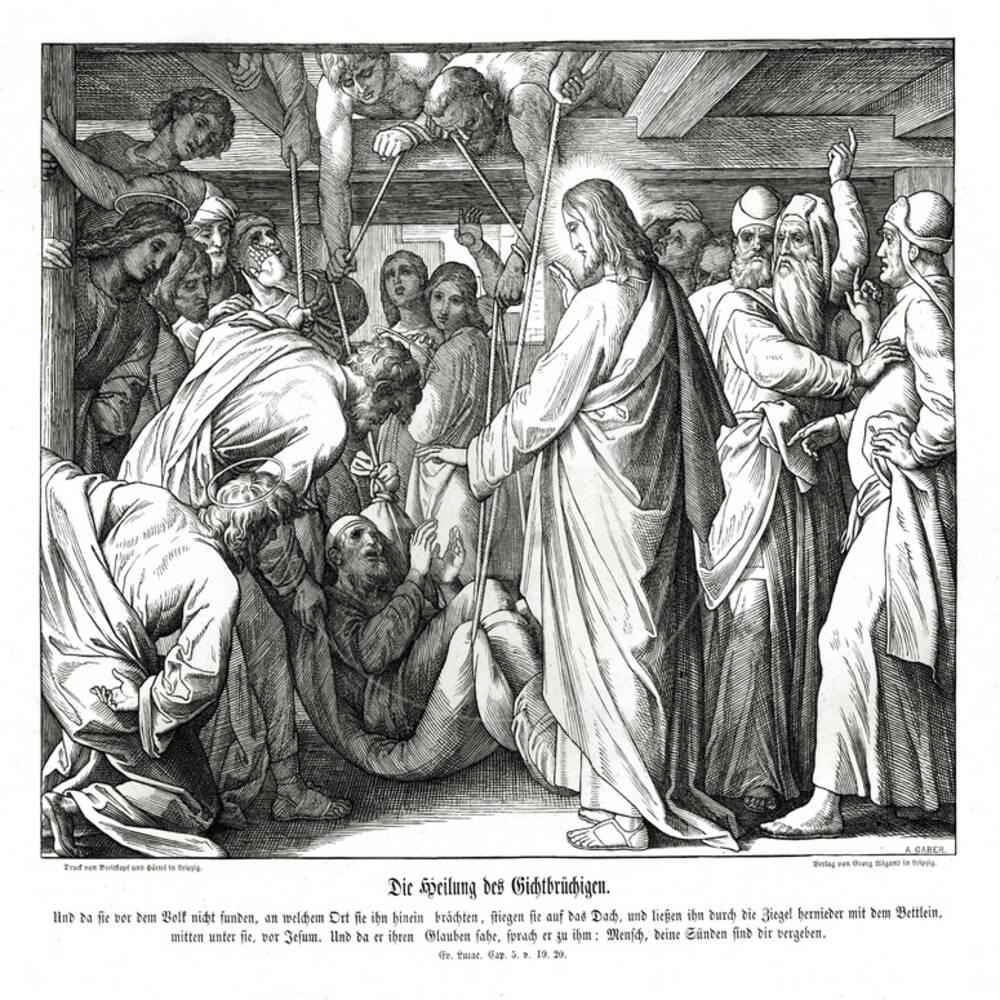
    2. And behold, there * they (four of them) brought to him a paralyzed man (Luther: “whom had been afflicted by paralysis, the small or half stroke”) who was laying on a bed (He could neither move nor stir on account of his sickness. They sought a way how they might bring him in and lay him before Him; and when they could not come to Christ in any other way on account of the great multitude of people, and also could not find a place in which they could bring him in, they climbed onto the roof, where He was, and uncovered it, and let him down through the tiles with the little amongst their midst before Jesus, Mark 2:4, Luke 5:19). Now when Jesus saw their faith (understand not only the faith of the bearers, ** but also of the paralytic man himself; for if he had not believed in a saving way and at the same time with trust in Christ’s mediating office, Christ would not have forgiven his sins, nor called him son), He said to the paralyzed man, “Be comforted (and be of good courage), My son, your sins (which make you anxious in your heart) are forgiven you (Thus Christ begins His cure with the soul, because all bodily illnesses come from sin, and because the health of the body without the health of the soul is of little usefulness).”

    * Mark 2:1ff. Luke 5:18 (Luke 7:50; Acts 9:33)

    ** Their faith came to the aid of the sick man, to promote the healing of his body in love, as far as it was possible.

    3. And behold, some among the scribes (and the Pharisees, those who were sitting there and heard such) said amongst themselves (thought in their hearts), “This one (Jesus from Nazareth) blasphemes God (in that He ascribes to Himself such authority, which belongs only to God; for who can forgive sins except God alone? Luke 5:21).”

    (Luke 7:49)

    4. But when Jesus saw their thoughts (He knew immediate in His spirit that they thought thus within themselves, therefore), He said, “Why do you think such wicked things in your hearts (in that you falsely accuse me of blasphemy of God within yourselves, when that which I do nevertheless is my office)?

    (Zechariah 8:17)

    5. Which is easier (according to outward appearance and the judgement of reason), to say (to the paralyzed man), “Your sins are forgiven,” or to say, “Stand up (take up your bed) and walk?” (You think in your hearts: If I truly could forgiven this paralytic his sins in fact and truth, then I would also have been able to make him whole as well; but because this had not happened, so that is also lacking [i.e., I have not actually forgiven his sins].)

    6. But so that you know (and see in fact) that the Son of Man has the authority (and indeed from His own power) to forgive sins (and that the forgiveness of sins is powerful, which I have declared to this paralytic man, and in truth has come upon him; well then I will thus make this man well before your eyes, therefore),” He then said to the paralytic, “ (I say to you,) Stand up, take up your bed (upon which you have had to lie ill and sick for very long time), and go home.”

    (John 5:8; Acts 9:34)

    7. And (immediately) he stood up (so that all who those present saw, and he lifted up the little bed upon which he had lain) and went home (and praised God).

    8. And the people that saw (this miracle) marveled and praised God, who had given such authority to men (they praised God, that He had sent them such a prophet who forgives sins and who could heal diseases which by nature are incurable. “All those were astonished who heard and saw this, and they  were filled with fear and said, ‘We have seen extraordinary things today, and we have never seen such before,” Mark 2:12, Luke 5:26).

    (Luke 7:16ff.; 1 Thessalonians 5:18)

    Useful Applications

    I. DOCTRINE: Christ’s true and eternal divinity shines forth from the fact that He searches out men’s hearts, forgives sins (which belongs to God alone), and heals incurable diseases (v. 2–7).