Tag: Miracles

  • Notes and Useful Applications for John 2:1–11 from Das Weimarische Bibelwerk (1877)

    The following is my translation of the notes and useful applications for the Holy Gospel of the Second Sunday after Epiphany, John 2:1–11, as they are found in Das Weimarische Bibelwerk (1877). Square brackets indicate my own notes and additions. For the useful applications, I recommend the reader see this very helpful article by Dr. Benjamin T. G. Mayes.
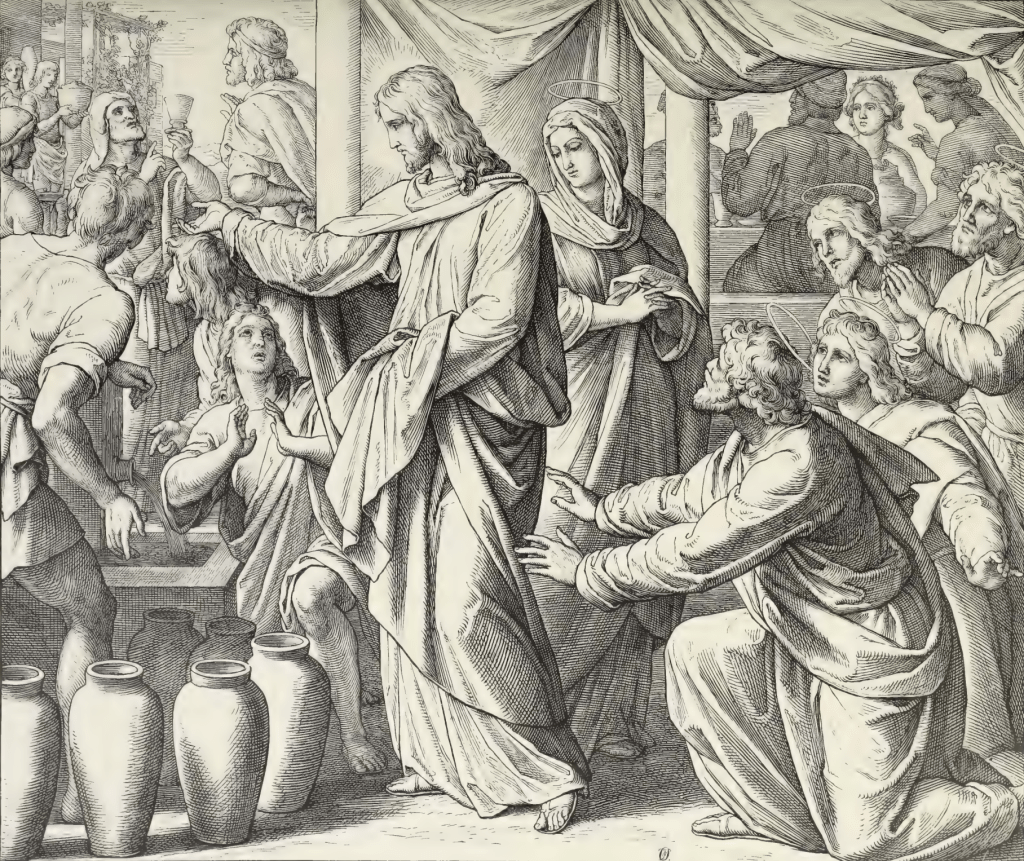
    The Wedding at Cana, by Julius Schnorr von Carolsfeld

    I. The history of the wedding at Cana. (v. 1–11)

    Annotated Text

    1. And on the third day (after Jesus had gone into Galilee, John 1:43, and had spent two days on the way) there was a wedding at Cana in Galilee, and the mother of Jesus was there (perhaps as a related kinswoman).

    2. Now Jesus and His disciples (who were mentioned in John 1[:35–51]) were also invited to the wedding (therefore, they were also present there. With His presence, Christ not only wanted to demonstrate His affability, but rather, by His very first miracle, He also wanted to honor the married estate as the first ordinance of God among men and the most excellent picture of the communion of Christ with His Church and teach that marriage ought to be held in honor by all, and the marriage bed ought to be kept undefiled, Hebrews 13:4.).

    3. And when the wine had been used up (because the supply was meagre on account of the poverty of the newly married couple), the mother of Jesus said (from good intention and care, but at an inopportune time, and also with a certain timidity, worry, and faint-heartedness) to Him, “They have no wine (They do not have enough wine; therefore, prove yourself as an almighty and miracle-working Lord in this emergency).

    4. Jesus said to her, “Woman, what * have I (in such a work that concerns My office) to do with you? My hour is not yet come (I know well how and when I shall help).

    * 2 Samuel 16:10 (Matthew 12:48)

    5. His mother (was assured by these words, that her Son Jesus would prove Himself helpful at the right time, and) said to the servants, * “Whatever He (this my Son) says to you, do it (even though it may seem illogical to you).

    * Genesis 41:55

    6. Now there were set there six stone water jars (large containers or tubs)1, according to the manner of * Jewish purification (from which the Jews, according to old custom and according to the ordinances of the fathers, were accustomed not only to wash and purify their hands, but rather also the dishes, cups, and other vessels many times), and in each of them were two or three measures. (Luther: “Metreta in Greek [μετρητὰς]; two metreta make about one Eimer[2] of wine among us .”)

    1 * Or also “immovable troughs,” as one calls them in some places.

    * Mark 7:3

    [2] An “Eimer” was perhaps around 56.5 liters.

    7. Jesus said to them (to the servants and waiters, John 2:5), “Fill the water jars with water.” And they filled them until them up to the top.

    8. And He said to them (after He had changed the water into wine by His divine power), “Draw [some] now (into your vessels), and bring it to the master of the feast1 (to taste it, so that he might let it be served afterward to the guests). And they brought it (to him, as the Lord commanded them).

    1 * To “the steward of the feast,” who was chosen at times by lot. Today one might say “the host.”

    9. But when the master of the feast tasted the wine which has become water and did not know from whence it (such a fine wine kept until now) came (but the servants who had drawn the water knew) (and they did not immediately tell it to the master of the feast, to have him test it as to what he would say about it), the master of the feast called the bridegroom,

    10. and said to him, “(How should I understand this?) Everyone gives (at his appointed banquet and celebration) the good wine first, and when they (the guests) have become drunk (have enjoined themselves a little and drunk for merriment), then the inferior; (but) You (on the other hand) have kept the good wine until now (which seems strange to me.” However, there is no doubt that afterward the master of the feast with all the other attendees came to know the truth of this miracle of Christ.)

    11. This is the first sign (visible miracle), that Jesus did (after He had begun His preaching office), that happened at Cana in Galilee; and He revealed (thereby) His (until now completely hidden under the form of a servant) glory (glory as of the only-begotten Son of the Father, John 1:14, of which He only allowed a single ray to shine forth, as the sun does at time from the clouds). And His disciples believed in Him (their faith in Him as the now appeared Messiah was thereby markedly strengthened).

    Useful Applications

    I. DOCTRINE:  That the Lord Christ Himself, together with His mother and disciples, was at a wedding in Cana in Galilee, redounds to the married estate a particularly great honor, that it is a holy well-pleasing estate to God. (v. 1–2)
  • Martin Chemnitz’s Sermon for the Twelfth Sunday after Trinity

    Martin Chemnitz’s Sermon for the Twelfth Sunday after Trinity

    The following is my translation of Martin Chemnitz’s sermon for the Twelfth Sunday after Trinity as found in his Postilla (Vol. II, pgs. 429–434). Chemnitz uses a composite text based off of Matthew 15:29–31 and Mark 7:31–37. Curly brackets indicate marginal notes present in the original text. Square brackets indicate my own notes and additions. I have broken up some of the longer paragraphs for the sake of readability.

    Composite Gospel Text (Matthew 15[:29–31]; Mark 7[:31–37])

    And when Jesus went out again from the region of Tyre and Sidon, He went on further from there and came to the Galilean Sea, in the midst of the region of the Decapolis, and He went up on a mountain and sat down there. And there came to Him many people, having with themselves the lame, the blind, the mute, the crippled, and many others, and they cast them at the feat of Jesus, and He healed them so that the people marveled when they saw that the mute speaking, the crippled were healed, the lame walking, the blind seeing, and they praised the God of Israel.

    And they brought to him a deaf man who was mute, and they asked Him that He lay hands on him, and He took him aside from the people, placed His finger in his ear and spit, and touched his tongue, and He looked up to heaven, groaned, and said, “Ephphatha,” that is, “Be thou opened.” And immediately his ears were opened, and the bond of his tongue was loosed, and he spoke right. And He forbid them that they should tell no one. But the more He forbid them, the more they spread it, and they marveled beyond measure and said, “He has made all well, He makes the deaf hear and the speechless speak.”

    Explanation of the Gospel

    {Ordering of the Doctrine in the Sunday Gospels}

    If one pays attention diligently to the order of the Sunday Gospels, then one has from it a beautiful reminder (Erinnerung). We have previously heard how God punishes those who despise His Word, and how one should guard against such punishment so that he makes the temple of God to a house of prayer (Bethauß). It is also reported how one can make it into a house of prayer in the Law, in the article of justification or the Gospel, and in prayer according to the example of the tax collector [Luke 18:9–14]. Thereupon it follows that we do not have such from our own powers, but rather, with respect to this, we are deaf, mute, and blind.

    {Summary of the Doctrine of this Gospel}

    Before the Fall, we were thus created so that we made the temple a house of prayer in the Law, the Gospel, and the doctrine of prayer, so that when God saw everything that He had made, it was not only good, but very good [Genesis 1:31], especially the rational creatures, angels, and men. However, many of the angels have fallen; also, the serpent deceived mankind and thus sin came into the world and everything became wicked so that we are now deaf and blind by nature. But God had compassion on us and sent His Son, who has now brought again into right what was corrupted in Adam through Satan, and has thereby healed us, that He makes healthy our external members where we understand it most easily; likewise, He thereby heals our inner wound and evil from which we cannot rescue ourselves, as we are “children of wrath” (Ephesians 2[:3]) and our ears are deaf, our eyes are blind, are are tongue is bound, but God alone rescues and helps. And finally, that He thereby frees us from eternal punishment. Thus, He has made all things good [Mark 7:37], and He still does it, says Mark, and for this He uses lowly means: He speaks a word, He spits, He places His finger in the ears, etc. Then, one might think that the ears should well be stopped much more, and the eyes become darker! But when Christ uses such despised means, whereby the Word of God and the most worthy Sacraments are signified, He thereby helps and makes all things good, so that the temple among us becomes a house of prayer, and God may thus graciously turn away the well-deserved punishment. These we do not want to deal with at great length now, but rather only want to pay attention to what this Gospel teaches us for comfort under the cross (zum Trost im Creutz).

    {Division of the Sermon}

    Now there are here three kinds of people: [1] the Gergesenes [i.e., the crowd], [2] the mute man, [3] and the Lord Christ, and thus there are also three kinds of doctrine under the cross which we thus want to make use of and that we want to take away from this lesson.

    1. First, what we ought to do and think when God lays a cross upon other people.
    2. Second, how we ought to conduct ourselves when we ourselves come under the cross.
    3. Third, what the Lord Christ does here, and what we have to comfort ourselves in Him.

    First Part

    Forthcoming at a later time.

    Second Part

    Forthcoming at a later time.

    Third Part

    Forthcoming at a later time.