The following is my translation of the notes and useful applications for Numbers 14:26–35, as they are found in Das Weimarische Bibelwerk (1877). This passage is not assigned as a reading for any particular Sunday. However, St. Paul references this even in the Epistle Reading for Septuagesima, 1 Corinthians 9:4–10:5. Square brackets indicate my own notes and additions. For the useful applications, I recommend the reader see this very helpful article by Dr. Benjamin T. G. Mayes.
III. Moses’s intercession for the people, and what he thereby accomplished. (v. 13–35)
Annotated Text
26. And the Lord spoke with Moses and Aaron (what God had recently said to Moses only [v. 20–25], He repeated with more detail in the presence of Aaron), and said:
27. “How * long will this evil congregation murmur against Me?1 For I have heard the murmuring of the children of Israel, that they have murmured against Me.
* Psalm 106:25
1 Hebrew: “How long shall I overlook this evil congregation, which (still) murmurs against Me (incessantly)?”
28. Therefore, say to them, ‘As truly as I live,’ says the Lord, ‘I will do to you, that which you have said before my ears (since you have clarified that you would much rather die in this wilderness than cross over into the promised land, v. 2).
29. Your * bodies shall decay (and not be buried in the promised land where your forefathers, the patriarchs, lie) in thiswilderness (that is so unpleasant to you); and all of you who were numbered1 from twenty years old and above, you who have murmured against Me (as well as your wives who likewise murmured, all of you together),
30. You shall not come into the land over which I have lifted up my hand (sworn), that I would let you dwell therein; except * Caleb, the son of Jephunneh and Joshua, the son of Nun (and others from the tribe of Levi, who did not concur with your murmuring).
* Numbers 26:65, 32:12
31. Your * children, of whom you said, ‘They will be prey’ (v. 3), I will bring them in, that they shall know (and occupy) the land, which you have despised.
* Deuteronomy 1:39
32. But you, together with * your bodies, shall decay in this wilderness.
* Numbers 14:36
33. And your children shall be shepherds in the wilderness (tending livestock; indeed, even themselves wandering about as a herd of cattle in the wilderness) for forty years (the two years that have already passed being included, Deuteronomy 2:14), and they shall bear * your harlotry (to repay your wickedness and unfaithfulness against Me, your faithful God, and to fully make you partakers of your spiritual harlotry, namely, the idolatry and murmuring against Me), until your bodies are all in the wilderness (until they are altogether ground up);
* Psalm 95:10–11; Ezekiel 4:6; Hebrews 3:17
34. According to the number of forty days in which you had scouted the land, for each you shall count a year (as many days as you spent scouting the land of Canaan, so many years you shall still remain in the wilderness), so that they2 shall bear your misdeeds for forty years (and not only your children, but also you yourselves, inasmuch as within such time you shall be decimated and die), * so that you (experience in fact and) become awarewhat it is when I withdraw2(and, in addition, oppose myself to them in My wrath) the † hand (My grace, protection, and assistance from stiff-necked sinners).
1 Hebrew: “You shall”
* Jeremiah 2:19
2 Hebrew: “when one makes Me turn away (that is, hinders My purpose, as you have done).” See Numbers 30:6, 12; 32:7, 9.
† Deuteronomy 31:6, 8; Psalm 74:11
35. I * the Lord have spoken that I will also do so to all this evil congregation, who have rebelled against Me. In this wilderness they shall all be, and there they shall die (and thus remain).’”
* Ezekiel 5:17
Useful Applications
III. DOCTRINE: Concerning God’s righteous judgment against impatient doubters. (v. 26, 35)
The following is my translation of the notes and useful applications for one of the Old Testament Readings assigned for the Transfiguration of our Lord, Exodus 3:1–14, as they are found in Das Weimarische Bibelwerk (1877). Square brackets indicate my own notes and additions. For the useful applications, I recommend the reader see this very helpful article by Dr. Benjamin T. G. Mayes.
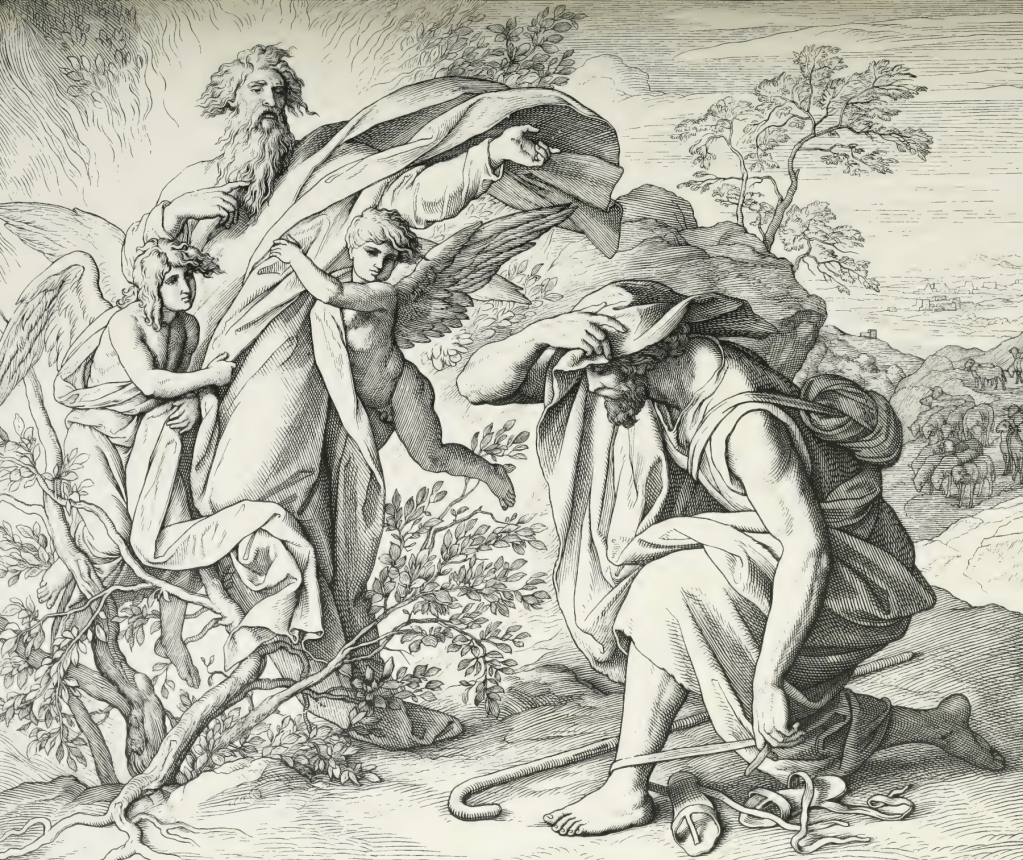
Moses is Called to Lead Israel from Egypt, by Julius Schnorr von Carolsfeld
I. The appearance of the Son of God in the fiery bush, and how Moses approached. (v. 1–6)
II. The promise of God concerning help and salvation, and how Moses was called to his office. (v. 7–10)
III. How Moses refused this call two distinct times, partly on account of his unworthiness, partly on account of the ignorance of the children of Israel, that they may not know the name of God; and how the Lord answered thereafter. (v. 11–14)
Annotated Text
1. Now Moses tended (in those days in the fortieth year) the sheep of Jethro, his father-in-law,1 the priest (the captain and magistrate) in Midian, and he drove the sheep out in the wilderness (into the land of Arabia, which is called the wilderness of Sinai), and came to the mountain of God (so named on account of the present and following divine revelation, called) Horeb.
1 † Perhaps the brother-in-law, for the word from which the Hebrew comes signifies in general a relationship through marriage and can be that the son follows the father in office. Age and names can suggest this. See Exodus 2:18, 23; Numbers 10:29; Judges 1:16, 4:11, etc.
2. And the Angel of the Lord (the Lord, the eternal self-subsisting Son of God, who afterward in the fullness of time was sent into the flesh by the Father, the Lord) appeared to him * in a fiery flame from the bush.1 And he saw that the bush burned with fire and was nevertheless not consumed (by the flame of fire).
* Exodus 23:20; Deuteronomy 33:16 (Acts 7:30)
1 † Thornbush, particularly a bramble-bush; from this Mount Sinai appears to have received its name.
3. And he said (to himself with wonder), “I will (go) there and see this great sight (I will inspect and research), why the bush does not burn (what the cause might be that the green wood in the midst of which the flame of fire burns is not consumed? By this fiery bush is prefigured the mystery of the incarnation of the Son of God, that namely, in the fullness of time, He would unite true human nature to Himself personally, and also fill it with the light of His divine majesty and divine attributes, yet so that human nature would not be harmed or consumed by the divine nature in the least, and that in such personal union His assumed human nature would complete the work of redemption of the human race, prefigured by the deliverance from Egyptian slavery.)1
(Acts 7:31)
1 † Whether the divine preservation of His Church in the fire and thorns of the (Egyptian) afflictions has no place here is to be considered, and it is likely that it was in view.
4. But when the Lord saw (the Son of God in the fiery bush) that he went over (wanted to draw near) to see, God (the Son of God) called to him from the bush, and * said, “Moses, Moses!” He answered, “Here I am. (What is your desire? Speak, for Your servant listens, 1 Samuel 3:10.)”
* Genesis 22:11
5. He said, “Do not tread here, take off your shoes from1 your feet (as a sign of your impurity); for the place upon which you stand is (on account of My divine presence and revelation through the Word and through sign of the fiery bush) a * holy land.”
1 Hebrew: “cast them down” (For the Jewish shoes were fasted to the foot only from above with a strap, as they are still worn by the Capuchin friars.)
* Genesis 28:17 (Joshua 5:15)
6. And He said further, * “I am the God of your father, the God of Abraham, the God of Isaac, and the God of Jacob (I have established a gracious covenant with your forefathers, the holy patriarchs, and promised them that I would be their God, that I would nourish and protect them, that I would sanctify and renew them, and that I would bestow all good upon them, that I would resurrection them again after their death, and that I would gather them into eternal life; but, in particular, that I would give the land of Canaan to their descendants, and that the Messiah shall be born from their race).” And Moses hid his face, for he (as an impure sinner) was afraid to look upon God (the most-holy Lord).
* Matthew 22:32 (Mark 12:26; Luke 20:37; Acts 7:37, 32)
7. And the Lord said, “I have (indeed) seen (from before time and even now) the misery of My people in Egypt (the descendants of Abraham, Isaac, and Jacob, who are the people of My special possession), and I have heard their cries over those who drive them (King Pharoah, his counselors, and his officials); I have known their sorrow (and let it come into My heart),
(Acts 7:34)
8. And I have come down (I have revealed My special presence in the fiery bush and am determined) that I rescue them from the hand of Egypt (slavery and oppression), and lead them out from this land into * a good and far land, in a land in which flows milk and honey (which is rich and fruitful), namely, to the place (into the land) of the Canaanites, the Hittites, the Amorites, the Perizzites, the Hivites, and the Jebusites (whom altogether are accursed and notorious sinners, Leviticus 18:24–25).
9. Because now the cry of the children of Israel has come before me (because the children of Israel, in their cries and prayers have set My covenant and promise before Me), and I have seen their fear (the external bodily need), how the Egyptians frighten them;
10. so * go now, I will send you to Pharoah (the King in Egypt), that you1 lead my people, the children of Israel from Egypt (the house of slavery).”
1 Hebrew: “Come now! Behold, the cry has come, etc.” (v. 9) “Come! (I say) go, for I will send you to Pharoah, and you will lead My people, etc.”
11. Moses said to God, * “Who am I, that I should go to Pharoah and lead the children of Israel from Egypt?” (My person, reputation, and strength are far too meagre for such a great work.)
* Exodus 4:10; 1 Samuel 18:18
12. He said, * “I will be with you (as Immanuel, the strong God). And this shall be the sign for you (a sign of remembrance, to remind you of what I now say to you in the future, and now are assured of this blessing), that I have sent you: When you have led My people from Egypt, you will offer sacrifice to God on1 this mountain (where I have now appeared to you and have given you the call to lead My people).”
* Genesis 31:3; Judges 6:16
1 Hebrew: “in” (For sacrifices were never offered upon it, also upon which few were allowed come. See Exodus 24:9ff.)
13. Moses said to God, “Behold, when I come to the children of Israel, and say to them, ‘The God of your fathers has sent me to you,’ they will say to me, ‘How shall we call His name (what is His proper name, by which He will be distinguished from the gods of the Egyptians)?’ What shall I say to them (as an answer)?”
14. God said to Moses, * “I AM WHO I AM (I am the eternal, unchangeable God, the Creator and Preserver of all creatures, complete in Myself; I will also the fullness of time assume human nature, and in it complete the great work of redemption from spiritual slavery.).” And He said, “Thus you shall say to the children of Israel (the only true God’s name is this): ‘I AM has sent me to you (Luther: “When you come there, then I will be with you, and show Myself such that you shall know that it is I.”).”
* Deuteronomy 4:35; Revelation 1:4, 8
Useful Applications
I. CORRECTION: That we ought to come to the place where God deals with us through His word with reverence, just as Moses did. (v. 1–6) II. DOCTRINE: That God alone knows how to raise up useful people for the help and comfort of His suffering Church, as He did with Moses. (v. 7–10) III. COMFORT: That those who are orderly called, even to a dangerous office, ought to comfort themselves with the assistance of God. (v. 11–12)
The following is my translation of the notes and useful applications for the Holy Gospel of the Transfiguration of our Lord, Matthew 17:1–9, as they are found in Das Weimarische Bibelwerk (1877). Square brackets indicate my own notes and additions. For the useful applications, I recommend the reader see this very helpful article by Dr. Benjamin T. G. Mayes.
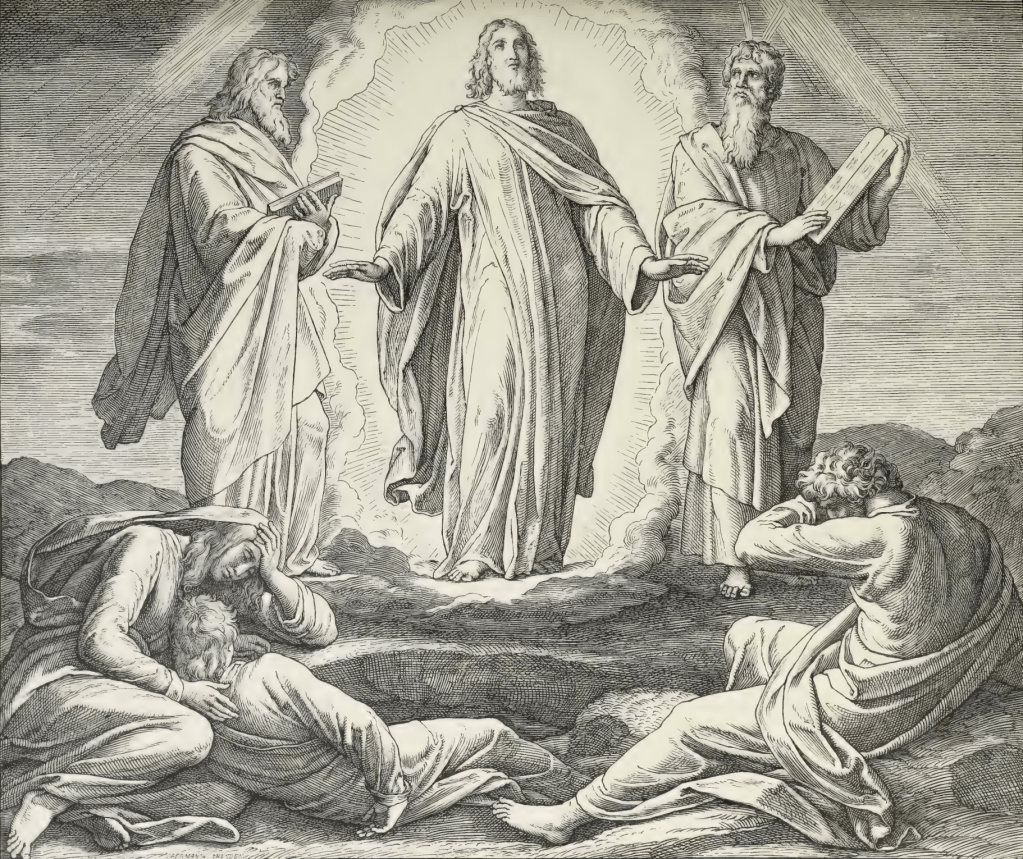
The Transfiguration of Jesus, by Julius Schnorr von Carolsfeld
I. The history of the transfiguration of Christ on Mount Tabor. (v. 1–8) II. The conversation of Christ with His disciples concerning the future Elijah. (v. 9–13)
Annotated Text
1. And after * six days (In Luke it says, “And it came to pass about eight days after these sayings,” [Luke 9:28]. For there had been six days between the time Jesus spoke these words at the end of the nearest preceding chapter and afterwards on the eighth day this Transfiguration followed), Jesus took to Himself Peter and James and John, his (James’s) brother (which three He likewise afterwards took to Himself when He wanted to go to His suffering in the garden of the Mount of Olives, Matthew 26:37, to indicate that those who have much of the suffering of Christ are also richly comforted through Christ, 2 Corinthians 1:5), and lead them (specially alone from other people, and went with them) to a high mountain (called Tabor, situated in Galilee,1 to which He withdrew to pray, and when He prayed, the form of His face was altered, Luke 9:28–29).
* Mark 9:2 (Luke 9:28)
1 † Or as others hold, “Panium, near Caesarea Philippi.” Peter calls it simply “the holy mountain” [τῷ ἁγίῳ ὄρει], 2 Peter 1:18.
2. And (He) was * transfigured before them (He was transfigured before them, Mark 9:2, in such a way that He received an entirely different form, He allowed them to see a glance of His heavenly, peculiar Majesty and glory, which was communicated to Him according to His human nature by virtue of the personal union, so that they would be guarded against the offense of the cross of Christ), and His face shown as the sun, and His clothes were white (and gleamed) as light (they became bright and very white as the snow, in such a way that no fuller on earth can make them so white, Mark 9:3).
* John 1:14; 2 Peter 1:16–17
3. And behold, there appeared to them (two men bodily, who were) Moses and Elijah, who (appeared in radiance and) spoke with Him (concerning the departure [τὴν ἔξοδον] which He was to fulfill at Jerusalem, that is, concerning His suffering. As Moses and the prophets had prophesied of Christ in their writings, John 5:39, 5:46, Acts 10:43, so also Moses thus speaks here with Christ, as well as Elijah in the name of the all the prophets, and give Him testimony, that He is the Messiah and Savior of the world).
4. But Peter (and those who were with Him were full of sleep; but when they awoke, they saw His radiance and the two men standing with Him. And it came to pass when they were departing from Him, Luke 9:32–33, Peter began) answered and said to Jesus, “Lord (and Rabbi, Mark 9:5, that is, Master, Luke 9:33), it is good to be1 here (for this transfiguration of Christ and this bodily conversation which Moses and Elijah held with Christ was a foretaste and prefiguration of the joy of eternal life); if you would like, then I will make three huts here, one for you, one for Moses, and one for Elijah (but he did not know what he was saying, for they were confused, Mark 9:6).
1 Greek: “It is something (truly) beautiful (and pleasant), that we are here (in such a pleasurable bright light).” [καλόν ἐστιν ἡμᾶς ὧδε εἶναι]
5. Then while He was thus still speaking, behold, there (came and) overshadowed them a luminous cloud (so that they were surrounded by it and were terrified when the cloud covered over them). And behold, a Voice (namely, the heavenly Father, fell) from the cloud (which) said (concerning Jesus Christ), * “This is My beloved (only-begotten) Son (whom I have begotten from eternity out of My essence), in whom I have good pleasure, whom you ought to hear (that you believe what He says to you and do what He commands you. Thus there is found here once more a glorious revelation of the most-holy Trinity: the Father allows His voice to beard from heaven, the Son stands in His transfiguration on the mountain, the Holy Spirit, who enlightens the hearts of men, reveals Himself in a bright cloud).”
* Matthew 3:17ff.; 2 Peter 1:17
6. When the disciples heard this, they fell (from fear) on their faces, and were very terrified (because they could not bear God’s majesty).
7. But Jesus came to them, * touched them (strengthened and comforted them) and said, “Stand up, and do not be afraid.”
* Daniel 8:18, 10:10
8. Now then they lifted up their eyes (and looked around themselves, Mark 9:8, and while such a Voice occurred, Luke 9:36, they found and) they saw no one (with them), except Jesus alone (Moses and Elijah had disappeared again).1
1 * Or rather had entered the bright cloud, Luke 9:35.
9. And when they descended from the mountain, Jesus commanded them and said, “You shall tell no one this vision (this revelation of My glory) until the Son of Man is raised from the dead (for Christ at that time was still in the state of His humiliation, and wanted that He should suffer and die beforehand before He entered into His glory, Luke 24:26. But afterward, after Christ’s resurrection and ascension, both apostles Matthew and Peter not only proclaimed such, but rather also recorded it in their Scriptures. The disciples have followed such a command, as is fitting; for Luke reports of them when he says, “And they were silent and proclaimed nothing to anyone in those days as to what they had seen,” Luke 9:36).
* Matthew 16:20
Useful Applications
I. DOCTRINE: Christ’s transfiguration according to His humanity on the mountain is a picture of the glory and transfiguration of the bodies of believers as they will be in the resurrection of the dead and in eternal life (v. 1–2)
The following is my translation of the notes and useful applications for the Old Testament Reading of the Fourth Sunday of Advent (Memento Nostri), Deuteronomy 18:15–19, as they are found in Das Weimarische Bibelwerk (1877). Square brackets indicate my own notes and additions. For the useful applications, I recommend the reader see this very helpful article by Dr. Benjamin T. G. Mayes.
III. A prophecy concerning the great prophet (Christ). (v. 15–19)
Annotated Text
15. A * Prophet, like me (and even much higher, indeed, the most excellent and highest Prophet)1will the Lord, your God, raise up (bring forth) for you, from you and your brothers (namely, the promised Messiah, true God and man), † to Him shall you listen (receive Him with true faith and follow Him. Luther: “Here another kind of preaching is clearly promised other than the preaching of Moses, which cannot be the Law which was sufficiently given through Moses; therefore, it must be the Gospel. And this Prophet is no one other than Jesus Christ Himself, who has brought such a new preaching on earth”).
* John 6:14; Acts 3:22, 7:37
† Psalm 2:12
1 † Through whom God, and through whose mediatorial office (indeed, a better reconciliation office), will establish a New Covenant, Jeremiah 31:31ff., as He had established [the Old Covenant] through my mediation (cf. Deuteronomy 18:18, 34:10). But concerning the Law of the Messiah, see Isaiah 2:2, 42:4, and 61:1ff.
16. Just as you then1 requested * of the Lord your God at Horeb (with the giving of the Law), on the day of (public general) assembly (of the Israelite people around the mountain), and said, ‘I will no longer hear the voice of the Lord, my God,’ and I will see no more the great fire (that burned on the mountain), that I not die (from terror and anxiety, but rather Moses shall recite the Word of the Lord to us).’
* Exodus 20:19; Hebrews 12:19 (Deuteronomy 9:10)
1 Hebrew: “indeed,” as you spoke of it previously, v. 17, so will it happen. (I will no longer speak with them such a terrifying manner, but rather in a loving manner.)
17. And the Lord said to me, “They have * spoken well (for without a Mediator there is no dealing with Me).”
* Deuteronomy 5:28
18. I will raise up for them a * Prophet like you (of such nature and such reputation, and of such glorious, indeed, far greater gifts and deeds) from their brothers (the Jewish people), and I will put My words ** in His mouth, and He1 shall speak all things to them which I have commanded to Him (He shall indicate My thinking to the people).
* John 1:45
† Hebrews 3:2ff, 12:24
** John 7:16, 8:26, 40
1 * He Himself, who is the Lord your God, v. 14, and not more in the fire, but rather in a friendly manner (see Isaiah 52:6; cf. Zephaniah 3:9; John 1:18; Matthew 17:5; etc.).
19. And whoever will not * hear My words, which He will speak in My name (but rather wantonly despise them and cast them to the wind), I will demand1 it of Him (I will attend to him with temporal and eternal punishment).”
* Matthew 17:5 (John 12:48)
1 † How? See Malachi 4:6. This is what is called the ban, which one still sees with one the eyes placed upon the Jews and the land of Israel on account of this dreadful misdeed (cf. Deuteronomy 32:43).
Useful Applications
III. CORRECTION: To receive the Word of the Great Prophet, Christ, willingly and follow Him in faithful obedience. (v. 15–19)
The following is my translation of the notes and useful applications of the Old Testament for the Feast of the Holy Cross, Numbers 21:4–9, as they are found in Das Weimarische Bibelwerk (1877). Square brackets indicate my own notes and additions. For the useful applications, I recommend the reader see this very helpful article by Dr. Benjamin T. G. Mayes.
II. Concerning the grumbling of the Israelites, and how they were punished with fiery serpents. (v. 4–6)
4. Then they traveled(the Israelites by God’s command)from Mount Hor by the way of the Sea of Reeds, so that they * went around the land of Edom(because they could not obtain from them friendly passage, cf. 20:20, for which reason they deviated from the correct highway which led to the land of Canaan, and it had the appearance as though they would much sooner come to Egypt than to the land of Canaan).
* Cf. Deuteronomy 2:1.
5. And the people became * disgruntled on the way **(because they detoured so far away, also because their journey lasted so long, and they saw no end of it yet), and they spoke ** against God and against Moses(from great impatience), “Why have you *** led us out from Egypt so that we die in the wilderness? For there is no bread or water here, and our soul is nauseated over this worthless food(we have become weary of the manna, and can no longer look upon it without disgust, because we have eaten the same thing a whole forty years).
* Cf. Numbers 11:1
** These words still belong to v. 4 and are to be translated, “but the people became disgruntled over which way (or un-way); v. 5. “therefore then the people, etc.”
*** Hebrew: You have, etc. (Moses and Aaron, who was indeed dead, however while he was alive had had led the matter together with Moses).
6. Then the Lord sent fiery * serpents among the people(Luther: “Therefore, they were called fiery because the people bitten by them became fiery-red by their poison and died from the burning heat, as from a pestilence or a carbuncle); they bit the people, so that a great people in Israel died(a painful and wretched death).
* Cf. Wisdom of Solomon 16:5; 1 Corinthians 10:9.
III. Concerning their repentance, and how God averted the plague. (v. 7–18)
7. Then they came to Moses(as the serpents had already bitten many of them and a great multitude of people had perished and the others had been humbled through their punishment)and said, * “We have sinned, for we have spoke against the Lord and against you(murmured out of impatience); pray to the Lord, that He take away the serpents from us(that we might not perish so miserably). Moses prayed for the people(who nevertheless had so often shown themselves rebellious and ungrateful toward him).
* Cf. Numbers 14:40; 1 Samuel 7:6.
8. Then the Lord said to Moses, “You make a * bronze serpent(which was formed as the fiery serpents, because it was made from copper), and set it for a sign **; that whoever is bitten and looks at it, he shall live(he shall recover and through this special wondrous sign be kept alive).
* See John 3:14.
** Hebrew: on a banner-pole (so that it might stand quite high and could be seen from afar)
9. Then Moses made a bronze serpent, and set it for a sign; and when a snake bit someone, so he looked at the bronze serpent, and he remained alive.(John 3:14–15 applies such image to Christ Himself, that, whoever is wounded by the bite of the old poisonous serpent and looks Him lifted on the cross with true faith, he shall be healed spiritually and eternally.)
(2 Kings 18:4; John 6:40)
[v. 10–18 omitted due to the assigned reading]
Useful Applications
II. WARNING: With respect to the despising of God and His benefits, which is severely punished by Him, is to be seen in the people of Israel when they became disgusted with the manna, v. 4–6; III. DOCTRINE: That God demonstrates His mercy in the midst of punishment to those who turn back to Him [i.e., repent], v. 7–9.

 PATTERN OF SOUND WORDS