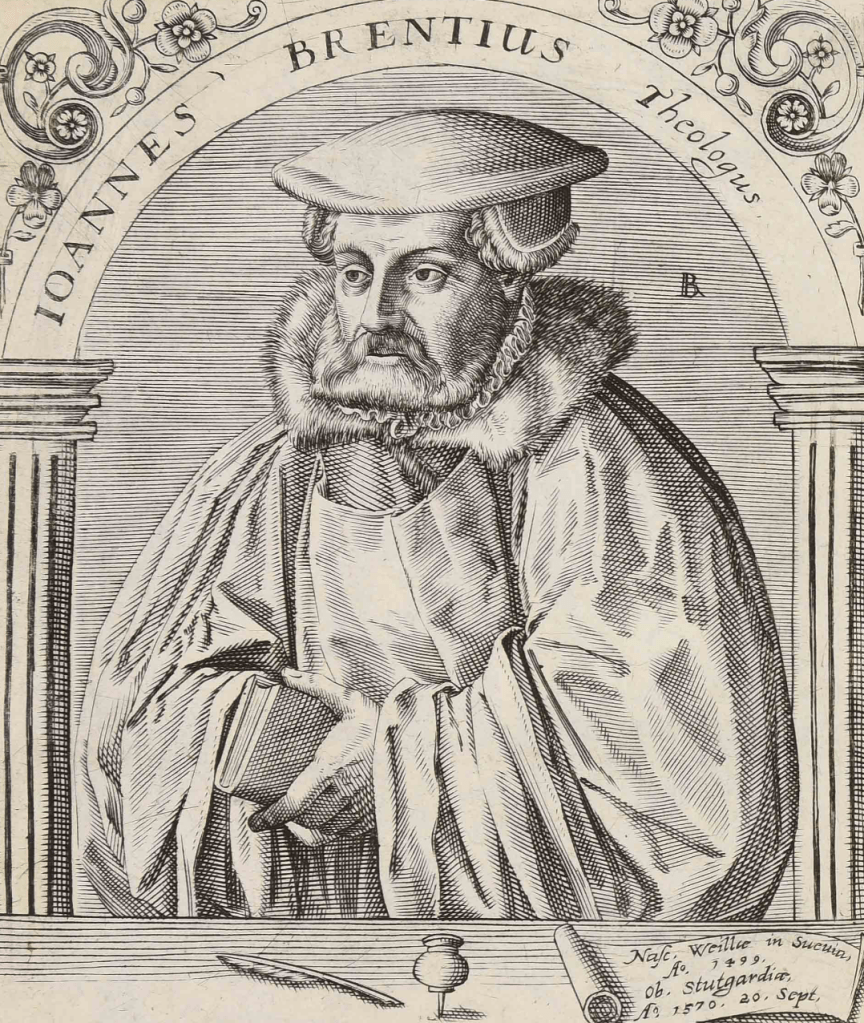
Here is my translation of Johannes Brenz’s summary of the Holy Gospel for Quinquagesima (Luke 18:31–43) as found in his Postilla (pg. LXIX). Square brackets and footnotes are my own notes and additions.
Summary of This Gospel
In this Gospel we learn:
First, where all the prophecy of the prophets has looked for the most part, and in which places Holy Scripture deals with the suffering and resurrection of our Lord Jesus Christ. [v. 31–33]
Second, to this end, the Gospel is not a new doctrine. [v. 31–33]
Third, why Christ preached concerning His suffering. [v. 31–33]
Fourth, that human reason darkens the bright clear truth in such a way that man cannot see it. Likewise, why the weakness of the apostles is held before us, namely, that we learn to know ourselves and give God alone the honor. [v. 34]
Fifth, the blind beggar is dealt with, where it is to be noted how the Law of the Jews at that time was no longer observed.1 Also, that one ought not turn away the hand from any needy person, so that God may bless us. [v. 35–43]
Sixth, why tribulations are sent to us, namely, not only on account of our sins, but also that God’s work and glory may be revealed in us. [v. 42–43]
Seventh, the blind man teaches us how we ought to grasp onto Christ, whom we ought to follow in every trial (Anfechtung). [v. 35–43]
Later in the sermon (pg. LXXII), Brenz will cite Deuteronomy 15[:7–11], Leviticus 19[:9–10], and Deuteronomy 14[:28–29] to show Israel’s obligation to care for the poor. Many places from the prophets could also have been cited which speak about Israel despising the poor (e.g., Isaiah 3:14–15, Ezekiel 22:29, etc.). ↩︎
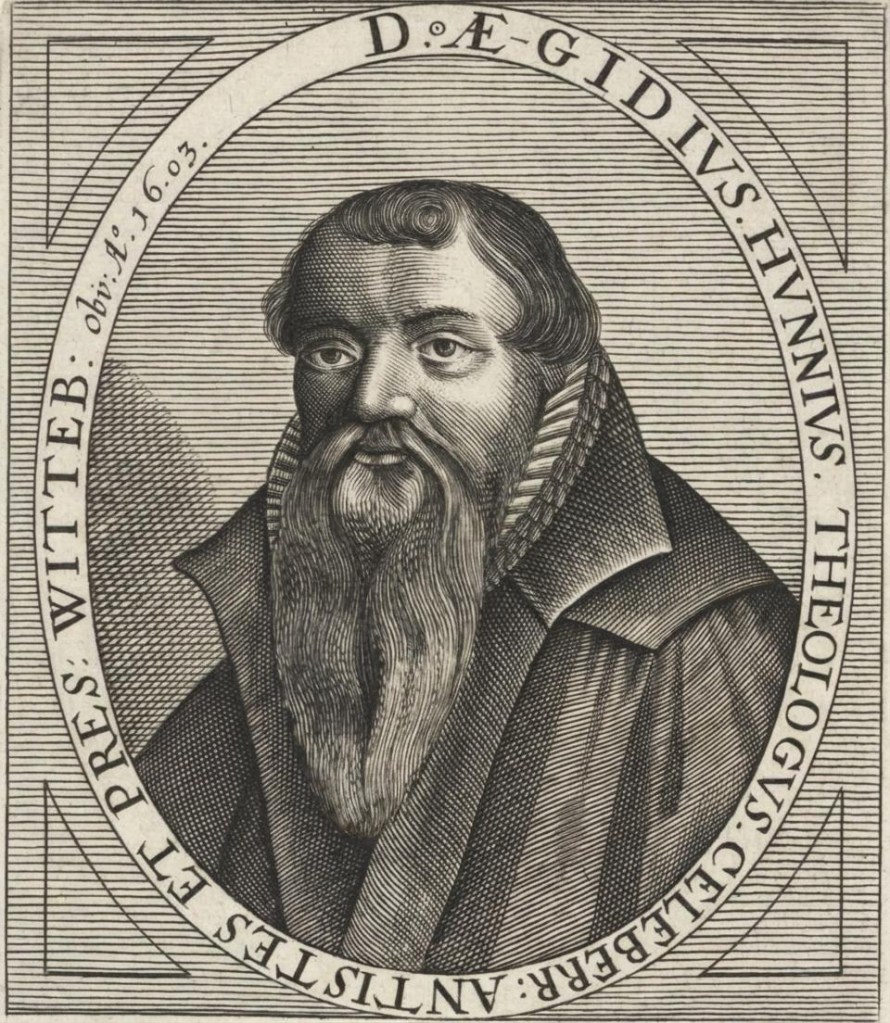
The following is my translation of Aegidius Hunnius’s introduction and sermon outline for the Holy Gospel of Quinquagesima (Luke 18:31–43) from his Postilla (Vol. I, pg. 288). Square brackets and footnotes are my own notes and additions.
Explanation of the Gospel
In today’s Gospel, a journey of the Lord Christ is described to us, when he undertook to go up from Galilee to Jerusalem shortly before the last Passover, in order to present Himself obediently to the heavenly Father as a pure sacrifice. And the Evangelists have written down with diligence what Christ spoke and did on this journey. For besides Luke, Matthew and Mark have also recorded this history in its parts and circumstances, who recall with diligence both the conversation the Lord Jesus had on the way with the disciples and what kind of divine miracle He worked on a poor blind man near Jericho, whom He made seeing at his humble and pleading prayer [see Matthew 20:17–19, 29–34; Mark 10:32–34, 46–52].
First, we will hear the Lord Christ’s prophecy concerning His impeding suffering and death. [v. 31–33]
Second, how the disciples received such preaching. [v. 34]
Third, concerning the sign He did on the blind man at Jericho. [v. 35–43]
The following is my translation of the notes and useful applications for the Holy Gospel of Quinquagesima, Luke 18:31–43, as they are found in Das Weimarische Bibelwerk (1877). Square brackets indicate my own notes and additions. For the useful applications, I recommend the reader see this very helpful article by Dr. Benjamin T. G. Mayes.
V. A prophecy concerning Christ’s suffering and death. (v. 31–34)
VI. The history of [the healing] of a blind man. (v. 35–42)
Annotated Text
31. Now He took to Himself the twelve (the twelve apostles), and said to them, “Behold, * we are going (now on this journey) up to Jerusalem (because the time of My suffering has drawn near, I will also draw near to the determined place of My suffering), and all will1 be fulfilled that is written by the prophets concerning2 the Son of Man (about3 My suffering, death, and resurrection).
* Matthew 17:22ff. (Matthew 20:17; Mark 10:32)
1 * Soon now, when I this time, as the last time, shall take Myself there.” Previously when He had preached the same, he spoke only of it in general (see Matthew 16:21, 17:12–22, etc.).
2 Greek: “in” [There is no preposition in the Greek, but τῷ is in the dative case.]
3 * “through or with My…” [I wasn’t sure what this getting at.]
32. For He will be * handed over to the Gentiles (to Pilate, the Gentile governor, and his soldiers), and He will be mocked and shamed (kept in the most disgraceful and shameful way with words and deeds), and spit upon;
* Matthew 27:2
33. and they will scourge and kill Him, and the third day He will rise again.”
(Joshua 2:19)
34. * But they understood none of this, and the saying was hidden from them, and they did not know what it was that He had said (because the disciples, in the supposed worldly kingdom of Christ, had imagined pure joy and good days for themselves, they could not agree with Christ’s suffering, death, and resurrection).
* Luke 9:45
35. Now it happened, when He (Jesus) came near (on His journey) to Jericho,1 * a blind man sat on the way and he was begging.
* Matthew 20:29–30; Mark 10:46
1 * Before he had yet entered the city (Luke 19:1). But the like, as is usual, are found again at the conclusion (see Matthew 20:29).
36. Now when he heard the people that were passing by (and following Christ in heap), he inquired what this was (what the tumult that he heard signified).
37. Then they preached to him, “Jesus of Nazareth is passing over.”
38. And He called and said, “Jesus, you Son of David (You who are the Messiah and the Savior of the World, the one promised to David and born from his lineage according to the flesh), have mercy on me (help me out of pure grace and unmerited compassion)!”
39. But those passing by warned him that he should be silent. But he cried out much more, “You, Son of David, have mercy on me!”
40. Now Jesus stood still and called for him to be brought. Then when they brought him near to Him, He asked him,
41. and said, “What do you what me to do for you?” He (the blind man) said, “Lord, that I may see.”
42. And Jesus said to him, “Be seeing; * your faith has helped you.”
* Matthew 9:22 (Luke 17:19)
43. And immediately * he was seeing1, and followed Him, and praised God. And all the people who saw this praised God.
* Psalm 146:8
1 Greek: “saw again” [ἀνέβλεψεν] (for he was not born blind, as the one in John 9:1ff., but had lost his sight through an accident; the same also goes for v. 41).
Useful Applications
V. DOCTRINE: Concerning the joyfulness and desire of Christ to suffer and die for us, because He had previously known all His suffering, and nevertheless willingly went to Jerusalem where it would happen. (v. 31) VI. CORRECTION: That we ought to call upon Christ with all our heart for spiritual illumination as this blind man did for bodily illumination. (v. 40) COMFORT: Christ, the Light of the World, will not allow anyone to lack who does not willfully shut his eyes (as he testifies with this cure). (v. 41)

 PATTERN OF SOUND WORDS