Tag: Prayer

  • Notes and Useful Applications for Philippians 4:4–7 from Das Weimarische Bibelwerk (1877)

    The following is my translation of the notes and useful applications for the Epistle Reading of the Fourth Sunday of Advent (Memento Nostri), Philippians 4:4–7, as they are found in Das Weimarische Bibelwerk (1877). Square brackets indicate my own notes and additions. For the useful applications, I recommend the reader see this very helpful article by Dr. Benjamin T. G. Mayes.

    I. Several admonitions which partly concern particular persons and partly are directed toward godliness in general. (v. 1–9)

    Annotated Text

    4. Rejoice * in the Lord (Christ, who has done so much good for you) always (in both good and bad circumstances), and once more I say (I repeat it once again), Rejoice!

    * Philippians 3:1; 2 Corinthians 13:11 (1 Thessalonians 5:16)

    5. Let your * forbearance (good faith and equity) be known to all men (be friendly and peaceable toward all men, be they friend or foe; also yield your own right at times for the sake of the preservation of peace and unity, Matthew 5:5, 9, 25). † The Lord is near (The judge is at the door, James 5:9, to procure justice for you).

    * Titus 3:2

    † 1 Corinthians 10:11 (1 Corinthians 16:22; Hebrews 10:25; 1 Peter 4:7)

    6. * Be worried about nothing (do not hang on to mistrustful and unnecessary worries); but rather in all things (in good and bad circumstances) † let your requests be made known before God in prayer and supplication with thanksgiving (pray in firm trust in God and thank Him for all His benefits).

    * Matthew 6:25, 31ff.

    † Psalm 145:18 (Psalm 55:23; 1 Peter 5:7; James 5:13; Colossians 3:17)

    7. And * the peace of God (by which God the Father is graciously deposed toward you, in which you stand firmly by virtue of the reconciliation which had been accomplished and obtained for you), which is higher than all reason (whose worth no human reason can grasp), will guard1 (and, as it were, will bastion) your hearts and minds (in all temptations and tribulations) in Christ Jesus (by whom God has granted you all things, Romans 8:32, so that you can remain steadfast with him)!

    * John 14:27 (Colossians 3:15)

    1 Greek: “And” (in this way) “the peace of God will guard” (as with a garrison) [καὶ ἡ εἰρήνη τοῦ θεοῦ… φρουρήσει]

    Useful Applications

    [There are no useful applications for v. 4–7.]
  • Notes and Useful Applications for 1 Kings 17:17–24 from Das Weimarische Bibelwerk (1877)

    The following is my translation of the notes and useful applications for the Old Testament Reading for the Sixteenth Sunday after Trinity, 1 Kings 17:17–24 as they are found in Das Weimarische Bibelwerk (1877). Square brackets indicate my own notes and additions. For the useful applications, I recommend the reader see this very helpful article by Dr. Benjamin T. G. Mayes.

    IV. The Resurrection of the Son of the Widow from Death (v. 17–24)

    Notes

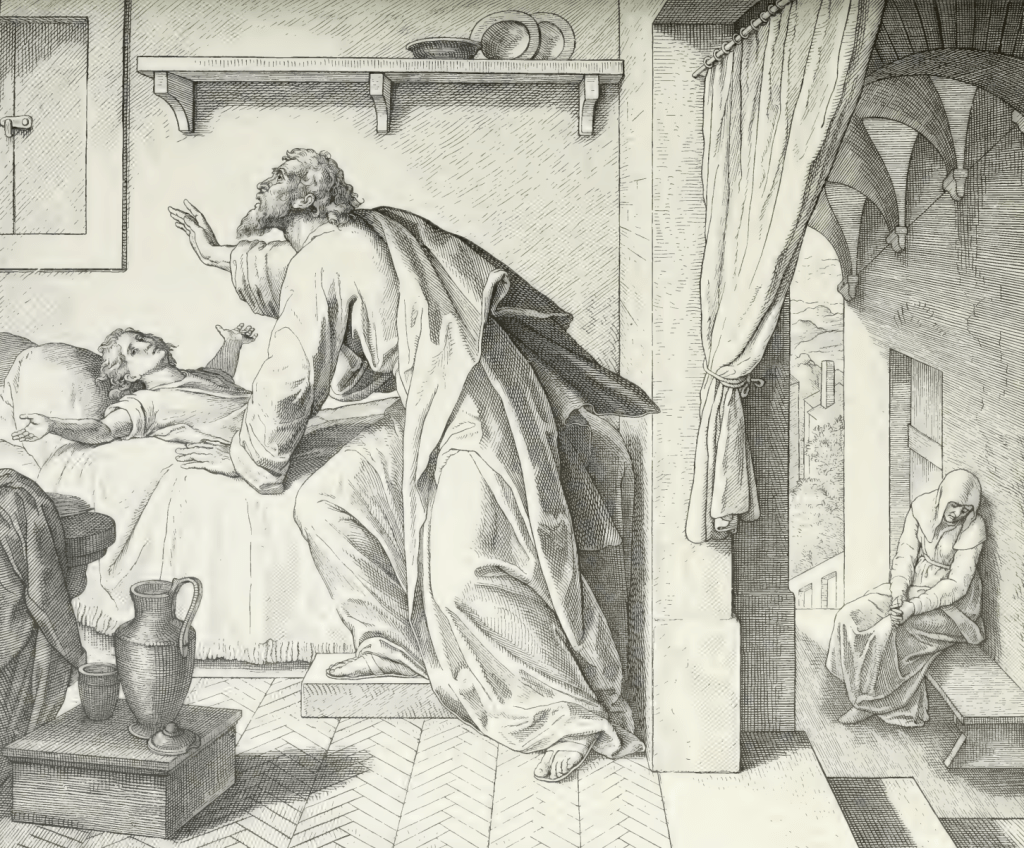
    17. And after these things, the son of the woman (the widow), his hostess, became ill, and his illness was so severe, that no breath remained in him (so that his soul departed from him and he died).

    18. And she (the widow) said to Elijah, * “What have I to do with you, you man of God (how badly do we harmonize together)? You have come to me that my misdeeds be remembered, and that my son would die (you are a holy man and I am a poor sinner, and I have not regarded you as one should treat such a man; therefore, I am now so heavily afflicted).

    * Judges 11:12; 2 Samuel 16:10

    19. He said to her, “Give me * your son.” And he took him from her bosom, and went into the room where he dwelt, and laid him upon the bed.

    * 2 Kings 4:32

    20. And he called upon the Lord (that He would give him grace and power to raise the dead boy), and said, “O Lord, my God, have You also done evil to the widow, with whom I am a guest, that You should kill her son?”

    21. And he stretched himself over the child (he laid himself upon the child, spread himself over him, to warm his dead body) three times, and called upon the Lord, and said, “O Lord, my God, let the soul of this child come again to him (to his body).

    (2 Kings 4:34; Acts 20:10)

    22. And the Lord heard the voice of Elijah, and the soul of the child came back to him, and he became alive.

    23. And Elijah took the child, and brought him down from the room into the house, and * gave him to his mother, and said, “See here, * your son lives.”

    * Luke 7:15

    ** John 4:50

    24. And the woman said to Elijah, “Now I know that you are a man of God (a true prophet), and the * Word of the Lord in your mouth is truth.”

    * 2 Samuel 7:28

    Useful Applications

    IV. COMFORT: Elijah’s prayer, which was granted by God, reminds us that believers do not call upon God vainly in their concerns, v. 21–22. DOCTRINE: On the other hand, this woman gives an example of an unstable and timid disposition, which one ought to guard oneself against, v. 18.