Tag: Resurrection

  • Notes and Useful Applications for John 4:47–54 from Das Weimarische Bibelwerk (1877)

    The following is my translation of the notes and useful applications for the Holy Gospel for the Twenty-First Sunday after Trinity, John 4:47–54, as they are found in Das Weimarische Bibelwerk (1877). Square brackets indicate my own notes and additions. For the useful applications, I recommend the reader see this very helpful article by Dr. Benjamin T. G. Mayes.

    II. How Jesus was received in Nazareth and in other places, and also how the royal official’s son was freed from the fever. (v. 43–54)

    Annotated Text

    47. And there was a royal official (a distinguished servant in the house of Herod the tetrarch, who nevertheless was considered a king by the common man and thus was called a king, Matthew 14:1, 9; Mark 6:14), whose son lay sick in Capernaum. This one heard that Jesus came (He had learned that Jesus had come) from Judea in Galilee, and he went to Him (to Cana, about five miles’ way), and he asked Him that He come down (go with him to Capernaum) and help his son, for he was sick unto death (therefore, he also supposed that Christ would have to be present himself for so dangerous an illness, and that he could not perform this work of healing if he were absent, much less raise him from the dead if he should die).

    48. And Jesus said to him: * “If you do not see signs and wonders, ** then you will not believe (“You Jews believe no more than you see. If I go with you, you suppose that I could help your son; but what kind of faith is that?” To believe rightly means not to doubt at all about that which one does not see, Hebrews 11:1, and to ground oneself in the omnipotence and goodness of God insomuch that he can and will help, even above and against all sense and reason).

    * John 2:18; 1 Corinthians 1:22

    ** behold presently with your own eyes. The answer is aimed at the request to come down in v. 47 and agrees with Matthew 9:18.

    49. The royal official said (further, in the weakness of his faith) to Him, “Lord, come down, before my child dies (otherwise, Your presence will be in vain).

    50.  Jesus said to him, “Go (at this My Word, to which you shall attach firm faith), * your son (has not died as you think, but) lives (through the divine power of this My Word, and when you come home, you will find him alive and well).” The man believed the Word that Jesus spoke to him, and he went (in certain confidence that the Lord’s Word would come to pass; therefore, he also did not hurry home all at once, to which he could have come that same evening if he had wanted, but rather remained overnight on the way).

    * 1 Kings 17:23

    51. And while he was going (further, on the next day), his servants met him, proclaimed it to him and said, “Your son lives (and is completely alive, healthy, and strong).”

    52. Then he investigated from them the hour in which it had become better with him. And they said to him, “Yesterday, around the seventh hour (according to our time, around 1 PM in the afternoon) the fever left him.”

    53. Then the Father realized (and heard precisely) that it was (exactly) around the hour in which Jesus had said to him, “Your son lives (v. 50).” And he (as now he had been fully convinced of the divine miraculous power of Christ) believed along with his entire household (his wife, children, and household servants were brought through to true faith in Christ. And some hold that this royal official’s wife was Joanna, who is mentioned in Luke 8:3, and that she is called the wife of Chuza, the steward of Herod, who followed the Lord and ministered to Him from her own possessions).

    (Acts 16:32, 18:8)

    54. This is now the second sign that Jesus did when He came from Judea into Galilee. (The first is described in John 2:7ff.)

    Useful Applications

    II. DOCTRINE: What faith or heartfelt confidence in Christ’s Word and promise has for power and might is testified by the royal official (v. 50–53). DOCTRINE: But how the Lord Jesus often uses many wondrous preparations and arrangements to awaken and to strengthen faith is seen from both stories (v. 16–54).

  • Notes and Useful Applications for 1 Kings 17:17–24 from Das Weimarische Bibelwerk (1877)

    The following is my translation of the notes and useful applications for the Old Testament Reading for the Sixteenth Sunday after Trinity, 1 Kings 17:17–24 as they are found in Das Weimarische Bibelwerk (1877). Square brackets indicate my own notes and additions. For the useful applications, I recommend the reader see this very helpful article by Dr. Benjamin T. G. Mayes.

    IV. The Resurrection of the Son of the Widow from Death (v. 17–24)

    Notes

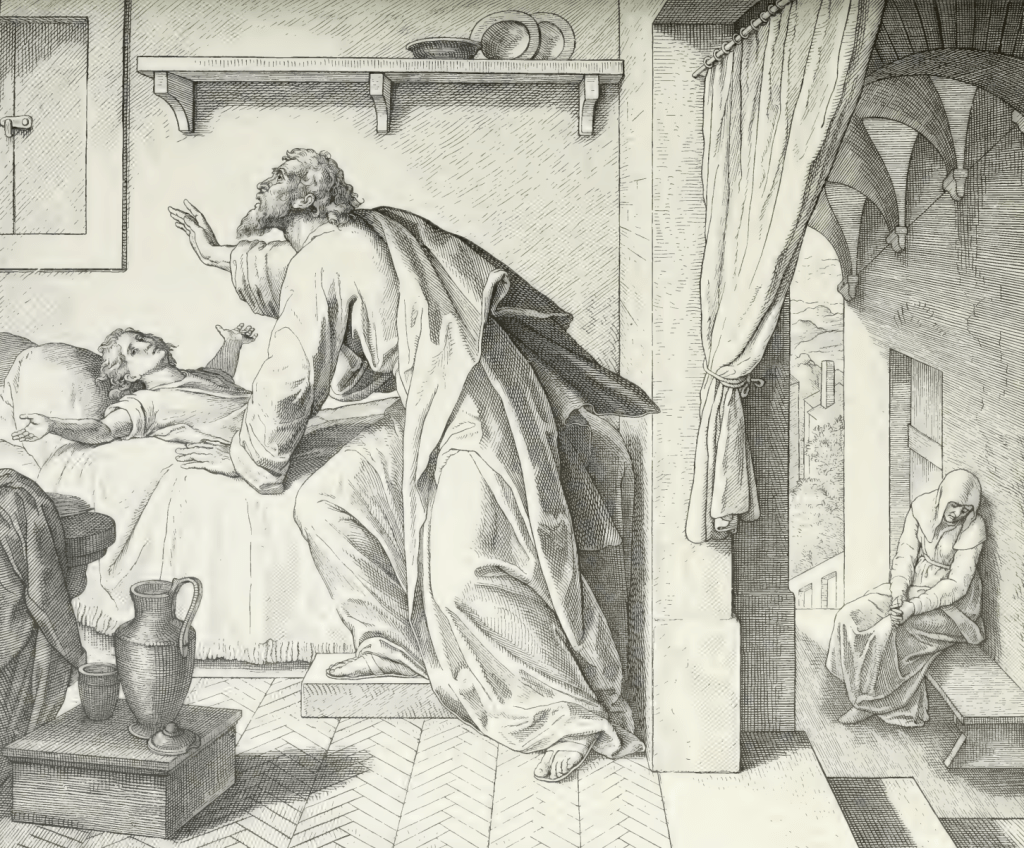
    17. And after these things, the son of the woman (the widow), his hostess, became ill, and his illness was so severe, that no breath remained in him (so that his soul departed from him and he died).

    18. And she (the widow) said to Elijah, * “What have I to do with you, you man of God (how badly do we harmonize together)? You have come to me that my misdeeds be remembered, and that my son would die (you are a holy man and I am a poor sinner, and I have not regarded you as one should treat such a man; therefore, I am now so heavily afflicted).

    * Judges 11:12; 2 Samuel 16:10

    19. He said to her, “Give me * your son.” And he took him from her bosom, and went into the room where he dwelt, and laid him upon the bed.

    * 2 Kings 4:32

    20. And he called upon the Lord (that He would give him grace and power to raise the dead boy), and said, “O Lord, my God, have You also done evil to the widow, with whom I am a guest, that You should kill her son?”

    21. And he stretched himself over the child (he laid himself upon the child, spread himself over him, to warm his dead body) three times, and called upon the Lord, and said, “O Lord, my God, let the soul of this child come again to him (to his body).

    (2 Kings 4:34; Acts 20:10)

    22. And the Lord heard the voice of Elijah, and the soul of the child came back to him, and he became alive.

    23. And Elijah took the child, and brought him down from the room into the house, and * gave him to his mother, and said, “See here, * your son lives.”

    * Luke 7:15

    ** John 4:50

    24. And the woman said to Elijah, “Now I know that you are a man of God (a true prophet), and the * Word of the Lord in your mouth is truth.”

    * 2 Samuel 7:28

    Useful Applications

    IV. COMFORT: Elijah’s prayer, which was granted by God, reminds us that believers do not call upon God vainly in their concerns, v. 21–22. DOCTRINE: On the other hand, this woman gives an example of an unstable and timid disposition, which one ought to guard oneself against, v. 18.

  • Notes and Useful Applications for Luke 7:11–18 from Das Weimarische Bibelwerk (1877)

    The following is my translation of the notes and useful applications for the Holy Gospel of the Sixteenth Sunday after Trinity, Luke 7:11–17 as they are found in Das Weimarische Bibelwerk (1877). Square brackets indicate my own notes and additions. For the useful applications, I recommend the reader see this very helpful article by Dr. Benjamin T. G. Mayes.

    Notes

    II. The Resurrection of the Dead Son of the Widow at Nain (v. 11–18)

    11. Now it happened afterward * that He (the Lord Jesus) came into a city (among the mountains of Hermon, located four miles away from Capernaum) with the name Nain; and many of His disciples went with Him (not only the twelve Apostles, but rather also many other who were His disciples and hearers) and many people (which followed after the Lord Christ for the sake of His teaching and miracles).

    * Greek: “On the following day”

    12. Now as He came near to the gate of the city, behold, there a dead man was being carried out, * who was * the only son of his mother, and she was a widow. And many people from the city went out with her (for the burial of her son).

    *For the Jews had to have their graves outside of the city.

    ** 1 Kings 17:17.

    13. And when the Lord saw her, * He was moved with pity for her (from heartful compassion) the same (grieving widow), and said to her, ** “Do not weep (excessively over the deadly departure of your son).”

    * Matthew 9:36

    ** Jeremiah 31:16

    14. And He came forward and touched (with His almighty, life-giving hand)  the casket (the deathbed, the bier, upon which the young the man was openly carried), and the bearers stood. And He said, “Young man, * I (who am the resurrection and the life, John 11:25) say to (command) you, stand up.”

    * Mark 5:41

    15. And the dead man sat upright, and began to speak. * And He gave him (living again) to his mother. (This is the first dead person whom Christ raised in the New Testament; afterward, He also raised the daughter of Jairus, the ruler of the school, Matthew 9:25, and Lazarus, John 11:43–44, from the dead, and in His resurrection there were many bodies of the saints who were raised with Him, Matthew 27:52)

    * 2 Kings 4:36

    16. And fear came upon all of them (for they were greatly astonished over this great miracle), and they praised God and said, “A great prophet (who is the Messiah Himself) has risen among us, and ** God has visited His people (through the sending of this prophet in grace). ***

    * The like had not happened since the time of Elisha, and thus not in nine hundred years, much less with such circumstances.

    ** Luke 1:68, 78 (Deuteronomy 18:15, 18; Matthew 16:14)

    *** Or, according to the Greek: “And (some) said (who still regarded Him as a mere man, but nevertheless held Him to be a prophet), ‘A great prophet has risen among us.’ Or (others, who still went further said), ‘God has visited His people (through the Messiah Himself).’”

    17. And this report of Him resounded in all the Jewish lands and in all the surrounding lands.

    Useful Applications

    II. DOCTRINE: As easy as it was for Christ to raise this young man from the dead with a word, thus will He also by His divine almighty Word raise all the dead on the Last Day (v. 14–15).

  • Chemnitz’s Homily Outline for the First Sunday after Easter (Dominica Quasimodogeniti)

    Chemnitz’s Homily Outline for the First Sunday after Easter (Dominica Quasimodogeniti)

    The following is my translation of Martin Chemnitz’s homily outline for the First Sunday after Easter (Dominica Quasimodogeniti) found in his Postilla (Vol. II, pgs. 89–90). Chemnitz’s text is John 20:19–31. Square brackets indicate my own personal notes.

    Chemnitz’s Homily Outline

    “Now in order that we may handle this doctrine in a useful manner, so we will set it forth in these points:

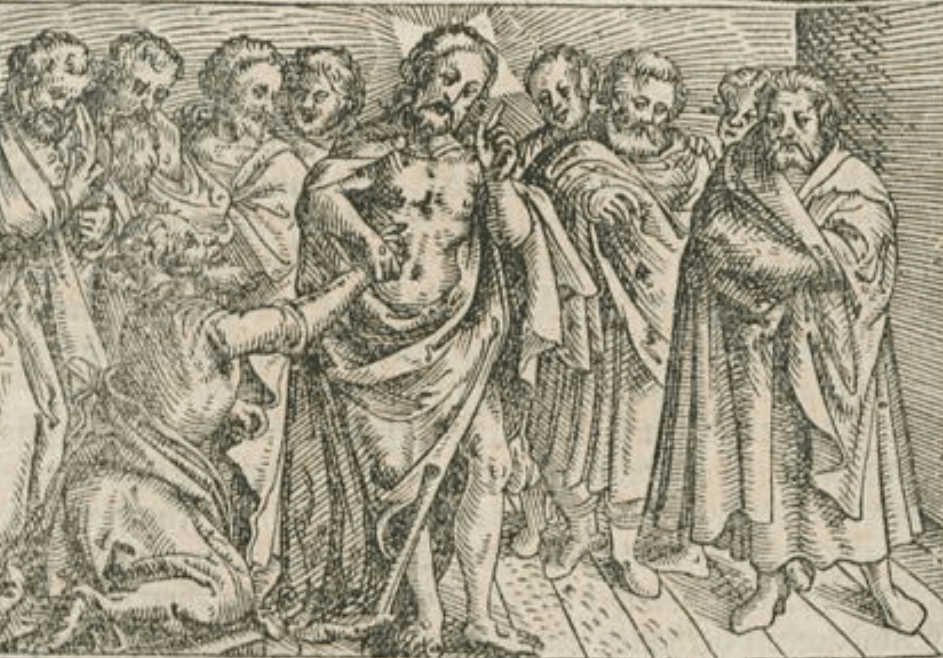
    1. First, here is described, because the Lord Christ had previously declared that He had to suffer and die and rise again, in order that He institute the preaching office (Predigamt) on earth: How He has instituted the preaching office (Predigamt), and how preachers and hearers ought to thereby be reminded how the preaching office must and ought to be carried out, that thereby everything happens in the name of Christ and in the stead of Christ (in Namen Christi… und an Christi statt), and what He gives to preachers and to hearers as a reminder (Erinnerung) and for doctrine (Lehre).
    2. Second, how the Lord did not only institute the preaching office (Predigampt) in general (ins gemein), but rather directed it that it ought to be carried out that it be (seien) the keys of the kingdom of heaven, by which the unrepentant are to have heaven closed to them and the repentant are to have heaven opened and unlocked to them. And how the preacher ought to carry out and use these keys. Also, what the hearers ought to think of the keys, how they ought to use the loosing key for consolation (Trost), but ought to use the binding key for warning (Warnung), and how they ought not think, ‘Why do I care whether heaven is being barred only by the preacher? What power (Macht) does he have?’ But rather we ought to consider what the Lord says here: that what the preacher does here is valid in heaven with our Lord God and is effective there [John 20:23].1
    3. Third, how no man of high or low station (Standts), ought to presume to hinder God in this order and not allow the preaching office (Predigamt) to take its course both in its teaching office (Lehrampt) as well as in its rebuking office (Straffampt).2 Because God wants to maintain this order (Ordnung), and thereby be efficacious and through this means allow His treasury to be opened so that from it all the treasures of God—which are God’s, which the Son of God has acquired and earned for us through His obedience, suffering, and death—may be brought forth and be distributed among us. And how, the devil therefore sets himself so opposed to this office (Ampt), and especially the rebuking office (Straffampt). Therefore, all Christians, preachers, political authorities, and hearers ought all the more strongly to uphold it, that this office may be carried out unhindered among them.

    We will now deal with these three points briefly in this sermon. To this end, the blessed God give us His Holy Spirit, that we may hear and learn fruitfully.”

    Footnotes:

    1. The reader should remember and consider the Small Catechism’s explanation of the Office of the Keys: “The Office of the Keys is that special authority which Christ has given to His church on earth to forgive the sins of repentant sinners, but to withhold forgiveness from the unrepentant as long as they do not repent.” ↩︎
    2. The rebuking office (Straffampt) is typically dealt with more explicitly on the Fifth Sunday after Easter because of John 16:8, “And when the Paraclete comes, He will convict/rebuke the world of sin, and of righteousness, and of judgment.” See Chemnitz, Postilla, Vol II. pgs. 166ff. See also Johann Gerhard, Theological Commonplaces, Vol. XXVI/2, § 270. ↩︎