Tag: Salvation

  • Notes and Useful Applications for Luke 8:4–15 from Das Weimarische Bibelwerk (1877)

    The following is my translation of the notes and useful applications for the Holy Gospel of Sexagesima, Luke 8:4–15, as they are found in Das Weimarische Bibelwerk (1877). Square brackets indicate my own notes and additions. For the useful applications, I recommend the reader see this very helpful article by Dr. Benjamin T. G. Mayes.

    4. Now, when a great people were with one another, and had hastened to Him (Christ) from the cities, He spoke * by a parable (to thereby clarify the dissimilarity of the hearers of the divine Word):1

    * Matthew 13:3; Mark 4:2

    1 † However, He used this parable on a good occasion to so great a crowd of various kinds of people, and for the most part from the countryfolk, who were present.

    5. “A Sower went out to sow His Seed; and as He sowed, some fell on the way was trampled, and the birds among the heavens devoured it.

    6. And some fell among the rocks, and when it came up,1 it withered because it had no moisture (no dampening, from which it could have been rooted more deeply and grown further).

    1 Greek: “after it had come up” [καὶ φυὲν]

    7. And some fell among the thorns, and thorns grew up with it and choked it (before it ripened).

    8. And some fell on a good land, and it came up and (some) bore * a hundredfold fruit.” When He said this, He called out, “Whoever has ears to hear (and received the gift from God to grasp and to understand), let him hear (let him diligently pay attention to it and be mindful of it in his heart as to what I mean with this parable).”

    * Genesis 26:12

    9. Now His disciples asked Him and said, “What does this parable mean (what is signified by it)?”

    (Matthew 13:10)

    10. Now He said, “To you it is given to know the mystery of the Kingdom of God (this and other hidden spiritual things which God has revealed in His Word and Gospel); but to the others (those who despise such mysteries and do not allow their right understanding to be seriously applied to themselves) in parables (with success, nevertheless, from their guilt, because they do not concern themselves further with it), * that they do not see it (do not understand what they ought to know for their salvation), even if they see it (even if they, with their external eyes, see my miracles, which I perform to strengthen their faith and to make them righteous and saved through faith), and do not understand, even if they hear (what I preach to them).

    * Isaiah 6:9–10; Matthew 13:14; Mark 4:12; John 12:40; Acts 28:26 (Matthew 11:25; 2 Corinthians 4:3)

    11. But this is the parable (its right understanding): The seed is the Word of God.

    12. Now that which is on the way, are those who hear; thereafter the devil comes and takes the (heard) Word from their hearts (tears it out of the heart or hinders it so that it does not come into the heart rightly; when the people in matters of religion are always doubting, when they secure and accustomed to sin, eagerly hear something new and splendid, sleep during the sermon and evade it with strange thoughts, do not allow themselves to be moved toward correction, etc.), so that they do not believe (draw no right, living, and active faith from hearing of the divine Word) and (thus, in the lack of true faith) are not saved.

    (1 Peter 1:23; Hebrews 4:2)

    13. Now that which is on the rock (the rock on which the seed of the Divine Word was sown), are those who when they hear receive the Word with joy (because they hope to have good days with it); and they have no root (the Word of God does not take deep root in their hearts, therefore there is no endurance along with their faith); for a time (so long as it goes well with them) they believe, and at a time of temptation (when cross, tribulation, and persecution break in) they fall away (from the Word of God and from saving faith).

    (2 Timothy 2:10)

    14. Now that which fell among the thorns (the hearers, among whom the seed of the Word was sown as among thorns), these are those,1 who hear it, and go (secure) among the cares, riches, and pleasures of this life (as soon as they have come from Church and heard God’s Word, they run and race, strive and scheme after temporal goods, vain honor, the pleasures of this life, the lust of the eyes, the lust of the flesh, and proud living, 1 John 2:16, so that these are their foremost concerns) and (with these anxieties, the seeds of the heard word) are choked and bring forth no (ripe) fruit (so that the seed cannot bring forth any fruits of faith and good works within them).

    (1 John 2:15ff.; Sirach 31:1ff.)

    1 Greek: “but as concerns that which fell among the thorns, these are such who” [τὸ δὲ εἰς τὰς ἀκάνθας πεσόν, οὗτοί εἰσιν]

    15. But that which is on the good land, these are those who hear (as well as understand) the Word and * retain it in a decent, good (upright) heart (purified from strange thoughts, greed, evil lust, envy, hatred, etc.), and bring forth † fruit (through a holy and godly life) in patience (so that they do not allow themselves to be turned away from God and His Word by the cross, temptation, and persecution, or by the nuisances of the world).”

    * Acts 16:14

    † Hebrews 10:36 (Matthew 13:23; 1 Corinthians 15:2; Hebrews 6–7; Revelation 3:8–10)

    Useful Applications

    II. CORRECTION: That we, when we become believers through God’s Word, ought not fall away during the time of temptation and persecution. (v. 15)

  • Notes and Useful Applications from Isaiah 55:10–13 from Das Weimarische Bibelwerk (1877)

    The following is my translation of the notes and useful applications for the Old Testament Reading of Sexagesima, Isaiah 55:10–13, as they are found in Das Weimarische Bibelwerk (1877). Square brackets indicate my own notes and additions. For the useful applications, I recommend the reader see this very helpful article by Dr. Benjamin T. G. Mayes.

    III. Consolation in the power of the divine Word, what it will work in the repentant. (v. 10–13)

    Annotations

    10. For just as the rain and the snow fall from heaven and do not return from there, but rather water the earth (very richly), and make it fruitful and increase so that it gives seed to sow and bread to eat;

    11. Thus shall the * Word, which proceeds from My mouth also be. It shall neither return to Me empty, but rather do what pleases Me, and shall succeed in that for which I sent it (shall nevertheless be effective at all times in the hearts of certain men).

    * Acts 12:24 (1 Corinthians 2:4ff.)

    12. For you shall set out in joy (from your spiritual captivity), and be led in peace (into your heavenly eternal Fatherland).1 The mountains and hills shall exult with glory before you, and all the trees in the field will clap with their hands (all creatures shall themselves, as it were, rejoice with you).

    1 Hebrew: “be brought to this (to the Church of Christ as a gift of the Lord; see Isaiah 18:7).”

    * Isaiah 44:23 (66:21ff.; Psalm 96:12; Psalm 98:8)

    13. The fir will grow instead of the thornbushes, and the myrtle instead of the briars (the Gentiles, who were unfruitful, withered thornbushes and briars before their conversion shall be made fruitful through the Word of the Gospel and through the Holy Spirit for all good works); and it shall be a name and eternal sign for the Lord that shall never be eradicated (the call of the Gentiles and the salvation of the Church will bring redound to the eternal praise and glory of the divine name, and also be a mark of the power and saving truth of the Gospel).

    (Isaiah 41:19; Matthew 16:18)

    Useful Applications

    III. DOCTRINE: Concerning the abundant power of the preached Word of God in the conversion and salvation of men. (v. 10–11) CONSOLATION: That God will not withdraw from His Church until the end of the world. (v. 13)

  • Notes and Useful Applications for Matthew 20:1–16 from Das Weimarische Bibelwerk (1877)

    The following is my translation of the notes and useful applications for the Holy Gospel of Septuagesima, Matthew 20:1–16, as they are found in Das Weimarische Bibelwerk (1877). Square brackets indicate my own notes and additions. For the useful applications, I recommend the reader see this very helpful article by Dr. Benjamin T. G. Mayes.

    I. An explanation of the nearest preceding words [from v. 15], “There are many who are first, etc.,” with a parable of the laborers. (v. 1–16)

    Annotated Text

    1. “The 1 kingdom of heaven is like a House-father, who went out (first thing) in the morning to hire laborers into * His vineyard. (In this parable, by the kingdom of heaven is understood the estate of the Church of God, or the kingdom of grace here on earth, not only with regards to the call of God into the Church, but also the transfer of men out of the kingdom of grace into the kingdom of glory and majesty. By the house-father is understood God the Lord, the heavenly House-Father, John 15:1, who immediately from the beginning of the world has called men into vineyard of His Church through the preaching of His Word and continues this calling until the end of the world in such a form that at different times of the world He calls men to His Church and kingdom of grace.)2

    1 Greek: “For…” [γάρ] — One should note here this little word, which provides the occasion [v. 15] and the key to the parable, which most German editions have omitted.

    * Matthew 21:33 (Isaiah 5:1ff.)

    2 † In particular, He calls at all times laborers as stewards (that is, teachers) into His vineyard of the Christian Church, whom He does not allow to labor vainly, but rather He kindly divides His gifts, bodily benefits and provisions, necessary relief, internal consolation, and the like in His order and measure.

    2. And when He came to agreement with the laborers for a groschen[1] (concerning the value of a groschen, see Matthew 18:28) for a day (when He made a promise to those who had been called by Him into the spiritual vineyard that their labor shall not remain unrewarded), He sent them into His vineyard (to carry out their labor in it according to estate and calling of each person).

    [1] A groschen was a silver coin that was often issued as part of a daily wage. The Greek word here is denarius (δηναρίου).

    3. And He went out (by this going out is signified that God, out of the hidden light of His majesty, as it were, has stepped forth and revealed Himself in His Word) around the third hour (when it was already three hours of the day) and He saw others in the market (in this world) standing idly (who had not yet come into the spiritual vineyard of the Church, and therefore, were not rightly serving God),

    4. and He said to them, ‘You go out (as the previous workers who were called before you) into the vineyard; I will give to you what is right (I will thus make it with you that you should have no cause to complain about me, as if I wanted to allow myself to be worked for and served for free).

    (1 Corinthians 15:58)

    5. And they went out. Once more, He went around the sixth and ninth hour (the sixth hour is the time of midday, the ninth hour is the time of vespers, three hours before the setting of the sun) and did likewise in this manner (He called those whom He saw standing idly in the market, likewise to go into the vineyard in order to work).

    6. But around the eleventh hour (when only one hour was remaining until sunset, John 11:9) He went out and found others (by which the Gentiles can be understood, as those who were called in the last part of the world) standing idly and said to them, ‘Why are you standing here idly the entire day?’

    7. They said to Him, ‘No one has hired us.’ He said to them, ‘You also go out into the vineyard, and whatever is right, shall become you.’ (cf. v. 4)

    8. Now when it had become evening (),1 the Lord of the vineyard (the heavenly House-Father, who is Lord over all) said to His Steward (to Christ, His Son, whom He has set as Lord over His house, Hebrews 3:6), ‘Call the laborers and give to them the wage and begin with the last, until the first (thus, that you give to each a groschen, to the last as well as to the first).’

    1 † Others understand by the evening not precisely the end of the world, but rather the time of the promised reward of grace in general; since some, especially the reward-seeking Jews, according to the nature of their special covenant shall receive only a temporal reward, but others, [namely,] the right-believing in Christ from the Jews and Gentiles shall receive the eternal reward of grace by faith, according to God’s promise, certainly, but none from merit.

    9. When they came who were hired around the eleventh hour, they each received a groschen.

    10. But when the first came, they thought they would receive more (because they had labored longer in the vineyard); and each of them also received his groschen. (By those who were hired around the eleventh hour are understood those who at the preceding calling willingly entered into the vineyard of the Christian Church, labored faithfully therein, and in their labor did not look to the reward, but rather to the goodness of the heavenly House-Father and to His promise. In particular, this refers to believing Gentiles, who do not rely upon their own righteousness and upon the merit of their works, but only upon the grace of God in Christ. By the first are understood those men who indeed followed the call, came into the fellowship of the Church of God, and labored therein; but only sought the reward, and therefore relied upon the merit of their works and in their hearts exalted themselves over the laborers of grace. In particular, this pertains to the Jews who were called to the Kingdom of God first, that is, before the Gentiles; but they sought to establish their own righteousness, Romans 10:3, and placed the trust of their hearts in the merit of their works. These receive their groschen, that is, the promised reward, which they have already received in this life in the manifold temporal blessings, Matthew 6:2; but they neither have any share in the eternal reward, nor anything for which to hope.)

    11. And when they received it, they murmured (from impatience and seeking a better reward) against the House-Father (who, in their opinion, maintained no equity).

    (Luke 15:28ff.)

    12. And they said, ‘These last have only labored for an hour, and you have made them equal to us who have born the burden and heat of the day (having labored throughout the entire day with great hardship).

    13. But He answered and said to one among them (namely, one who elevated himself before others), ‘My friend, I have done you no injustice. Did you not agree with Me for a groschen?

    14. Take what is yours and go away. But I will give to these last just as I gave to you. (This must not be understood as if even the murmuring work-saints, who build and presume upon their own merit, will obtain eternal life, since by the groschen is not to be understood precisely eternal life, but rather, in general every kind of reward, whether it be here temporally in this, or there eternally in that life; and thus indeed these murmuring work-saints also receive their reward, namely, temporal blessing, but not the eternal reward in heaven.)

    15. * Or do I not have the right to do what I want with that which is Mine? (Should it be forbidden to Me to deal with that which is My own, and which no one can earn from me, according to My gracious will?) Do you therefore see askew (are you therefore so resentful and envious), that I am so kind (free-giving)?’

    * Romans 9:21

    16. Thus (all servants of God, especially Church ministers, should not to look for temporal gain, honor, and the like in their work, much less should they envy others; but rather, in faithful and  honest purpose toward God’s promise, they ought to persevere in their duty and call with true godliness, so that they do not deprive themselves of God’s grace and eternal blessing with pride, envy, and murmuring. For) the * last (the laborers of grace, who rely only on God’s grace and do not insist upon their merit) will be the first (will be preferred to the first), and the first (those who are murmuring work-righteous men) will be the last (that is, will be rejected). For many (that is, all, all men) are called (through the Word to the Church of God); but few (reckoned contrary to the great heap of the damned) are chosen (by God to eternal life because they seek righteousness and eternal life not only and solely in the grace of God and in Christ, but rather in the merit of their own works and exalt themselves over others).”

    * Matthew 19:30, 22:14 (Mark 10:31; Luke 13:30)

    Useful Applications

    I. CORRECTION: That we, by impatience and grumbling, shall not overcome [or become master of] God in His governance and in the rewarding of good, but rather ought to leave everything to His holy will and allow ourselves to be content with that which He bestows upon us with thanksgiving. (v. 11–15)

  • Notes and Useful Applications for Exodus 3:1–14 from Das Weimarische Bibelwerk (1877)

    The following is my translation of the notes and useful applications for one of the Old Testament Readings assigned for the Transfiguration of our Lord, Exodus 3:1–14, as they are found in Das Weimarische Bibelwerk (1877). Square brackets indicate my own notes and additions. For the useful applications, I recommend the reader see this very helpful article by Dr. Benjamin T. G. Mayes.

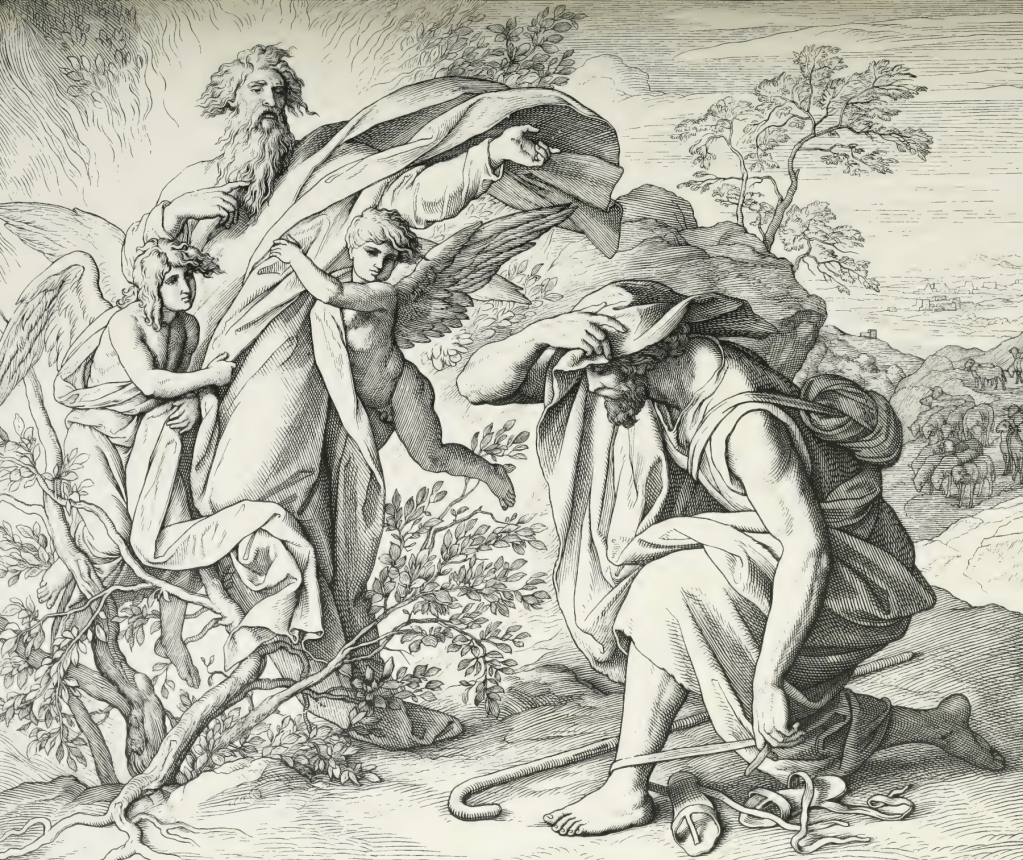
    Moses is Called to Lead Israel from Egypt, by Julius Schnorr von Carolsfeld

    I. The appearance of the Son of God in the fiery bush, and how Moses approached. (v. 1–6)

    II. The promise of God concerning help and salvation, and how Moses was called to his office. (v. 7–10)

    III. How Moses refused this call two distinct times, partly on account of his unworthiness, partly on account of the ignorance of the children of Israel, that they may not know the name of God; and how the Lord answered thereafter. (v. 11–14)

    Annotated Text

    1. Now Moses tended (in those days in the fortieth year) the sheep of Jethro, his father-in-law,1 the priest (the captain and magistrate) in Midian, and he drove the sheep out in the wilderness (into the land of Arabia, which is called the wilderness of Sinai), and came to the mountain of God (so named on account of the present and following divine revelation, called) Horeb.

    1 † Perhaps the brother-in-law, for the word from which the Hebrew comes signifies in general a relationship through marriage and can be that the son follows the father in office. Age and names can suggest this. See Exodus 2:18, 23; Numbers 10:29; Judges 1:16, 4:11, etc.

    2. And the Angel of the Lord (the Lord, the eternal self-subsisting Son of God, who afterward in the fullness of time was sent into the flesh by the Father, the Lord) appeared to him * in a fiery flame from the bush.1 And he saw that the bush burned with fire and was nevertheless not consumed (by the flame of fire).

    * Exodus 23:20; Deuteronomy 33:16 (Acts 7:30)

    1 † Thornbush, particularly a bramble-bush; from this Mount Sinai appears to have received its name.

    3. And he said (to himself with wonder), “I will (go) there and see this great sight (I will inspect and research), why the bush does not burn (what the cause might be that the green wood in the midst of which the flame of fire burns is not consumed? By this fiery bush is prefigured the mystery of the incarnation of the Son of God, that namely, in the fullness of time, He would unite true human nature to Himself personally,  and also fill it with the light of His divine majesty and divine attributes, yet so that human nature would not be harmed or consumed by the divine nature in the least, and that in such personal union His assumed human nature would complete the work of redemption of the human race, prefigured by the deliverance from Egyptian slavery.)1

    (Acts 7:31)

    1 † Whether the divine preservation of His Church in the fire and thorns of the (Egyptian) afflictions has no place here is to be considered, and it is likely that it was in view.

    4. But when the Lord saw (the Son of God in the fiery bush) that he went over (wanted to draw near) to see, God (the Son of God) called to him from the bush, and * said, “Moses, Moses!” He answered, “Here I am. (What is your desire? Speak, for Your servant listens, 1 Samuel 3:10.)

    * Genesis 22:11

    5. He said, “Do not tread here, take off your shoes from1 your feet (as a sign of your impurity); for the place upon which you stand is (on account of My divine presence and revelation through the Word and through sign of the fiery bush) a * holy land.”

    1 Hebrew: “cast them down” (For the Jewish shoes were fasted to the foot only from above with a strap, as they are still worn by the Capuchin friars.)

    * Genesis 28:17 (Joshua 5:15)

    6. And He said further, * “I am the God of your father, the God of Abraham, the God of Isaac, and the God of Jacob (I have established a gracious covenant with your forefathers, the holy patriarchs, and promised them that I would be their God, that I would nourish and protect them, that I would sanctify and renew them, and that I would bestow all good upon them, that I would resurrection them again after their death, and that I would gather them into eternal life; but, in particular, that I would give the land of Canaan to their descendants, and that the Messiah shall be born from their race).” And Moses hid his face, for he (as an impure sinner) was afraid to look upon God (the most-holy Lord).

    * Matthew 22:32 (Mark 12:26; Luke 20:37; Acts 7:37, 32)

    7. And the Lord said, “I have (indeed) seen (from before time and even now) the misery of My people in Egypt (the descendants of Abraham, Isaac, and Jacob, who are the people of My special possession), and I have heard their cries over those who drive them (King Pharoah, his counselors, and his officials); I have known their sorrow (and let it come into My heart),

    (Acts 7:34)

    8. And I have come down (I have revealed My special presence in the fiery bush and am determined) that I rescue them from the hand of Egypt (slavery and oppression), and lead them out from this land into * a good and far land, in a land in which flows milk and honey (which is rich and fruitful), namely, to the place (into the land) of the Canaanites, the Hittites, the Amorites, the Perizzites, the Hivites, and the Jebusites (whom altogether are accursed and notorious sinners, Leviticus 18:24–25).

    * Exodus 33:3 (Exodus 13:5ff; Genesis 9:25, 11:7, 15:16, 18:21)

    9. Because now the cry of the children of Israel has come before me (because the children of Israel, in their cries and prayers have set My covenant and promise before Me), and I have seen their fear (the external bodily need), how the Egyptians frighten them;

    10. so * go now, I will send you to Pharoah (the King in Egypt), that you1 lead my people, the children of Israel from Egypt (the house of slavery).”

    * Psalm 105:26; Acts 7:34 (Hosea 12:14; Sirach 45:3ff.)

    1 Hebrew: “Come now! Behold, the cry has come, etc.” (v. 9) “Come! (I say) go, for I will send you to Pharoah, and you will lead My people, etc.”

    11. Moses said to God, * “Who am I, that I should go to Pharoah and lead the children of Israel from Egypt?” (My person, reputation, and strength are far too meagre for such a great work.)

    * Exodus 4:10; 1 Samuel 18:18

    12. He said, * “I will be with you (as Immanuel, the strong God). And this shall be the sign for you (a sign of remembrance, to remind you of what I now say to you in the future, and now are assured of this blessing), that I have sent you: When you have led My people from Egypt, you will offer sacrifice to God on1 this mountain (where I have now appeared to you and have given you the call to lead My people).”

    * Genesis 31:3; Judges 6:16

    1 Hebrew: “in” (For sacrifices were never offered upon it, also upon which few were allowed come. See Exodus 24:9ff.)

    13. Moses said to God, “Behold, when I come to the children of Israel, and say to them, ‘The God of your fathers has sent me to you,’ they will say to me, ‘How shall we call His name (what is His proper name, by which He will be distinguished from the gods of the Egyptians)?’ What shall I say to them (as an answer)?”

    14. God said to Moses, * “I AM WHO I AM (I am the eternal, unchangeable God, the Creator and Preserver of all creatures, complete in Myself; I will also the fullness of time assume human nature, and in it complete the great work of redemption from spiritual slavery.).” And He said, “Thus you shall say to the children of Israel (the only true God’s name is this): ‘I AM has sent me to you (Luther: “When you come there, then I will be with you, and show Myself such that you shall know that it is I.”).”

    * Deuteronomy 4:35; Revelation 1:4, 8

    Useful Applications

    I. CORRECTION: That we ought to come to the place where God deals with us through His word with reverence, just as Moses did. (v. 1–6) II. DOCTRINE: That God alone knows how to raise up useful people for the help and comfort of His suffering Church, as He did with Moses. (v. 7–10) III. COMFORT: That those who are orderly called, even to a dangerous office, ought to comfort themselves with the assistance of God. (v. 11–12)

  • Notes and Useful Applications for Isaiah 42:1–9 from Das Weimarische Bibelwerk (1877)

    The following is my translation of the notes and useful applications for the Old Testament reading of the First Sunday after Epiphany, Isaiah 42:1–9, as they are found in Das Weimarische Bibelwerk (1877). Square brackets indicate my own notes and additions. For the useful applications, I recommend the reader see this very helpful article by Dr. Benjamin T. G. Mayes.

    Note: This is the appointed reading from the Lutheran Missal Project.

    I. A promise of God the heavenly Father and a prophecy concerning Christ as to what kind of office He will have and how He will carry it out. (v. 1–9)

    Annotated Text

    1. Behold, this is * My Servant (although Christ, according to His divine nature, is equal to God the Father in essence, power, and honor and also according to His human nature has received divine attributes by virtue of the personal union, nevertheless, for our sake, He has become the servant of God the Father through His humiliation, Philippians 2:7), whom I uphold;1 and (this is) My Elect (the one whom I have chosen for the work of redemption from eternity past), in † whom My soul has good pleasure. I have given Him My Spirit (without any measure, so that He should rest fully on Him, Isaiah 11:2, John 3:34), He will bring forth justice (how a man must become righteous before God and be blessed) among the Gentiles (through the preaching of the Gospel).

    * Matthew 12:18

    1 Hebrew: “I grasp Him and support Him” (see Exodus 17:12). Thus, in Matthew 12[:18–21] is the meaning only expressed.

    † Matthew 3:17, 17:5; 2 Peter 1:17 (Isaiah 49:6)

    2. He will not cry out nor call (Christ will not establish a worldly kingdom in which there is much turmoil and unrest, Luke 17:20), and His voice will not be heard in the streets (He will conduct Himself in humility and in the lowly form of a servant, Philippians 2:7).

    (Matthew 12:19)

    3. The * bruised reed He will not break (He will not further trouble contrite and broken hearts, but much more comfort them and bless them), and the smoldering wick (the little light of weak faith in the one who wants to despair on account of his sins) He will not quench (He will show Himself gentle toward those who labor and are burdened, Matthew 11:28–29, and He will bear with their weaknesses with patience). He will teach to keep the justice (which counts before God) truthfullly1 (He will also instruct those who have become righteous through faith in Him as to how henceforth they ought to serve God the Lord in holiness and righteousness, Luke 1:74–75).

    * Matthew 12:20; Psalm 34:19 (Matthew 9:12ff.)

    1 Hebrew: “to bring forth to firm conviction” (that is, “perform.” Therefore, it is also given as “unto victory” or “victorious” [εἰς νῖκος] in Matthew 12[:20].

    4. He will be neither sullen nor dreadful (Luther: “He will not be harsh or irascible and sour, but rather friendly, gentle, and benevolent”), until He establishes justice on earth;1 and the islands will wait (there will also be far remote Gentile peoples called to His kingdom, who dwell on the islands) for His Law (for the doctrine of the Gospel).

    (Jeremiah 23:5; Matthew 12:21)

    1 Hebrew: “He will not become distressed (that is, disgruntled, Isaiah 61:3), nor retreat, until He establishes justice in the land (of Israel); thereafter, etc.”

    5. Thus says God, the Lord, who created and spread out heaven, who made the earth and its vegetation, who gives breath to the people who are on it and spirit (life) to those who go on it:

    6. I, the Lord (God the Father) have called (I have ordained You for this, that You shall carry out the work of redemption) You (My beloved Son, Christ) with righteousness (in such manner that You will render a complete payment to My righteousness, and obtain the perfect righteousness that counts before Me for the human race), and I will grasp You by the hand (as You contend against death, sin, devil, and hell), and I will keep you, and I will have You given as a covenant (as Mediator of the New Testament or Covenant) among the people1 (that You establish and confirm them through Your blood), as Light * to the Gentiles (that You bring not only the Jews but also the Gentiles through the light of the Gospel into the light of the saving knowledge of God and their Savior);

    1 The people of Israel (see Romans 9:4, 15:8; Acts 3:25).

    * Isaiah 9:2, 49:6, 60:1 (Daniel 9:24; Luke 2:32; Romans 5:19; Romans 8:2ff.)

    7. that You shall open the eyes of the blind (those stuck in spiritual blindness), and lead the prisoners from the prison (that You redeem them from the curse of the Law, as well as death and eternal condemnation) and those who * sit in darkness (who lack the true knowledge of God in Christ), from the prison (in which no light lightens or shines).

    * Matthew 4:16 (Isaiah 35:5, 61:1; Luke 1:79; Acts 26:18)

    8. * I am the Lord (who alone am the only true self-subsisting God), that is My (proper) name; † and I will give My honor to no other (false god), nor My praise to idols.

    * Exodus 3:15

    † Isaiah 48:11 (Exodus 6:3; Psalm 83:19)

    9. Behold what shall come I proclaim to you beforehand,1 and I proclaim new things (of which no one could have surmised); before they come up (spring forth and flourish), I let you hear of them (Here, the promise properly speaking is to be understood of the coming of the Messiah, who in the prophet Zechariah 6:12 is called “Zemah,” that is, a “Branch”).

    (Isaiah 41:26)

    1 Hebrew: “Behold, the first things (which I had previously allowed to be spoken, e.g., the conquest of Canaan, the kings of Israel, etc.) have come, and what is new (that is, what has not yet come), etc.” See Isaiah 43:19.

    Useful Applications

    I. COMFORT: That all repentant, troubled, and broken hearts (who are like a bruised reed and a smoldering wick) ought to be raised up, comforted, and made joyful by their Savior Christ from His holy Word. (v. 3–4)

  • Notes and Useful Applications for Jeremiah 23:5–8 from Das Weimarische Bibelwerk (1877)

    The following is my translation of the notes and useful applications of the Old Testament Reading for the First Sunday of Advent (Ad Te Levavi), Jeremiah 23:5–8, as they are found in Das Weimarische Bibelwerk (1877). Square brackets indicate my own notes and additions. For the useful applications, I recommend the reader see this very helpful article by Dr. Benjamin T. G. Mayes.

    III. He sets before them in contrast [to this account of punishment (v. 1–4)], the prophecy concerning the true Helper and Savior Jesus Christ. (v. 5–8)

    Annotated Text

    5. “Behold, * the time (of the New Testament) is coming,” says the Lord, “that I will raise up for David (from his stem and descendants, according to My promise) † a righteous Branch (a Son); and He (namely, the Messiah) shall ** be a (spiritual) King, who will rule well, and establish justice and righteousness on earth (He will acquire perfect righteousness through His obedience and suffering,1 and appropriate it to the members of His kingdom through faith, and protect His Church against enemies).

    * Jeremiah 30:3

    † Isaiah 4:2ff.

    ** Isaiah 32:1 (33:14–16; Psalm 132:17; Isaiah 11:3ff.)

    1 † See Psalm 22:31–32; for He will be a help through an everlasting redemption, v. 6.

    6. At that time * shall Judah (the Christian Church) be helped, and shall Israel (who is each true believer in Christ) dwell secure. And this will be His name (the Messiah’s), that one will call Him (in true faith), “The Lord (the true God), who is our righteousness” (who has brought us eternal righteousness, Daniel 9:24; who also has been made righteousness for us from God, 1 Corinthians 1:30; so that we might become in Him the righteousness which avails before God, 2 Corinthians 5:21).

    * Jeremiah 33:16; Isaiah 45:24 (Isaiah 53:11; Romans 3:21)

    7. Therefore, behold, * the time is coming,” says the Lord, “that one will no longer say, ‘As true as the Lord lives, who has led the children of Israel out of the land of Egypt (in a bodily manner),’

    * Jeremiah 16:14–15

    8. but rather, ‘as true as the Lord lives, who has led forth the seed of the house of Israel (in a spiritual manner according to this type), and has brought them out from the land of the north and from all the lands1 into which I had driven them, so that shall dwell in their own land.’”

    1 † This teaches that the talk is of the general assembly of believers in the New Testament, John 10:16; Matthew 8:11; of which those from the north have been a prelude and a sample.

    Useful Applications

    III. DOCTRINE: That Christ the Son of God who has been sent form the heavenly Father into the world (signified through the true Branch of David), is the King of His believers, by whom they obtain righteousness and eternal salvation. (v. 5–6)

  • Notes and Useful Applications for John 8:31–36 from Das Weimarische Bibelwerk (1877)

    The following is my translation of the notes and useful applications for the alternate Gospel Reading for the Commemoration of the Lutheran Reformation (Reformation Day), John 8:31–36, as they are found in Das Weimarische Bibelwerk (1877). Square brackets indicate my own notes and additions. For the useful applications, I recommend the reader see this very helpful article by Dr. Benjamin T. G. Mayes.

    II. A discussion with the Jews concerning the office of Christ, concerning the true freedom of the children of Abraham and their characteristics, as well as concerning the divinity of Christ. (v. 12–58)

    Annotated Text

    31. Then Jesus now said to the Jews who believed in Him, “If * you (steadfastly) remain in My Speech (and My Words remain in you, John 15:7), so you are My true disciples (those to whom the end of faith, eternal salvation, will be gifted).

    * John 7:17; 15:10, 14.

    32. And you will know the truth (have the faith of God’s elect, the knowledge of the truth according to godliness, in the hope of everlasting life, Titus 1:1–2), and the truth (such blessed knowledge of salvation, which consists in the forgiveness of sins, Luke 1:77) * will make you free (from slavery to sin, John 8:34, and from eternal death, John 8:51).”

    * John 8:36ff. (Romans 6:13; Galatians 5:1; 1 Peter 2:16)

    33. Then they answered Him (namely, the others who were still unbelieving Jews, who were mixed with those believers), “We are Abraham’s seed, *  we have never been anyone’s slaves (bondsmen) at anytime (The Jews said this out of lying presumption and a proud mind, for in truth the situation was something much different, as is known from the histories). ** How can You say then, ‘You shall be free?’”

    (Matthew 3:9; Jeremiah 2:14)

    * Greek: “and” – (By the former, they boast of a free origin, but with one, they boast of a free estate.)

    ** Nevertheless, it could also be that those who lived at that time and spoke with Christ had wanted it to be understood only of themselves, as those who were indeed subjects of the Emperor, but who were not slaves and still lived according to their own laws.

    34. Jesus answered them and said, “Truly, truly, I say to you, * whoever sins (whoever lets sin reign in his mortal body, gives obedience to its lusts, and gives his members over to sin as instructions of unrighteousness, Romans 6:12–13), he is sin’s slave (and is free concerning righteousness, whose end is eternal death, Romans 6:20–21).

    * Romans 6:16, 20; 2 Peter 2:19; 1 John 3:8.

    35. However, the * slave (as it goes in common life) does not remain eternally in the house (in this way also whoever is a slave of sins and a bondsman of the devil, 1 John 3:8, 2 Timothy 2:26; and such a one who remains stiff-necked without repentance has no part nor inheritance in the house of God and in the eternal kingdom of heaven, John 14:2, even though he finds himself among the external heap of the congregation of God); the Son (that is, God’s) remains (in the same house of God) eternally (and with Him those also remain therein, who hold fast the confidence and the boast of hope until the end, Hebrews 3:6).

    * Genesis 21:10

    36. So now, if the Son * makes you free (through the heavenly truth, John 8:32), so you will be truly (and eternally) free (from sin, death, and hell).”

    * Romans 6:18, 22; 1 Corinthians 7:22, Galatians 5:1 (Romans 8:2)

    Useful Applications

    [There are no applications listed for v. 31–36 in the text. AJB]