Tag: Second Sunday after Epiphany

  • Notes and Useful Applications for John 2:1–11 from Das Weimarische Bibelwerk (1877)

    The following is my translation of the notes and useful applications for the Holy Gospel of the Second Sunday after Epiphany, John 2:1–11, as they are found in Das Weimarische Bibelwerk (1877). Square brackets indicate my own notes and additions. For the useful applications, I recommend the reader see this very helpful article by Dr. Benjamin T. G. Mayes.
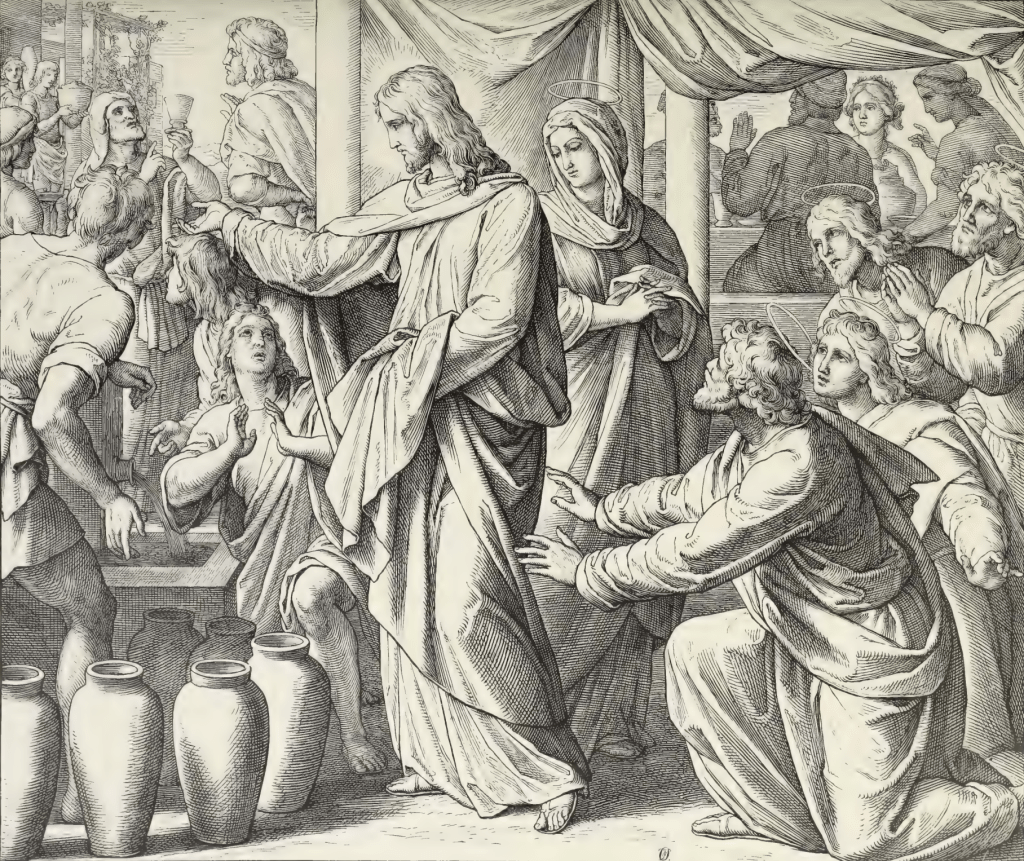
    The Wedding at Cana, by Julius Schnorr von Carolsfeld

    I. The history of the wedding at Cana. (v. 1–11)

    Annotated Text

    1. And on the third day (after Jesus had gone into Galilee, John 1:43, and had spent two days on the way) there was a wedding at Cana in Galilee, and the mother of Jesus was there (perhaps as a related kinswoman).

    2. Now Jesus and His disciples (who were mentioned in John 1[:35–51]) were also invited to the wedding (therefore, they were also present there. With His presence, Christ not only wanted to demonstrate His affability, but rather, by His very first miracle, He also wanted to honor the married estate as the first ordinance of God among men and the most excellent picture of the communion of Christ with His Church and teach that marriage ought to be held in honor by all, and the marriage bed ought to be kept undefiled, Hebrews 13:4.).

    3. And when the wine had been used up (because the supply was meagre on account of the poverty of the newly married couple), the mother of Jesus said (from good intention and care, but at an inopportune time, and also with a certain timidity, worry, and faint-heartedness) to Him, “They have no wine (They do not have enough wine; therefore, prove yourself as an almighty and miracle-working Lord in this emergency).

    4. Jesus said to her, “Woman, what * have I (in such a work that concerns My office) to do with you? My hour is not yet come (I know well how and when I shall help).

    * 2 Samuel 16:10 (Matthew 12:48)

    5. His mother (was assured by these words, that her Son Jesus would prove Himself helpful at the right time, and) said to the servants, * “Whatever He (this my Son) says to you, do it (even though it may seem illogical to you).

    * Genesis 41:55

    6. Now there were set there six stone water jars (large containers or tubs)1, according to the manner of * Jewish purification (from which the Jews, according to old custom and according to the ordinances of the fathers, were accustomed not only to wash and purify their hands, but rather also the dishes, cups, and other vessels many times), and in each of them were two or three measures. (Luther: “Metreta in Greek [μετρητὰς]; two metreta make about one Eimer[2] of wine among us .”)

    1 * Or also “immovable troughs,” as one calls them in some places.

    * Mark 7:3

    [2] An “Eimer” was perhaps around 56.5 liters.

    7. Jesus said to them (to the servants and waiters, John 2:5), “Fill the water jars with water.” And they filled them until them up to the top.

    8. And He said to them (after He had changed the water into wine by His divine power), “Draw [some] now (into your vessels), and bring it to the master of the feast1 (to taste it, so that he might let it be served afterward to the guests). And they brought it (to him, as the Lord commanded them).

    1 * To “the steward of the feast,” who was chosen at times by lot. Today one might say “the host.”

    9. But when the master of the feast tasted the wine which has become water and did not know from whence it (such a fine wine kept until now) came (but the servants who had drawn the water knew) (and they did not immediately tell it to the master of the feast, to have him test it as to what he would say about it), the master of the feast called the bridegroom,

    10. and said to him, “(How should I understand this?) Everyone gives (at his appointed banquet and celebration) the good wine first, and when they (the guests) have become drunk (have enjoined themselves a little and drunk for merriment), then the inferior; (but) You (on the other hand) have kept the good wine until now (which seems strange to me.” However, there is no doubt that afterward the master of the feast with all the other attendees came to know the truth of this miracle of Christ.)

    11. This is the first sign (visible miracle), that Jesus did (after He had begun His preaching office), that happened at Cana in Galilee; and He revealed (thereby) His (until now completely hidden under the form of a servant) glory (glory as of the only-begotten Son of the Father, John 1:14, of which He only allowed a single ray to shine forth, as the sun does at time from the clouds). And His disciples believed in Him (their faith in Him as the now appeared Messiah was thereby markedly strengthened).

    Useful Applications

    I. DOCTRINE:  That the Lord Christ Himself, together with His mother and disciples, was at a wedding in Cana in Galilee, redounds to the married estate a particularly great honor, that it is a holy well-pleasing estate to God. (v. 1–2)
  • Notes and Useful Applications for Ephesians 5:22–33 from Das Weimarische Bibelwerk (1877)

    The following is my translation of the notes and useful applications for the Epistle Reading of the Second Sunday after Epiphany (Lutheran Service Book), Ephesians 5:22–33, as they are found in Das Weimarische Bibelwerk (1877). Square brackets indicate my own notes and additions. For the useful applications, I recommend the reader see this very helpful article by Dr. Benjamin T. G. Mayes.

    Note: The historic reading is Romans 12:6–16a.

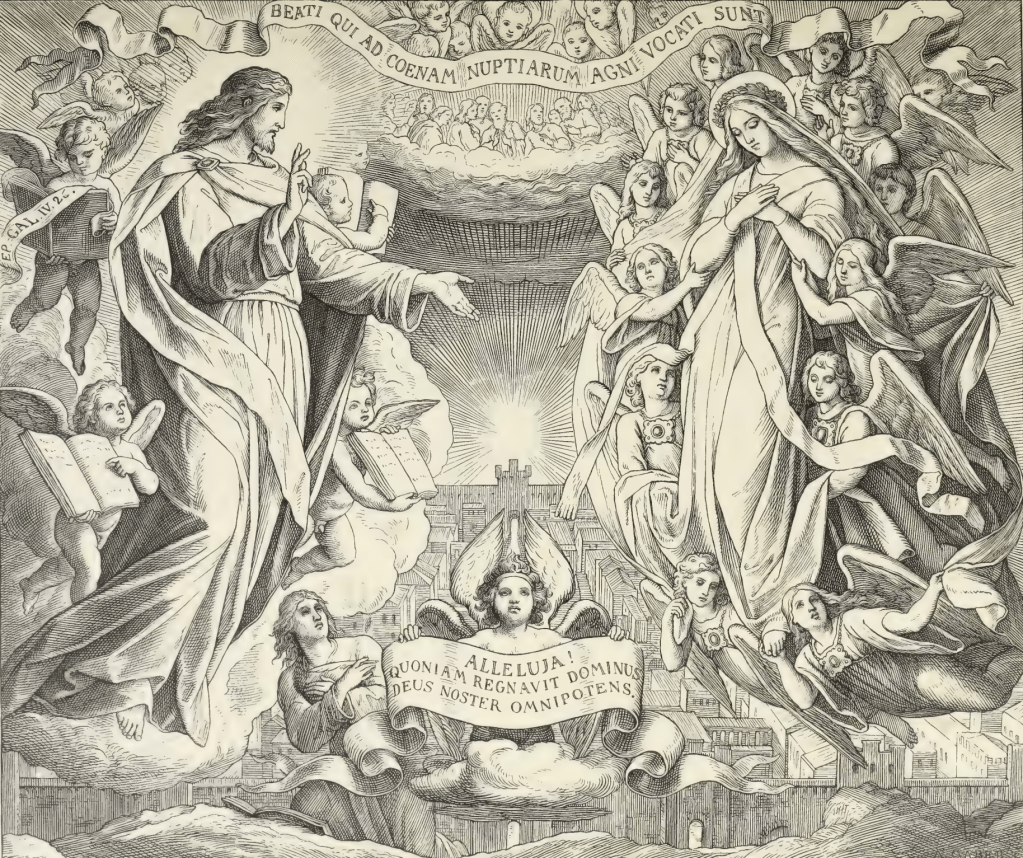
    John Sees the New Jerusalem, by Julius Schnorr von Carolsfeld

    II. Special rules for wives who have become believers, how they ought to conduct themselves toward their husbands. (v. 22–24)

    III. An instruction for the men, together with a strong admonition to both parts taken from the example of Christ and the congregation. (v. 25–33)

    Annotated Text

    22. The (married) wives to be subject to their husbands,1 as to the Lord (as to God Himself,2 because He has commanded such obedience, and also has good pleasure in it, and wants it to be regarded and considered as rendered to Himself).

    * Genesis 3:16; Colossians 3:18; 1 Peter 3:1 (Titus 2:5)

    1 Greek: “You wives to be subject to your husbands” [αἱ γυναῖκες τοῖς ἰδίοις ἀνδράσιν]

    2 † See Ephesians 6:6ff.

    23. For the * husband is the head of the wife (He has authority over his wife from God’s order); just as Christ also is the Head of the congregation (His Church), and He (Christ) is the Savior (who defends her against all enemies in this world and wants to make her blessed there) of (this) His (spiritual) body (the Church).

    * 1 Corinthians 11:3ff. (1 Timothy 2:11–12)

    24. But, as now the congregation is subject to Christ (as their Lord and Head), in this way (ought) also the wives to their husbands (as those from whom they have honor and protection, being subject and obedient) in all (just) things.

    (Colossians 3:18ff.)

    25. You (married) * husbands, love your wives, just as Christ also has loved the congregation (His Church), and has given Himself (into death) for her,

    * Colossians 3:19ff. (1 Peter 3:7)

    26. so that He might sanctify * her (that she be considered holy and made holy, both through the donation of His righteousness and the indwelling of the Holy Spirit), and purify1 her (being washed from the filth of sin) through the water-bath in the Word (through Holy Baptism, in which water and Word are bound with one another),

    * John 17:17

    1 Greek: Alternatively, “in that He purified her…” [καθαρίσας]

    † John 3:5

    27. that He might present her to Himself (then on the Last Day and in eternal life) a (such a) congregation (and spiritual bride), which * is glorious (and indeed beautiful), not having a spot or wrinkle (any stain of sin or disfigurement), or any such thing (that could make her unsightly), but rather that she would be holy and blameless (in this life through the reckoned holiness of Christ, 1 Corinthians 1:30, and through the begun sanctification of the Spirit, but there in that life through perfect holiness, so that the Law can neither condemn nor accuse her).

    * Psalm 45:14; Song of Songs 4:7; 2 Corinthians 11:2 (Revelation 19:7ff.; 1 Thessalonians 3:13, 5:23)

    28. In this way the (married) husbands also ought to love their wives as their own bodies (because they on account of the marriage covenant are one flesh, Genesis 2:24; Matthew 19:5–6). Whoever loves his wife, loves himself (His own body and His own flesh).

    29. For no one ever hated his own flesh (unless he was completely insane); but rather he nourishes it, and tends to it (he provides for his body with all its needs[1]), just as also the Lord (Christ) the congregation (as He provides for all her needs and protects her).

    (Colossians 2:23)

    [1] German: “Hülle und Fülle”

    30. For * we (true believers) are members of His (spiritual) body, (His Church, and on account of His flesh and His assumed human nature we are) of His flesh and of His bones (His blood relatives, indeed His brothers, Genesis 37:27).

    * Romans 12:5; 1 Corinthians 6:15 (1 Corinthians 12:12ff.)

    31. For this reason (on account of the close married union of husband and wife) a man (a married man) * will leave father and mother, and will cling to his wife (love the wife more than father and mother), and the two will be1 one flesh.

    * Matthew 19:5ff. (Genesis 2:24)

    1 Greek: “these” (thus bound in marriage)

    32. This mystery is great (and incomprehensible to human reason), but I speak of Christ and the congregation (of the spiritual union of Christ with His bride, the Christian Church, whose close union is prefigured in the married estate. Luther: “A sacrament or mystery is called a secret or a hidden thing, which nevertheless shows its meaning from the outside. In this way, Christ and His congregation is a secret thing, a great holy hidden thing, that one believes and cannot see. But through a husband and wife, as through an external sign, it is signified that just as a husband and a wife are one body and have all goods in common, so also the congregation has everything that Christ is and has”).

    (Song of Songs 1:1ff; Psalm 45:10ff; Isaiah 62:4)

    33. Nevertheless (although this great secret properly refers to Christ and His Church, nevertheless it ought to be an admonition to you that) you also (according to the example of Christ), indeed each and every (Christian married husband), have love for His wife as for Himself; but let the wife fear (and honor in all subjection) the husband1 (her married lord).

    (Colossians 3:19; 1 Peter 3:6)

    1 Greek: “(Yet let him love her) in such a way, that the wife always maintains due reverence toward the husband.”

    Useful Applications

    II. CORRECTION: That wives are to be subject to their husbands in true love and obey in just things, because God has thus commanded it. (v. 22)

    III. CORRECTION: That husbands, on the other hand, ought to love, honor, nourish, and care of them as their own bodies. (v. 28–29) DOCTRINE and CORRECTION: That there is no more beautiful image of the union of Christ and His Church, indeed, of all believers with Him, than the holy married estate, which also for that reason is to be entered into and led with all faithfulness and love. (v. 30–33)