Tag: Sexagesima

  • Aegidius Hunnius’s Sermon Outline for the Gospel of Sexagesima

    The following is my translation of Aegidius Hunnius’s introduction and sermon outline for the Holy Gospel of Sexagesima (Luke 8:4–15) from his Postilla (Vol. I, pg. 266). Square brackets and footnotes are my own notes and additions.
    Explanation of the Gospel

    This sermon, as it is presented to us in the parable just read, the Son of God has spoken not only for Himself, but rather has also commanded it to His hearers with special diligence, when He cried out and said, “Whoever has ears to hear, let him hear!” [Luke 8:8] With this saying, as with the sound of a mighty trumpet, He awakens sleeping hearts to diligent attentiveness, seriousness and devotion for the hearing of His sermon, because there such matters are handled upon which the well-being and salvation of all the world depends, since once again, He describes the occasion of the high works of God and His Kingdom upon earth in parabolic way and opens the mystery of how it happens that not all hearers of the Word are converted and improved unto eternal life.

    So then, let us present out hearts and ears, and indeed examine with a wakeful mind what God’s Son, our Lord and Teacher Jesus Christ has taught and preached to us concerning these important points. Let us not listen superficially, as the people did, who after hearing the parable, withdrew again without any investigation after spiritual understanding.1 Rather, let us persevere in the sermon of Christ with His disciples until we have heard the explanation from His mouth and have made use of it.2

    1. First, we will hear the parable recounted in itself [v. 4–8].

    2. Second, we will hear how the disciples desire that the parable might be explained to them and that Christ offers Himself to this end [v. 9–10].

    3. Third and last, we will consider and contemplate the explanation of Christ [v. 11–15].


    1. “Every poor sinner should therefore attend to the Word, hear it attentively, and not doubt the Father’s drawing. For the Holy Spirit will be with His Word in His power, and will work by it. That is the Father’s drawing. The reason why not all who hear the Word believe, and some are therefore deeply condemned, is not because God had begrudged them their salvation. It is their own fault. They have heard the Word in such a way as not to learn, but only to despise, blaspheme, and disgrace it. They have resisted the Holy Spirit, who through the Word wanted to work in them, as was the case at the time of Christ with the Pharisees and their followers.” (FC SD XI.77–78) ↩︎
    2. Note the italicized portion: “The preacher’s planting and watering and the hearer’s running and hearing would both be in vain and no conversion would follow it if the power and effectiveness of the Holy Spirit were not added [1 Corinthians 3:6–7]. The Spirit enlightens and converts hearts through the Word preached and heard. So people believe this Word and agree with it. Neither preacher nor hearer is to doubt this grace and effectiveness of the Holy Spirit. They should be certain that when God’s Word is preached purely and truly, according to God’s command and will, and people listen attentively and seriously and meditate on it, God is certainly present with His grace.” (FC SD II.55) ↩︎
  • Johannes Brenz’s Summary of the Gospel for Sexagesima

    Here is another brief translation of Johannes Brenz’s sermon outline for the Gospel of Sexagesima (Luke 8:4–18) as found in his Postilla (pg. LXIIII).

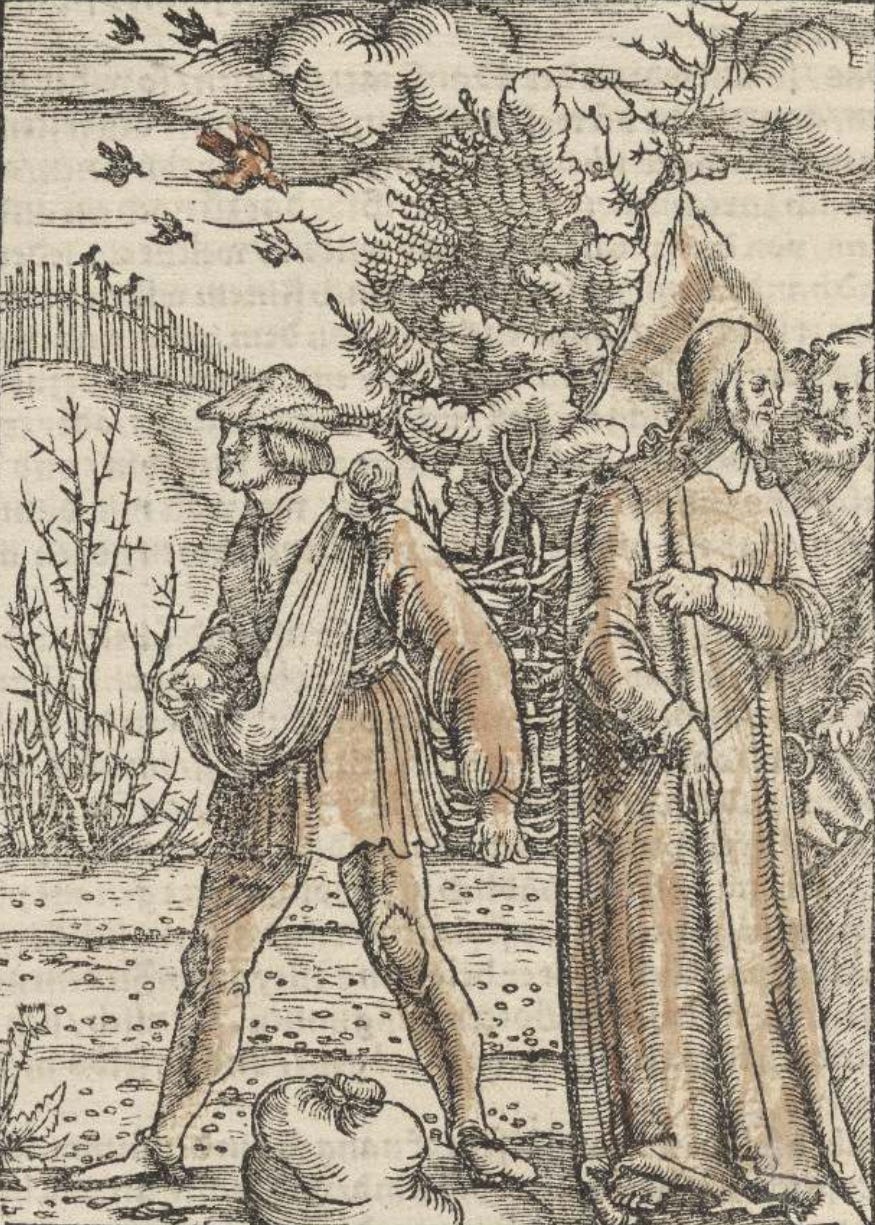
    Artwork found in Brenz’s Postilla (1556), pg. LXIIII

    Summary of this Gospel

    In this Gospel, we learn:

    1. First, that the doctrine of the Gospel is not the cause of all misfortune and evil, but rather Satan and our sin.
    2. Second, what Christ’s doctrine is, namely, concerning the Kingdom of God.
    3. Third, that our unbelief and malice are a cause that we cannot understand the Gospel.
    4. Fourth, the hearers of the Gospel are dealt with, namely, that there are four kinds.
      • The first are those who according to the Gospel remain knaves (Buben) as before; and here is taught how these ought to conduct themselves so that they do not perish.
      • The second are those who receive the Gospel with joy, but as soon an evil wind comes, they have no faith; how these may be preserved is also taught alongside.
      • The third are those who because of anxiety, sustenance, or the riches of this world cannot grasp the Gospel; how these should act so that they may come to eternal life is also indicated.
      • The fourth are those who hear the Gospel and keep it, who will be saved.
    5. Fifth, it is also taught how there is no estate higher before God and of more worth than another.
    6. Last, that the Gospel, where it is preached, does not depart without fruit.

  • Aegidius Hunnius’s Sermon Outline for the Epistle of Sexagesima

    The following is my translation of Aegidius Hunnius’s introduction and sermon outline for the Epistle Reading of Sexagesima (2 Corinthians 11:19–12:9) from his Postilla (Vol. I, pgs. 255–256). Square brackets and footnotes are my own notes and additions.

    Explanation of the Epistle

    Beloved in the Lord, all ambition and fame-seeking was foreign and far from St. Paul; he sought his honor not in himself, but rather in God and in His Lord Christ. As he writes to the Galatians in the sixth chapter: “Far be it from me to boast, except concerning the cross of Jesus Christ” (Galatians 6:14).

    But the false teachers who had snuck into the Christian congregations undertook to diminish this precious worthy apostle and make him despised among the Corinthians, which Paul would have suffered and gotten over silently if the contempt were about His person alone. However, the deceitful evil enemy most of all desired to bring the Gospel into contempt and to make wide room and opportunity for the false apostles with their unsound doctrine, so that they could come forward with it into the marketplace and sell their unfit evil truth as good, their false doctrine as pure evangelical truth, thereby falsifying the pure doctrine, leading astray the simple, and murdering souls, indeed, even wrecking the Gospel with eternal harm to many people.

    Thus, the holy teacher and apostle Paul was urged by necessity to recount in an extensive record what good he did in regard to the Gospel, how much he suffered and endured over it, also that he had studied and learned his doctrine through a heavenly revelation in the paradise of God. He did all of this not for himself for his own boast, but rather for the praise, honor, and glory of God, for the advancement of the Gospel which he preached, for the edification of the Christian congregation in Corinth as well as in other places, and, on the other hand, for the annoyance the devil together with his scales, and for the detriment, destruction, and demise of his damned kingdom.

    We will listen to the beloved apostle and summarize this text into two chief points:

    1. First, how he does not make himself equal to the false apostles from Judaism only on account of his origin and blood [v. 11:22], but rather also far surpasses them in his labor and tribulation he suffered for the Gospel [v. 11:23–29], and thus boasts of his own weakness [v. 11:30, 12:5, 9].1
    2. Second, how he also boasts of the power of God, namely, the glorious revelation that happened to him in the third heaven [v. 12:1–5], and boasts of the doctrine which he learned there to properly save its reputation against the diminishment of his enviers.

    1. “Troubles are not always punishments or signs of wrath. Indeed, terrified consciences should be taught that there are more important purpose for afflictions, so that they do not think God is rejecting them when they see nothing but God’s punishment and anger in troubles. The other more important purposes are to be considered, that is, that God is doing His strange work so that He may be able to do His own work… Therefore, troubles are not always punishments for certain past deeds, but they are God’s works, intended for our benefit, and that God’s power might be made more apparent in our weakness. So Paul says God’s strength “is made perfect in weakness” (2 Corinthians 12:9).” (Ap XIIb.61, 63) ↩︎
  • Notes and Useful Applications for Luke 8:4–15 from Das Weimarische Bibelwerk (1877)

    The following is my translation of the notes and useful applications for the Holy Gospel of Sexagesima, Luke 8:4–15, as they are found in Das Weimarische Bibelwerk (1877). Square brackets indicate my own notes and additions. For the useful applications, I recommend the reader see this very helpful article by Dr. Benjamin T. G. Mayes.

    4. Now, when a great people were with one another, and had hastened to Him (Christ) from the cities, He spoke * by a parable (to thereby clarify the dissimilarity of the hearers of the divine Word):1

    * Matthew 13:3; Mark 4:2

    1 † However, He used this parable on a good occasion to so great a crowd of various kinds of people, and for the most part from the countryfolk, who were present.

    5. “A Sower went out to sow His Seed; and as He sowed, some fell on the way was trampled, and the birds among the heavens devoured it.

    6. And some fell among the rocks, and when it came up,1 it withered because it had no moisture (no dampening, from which it could have been rooted more deeply and grown further).

    1 Greek: “after it had come up” [καὶ φυὲν]

    7. And some fell among the thorns, and thorns grew up with it and choked it (before it ripened).

    8. And some fell on a good land, and it came up and (some) bore * a hundredfold fruit.” When He said this, He called out, “Whoever has ears to hear (and received the gift from God to grasp and to understand), let him hear (let him diligently pay attention to it and be mindful of it in his heart as to what I mean with this parable).”

    * Genesis 26:12

    9. Now His disciples asked Him and said, “What does this parable mean (what is signified by it)?”

    (Matthew 13:10)

    10. Now He said, “To you it is given to know the mystery of the Kingdom of God (this and other hidden spiritual things which God has revealed in His Word and Gospel); but to the others (those who despise such mysteries and do not allow their right understanding to be seriously applied to themselves) in parables (with success, nevertheless, from their guilt, because they do not concern themselves further with it), * that they do not see it (do not understand what they ought to know for their salvation), even if they see it (even if they, with their external eyes, see my miracles, which I perform to strengthen their faith and to make them righteous and saved through faith), and do not understand, even if they hear (what I preach to them).

    * Isaiah 6:9–10; Matthew 13:14; Mark 4:12; John 12:40; Acts 28:26 (Matthew 11:25; 2 Corinthians 4:3)

    11. But this is the parable (its right understanding): The seed is the Word of God.

    12. Now that which is on the way, are those who hear; thereafter the devil comes and takes the (heard) Word from their hearts (tears it out of the heart or hinders it so that it does not come into the heart rightly; when the people in matters of religion are always doubting, when they secure and accustomed to sin, eagerly hear something new and splendid, sleep during the sermon and evade it with strange thoughts, do not allow themselves to be moved toward correction, etc.), so that they do not believe (draw no right, living, and active faith from hearing of the divine Word) and (thus, in the lack of true faith) are not saved.

    (1 Peter 1:23; Hebrews 4:2)

    13. Now that which is on the rock (the rock on which the seed of the Divine Word was sown), are those who when they hear receive the Word with joy (because they hope to have good days with it); and they have no root (the Word of God does not take deep root in their hearts, therefore there is no endurance along with their faith); for a time (so long as it goes well with them) they believe, and at a time of temptation (when cross, tribulation, and persecution break in) they fall away (from the Word of God and from saving faith).

    (2 Timothy 2:10)

    14. Now that which fell among the thorns (the hearers, among whom the seed of the Word was sown as among thorns), these are those,1 who hear it, and go (secure) among the cares, riches, and pleasures of this life (as soon as they have come from Church and heard God’s Word, they run and race, strive and scheme after temporal goods, vain honor, the pleasures of this life, the lust of the eyes, the lust of the flesh, and proud living, 1 John 2:16, so that these are their foremost concerns) and (with these anxieties, the seeds of the heard word) are choked and bring forth no (ripe) fruit (so that the seed cannot bring forth any fruits of faith and good works within them).

    (1 John 2:15ff.; Sirach 31:1ff.)

    1 Greek: “but as concerns that which fell among the thorns, these are such who” [τὸ δὲ εἰς τὰς ἀκάνθας πεσόν, οὗτοί εἰσιν]

    15. But that which is on the good land, these are those who hear (as well as understand) the Word and * retain it in a decent, good (upright) heart (purified from strange thoughts, greed, evil lust, envy, hatred, etc.), and bring forth † fruit (through a holy and godly life) in patience (so that they do not allow themselves to be turned away from God and His Word by the cross, temptation, and persecution, or by the nuisances of the world).”

    * Acts 16:14

    † Hebrews 10:36 (Matthew 13:23; 1 Corinthians 15:2; Hebrews 6–7; Revelation 3:8–10)

    Useful Applications

    II. CORRECTION: That we, when we become believers through God’s Word, ought not fall away during the time of temptation and persecution. (v. 15)

  • Notes and Useful Applications from Isaiah 55:10–13 from Das Weimarische Bibelwerk (1877)

    The following is my translation of the notes and useful applications for the Old Testament Reading of Sexagesima, Isaiah 55:10–13, as they are found in Das Weimarische Bibelwerk (1877). Square brackets indicate my own notes and additions. For the useful applications, I recommend the reader see this very helpful article by Dr. Benjamin T. G. Mayes.

    III. Consolation in the power of the divine Word, what it will work in the repentant. (v. 10–13)

    Annotations

    10. For just as the rain and the snow fall from heaven and do not return from there, but rather water the earth (very richly), and make it fruitful and increase so that it gives seed to sow and bread to eat;

    11. Thus shall the * Word, which proceeds from My mouth also be. It shall neither return to Me empty, but rather do what pleases Me, and shall succeed in that for which I sent it (shall nevertheless be effective at all times in the hearts of certain men).

    * Acts 12:24 (1 Corinthians 2:4ff.)

    12. For you shall set out in joy (from your spiritual captivity), and be led in peace (into your heavenly eternal Fatherland).1 The mountains and hills shall exult with glory before you, and all the trees in the field will clap with their hands (all creatures shall themselves, as it were, rejoice with you).

    1 Hebrew: “be brought to this (to the Church of Christ as a gift of the Lord; see Isaiah 18:7).”

    * Isaiah 44:23 (66:21ff.; Psalm 96:12; Psalm 98:8)

    13. The fir will grow instead of the thornbushes, and the myrtle instead of the briars (the Gentiles, who were unfruitful, withered thornbushes and briars before their conversion shall be made fruitful through the Word of the Gospel and through the Holy Spirit for all good works); and it shall be a name and eternal sign for the Lord that shall never be eradicated (the call of the Gentiles and the salvation of the Church will bring redound to the eternal praise and glory of the divine name, and also be a mark of the power and saving truth of the Gospel).

    (Isaiah 41:19; Matthew 16:18)

    Useful Applications

    III. DOCTRINE: Concerning the abundant power of the preached Word of God in the conversion and salvation of men. (v. 10–11) CONSOLATION: That God will not withdraw from His Church until the end of the world. (v. 13)

  • Martin Chemnitz’s Sermon Outline for Sexagesima

    Martin Chemnitz’s Sermon Outline for Sexagesima

    The following is a translation of Martin Chemnitz’s sermon outline found in his postil for Sexagesima (Postilla, Volume I, pgs. 399–400). The Gospel reading is Luke 8:4–18. Square brackets indicate my own notes and additions.

    Division of the Sermon (pgs. 399–400)

    “This is the summary and content of this parable, which the Lord Christ himself has shown such understanding for us. Now, that we may thereby learn something useful from it, we will summarize it in these five points:

    1. First, how the Lord comes to this parable, and how he thereby reminds us into which great misery we have fallen through the Fall of our first parents, and what God the Almighty does with us, so that He might restore us from such misery and corruption of our [human] nature, and bring us again to righteousness; how to this end He uses the noble seed of His Word, thereby sowing it into our hearts, and making good again whatever was corrupted in them; and from where the Word has such power.
    2. Second, how everyone who considers himself to be saved should let this be a warning to him, that he should not despise the Word through which God solely accomplishes this, because the Lord says here, that He will strike the despisers of the Word with blindness, and because they will not receive the truth, He will never let them come to it. Therefore, how preachers ought to diligently admonish their hearers that they guard themselves against the despising of the Word, and each one remember that He is not to stop up his ears to God’s Word, but rather “gladly hear and learn it.” [cf. Luther’s Explanation of the Third Commandment in the Small Catechism]
    3. Third, if we are now not despisers [of God’s Word], that we are are then to further learn how we ought to rightly prepare ourselves to hear the Word of God in order that we may hear it with fruit, and what we ought to guard ourselves against lest the seed be thereby hindered so that it not come into fruition.
    4. Fourth, how we ought to apply ourselves diligently that we might be a good field (Acker) and bring forth good fruit, and everything that belongs to it: that one must hear the Word, grasp it in his heart, understand it, retain it in his heart, and bring forth fruit with patience.
    5. And then finally, how each one should take the parable for himself, go through it, and examine himself, how he finds himself, by what he is struck, so that he might use it for his benefit, and thus conduct himself so that he does not let God work on him in vain, since He intends good for us from the heart.

    If we thus make use with the parable in such a way and make use of it for ourselves, then we can use it usefully and fruitfully, and therefore we will deal with these points in an orderly manner.”