Here is another brief translation of Johannes Brenz’s sermon outline for the Gospel of Sexagesima (Luke 8:4–18) as found in his Postilla (pg. LXIIII).
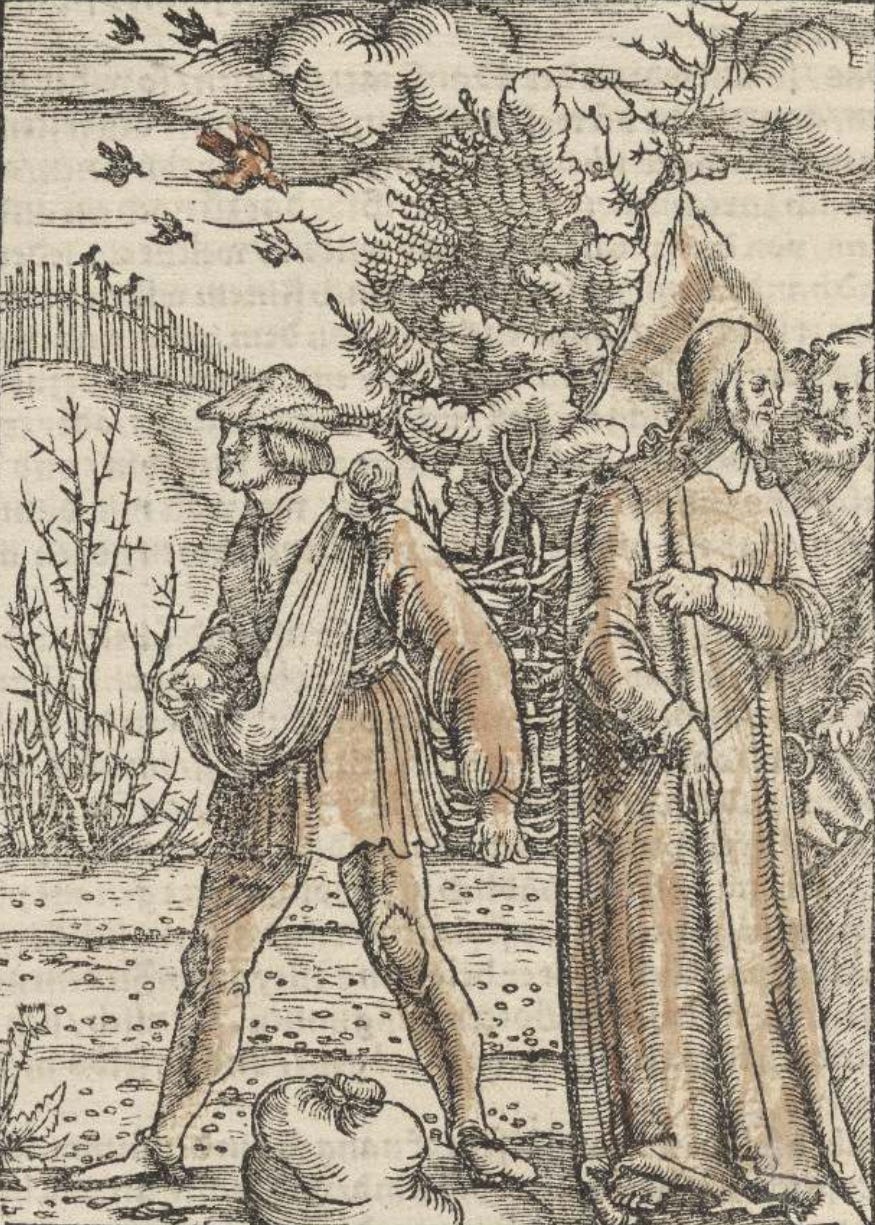
Artwork found in Brenz’s Postilla (1556), pg. LXIIII
Summary of this Gospel
In this Gospel, we learn:
First, that the doctrine of the Gospel is not the cause of all misfortune and evil, but rather Satan and our sin.
Second, what Christ’s doctrine is, namely, concerning the Kingdom of God.
Third, that our unbelief and malice are a cause that we cannot understand the Gospel.
Fourth, the hearers of the Gospel are dealt with, namely, that there are four kinds.
The first are those who according to the Gospel remain knaves (Buben) as before; and here is taught how these ought to conduct themselves so that they do not perish.
The second are those who receive the Gospel with joy, but as soon an evil wind comes, they have no faith; how these may be preserved is also taught alongside.
The third are those who because of anxiety, sustenance, or the riches of this world cannot grasp the Gospel; how these should act so that they may come to eternal life is also indicated.
The fourth are those who hear the Gospel and keep it, who will be saved.
Fifth, it is also taught how there is no estate higher before God and of more worth than another.
Last, that the Gospel, where it is preached, does not depart without fruit.
The following is my translation of the notes and useful applications for the Holy Gospel of Sexagesima, Luke 8:4–15, as they are found in Das Weimarische Bibelwerk (1877). Square brackets indicate my own notes and additions. For the useful applications, I recommend the reader see this very helpful article by Dr. Benjamin T. G. Mayes.
4. Now, when a great people were with one another, and had hastened to Him (Christ) from the cities, He spoke * by a parable (to thereby clarify the dissimilarity of the hearers of the divine Word):1
* Matthew 13:3; Mark 4:2
1 † However, He used this parable on a good occasion to so great a crowd of various kinds of people, and for the most part from the countryfolk, who were present.
5. “A Sower went out to sow His Seed; and as He sowed, some fell on the way was trampled, and the birds among the heavens devoured it.
6. And some fell among the rocks, and when it came up,1 it withered because it had no moisture (no dampening, from which it could have been rooted more deeply and grown further).
1 Greek: “after it had come up” [καὶ φυὲν]
7. And some fell among the thorns, and thorns grew up with it and choked it (before it ripened).
8. And some fell on a good land, and it came up and (some) bore * a hundredfold fruit.” When He said this, He called out, “Whoever has ears to hear (and received the gift from God to grasp and to understand), let him hear (let him diligently pay attention to it and be mindful of it in his heart as to what I mean with this parable).”
* Genesis 26:12
9. Now His disciples asked Him and said, “What does this parable mean (what is signified by it)?”
(Matthew 13:10)
10. Now He said, “To you it is given to know the mystery of the Kingdom of God (this and other hidden spiritual things which God has revealed in His Word and Gospel); but to the others (those who despise such mysteries and do not allow their right understanding to be seriously applied to themselves) in parables (with success, nevertheless, from their guilt, because they do not concern themselves further with it), * that they do not see it (do not understand what they ought to know for their salvation), even if they see it (even if they, with their external eyes, see my miracles, which I perform to strengthen their faith and to make them righteous and saved through faith), and do not understand, even if they hear (what I preach to them).
* Isaiah 6:9–10; Matthew 13:14; Mark 4:12; John 12:40; Acts 28:26 (Matthew 11:25; 2 Corinthians 4:3)
11. But this is the parable (its right understanding): The seed is the Word of God.
12. Now that which is on the way, are those who hear; thereafter the devil comes and takes the (heard) Word from their hearts (tears it out of the heart or hinders it so that it does not come into the heart rightly; when the people in matters of religion are always doubting, when they secure and accustomed to sin, eagerly hear something new and splendid, sleep during the sermon and evade it with strange thoughts, do not allow themselves to be moved toward correction, etc.), so that they do not believe (draw no right, living, and active faith from hearing of the divine Word) and (thus, in the lack of true faith) are not saved.
(1 Peter 1:23; Hebrews 4:2)
13. Now that which is on the rock (the rock on which the seed of the Divine Word was sown), are those who when they hear receive the Word with joy (because they hope to have good days with it); and they have no root (the Word of God does not take deep root in their hearts, therefore there is no endurance along with their faith); for a time (so long as it goes well with them) they believe, and at a time of temptation (when cross, tribulation, and persecution break in) they fall away (from the Word of God and from saving faith).
(2 Timothy 2:10)
14. Now that which fell among the thorns (the hearers, among whom the seed of the Word was sown as among thorns), these are those,1 who hear it, and go (secure) among the cares, riches, and pleasures of this life (as soon as they have come from Church and heard God’s Word, they run and race, strive and scheme after temporal goods, vain honor, the pleasures of this life, the lust of the eyes, the lust of the flesh, and proud living, 1 John 2:16, so that these are their foremost concerns) and (with these anxieties, the seeds of the heard word) are chokedand bring forth no (ripe) fruit (so that the seed cannot bring forth any fruits of faith and good works within them).
(1 John 2:15ff.; Sirach 31:1ff.)
1 Greek: “but as concerns that which fell among the thorns, these are such who” [τὸ δὲ εἰς τὰς ἀκάνθας πεσόν, οὗτοί εἰσιν]
15. But that which is on the good land, these are those who hear (as well as understand) the Word and * retain it in a decent, good (upright) heart (purified from strange thoughts, greed, evil lust, envy, hatred, etc.), and bring forth † fruit (through a holy and godly life) in patience (so that they do not allow themselves to be turned away from God and His Word by the cross, temptation, and persecution, or by the nuisances of the world).”

 PATTERN OF SOUND WORDS