Tag: Trinity

  • Notes and Useful Applications for Romans 6:1–11 from Das Weimarische Bibelwerk (1877)

    The following is my translation of the notes and useful applications for the Epistle Reading of the Sixth Sunday after Trinity, Romans 6:1–11, as they are found in Das Weimarische Bibelwerk (1877). Square brackets indicate my own notes and additions. For the useful applications, I recommend the reader see this very helpful article by Dr. Benjamin T. G. Mayes.
    I. An answer to the objection as though this doctrine of justification by faith gives a reason to sin. (v. 1–11)

    Annotated Text

    1. What shall we1 say to this? (Namely, to that which the godless deduce and conclude from what is said in Romans 5:20) * Ought we then to persist in sin (and continue wantonly), so that grace be all the more powerful? (So that God might have an occasion to pour out His grace and mercy all the more richly upon us?)

    1 Greek: “now” (since we are assured of so rich a grace). [The Greek text has οὖν, literally, “therefore.”]

    * Galatians 2:17

    2. May that be far (from us, that we should say or think such, much less that we do such! For) How should we1 want to live in sin, we2 who have died to it? (In a spiritual manner, that it has just as little right over us as over a dead man, and that accordingly we ought noy allow sin to live, work, and rule in us.)

    1 Greek: “still further”

    2 Greek: “we as those who”

    * Galatians 6:14 (1 Peter 2:24)

    3. Do you * not know1, that all who of us2 who have been baptized in (and upon) Jesus Christ (and were incorporated into Him in a spiritual manner) were baptized into His death? (So that we become partakers of the power of His death in no other way than if we ourselves were already dead to sins. Through such power of the death Christ, not only were our sins forgiven us, but we also received the Holy Spirit, who curbs and puts sin to death in us. Luther: “We are baptized into Christ’s death so that we die as He did; for we do not die completely to sin unless the flesh also dies bodily.”)

    * Galatians 3:27; Colossians 2:12 (2 Corinthians 4:11)

    1 Greek: “or” [ἢ]

    2 Greek: “as many of us” [ὅσοι]

    4. Therefore, we were each * buried with Him (in a spiritual manner) through Baptism into death so that just as Christ was raised from the dead through the glory of the Father (through the glorious power of God, which He allowed to be seen in the resurrection of Christ), † in this way we also ought to walk in a new life (henceforth lead a new life and no longer a sinful life. The holy apostle is referring to the practice that was used in the first apostolic Church, that those who were baptized were completely immersed under the water and thus, as it were, buried, and afterward were drawn out again of the water, and thus, as it were, raised again, to indicate, that they had become partakers of the power of the death and resurrection of Christ, and that they ought to die to sin, but on the other hand, walk in new holy life).

    * Romans 8:10

    † Ephesians 4:23; Colossians 3:8ff.; 1 Peter 2:1, 4:1–2; Hebrews 12:1 (Colossians 2:12)

    5. Therefore, we were planted together with Him to a similar death (that through Baptism we are planted into Him in such way that we are like Him in death, because we died to sin, Romans 6:2), so we will also be1 [planted with Him] (our beloved Savior) [in] * the resurrection.

    * 2 Timothy 2:11f. (John 15:5; Colossians 3:1ff.)

    1 Greek: “For if we are planted together with him (as it were, grafted into Him [σύμφυτοι]) according to the likeness of His death (that its power is reckoned and imparted to us), so it follows that we also ought to be planted together with Him in the likeness of His resurrection (and its power show itself in us).”

    6. Because we know, that our old man (our sinful flesh with its lusts and cravings) was crucified together with Him * (curbed, put to death, and made nothing; consequently its power to condemn us and to rule in us has been taken away through Christ’s suffering and death), so that the sinful body (the body of sin, the inherited sin, which poisons us in body and soul, and itself rules in all members) might cease (become powerless and no longer have reign [over us]), that we henceforth not serve sin.

    * Galatians 5:24 (Colossians 3:5)

    7. For whoever has died (has died in a spiritual manner to sin, Romans 6:2, and has rendered satisfaction to righteousness through one’s own or another’s death reckoned to him), he has been justified (made free and exonerated) from sin (that inherited sin and also his committed sins are no longer reckoned to him, so that sin also can no longer have dominion over him).

    8. Now if we have died (died to sin) with Christ (in a spiritual manner), so we believe that we also will live (in a new and spiritual manner) with him (because we have been raised by Him to a spiritual life).

    (Romans 8:17; Galatians 5:24, 2:20)

    9. And we know that Christ, being raised from the dead, * henceforth does not die (but rather remains in the new heavenly life always and eternally, into which He entered through the resurrection); death henceforth does not rule over Him (as also previously death did not rule over Him, because He died not under compulsion, but rather willingly).

    10. For in that He died, He died to sin * once for all (so that with His single sacrifice He might make full atonement for the sin of the entire world, which He had taken upon Himself, and also that He might abolish it  and destroy it, Hebrews 9:26); but in that He (now)† lives (in highest and heavenly joy), He lives to God (with God, His heavenly Father, and to the honor of God the Father, Philippians 2:11).

    * Hebrews 9:28

    † Isaiah 53:10 (Hebrews 7:16)

    11. In this way, you also consider yourselves, that you (with Christ) are dead to sin (and therefore you should no longer have any fellowship with it), and alive to God in Christ Jesus, our Lord (in whom you now ought to lead a new heavenly life before God, not only for a time, but rather continually, in spiritual joy which comes from a clear conscience and irreproachable conduct).

    (Galatians 2:19; Colossians 3:3)

    Useful Applications

    I. CORRECTION: The doctrine of justification and salvation which comes by grace only through faith in Christ ought not tempt us to sin, as though grace thereby would become all the more powerful, rather, it ought to restrain us from sin, because in Baptism we have renounced sin and, so to speak, have died with Christ so that as Christ was raised from the dead, so also we ought to walk in a new life. (v. 1–4)

  • Notes and Useful Applications for Matthew 3:13–17 from Das Weimarische Bibelwerk (1877)

    The following is my translation of the notes and useful applications for the Holy Gospel of the Baptism of Our Lord (Wednesday of the First Sunday after Epiphany), Matthew 3:13–17, as they are found in Das Weimarische Bibelwerk (1877). Square brackets indicate my own notes and additions. For the useful applications, I recommend the reader see this very helpful article by Dr. Benjamin T. G. Mayes.

    III. The history of the Baptism of Christ. (v. 13–17)

    Annotated Text

    13. At that time came Jesus from Galilee (from Nazareth, where He had been reared by His parents, Luke 2:51) to the Jordan to John (He did not send for Him and demand him to come to Him as His servant, but rather went Himself to him), that He might allow Himself to be baptized by him. (For although Christ had no need of baptism for His own person because He was altogether without sin [Hebrews 4:15], yet because He had laid upon Himself our sin, John 1:29, He also wanted for our sake to allow Himself to be baptized in order to drown our sin in the Jordan, indeed, to cast it into the depth of the sea, Micah 7:19, and sanctify the Jordan and all waters through contact with His holy and life-giving flesh for our saving baptism. )

    (Mark 1:9; Luke 3:21)

    14. But John opposed Him (He by no means wanted to allow it) and said, “I indeed need to be baptized (and washed of sin through Your blood and Your Holy Spirit) by You (as the lesser by the greater), and you come to me (that I should baptize You, when you are the Lord, the Creator, the Holy One, and Righteous One, but I am the servant, the creature, the sinner, and the unrighteous one)?

    15. But Jesus answered and said to him, “Let it thus be (in the present estate of my humiliation) now (that I be baptized by you); in this way it befits us to fulfill all righteousness (it befits Me, as the ordained Mediator, that I not only acquire and bring back again the lost perfect righteousness to the human race through My suffering and death, Daniel 9:24, 1 Corinthians 1:30, 2 Corinthians 5:21, but also that I sanctify the means ordained by God through which that same righteousness is offered to men and is appropriated to faith, among which is also the Sacrament of Holy Baptism; therefore, it befits Me to accept baptism, but you to impart it to Me.1 Luther: “All righteousness is fulfilled when we renounced all our righteousness and honor so that God only is regarded as the One who is righteous and who makes believers righteous. John does this when He lays aside His own righteousness and wants to be baptized and justified by Christ as a sinner. Christ also does this when He does not take up His own righteousness and honor, but rather allows Himself to be baptized and put to death, as any other sinner”).” Then he allowed it to Him (then John obeyed Christ so that he baptized Him).

    (Matthew 5:17; Galatians 4:4; Philippians 2:8)

    1 † The baptism of Christ was a part of His mediatorial office, according to which He also voluntarily submitted Himself to this will of His Father according to Zechariah 6:13, and thereby He presented a new pledge of His further, not yet carried out, perfect obedience; consequently, He brought about for us men all the gracious good pleasure of God, in particular the divine power of the ordained means of grace, above all, Holy Baptism, Psalm 40:9.

    16. And when Jesus was baptized, immediately He went up from the water (for at Christ’s baptism such admonition and teaching were not necessary which John was accustomed to use with other baptizands); and behold, then the heaven opened up over Him (it was seen that the heaven parted over Christ, and a bright luminous beam descended from heaven upon Christ to indicate that He is a Teacher from God who has come down from heaven, John 3:2, who through His mediatorial office would open heaven, Ephesians 1:10, and that the door of heaven is also opened to us through Holy Baptism, 1 Peter 3:21). And John saw (in this light) the Spirit of God (the Holy Spirit, the third person in the Godhead), as a dove (in bodily form as a dove, which is not a natural dove and also is not the mere external form of a dove, but rather a special creature of the Holy Spirit like a dove),1 descending and upon Him (Christ) coming (and also remaining upon Him, not as if Christ previously had previously not been partaking of the Holy Spirit; but rather, through this external descent, the inward dwelling of the Holy Spirit was indicated, that He received the Spirit not according to measure, but rather in the highest fullness, John 3:34, and that He is the one who baptized with the Holy Spirit, John 1:33).

    (Mark 1:10; Luke 3:22; John 1:32)

    1 * And thus, this description is not to be understood only as a likeness to a gradually falling cloud.

    17. And behold, a (distinguished, clear, and majestic) * voice (God the Father) from heaven spoke down (allowed itself to be heard from the same light), “This is My beloved Son, (whom I have begotten from eternity from My own essence according to His divinity, Psalm 2:7, and whom I now present to the entire world, especially to My people Israel, as their Savior in a personally assumed human nature and in the freely undertaken form a servant [Philippians 2:7])1 in whom I have good pleasure (through whom I will fulfill My gracious will of redemption of the human race, and in whom, My beloved Son, I will love all who believe in Him, Ephesians 1:6).”

    * Matthew 17:5; Mark 1:11, 9:7 (Matthew 12:18; 1 Peter 1:17; Colossians 1:13; Isaiah 42:1)

    1 † For there is no doubt that all this happened publicly and before many people who were present.

    Useful Applications

    III. DOCTRINE: Concerning the highly praised Holy Trinity, which is revealed here publicly: God the Father through the voice from heaven, God the Son in His assumed humanity, according to which He received baptism, and of which the Father said, “This is My beloved Son, etc.,” and God the Holy Spirit in the visible form of a dove. (v. 16–17) COMFORT: O blessed water-bath which the Son of God has sanctified in Himself! (v. 15ff.) COMFORT: Yet, even more comforting is this, that the Father also assures us of His good pleasure in Him. (v. 17)

  • Notes and Useful Applications for John 4:47–54 from Das Weimarische Bibelwerk (1877)

    The following is my translation of the notes and useful applications for the Holy Gospel for the Twenty-First Sunday after Trinity, John 4:47–54, as they are found in Das Weimarische Bibelwerk (1877). Square brackets indicate my own notes and additions. For the useful applications, I recommend the reader see this very helpful article by Dr. Benjamin T. G. Mayes.

    II. How Jesus was received in Nazareth and in other places, and also how the royal official’s son was freed from the fever. (v. 43–54)

    Annotated Text

    47. And there was a royal official (a distinguished servant in the house of Herod the tetrarch, who nevertheless was considered a king by the common man and thus was called a king, Matthew 14:1, 9; Mark 6:14), whose son lay sick in Capernaum. This one heard that Jesus came (He had learned that Jesus had come) from Judea in Galilee, and he went to Him (to Cana, about five miles’ way), and he asked Him that He come down (go with him to Capernaum) and help his son, for he was sick unto death (therefore, he also supposed that Christ would have to be present himself for so dangerous an illness, and that he could not perform this work of healing if he were absent, much less raise him from the dead if he should die).

    48. And Jesus said to him: * “If you do not see signs and wonders, ** then you will not believe (“You Jews believe no more than you see. If I go with you, you suppose that I could help your son; but what kind of faith is that?” To believe rightly means not to doubt at all about that which one does not see, Hebrews 11:1, and to ground oneself in the omnipotence and goodness of God insomuch that he can and will help, even above and against all sense and reason).

    * John 2:18; 1 Corinthians 1:22

    ** behold presently with your own eyes. The answer is aimed at the request to come down in v. 47 and agrees with Matthew 9:18.

    49. The royal official said (further, in the weakness of his faith) to Him, “Lord, come down, before my child dies (otherwise, Your presence will be in vain).

    50.  Jesus said to him, “Go (at this My Word, to which you shall attach firm faith), * your son (has not died as you think, but) lives (through the divine power of this My Word, and when you come home, you will find him alive and well).” The man believed the Word that Jesus spoke to him, and he went (in certain confidence that the Lord’s Word would come to pass; therefore, he also did not hurry home all at once, to which he could have come that same evening if he had wanted, but rather remained overnight on the way).

    * 1 Kings 17:23

    51. And while he was going (further, on the next day), his servants met him, proclaimed it to him and said, “Your son lives (and is completely alive, healthy, and strong).”

    52. Then he investigated from them the hour in which it had become better with him. And they said to him, “Yesterday, around the seventh hour (according to our time, around 1 PM in the afternoon) the fever left him.”

    53. Then the Father realized (and heard precisely) that it was (exactly) around the hour in which Jesus had said to him, “Your son lives (v. 50).” And he (as now he had been fully convinced of the divine miraculous power of Christ) believed along with his entire household (his wife, children, and household servants were brought through to true faith in Christ. And some hold that this royal official’s wife was Joanna, who is mentioned in Luke 8:3, and that she is called the wife of Chuza, the steward of Herod, who followed the Lord and ministered to Him from her own possessions).

    (Acts 16:32, 18:8)

    54. This is now the second sign that Jesus did when He came from Judea into Galilee. (The first is described in John 2:7ff.)

    Useful Applications

    II. DOCTRINE: What faith or heartfelt confidence in Christ’s Word and promise has for power and might is testified by the royal official (v. 50–53). DOCTRINE: But how the Lord Jesus often uses many wondrous preparations and arrangements to awaken and to strengthen faith is seen from both stories (v. 16–54).

  • Notes and Useful Applications for Matthew 22:34–46 from Das Weimarische Bibelwerk (1877)

    The following is my translation of the notes and useful applications for the Holy Gospel for the Eighteenth Sunday after Trinity, Mark 22:34–46, as they are found in Das Weimarische Bibelwerk (1877). Square brackets indicate my own notes and additions. For the useful applications, I recommend the reader see this very helpful article by Dr. Benjamin T. G. Mayes.

    IV. The last discourse of Christ with the Pharisees concerning the greatest commandment in the Law and concerning the Messiah. (v. 34–46)

    Annotated Text

    34. But when the Pharisees heard that He had stopped up the mouth of the Sadducees (thus that they could no longer answer Him nor rebuke His speech), they gathered together (namely, the Pharisees).

    35. And * one among them, a scribe, (who had heard them as they questioned one another, and saw that He had answered them finely; meanwhile, he came forward when the others were gathering together and taking counsel, and asked Him, Mark 12:28, and) tested Him (in the beginning, he had brought forth his question to Christ with a wicked intent, but afterward the Holy Spirit changed his heart), and said,

    * Luke 10:25.

    36. “Master, which is the foremost commandment (before all) in the Law (that we ought to keep and to fulfill before all things? The scribe wants to say this much: Because a resurrection of the dead will follow and another life exists after this one, as you have rightly answered the Sadducees, therefore the question now is, which is the foremost commandments that one must keep before all others if one wants to inherit eternal life)?

    37. But Jesus (answered and) said to him, (The foremost commandment before all commandments is this: “Hear, O Isarel, the Lord, our God, is one singular God,” Mark 12:29, and) * “’You shall love God (the only true God), Your Lord, with all your heart and all your soul and all your mind (and with all your powers, Mark 12:30).

    *Mark 12:30ff. (Deuteronomy 6:4–6; Luke 10:27)

    38. This is the foremost and greatest commandment (as the foundation of what follows, if it should be upright).

    39. But the second is like it (because God the Lord wants this commandment to be kept just as much as the first; also because both commandments require not only an external obedience, but rather also a inward obedience, and because no one can rightly love God unless he also loves his neighbor, 1 John 4:20–21; finally, because the transgression of the commandment concerning love of the neighbor is just as reprehensible as the transgression of the commandment concerning the love of God): ‘You shall love your neighbor (all those who need your help) as you yourself (thus, that you show them all the love, friendship, and kindness, which you desire, so that it may happen to you from others. There is no other greater commandment than this, Mark 12:31ff.).’

    * Leviticus 19:28; Luke 10:27; Romans 13:9; Galatians 5:14; James 2:8; Colossians 3:14.

    40. On these two commandments hang (is grasped or summed up, Romans 13:9) the entire Law and the Prophets (what Moses and the Prophets require of a man when they deal with the doctrine of the Law; they also can neither be sufficiently understood, nor rightly applied for the salvation of souls if one does not recognize from them our incapability to fulfill the Law and how necessary the Mediator is, who fulfills in us the righteousness that is demanded by the Law, Romans 8:3–4. And the scribe said to Him, “Master, You have truly spoken correctly; for there is one God, and there is none other besides Him; and to love Him with all the heart and with all the mind, and with all the soul, and with all powers and love one’s neighbor as oneself, this is more than bread offerings and all sacrifice.” But when Jesus saw that He had answered reasonably, He said to him, “You are not far from the Kingdom of God.” And no one dared to question Him further, Mark 12:32–34).”

    41. Now when the Pharisees were with one another, they asked Jesus (when He taught in the temple, Mark 12:35),

    (Matthew 22:34)

    42. and said, “What do you think concerning the Christ (what do you hold concerning the promised Messiah)? * Whose Son is He (from which stem and race will He be born when He comes?)?” They said, “David’s” (from the lineage of David, according to the divine promise).

    (Luke 20:41)

    * He led them there in order to show that the discussion is not settled with the Law, but rather that the knowledge of Christ and His person, as well as His office is necessary above all in the Kingdom of God.

    43. He (answered and) said to them (“How do they say, the scribes, that Christ is David’s Son?” Mark 12:35, Luke 20:41): “How then does David call Him in the Spirit (through the Holy Spirit, Mark 12:36, that is, through the inspiration of the Holy Spirit) a Lord, when He says (in the book of the Psalms):

    44. * “The Lord (God the Father) has said to my Lord (to Christ, His Son, who is my lord and my God): ‘Sit at My right hand (reign with Me in like majesty, power, and glory, 1 Corinthians 15:25; Hebrews 1:3, 8:1; Ephesians 1:20), until I place Your enemies as a footstool for Your feet (until I fully subject these to you on the Last Day. Then, David indeed calls Him his Lord, Mark 12:37).’”

    * Psalm 110:1; Mark 12:37; Luke 20:42; Acts 2:34; Hebrews 1:13 (Hebrews 10:13).

    45. So now, if David (the mighty king, who acknowledge no higher lord on earth, but rather only the true God in heaven) calls Him a Lord, whose Son then is He? (Christ does not deny that the Messiah will be David’s son according to His human nature, but rather He wants to give the Pharisees the knowledge that He will also be David’s Lord, according to His divine nature.)

    46. And * no one could answer Him a word (nor show the correct understanding and basis of this Davidic saying, because they did not know the Messiah rightly from the Holy Scripture, but rather held Him to be a mere man who would see a worldly kingdom on earth), ** and also no one dared to ask Him a question from the day forward (They tested Him with crafty questions. And many people heard Him gladly, Mark 12:37. But that Christ wanted to conclude all His sermons and miracles with this conversation concerning the Law and the Gospel, thereby He showed that everything contained in Holy Scripture can and ought to be drawn into these two chief points, namely, to the Law and the Gospel, Isaiah 8:20, John 1:17, Romans 11:32).

    * Luke 14:6.

    ** As the interpretation of the Jews today, [applying it] to Abraham, sounds truly wretched.

    Useful Applications

    IV. DOCTRINE: Christ is David’s Son and Lord, both as true man and as true God (v. 42–45). DOCTRINE: Whoever is lacking in this knowledge, is and remains with a legalistic nature and in darkness (v. 42–46).

  • Notes and Useful Applications for Luke 14:1–11 from Das Weimarische Bibelwerk (1877)

    The following is my translation of the notes and useful applications for the Holy Gospel for the Seventeenth Sunday after Trinity, Luke 14:1–11, as they are found in Das Weimarische Bibelwerk (1877). Square brackets indicate my own notes and additions. For the useful applications, I recommend the reader see this very helpful article by Dr. Benjamin T. G. Mayes.

    I. A miracle upon a man with dropsy at the meal. (v. 1–6)
    II. A warning, that one ought not desire to sit at the highest place. (v. 7–11)

    Annotated Text

    1. And it came to pass that He came (without doubt on account of a previous invitation) into a house of a ruler of the Pharisees in order to each bread on a Sabbath (to have a meal, in order that he might have pretext and opportunity to instruct him and his fellow people of the order *); and they (the Pharisees, who were in that same house) ** paid attention to Him (they laid in wait for Christ, whether He would say or do something, from which they might seize the opportunity to accuse Him as a transgressor of the Law).

    * Or those who were of his sect and party, to which the majority of the people of both sexes adhered to.

    ** Mark 3:2

    2. And behold, there was a man before Him who had dropsy (whom, without doubt, the Pharisees had requested there so that they may see whether Christ also would heal him on the Sabbath. For if He did it, they would have cause to despise Him as a transgressor of the Sabath; but if He did not do it, then they wanted to blame Him as being either so unmerciful or so powerless that He either would not or could not accomplish it).

    3. And Jesus answered (began to speak), and spoke to the scribes and Pharisees, and said, “Is it also lawful to heal on the Sabbath?”

    4. But they were still silent (maliciously, in order to not betray themselves). And He took him (the man with dropsy), and healed him, and let him go.

    5. And He responded and said to them, “Who among you, whose ox or donkey has fallen into the well, will not immediately pull him out on the Sabbath day?” (How much more is it not unlawful that I have helped this poor man on the Sabbath, who otherwise would have suffocated from dropsy?)

    (Luke 13:15)

    6. And they could not give an answer back to Him again.

    7. Now He spoke a parable to the guests (He admonished them to humility through a suitable example taken from a feast), when He noticed (in looking at them He perceived) how they chose to sit in the highest places (how each one eagerly wanted to have the place of best seat at the feast), and said to them:

    (Matthew 23:6)

    8. When you are invited by someone to a feast (or to another honorable banquet), do not sit down in the highest place, so that someone more honorable (who is held in greater honor) than you be invited by him.

    (Proverbs 25:6–7)

    9. And then the one who has invited you and him should come and say to you, “Give way for this man,” and you have to sit down at the lowest with shame.

    10. But rather when you are invited, go and sit in the lowest place, in order that when the one who has invited you comes, he says to you, “Friend, move up higher.” Then you will have honor before those who sit at table with you.

    (Sirach 3:20)

    11. For * whoever exalts himself (holds himself high in his heart, always striving after a higher estate, wanting to be more noble, more holy, and more pious than others and displays such pride openly with words, gestures, and works), he shall be humbled (be despised by God and men, put to shame, robbed of his goods and honors, and finally cast into the deep hell); and whoever humbles himself (gladly remains in a lowly estate, not thinking too much of himself, considering others more than himself, and acknowledges himself as guilty of the deepest hell on account of his sin), he shall be exalted (be brought to honor here, temporally, and there, eternally).

    * Matthew 23:12ff. (Luke 18:14; Proverbs 29:23; 1 Peter 5:5)

    Useful Applications

    I. CORRECTION: That one ought not neglect an opportunity to do good to others, as here Christ cared for the man with dropsy and healed him (v. 2–4). II. WARNING: Concerning wretched pride, when one chooses to sit at the highest place or considers himself in his mind to be higher, better, and more pious than others—such people are surely humbled by God and are cast down with shame (v. 7–11). DOCTRINE: Positions of honor remain in their order and worth; but to strive after them before others is not fitting, see Romans 13:7; 12:16.

  • Notes and Useful Applications for Ephesians 4:1–6 from Das Weimarische Bibelwerk (1877)

    The following is my translation of the notes and useful applications for the Epistle Reading for the Seventeenth Sunday after Trinity, Ephesians 4:1–6, as they are found in Das Weimarische Bibelwerk (1877). Square brackets indicate my own notes and additions. For the useful applications, I recommend the reader see this very helpful article by Dr. Benjamin T. G. Mayes.

    I. An admonition toward unity. (v. 1–6)

    Annotated Text

    1. So I now admonish you (my beloved Ephesians), I, the prison in the Lord * (for the sake of the confession of Christ), that you walk (lead such a life) as is proper to your calling into which you were called (as your Christianity, to which you have been called by God through the Gospel, requires),

    (Ephesians 3:1; Philippians 1:27; Colossians 1:10; 1 Thessalonians 2:12)

    * Greek: Alternatively, “I admonish you thus, as a prisoner,” or “I, who am (now) imprisoned in the Lord Christ (that is, for Christ’s sake).” The words “in Christ” refer to the exhortation, which agrees better with Ephesians 3:21.

    2. with * all humility and meekness (that you be humble without pride, and friendly without murmuring), with patience (at the same being patient in suffering), and bearing with one another in love (from love, let each regard the other’s faults in the best way; from which love humility, meekness, patience and other virtues ought to spring forth),

    * Acts 20:19; Colossians 3:12

    3. And be diligent to keep (to guard) the * unity of the Spirit (the concord of the minds in the good, which arises from the Holy Spirit)** through the bond of peace (which ought to bind all of you together).

    * 1 Corinthians 12:13 (Acts 4:32; Romans 12:18; 1 Peter 3:11)

    ** However, this comes from the love of Christ, and is therefore called the “bond of perfection” (Colossians 3:14), the like of which is not to be expected from any natural concord.

    4. * One body (indeed, all of you together are members of a spiritual body) and one Spirit (indeed, all of together are ruled and guided by one Spirit), as you also (through the Gospel) were called into a single hope of your calling (you all together have a single calling, and all hope for eternal salvation, Romans 8:24).

    * Romans 12:5 (Ephesians 1:18; 1 Corinthians 12:4ff.)

    5. One * Lord (there is one Lord for you all, namely Christ, the head of this spiritual body, who has not only created you, but also redeemed you with His blood to be His own possession), one faith (you have a single confession of faith), one baptism (you have been reborn through one baptism, baptized by one Spirit into one body, and made to drink of one Spirit, 1 Corinthians 12:13).

    * Deuteronomy 6:4; 1 Corinthians 8:4, 6 (1 Corinthians 12:3; 2 Peter 1:1)

    6. * One God and Father (of us) all (we all together have one God and father in heaven), who is over you all (He has authority to command you all), and through you all (He works all good in you), and in you all (He dwells in all of you. The Father is the first person, who is over all, and from Him are all things; the Son is the second person, who is through all, he fulfills all in all, v. 10; the Holy Spirit is the third person, who is in all, Romans 11:36, since the inhabited world is full of the Spirit of the Lord, Wisdom 1:7).

    * Malachi 2:10; 1 Corinthians 12:6

    Useful Applications

    I. CORRECTION: Toward Christian love and peaceableness; because we are one spiritual body, are governed by one Spirit, have one and the same hope of eternal life, there is one Lord of us all, we have one faith, one baptism, there is one God and Father of us all (v. 3–6).

  • Notes and Useful Applications for Proverbs 25:6–14 from Das Weimarische Bibelwerk (1877)

    The following is my translation of the notes and useful applications for the Old Testament Reading for the Seventeenth Sunday after Trinity, Proverbs 25:6–14, as they are found in Das Weimarische Bibelwerk (1877). Square brackets indicate my own notes and additions. For the useful applications, I recommend the reader see this very helpful article by Dr. Benjamin T. G. Mayes.

    III. How a man ought to conduct himself wisely at court. (v. 6–23)

    Annotated Text

    6. Do not flaunt * before the king (do not put yourself forward to preside over a high office, and to carry out great affairs of the kingdom), and do not stand (in a presumptuous manner and of yourself, out of pride and lust for honor) in the place of the great (of the foremost royal counselors and servants),

    (Sirach 3:22ff., 7:4–6, 13:13)

    * Hebrew: “Do not force your way into positions of honor”

    7. For it is better for you (if you are gifted and made fit by God to serve in distinguished offices, cf. Proverbs 22:29) that one say to you, * “Come up here,” than that you (on account of your presumption, greed for honor, and self-willed exaltation) before the prince (or before another eminent, honorable, and wise man) be humbled , so that your eyes must see ** (and afterwards you yourself have to be ashamed of it, Luke 14:9).

    * Luke 14:8ff.

    ** Hebrew: “whom your eyes have (previously) seen, (but whom you may now no longer be seen by).” See the Hebrew of 2 Kings 25:19.

    8. Do not rush hastily to quarrel; for what will you do afterwards (and how will it go with you), when your neighbor has shamed (injured and damaged) you? * (Will it not be done to you as you thought to do to your neighbor? And will they not in turn disgrace you and punish you fittingly? Deuteronomy 19:19)

    (Proverbs 20:13; 17:14)

    * Hebrew: “when your neighbor (opponent) puts you to shame (and demonstrates publicly how you have acted rashly)”

    9. Argue your (own) case with your neighbor (mildly and modestly; counsel and help, as much as ever possible toward reconciliation and toward peace, Matthew 5:23–25, 18:15), and (above all things) do not reveal another’s secret (do not mix yourself in other people’s affairs).

    (Sirach 19:13ff.)

    10. So that he who hears it does not rebuke you for it (and with these words, in return, disgrace and shame you), and your evil rumor never ceases.

    (Proverbs 11:13, 20:19; Sirach 19:6, 19:7, 19:10, 42:29)

    11. A * word, spoken in its time (with good deliberation according to the circumstance, place, time and persons) is like golden apples (Luther: “as if they were oranges and lemons”) in silver ** vessels (it is quite fitting, also pleasant and delightful to reasonable people).

    * Proverbs 15:23 (Sirach 41:21)

    ** Hebrew: “skillfully crafted”

    12. He who reproves a wise man who listens to him (so that in this way the speech of discipline achieves its desired effect), he is like a golden headband and a golden necklace (Proverbs 1:9).

    * Psalm 141:5 (Proverbs 9:8–9; Sirach 6:30ff.)

    13. Like the cold of the snow at the time of the harvest (namely, when the snow or ice is kept in deep pits under the earth until summertime, and then is used for the cooling of drinks and for the refreshing of languishing bodies), so is a faithful messenger to those who have sent him, and he refreshes the soul of his lords (when returns, and he has carried out his business well. Luther: “A faithful servant or subject cannot be paid enough”).

    * Proverb 13:17

    14. Whoever speaks much and does not keep it (Luther: “as the world does”), he is like clouds and wind without rain (Luther: “good words and nothing behind them”).

    * 2 Peter 2:17 (Jude 12; Sirach 4:34)

    Useful Applications

    III. CORRECTION: That one ought to humble himself before high-ranking people, v. 6–7; CORRECTION: That one faithfully keep what has been spoken, v. 14.

  • Notes and Useful Applications for Ephesians 3:13–21 from Das Weimarische Bibelwerk (1877)

    The following is my translation of the notes and useful applications for the Epistle Reading for the Sixteenth Sunday after Trinity, Ephesians 3:13–21 as they are found in Das Weimarische Bibelwerk (1877). Square brackets indicate my own notes and additions. For the useful applications, I recommend the reader see this very helpful article by Dr. Benjamin T. G. Mayes.

    II. A prayer of Paul to the Ephesians, that they ought not be scandalized at the state of Paul, but rather for that reason that they let themselves be strengthened all the more in the faith. (v. 13–21)

    Notes

    13. Therefore, I pray, that you do not become (or let yourself become) weary (and fall away from the truth of the Gospel) for the sake of my tribulations (persecution and bonds), which I suffer * for you (because the devil and the world hate and persecute me for this reason, because I have preached the Gospel to you), which are honor for you (because it redounds to your honor that you remain steadfast in the same doctrine, on account of which I suffer so many things. Indeed, my tribulations redound for the promotion of your eternal honor and salvation, because you are thereby strengthened in your faith when you see that I endure everything with patience for the sake of the Gospel to confirm its truth).

    (Ephesians 3:1; 1 Thessalonians 3:3; Philippians 1:14)

    * Greek: “for your sake”

    14. Therefore (to come back again to my former point) I bow (daily in my prayers) my knees (of the body and the heart) to the * Father of our Lord Jesus Christ,

    * Ephesians 1:3

    15. who is the true Father over all those called * children on heaven and earth (who is not only the Father of our Lord Jesus Christ, as His only-begotten Son, but rather also of all believers, whom He has adopted as children from grace, who are found partly in the Church Militant here on earth and partly in the Church Triumphant in heaven. Luther: “All angels, all Christians, indeed even all children of men are God’s children, for He has created them all.”),

    (Ephesians 4:6; Psalm 27:10)

    * Greek: “from whom (and from His grace) the enter race (of His children of grace) has the name (source and honor) of the sonship (of God).

    16. that He give you according * to the riches of His glory (according to His great and glorious mercifulness), ** to be strengthened through His (Holy) Spirit in the inner man (to grow and increase in faith and in all godliness),

    * Ephesians 1:7; 2:7

    ** Ephesians 6:10 (Romans 7:22; 2 Corinthians 4:16; 1 Thessalonians 4:1)

    17. and that Christ * dwell (so that Christ may dwell according to His gracious presence) by faith (as the blessèd means of union with Him) in your hearts, and that by being rooted and grounded in love (that you may also become so strong in love toward God and the neighbor that no trial or persecution may overpower you),

    * John 14:23 (Galatians 2:20; Colossians 2:7)

    18. so that you may * grasp (understand and consider by faith) with all the saints (true believers, the Christians reborn and sanctified through the Holy Spirit), what is the ** breadth, and the length, and the depth, and the height, * (how exceedingly great the grace of God is toward us men, which He has proven to us in Christ, that its breadth cannot be circumscribed, but extends from morning to evening throughout the entire world, that its length stretches from eternity to eternity, that its depth can be fathomed by no one, and that its height reaches far beyond the understanding of all angels and men. Luther: “Love proves that faith is upright; it then comprehends that there is nothing so broad, , long, ,deep, or high where Christ did not have the power and could not be able to help, and it does not fear sin, death, or hell, however broad, long, deep, etc. they may be, as Psalm 139:7 also says, “Where shall I go from Your Spirit?”)

    * Greek: Alternatively, “so that you, being rooted and grounded in love, may have sufficient capability to grasp”

    ** Job 11:8–9 (Psalm 103:12; Psalm 57:11)

    *** Namely, the dwelling of God in the Spirit, v. 17. See also Ephesians 2:19–22.

    19. Also (that you may likewise) know, that * Christ has love, which is much better than all wisdom (all other knowledge, and again, that the love of Christ is so great that no one can completely understand it in this life. Luther: “It is a much great thing to have love for Christ than to be able to preach much, 1 Corinthians 8:1–3, ‘Knowledge puffs up; love builds up.’ Likewise,  if anyone loves God, he is known by Him”), so that you may be filled with all the fullness of God (all divine riches in heavenly goods, with every kind of gift that God bestows out of grace. Luther “that God alone rule and work in you, and you be full of Him.”).

    (Ephesians 2:4ff.; 1 Corinthians 13:13; Romans 5:5; Philippians 1:9; Romans 14:17, 15:14)

    * or, “the love of Christ, which nevertheless surpasses all understanding”

    20. Now to Him, who can do (for the promotion of our salvation) exceedingly more (much more) than all that we pray or understanding, * according to the power (according to His divine power) that works in us (all good gifts in the regenerate),

    * Romans 16:25

    21. to Him (the same one true God) * be honor (to Him be praise) in the congregation which is in Christ Jesus (which Christ has called and preserves against all the gates of hell), for all time, from eternity to eternity (always and eternally)! Amen (that it happens in this way, and also will certainly happen in this way).

    * Romans 11:36, 16:27; 1 Timothy 1:17 (Jude 24)

    Useful Applications

    II. CORRECTION/IMPROVEMENT: That together with Paul we ought to bend the knees before the Father of our Lord Jesus Christ and pray that He may allow us be strengthened through His Spirit in the inner man, to grow in faith and godliness (v. 14, 16). DOCTRINE and COMFORT: Because indeed no greater grace can befall us than that we are equipped and adorned with heavenly and eternally goods through the love of Christ toward us (v. 19ff.).

  • Notes and Useful Applications for 1 Kings 17:17–24 from Das Weimarische Bibelwerk (1877)

    The following is my translation of the notes and useful applications for the Old Testament Reading for the Sixteenth Sunday after Trinity, 1 Kings 17:17–24 as they are found in Das Weimarische Bibelwerk (1877). Square brackets indicate my own notes and additions. For the useful applications, I recommend the reader see this very helpful article by Dr. Benjamin T. G. Mayes.

    IV. The Resurrection of the Son of the Widow from Death (v. 17–24)

    Notes

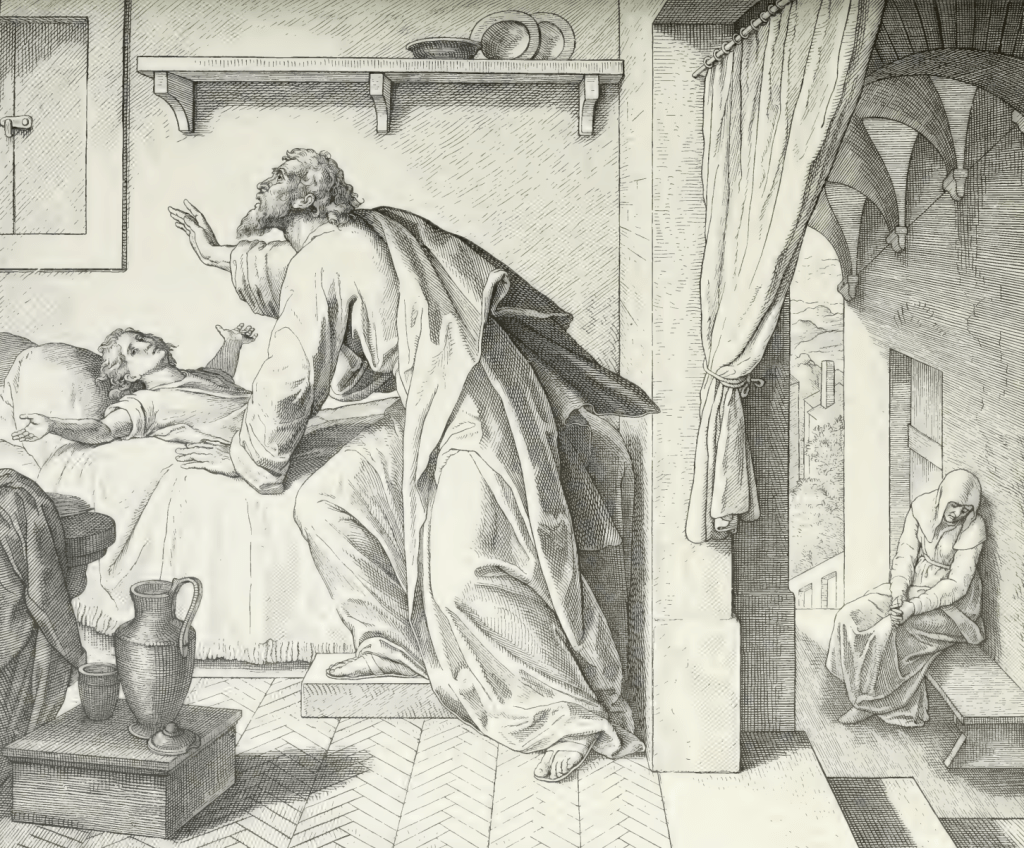
    17. And after these things, the son of the woman (the widow), his hostess, became ill, and his illness was so severe, that no breath remained in him (so that his soul departed from him and he died).

    18. And she (the widow) said to Elijah, * “What have I to do with you, you man of God (how badly do we harmonize together)? You have come to me that my misdeeds be remembered, and that my son would die (you are a holy man and I am a poor sinner, and I have not regarded you as one should treat such a man; therefore, I am now so heavily afflicted).

    * Judges 11:12; 2 Samuel 16:10

    19. He said to her, “Give me * your son.” And he took him from her bosom, and went into the room where he dwelt, and laid him upon the bed.

    * 2 Kings 4:32

    20. And he called upon the Lord (that He would give him grace and power to raise the dead boy), and said, “O Lord, my God, have You also done evil to the widow, with whom I am a guest, that You should kill her son?”

    21. And he stretched himself over the child (he laid himself upon the child, spread himself over him, to warm his dead body) three times, and called upon the Lord, and said, “O Lord, my God, let the soul of this child come again to him (to his body).

    (2 Kings 4:34; Acts 20:10)

    22. And the Lord heard the voice of Elijah, and the soul of the child came back to him, and he became alive.

    23. And Elijah took the child, and brought him down from the room into the house, and * gave him to his mother, and said, “See here, * your son lives.”

    * Luke 7:15

    ** John 4:50

    24. And the woman said to Elijah, “Now I know that you are a man of God (a true prophet), and the * Word of the Lord in your mouth is truth.”

    * 2 Samuel 7:28

    Useful Applications

    IV. COMFORT: Elijah’s prayer, which was granted by God, reminds us that believers do not call upon God vainly in their concerns, v. 21–22. DOCTRINE: On the other hand, this woman gives an example of an unstable and timid disposition, which one ought to guard oneself against, v. 18.

  • Notes and Useful Applications for Luke 7:11–18 from Das Weimarische Bibelwerk (1877)

    The following is my translation of the notes and useful applications for the Holy Gospel of the Sixteenth Sunday after Trinity, Luke 7:11–17 as they are found in Das Weimarische Bibelwerk (1877). Square brackets indicate my own notes and additions. For the useful applications, I recommend the reader see this very helpful article by Dr. Benjamin T. G. Mayes.

    Notes

    II. The Resurrection of the Dead Son of the Widow at Nain (v. 11–18)

    11. Now it happened afterward * that He (the Lord Jesus) came into a city (among the mountains of Hermon, located four miles away from Capernaum) with the name Nain; and many of His disciples went with Him (not only the twelve Apostles, but rather also many other who were His disciples and hearers) and many people (which followed after the Lord Christ for the sake of His teaching and miracles).

    * Greek: “On the following day”

    12. Now as He came near to the gate of the city, behold, there a dead man was being carried out, * who was * the only son of his mother, and she was a widow. And many people from the city went out with her (for the burial of her son).

    *For the Jews had to have their graves outside of the city.

    ** 1 Kings 17:17.

    13. And when the Lord saw her, * He was moved with pity for her (from heartful compassion) the same (grieving widow), and said to her, ** “Do not weep (excessively over the deadly departure of your son).”

    * Matthew 9:36

    ** Jeremiah 31:16

    14. And He came forward and touched (with His almighty, life-giving hand)  the casket (the deathbed, the bier, upon which the young the man was openly carried), and the bearers stood. And He said, “Young man, * I (who am the resurrection and the life, John 11:25) say to (command) you, stand up.”

    * Mark 5:41

    15. And the dead man sat upright, and began to speak. * And He gave him (living again) to his mother. (This is the first dead person whom Christ raised in the New Testament; afterward, He also raised the daughter of Jairus, the ruler of the school, Matthew 9:25, and Lazarus, John 11:43–44, from the dead, and in His resurrection there were many bodies of the saints who were raised with Him, Matthew 27:52)

    * 2 Kings 4:36

    16. And fear came upon all of them (for they were greatly astonished over this great miracle), and they praised God and said, “A great prophet (who is the Messiah Himself) has risen among us, and ** God has visited His people (through the sending of this prophet in grace). ***

    * The like had not happened since the time of Elisha, and thus not in nine hundred years, much less with such circumstances.

    ** Luke 1:68, 78 (Deuteronomy 18:15, 18; Matthew 16:14)

    *** Or, according to the Greek: “And (some) said (who still regarded Him as a mere man, but nevertheless held Him to be a prophet), ‘A great prophet has risen among us.’ Or (others, who still went further said), ‘God has visited His people (through the Messiah Himself).’”

    17. And this report of Him resounded in all the Jewish lands and in all the surrounding lands.

    Useful Applications

    II. DOCTRINE: As easy as it was for Christ to raise this young man from the dead with a word, thus will He also by His divine almighty Word raise all the dead on the Last Day (v. 14–15).