The following is my translation of the notes and useful applications for the Holy Gospel of the Sixteenth Sunday after Trinity, Luke 7:11–17 as they are found in Das Weimarische Bibelwerk (1877). Square brackets indicate my own notes and additions. For the useful applications, I recommend the reader see this very helpful article by Dr. Benjamin T. G. Mayes.
Notes
II. The Resurrection of the Dead Son of the Widow at Nain (v. 11–18)
11. Now it happened afterward * that He (the Lord Jesus) came into a city (among the mountains of Hermon, located four miles away from Capernaum) with the name Nain; and many of His disciples went with Him (not only the twelve Apostles, but rather also many other who were His disciples and hearers) and many people (which followed after the Lord Christ for the sake of His teaching and miracles).
* Greek: “On the following day”
12. Now as He came near to the gate of the city, behold, there a dead man was being carried out, * who was * the only son of his mother, and she was a widow. And many people from the city went out with her (for the burial of her son).
*For the Jews had to have their graves outside of the city.
** 1 Kings 17:17.
13. And when the Lord saw her, * He was moved with pity for her (from heartful compassion) the same (grieving widow), and said to her, ** “Do not weep (excessively over the deadly departure of your son).”
* Matthew 9:36
** Jeremiah 31:16
14. And He came forward and touched (with His almighty, life-giving hand) the casket (the deathbed, the bier, upon which the young the man was openly carried), and the bearers stood. And He said, “Young man, * I (who am the resurrection and the life, John 11:25) say to (command) you, stand up.”
* Mark 5:41
15. And the dead man sat upright, and began to speak. * And He gave him (living again) to his mother. (This is the first dead person whom Christ raised in the New Testament; afterward, He also raised the daughter of Jairus, the ruler of the school, Matthew 9:25, and Lazarus, John 11:43–44, from the dead, and in His resurrection there were many bodies of the saints who were raised with Him, Matthew 27:52)
* 2 Kings 4:36
16. And fear came upon all of them (for they were greatly astonished over this great miracle), and they praised God and said, “A great prophet (who is the Messiah Himself) has risen among us, and ** God has visited His people (through the sending of this prophet in grace). ***
* The like had not happened since the time of Elisha, and thus not in nine hundred years, much less with such circumstances.
** Luke 1:68, 78 (Deuteronomy 18:15, 18; Matthew 16:14)
*** Or, according to the Greek: “And (some) said (who still regarded Him as a mere man, but nevertheless held Him to be a prophet), ‘A great prophet has risen among us.’ Or (others, who still went further said), ‘God has visited His people (through the Messiah Himself).’”
17. And this report of Him resounded in all the Jewish lands and in all the surrounding lands.
Useful Applications
II. DOCTRINE: As easy as it was for Christ to raise this young man from the dead with a word, thus will He also by His divine almighty Word raise all the dead on the Last Day (v. 14–15).
The following is my translation of the notes and useful applications for the Holy Gospel for the Nineteenth Sunday after Trinity, Matthew 9:1–8, as they are found in Das Weimarische Bibelwerk (1877). Square brackets indicate my own notes and additions. For the useful applications, I recommend the reader see this very helpful article by Dr. Benjamin T. G. Mayes.
Notes
I. The History of the Paralyzed Man (v. 1–8)
1. Then He (the Lord Christ) entered into the boat (in which He had come from Capernaum into the regions of the Gergesenes, Matthew 8:18, 28) and crossed over again and came into His own city (Luther: “Capernaum,” where He had rented a house, and stayed there during the Passover, Matthew 4:13, 11:23, 17:24; John 2:12).
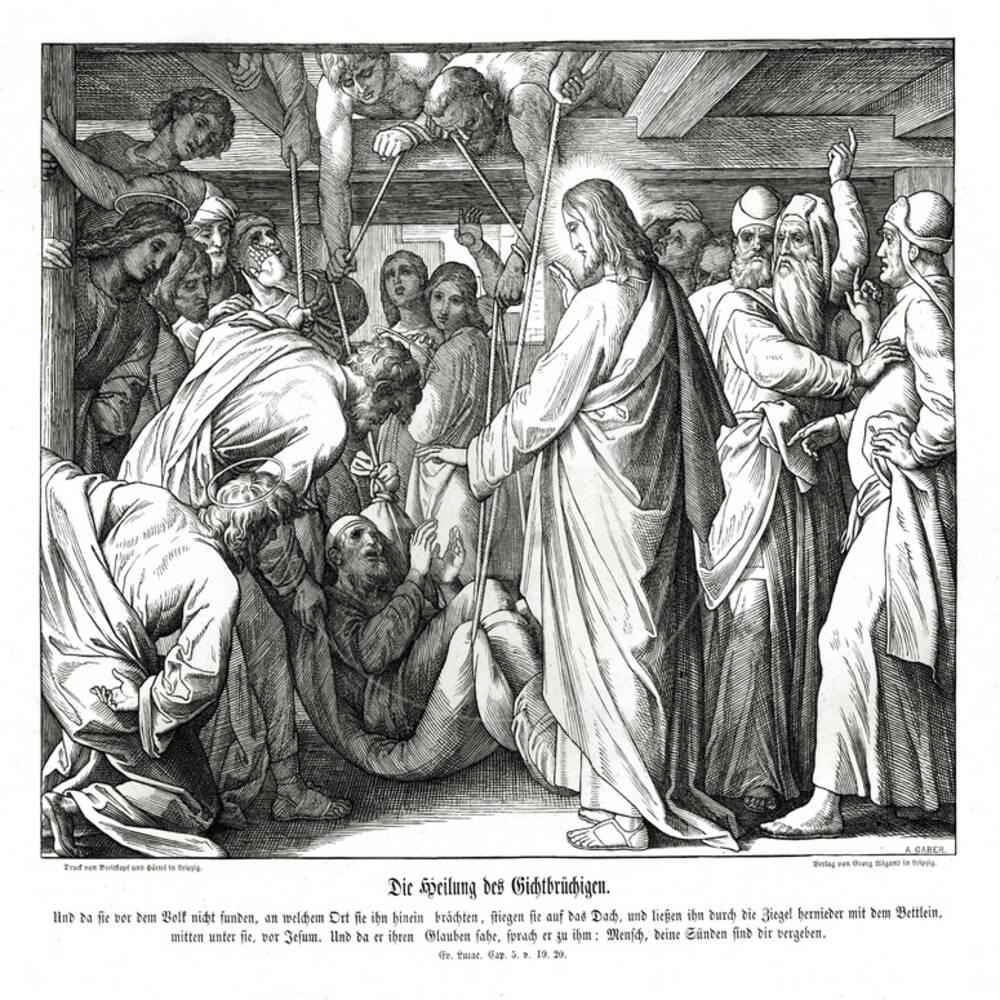
2. And behold, there * they (four of them) brought to him a paralyzed man (Luther: “whom had been afflicted by paralysis, the small or half stroke”) who was laying on a bed (He could neither move nor stir on account of his sickness. They sought a way how they might bring him in and lay him before Him; and when they could not come to Christ in any other way on account of the great multitude of people, and also could not find a place in which they could bring him in, they climbed onto the roof, where He was, and uncovered it, and let him down through the tiles with the little amongst their midst before Jesus, Mark 2:4, Luke 5:19). Now when Jesus saw their faith (understand not only the faith of the bearers, ** but also of the paralytic man himself; for if he had not believed in a saving way and at the same time with trust in Christ’s mediating office, Christ would not have forgiven his sins, nor called him son), He said to the paralyzed man, “Be comforted (and be of good courage), My son, your sins (which make you anxious in your heart) are forgiven you (Thus Christ begins His cure with the soul, because all bodily illnesses come from sin, and because the health of the body without the health of the soul is of little usefulness).”
* Mark 2:1ff. Luke 5:18 (Luke 7:50; Acts 9:33)
** Their faith came to the aid of the sick man, to promote the healing of his body in love, as far as it was possible.
3. And behold, some among the scribes (and the Pharisees, those who were sitting there and heard such) said amongst themselves (thought in their hearts), “This one (Jesus from Nazareth) blasphemes God (in that He ascribes to Himself such authority, which belongs only to God; for who can forgive sins except God alone? Luke 5:21).”
(Luke 7:49)
4. But when Jesus saw their thoughts (He knew immediate in His spirit that they thought thus within themselves, therefore), He said, “Why do you think such wicked things in your hearts (in that you falsely accuse me of blasphemy of God within yourselves, when that which I do nevertheless is my office)?
(Zechariah 8:17)
5. Which is easier (according to outward appearance and the judgement of reason), to say (to the paralyzed man), “Your sins are forgiven,” or to say, “Stand up (take up your bed) and walk?” (You think in your hearts: If I truly could forgiven this paralytic his sins in fact and truth, then I would also have been able to make him whole as well; but because this had not happened, so that is also lacking [i.e., I have not actually forgiven his sins].)
6. But so that you know (and see in fact) that the Son of Man has the authority (and indeed from His own power) to forgive sins (and that the forgiveness of sins is powerful, which I have declared to this paralytic man, and in truth has come upon him; well then I will thus make this man well before your eyes, therefore),” He then said to the paralytic, “ (I say to you,) Stand up, take up your bed (upon which you have had to lie ill and sick for very long time), and go home.”
(John 5:8; Acts 9:34)
7. And (immediately) he stoodup (so that all who those present saw, and he lifted up the little bed upon which he had lain) and went home (and praised God).
8. And the people that saw (this miracle) marveled and praised God, who had given such authority to men (they praised God, that He had sent them such a prophet who forgives sins and who could heal diseases which by nature are incurable. “All those were astonished who heard and saw this, and they were filled with fear and said, ‘We have seen extraordinary things today, and we have never seen such before,” Mark 2:12, Luke 5:26).
(Luke 7:16ff.; 1 Thessalonians 5:18)
Useful Applications
I. DOCTRINE: Christ’s true and eternal divinity shines forth from the fact that He searches out men’s hearts, forgives sins (which belongs to God alone), and heals incurable diseases (v. 2–7).
The following is my translation of the notes and useful applications for the Second Reading for the Feast of St. Michael and All Angels, Revelation 12:7–12, as they are found in Das Weimarische Bibelwerk (1877). Square brackets indicate my own notes and additions. For the useful applications, I recommend the reader see this very helpful article by Dr. Benjamin T. G. Mayes.
Notes
II. The Beginning of the Fourth Vision, in which two opposing parties are described, who have strong enmity against one another: the woman and the dragon; likewise, Michael and His angels on one side, and the dragon together with his angels on the other side. v. 19, 1–17.
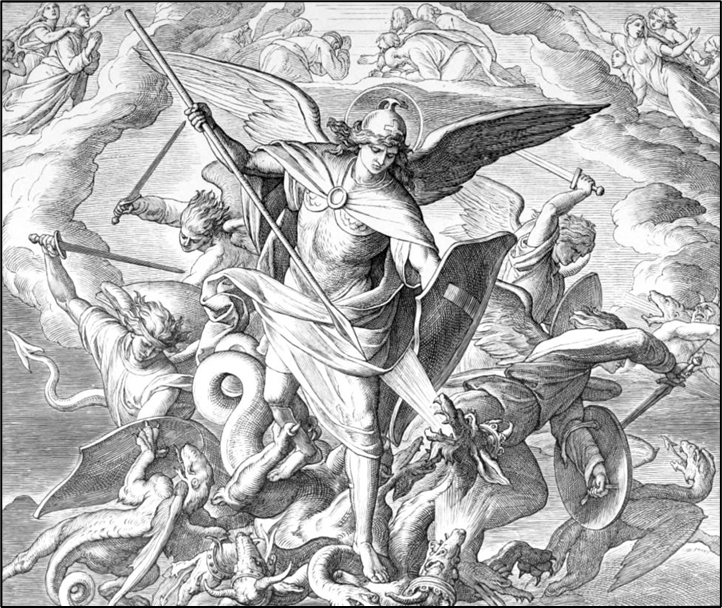
7. And there was a fight in heaven (in the Church-heaven here on earth; for after the devil, on account of his fall, has been cast out of the heaven of eternal glory, he may not come back into it again): * Michael and his angels fought with the dragon, and the dragon and his angels fought (This Michael is God’s Son, as it is explained in v. 10; He is, among other things, also called an angel for this reason, because in the protection of the Church, He carries out the office of an angel; otherwise, Michael is also the name of an archangel, Jude 9. But here Christ, the Son of God, is meant by this name, who is of one essence, one power, and one glory with God, His heavenly Father; for Michael means ‘Who is like God?’ And with this name the Holy Spirit directs us to the last chapter of the prophet Daniel, where it is proclaimed that in the last times, the great prince Michael shall arise, who stands for the holy people, Daniel 12:1. For since the dragon wants to attack the woman, that is, the true Church and the members of the spiritual body of Christ, so Christ takes His Church to Himself, and fights with His angels, by which not only the holy spirits in heaven are understood, but also all faithful teachers and preachers, against the dragon and his angels, by which not only the evil spirits who joined themselves to the devil and fell away from God are understood, but also the persecutors, the heretics, and all the scales of the hellish dragon). **
* Daniel 10:13, 21; 12:1.
** And: This battle is without doubt the blessed Reformation. If it were about the freedom of the Christian Church after the heathen persecutions [i.e., the legalization of Christianity in the Fourth Century], then one would have to seek it in the wars of Constantine the Great with Licinius, Maxentius, and so on.
8. And they did not win (for how could the devil overcome Christ, who is the power of God, 1 Corinthians 1:24? “The prince of this world is coming, and he has nothing in me,” says Christ to HIs disciples, John 14:30); also there was no more found to be a place for them in heaven (they were put to flight and cast out of heaven).
9. And the great dragon was cast out *, the old serpent (the evil enemy, who deceived our first parents through the serpent, Genesis 3:1, and has practiced his cunning and wickedness for a long time), who is called the Devil (the accuser, because he slanders God before men, Genesis 3:5, men before God, Job 1:9, and men against other men) and Satan (the adversary, because he is the enemy of God and men), who deceives the entire world (through his cunning and lies he deceives all those who allow themselves to be led by the spirit of the world, 1 Corinthians 2:12); and he was cast ** to the earth (by these words refers to the curse which God, after the fall of our first parents, pronounced upon the serpent: “Upon your belly you shall go, and dust you shall eat all the days of your life,” Genesis 3:14), and his angels were also *** cast out at that time (By this casting out of the devil from heaven it is signified that, after Christ through His death and resurrection had overcome the devil and taken power from him, Hebrews 2:14, He then, after His victorious resurrection, in which He stripped the principalities and the powers and made a show of them openly, and made a triumph out of them through Himself, Colossians 2:15, and after He sat down at the right hand of God, caused such obtained victory to be proclaimed in all the world, whereby the devil everywhere is driven out and trodden under the feet of the believers, Romans 16:20. “I saw Satan fall from heaven as lightning,” says Christ, Luke 10:18. Afterward, this overcoming and casting out took place at the time of Emperor Constantine the Great [in the Fourth Century], when the great persecutions ceased and peace was grated to the Church. In particular, this conflict and victory against the hellish dragon refers to our last times, when the kingdom of the antichrist and the doctrine of devils is attacked through the preaching of the Gospel, 1 Timothy 4:1, and are driven out of the Church-heaven; and this casting out will only fully happen on the Last Day, in which the dragon with his angels will be cast into the hellish pool, Revelation 20:14).
* Luke 10:18; John 12:31 (Revelation 20:2; Zechariah 3:1)
** Greek: “(Indeed), he was cast out,” or, “He was (I say) cast out”
*** Greek: “with him”
10. And I heard a great voice, which spoke in heaven, * “Now is the salvation, and the strength, and the kingdom, and the power of our God, His Christ ** (This is the triumph song and rejoicing of the true believers over this victory of the great prince Michael against the dragon, who in the same fight proved Himself to be an invincible hero and savior of His Church), because the accuser of our brethren has been cast out, *** who accuses them before God day and night.
* Revelation 11:15 (Job 1:9, 2:5; Zechariah 3:1)
** Greek: “Now has come (in powerful demonstrate made known and been revealed) the salvation and the power and the kingdom of our God, and the glory of His Christ (Anointed One).”
*** Greek: “is cast out (hurled down).”
11. And they * (the believers) have overcome ** him through the Lamb’s blood (because they firmly believed that Christ, through His suffering and the shedding of HIs blood, had overcome the devil for their good, and they set this victory in true faith against the devil’s accusation), and by the Word of their testimony *** (in that they remained steadfast in the confession of the Gospel, which is the testimony concerning Christ); and they have not loved their life even to death (their life was not so dear to them that in order to preserve it they would have denied Christ and His Word).
* Greek: “Also they themselves”
** Romans 8:37 (v. 17)
*** Concerning this, see Revelation 11:3.
12. Therefore *, rejoice you, you heaven, and those who dwell therein (all believers and elect of God, whose names are written in heaven, Luke 10:20, whose citizenship is in heaven, Philippians 3:20). But woe to those who dwell on the earth and on the sea (those who are minded toward earthly things, Philippians 3:19, who love the world and what is in the world, 1 John 2:15, since everything that is in the world, such as honor, riches, pleasure, power, etc., is unstable as the sea), for the devil has come down to you, and he has great wrath, and he knows that he has little time (because the time of the Judgement Day is near, in which he is to be cast into the hellish pool and will no longer exercise his malice upon the earth).
* Psalm 96:11
Useful Applications
II. COMFORT: That Christ Himself (who is signified by Michael) faithfully takes care of His believers in the militant church on earth and powerfully protects them against the devil and the antichrist, is depicted in this vision, v. 7–9.
The following is my translation of Martin Chemnitz’s homily outline for the Third Sunday after Trinity as found in his Postilla (Vol. II, pgs. 306–307). Square brackets indicate my own notes and additions.
Sermon Outline
Concerning those things we now want to handle in this sermon and what is thereby to be noted, it is divided into these four points:
First, we want from these three parables that we are reminded that the Lord begins the parables because He wants to indicate how it is with us by nature, that when we have lost something that has been dear to us, how we then have an even greater longing that we might recover it, and we are more concerned about the lost thing than we are mindful of that which nevertheless we still have and possess in our custody (Verwahrung). And He says that in this way God is inclined toward us, that when someone from among men is misled so that he comes into an erring path (Irrweg) and goes astray, God is not turned away, how God is then concerned for us that He might find us again and get us back again, how He diligently seeks us, and how He directs all care and effort therein do that he might restore us again, and that He does this from such a heart we when one is very distressed over a thing which he has lost and applies all diligence in order that he might get us back again. Such is the Fatherly heart of Christ toward us (vätterliches Hertz Christi gege uns), which we first ought to learn, know, and consider in this parable.
Second, thereafter we want to learn form this how we then ought to conduct ourselves to this, so that God’s care and effort might not be futile and in vain, that we [ought to] allow ourselves to be found by Him when He seeks us and that He can restore us again. And that we [ought] not run away from Him when He seeks us, but rather act like a strayed sheep, when it perceives that the Shepherd is after it and is seeking it, wanting to bring it back to the flock, it then stands still, and allows itself to be grasped and to be restored again, not running further into the wilderness, but rather turns back, and allows itself to be brought again to its place. And just as a coin is found again when one sweeps the house, lights a lamp, and looks with diligence for it, that we also thus [ought to] allow ourselves to be found and be sought out from the filth and foulness of our sins; and when God sets the light of His Law before us and shines it under our eyes and takes the broom in the hand that he might thereby again sweep us out from the dirt and the filth, that we then through such means—the preaching of the Law (Gesetzpredigt) and the blessed cross—[ought to] allow ourselves to be helped out from the filth again; and when we have been willful and brazen before our heavenly Father and have abused His longsuffering (Langmut), and He has therefore placed us in poverty, grief, and misery, that we [ought to] come to our senses in the midst of the cross, and in true repentance turn again to God and be received into grace by Him and be accepted again.
Third, that we especially take this into consideration, how the parables proceed to this: with which heart God seeks us, how great a joy it is to Him when we allow ourselves to be found, how kindly He receives the repentant sinner, and therein has the greatest joy and delight when we rightly conduct ourselves in this matter so that He does not deal with us according to His fury and wrath, but can be gracious and merciful to us and show us His fatherly love.
Fourth and finally, how every Christian, both preacher and hearer, ought to learn from this how we also ought to strive after the example of the heavenly Father and His beloved Son Jesus Christ, our faithful Shepherd, so that we also be so disposed toward repentant sinners and have such a heart toward them as here we hear God has toward such. This especially applies to those whom God has preserved from serious falls and offenses more than others, as is here seen in the older brother, who exalted himself on account of his piety so that he was unwilling to allow his younger brother to be received into grace even when his brother had nevertheless repented. For this reason, he was rebuked and admonished by the father. And how he makes too much of this that he says, “I have never transgressed your command, and have done everything as was appropriate” [Luke 15:29], how each ought to guard himself from such speech and thoughts.
To these four points we want to briefly direct [our attention] as to what is chiefly to be considered in this Gospel in the three parables presented to us. God grant us His grace and blessing to this end.
The following is my translation of Chemnitz’s homily for the First Sunday after Trinity on Luke 16:19–31 as found in his Postilla (Vol. II, pg. 280–87). Square brackets indicate my notes and additions. I have broken up some of the longer sentences and paragraphs for the sake of readability in English.
Explanation of the Gospel
Beloved in Christ the Lord,
Whoever wanted to demonstrate high art in this Gospel and had excessively inquisitive hearers (fürwitzige Zuhörer) whose ears itched for high questions, he would here have a good opportunity and reason to speak and to dispute subtly of such things which he himself would not understand and by which the hearers also would be bettered little, namely: what is the bosom of Abraham in which Lazarus is comforted, where it is to be found, and how Lazarus can be in the the bosom of Abraham, and how he can have a finger even though his body has not yet been raised to the joy of eternal life; likewise, what and where the place is where the rich man is tormented because he is not yet in the true hell (der rechten Hell) to which he will only come to on the Last Day, what the tongue is which he would gladly let him touch, what also the eyes are with which he saw Lazarus from afar even though his body is also not yet in the true condemnation (die rechten Verdammniß), but rather lies buried in the earth, also what is the chasm which is fixed between the two places. However Paul says in the first letter to the Corinthians in the fourteenth chapter that he would rather speak five words in the common [tongue] with his understanding in order that he might also instruct others rather than otherwise speak ten thousand words in tongues by which no one would be improved (1 Corinthians 14:19). Thus St. Paul elsewhere wills that one ought to arrange all things in the Church of God for edification and improvement [1 Corinthians 14:26, 40].
Homily Outline
Thus we also have here an explanation from the Lord Christ of a high difficult question, not that we might repent of our excessive inquisitiveness (Fürwitz), but that we may make use of it for edification (Erbauung), for warning (zur Warnung), and for comfort (Trost); and from this, the following three points are set forth in this text:
First, what sort of state or condition there is with the souls of the deceased righteous men and the godless [i.e., intermediate states].
Second, how we may can make use of this Gospel profitably for warning and comfort, both in prosperity and while under the cross (beid im Glück und im Creutz).
Third, why it is that the rich man is condemned and the poor man is saved, so that we may not err from the right way here along with the rich man, but rather may finally be comforted with Lazarus.
Concerning the First Point: [Intermediate States]
Thus, the first doctrine here in the Gospel concerns the state (Zustandt) of the blessed and the damned soul after a person’s death until the Last Day. For you know that on the Last Day, all the bodies of the dead will rise again and entire great crowd of all men will be divided from one another into two parts, some to the right hand of the Lord Christ, and some to the left hand. Those who are placed at the right hand will be directed to eternal life, but the godless at the left hand [will be directed] into eternal hellish fire (Matthew 25[:31–46]). But the question arises, how does it go now and how will it go when someone has died until the Final Judgment? The body is laid in the earth as we see and know before our eyes, but where does the soul remain? And such is not an unnecessary question, for the right answer to it has foundation in God’s Word and is useful for our betterment (Besserung). Now this is an old error of the Greeks which is also being stirred up again in our time, as though the soul of man, after his death, should sleep and neither understand, nor know, nor feel anything [i.e., “soul sleep”]. But Christ speaks here of a damned soul and of a blessed soul and He distinguishes between the godless rich man and the poor God-blessed Lazarus, as He will on the Last Day, and He says that after the death of pious Lazarus, his soul was carried by the angels into Abraham’s bosom [Luke 16:22], which is not yet the true place (der rechte Ort) of the perfect joy in eternal life, which Lazarus, along with all the elect, shall only fully come to on the Last Day. Likewise, He says that the soul of the rich man came to the place of torment (den Ort der Qual) [Luke 16:23], which is also called hell here [i.e., “Hades,” ᾅδῃ], and yet it is not yet the deepest hell (die tieffte Hell) into which the body and soul of the rich man shall only be cast into at the Final Judgment (Matthew 25[:46]).
Now the Lord Christ says that Lazarus followed in the footsteps of his father Abraham and had believed in the promise made to Abraham [cf. Romans 4], but in great misery, so that no one could have thought that God should know him or that any angel should take care of him, for he lay there before the rich man’s door despised and full of sores. And yet, the Scripture says that God has commanded His angels concerning him that they ought to bear him up in their hands (Psalm 91[:11–12]). When he dies, the little angels carry his soul into Abraham’s bosom, not as though it were so heavy, but rather Christ had wanted to demonstrate by this what a precious treasure the souls of the righteous are to God and how certain and true the comfort from the Psalm is that the holy little angels have been commanded to diligently watch over such a soul and to bear it up in their hands immediately. So then, his soul is thus carried into Abraham’s bosom, which the Ancients rightly explained in this way, as when a mother has been away for a long time and finally comes once again to the house and the little children run to her with joy and fall into her bosom and the mother joyfully receives them to herself and hugs them and kisses them.
I could not locate a source for this allusion.
In this way, Abraham is called the father of all believers, as is said in Romans 4. To him comes Lazarus, and he is gladly received by him into his bosom and is comforted, and yet, he is not yet at the true place of salvation (den rechten Ort der Seligkeit), but rather, as the Revelation of John says, they are gathered under the altar, where they rest and are comforted, clothed in white garments, as a sign and pledge of the consolation which will surely follow (Revelation 6[:9–11]). And because the joy is already so great, and yet it is not yet the true, eternal, perfect joy (der rechte ewige vollkommene Freud) which will only begin on the Last Day, thus Lazarus had to comfort himself with this further, that such future joy will also be all the more momentous and glorious. Beyond this, it makes this his joy even greater, that he sees the rich man sitting in the flames and in the torment, and then he thinks, “Thanks and praise be to God! For You have graciously preserved me so that I did not come to the place of torment, but rather here, where I am comforted, and still have this before me, that it will soon be even better with me.” And finally, this also makes him greatly rejoice, that he hears the chasm (die Klufft) is firmly fixed and he need not worry that he will be deprived again of such joy in eternity; as it sadly goes here in the world where we are poor sinners and we find ourselves daily in worry and danger with regard to the joy of eternal life because of our sin. in addition to this, it often happens that one rightly and piously begins in his Christianity so that he hopes he will inherit the joy of salvation in Christ, but he does not remain steadfast until the end, but falls away, and thereby is deprived of the joy. Similarly, even when a joyful moment and a good season comes to Christians in which they rejoice, so nevertheless it does not last long, bur rather, one cross soon follows after the other so that their joy is disturbed and taken away. Such, alas, is how it goes in this life. But there it shall be said, “The chasm is fixed” [Luke 16:26], and the salvation of the righteous is so guarded and assured that they cannot be damned nor come to the place of torment, to the rich man, even if they wanted to go down to him.
On the other hand, what is the state of the soul of the rich godless man after his death until the Last Day? To this the text answers: He is in hell. What is hell? A place of torment. Where then is such a place? Where is the bosom of Abraham? Is the one a place beneath us and the other a place above us? Answer: Where it is, we do not want to dispute, but (as St. Augustine says) we should pray to God that may come to the place where we are refreshed with poor Lazarus and by no means to the place of torment.
I looked at several of Augustine’s sermons, but could not find a quote to this effect.
But here, Christ wants to describe and depict the pain, anguish, and suffering of the damned in this parable for us. For because it is a spiritual torment (Geistliche Qual) which one cannot see with bodily eyes (mit leiblichen Augen), so Christ takes a likeness (or a parable, Gleichnuß) from bodily things so that we who are still living in the flesh can reflect upon the matter a little better, as if someone were lying in the midst of a flame of fire and desired only a single tiny drop of water to touch his tongue and yet it was denied to him. So the rich man also thinks here, “Ah! Could I not have but a little refreshment? Surely, there is not another living soul on earth, however poor he may be, who could not at least obtain a little drop of water with which to quench my thirst! Could not even so much be given to me?” “No,” says Abraham. “You have received your good in your life.” David says in the seventeenth Psalm, “God fills their belly with His good things, thereby they have their portion there” (Psalm 17[:14]). And Jeremiah says in the twelfth chapter, “They are fattened and prepared as sheep for the slaughter-bench” (Jeremiah 12[:3]). This is what is truly dreadful, that afterward, in hell, they ought not receive even a single little drop of water from the exuberant grace and the infinite goodness of God, with which they may moisten their tongue only but a little. And this rich man must also reflect upon this in addition: If the torment is already so great, what then will it be like on the Last Day? Thus, he not only has the present pain, but also this anxiety torments and afflicts him even more: “Ah! What then shall become of me when I shall hear this verdict on the Last Day: ‘Depart from me, you accursed, into the eternal hellish fire’?” (Matthew 25[:41]). Likewise, Peter says in 2 Peter 2[:4, 9] that “if God did not spare the angels… then He also knows how to reserve the unrighteous under punishment for the Day of Judgment to punish them.” Beyond this, he sees Abraham living in joy who also had been rich, but also devout and God-fearing, who had taken in and fed strangers and the poor [cf. Genesis 18:1–8]. He also sees poor Lazarus sitting in joy, whom he had previously not looked upon with a single eye, which makes his torment even greater for him because he sees the joy in others and must go without it entirely and in addition be tormented, just as hunger is more painful to someone and plagues him more when food is set before him that he may see it and yet not enjoy it [Psalm 112:9–10]. There the worm of his own conscience bites and gnaws at him so that he must think, “Ah! This is what you wanted to have! It is your own fault! You did not want to let yourself be warned!” Finally, he must hear with terror, “The chasm is fixed.” But here “a chasm” means a great wide fissure so that no one can cross over at all, as Abraham says, “There is such a chasm between us and you so that no one can come to the other, no one from you can come over to us here.” [Luke 16:26] By this it is given to him to understand that his torment will never cease in eternity nor come to an end and that he will not partake of any joy in eternity, not even in the least. This makes the torment even greater for him still. This is the first point concerning the condition of souls after a man’s death until the Last Day as it pertains to both the righteous and the godless.
This same doctrine is repeated by Chemnitz in his Examination of the Council of Trent, “So far as the middle order, state, or place is concerned [i.e., purgatory]—Scripture makes only two orders or places for human beings after this life: “He who believes and is baptized will be saved; but he who does not believe will be condemned” (Mark 16:16). “He who believes in Him is not condemned; he who does not believe is condemned already,” likewise, “He who believes in the Son has eternal life; he who does not obey the Son shall not see life, but the wrath of God rests upon him” (John 3:18, 36). Thus in Luke 16 only two places are assigned to souls departing from the body prior to the Last Judgment, a place of comfort and a place of torments. And indeed, a chasm is so firmly fixed immediately after death that no one is able to pass over from the place of torments to the place of comfort.” (Vol. III, pg. 312) See also the discussion in Johann Gerhard, On Death (Part One), Theological Commonplaces XXIX/1, § 159, pg. 230ff.
Concerning the Second Point: [Warning and Comfort]
Second, we here have to pay attention to this Gospel how we make may make use of it profitably for warning in prosperity and good days (zur Warnung in Glück und guten Tagen) and for comfort while under the cross and in misery (zum Trostim Creutz und Elendt). For we ought not dispute so meticulously about what is the bosom of Abraham, or the flame, or the place of torment, or the tongue, or the little drop of water. Even if we actually knew all such things, it would still not yet justified. But rather we ought to direct our thoughts as to how we might rightly make use of the narrative.
This happens thus: God distributes His goods here unequally—the one is rich, the other is poor; the one is healthy, the other is sick; the one is blessed, the other is miserable. Now God says that it shall go well for the righteous and evil for the godless, and yet, the opposite is found, as Solomon says in Ecclesiastes that the same happens to both, to the righteous as to the wicked (Ecclesiastes 9[:2]). Indeed, one often sees quite the opposite, that it goes well for the wicked and the pious are laden with the cross and misery, as is demonstrated plainly in this narrative. For there is a pious, God-fearing man whose name is Lazarus, and yet he does not have much good fortune. Indeed, he is poor and (like Job [see Job 2:7]) full of sore and boils so that he cannot work, and there is no one who would even give him the crumbs that he might satisfy himself. He is so despised that only the dogs have regard for him. On the other hand, there is a godless man who has no regard for God, who despises his neighbor and is stingy and unmerciful toward him, and yet he is rich, has good peaceful days, and lives always gloriously and in joy. And when things go contrary to expectation so that the pious are stuck in misfortune, the world mocks them and thinks they have no gracious God nor any help from the Lord (Psalm 3[:2]), yet, on the other hand, when everything happens fortunately for the godless, the world once again thinks that they sit in the bosom of God and there can be no lack for them. Indeed, the God-blessed themselves are often troubled by it also and they take offense at it, as David says, “I had almost let my foot slip.” (Psalm 73[:2]) And Jeremiah says, “Lord, I will not murmur against You; but nevertheless, I must pour out the thoughts of my heart into Your bosom. These are your children, whom you inflict with all misfortune, and on the other hand, you heap up your goods upon the godless—how can this be?” (~Jeremiah 12). And in Malachi and Psalm 73, the righteous complain, “Is it in vain that I wash my hands in innocence?” “It is in vain that one serves God, and what use is there that we keep His commandments?” “We cannot accept it that God acts thus.” (Psalm 73[:13]; Malachi 3[:14]).
But as Psalm 73 says, one must look to the end (sehe das Endt an), for in the end it is evident whom He has struck (Psalm 73[:17ff.]). Lazarus was indeed inflicted for a long time, but, finally, when he died, he was carried by the angels into Abraham’s bosom where he is refreshed in eternity. But where Satan preaches (Matthew 4[:9] and Luke 4[:7]), “Behold, all this I will give you if you fall down and pray to me” and someone thereupon prays to the devil and all is given to him, then the world says, “Oh, these are the blessed people! Happy is the people for whom it thus goes” (Psalm 144:5). However Christ says here, “Look to the end” (Sihe das Endt an), for it did not endure with this glutton. He finally died and came to hell, into the place of eternal torment, and had to hear, “You received your good things in your life” [Luke 16:25]. Let us consider this well, and truly strive after it, not that we may receive our goods here, but rather that the end may be good, so that we do not desire to give ourselves over to vain joy, merriment, and splendor. For when the end comes, then the splendid garments and well-living is then over. Where will we find ourselves then? In hell. Therefore, live in the fear of God (in der Furcht Gottes). If you are stuck under the cross, then be patient and think: “It will someday all come to the end.” Then, you shall be comforted in endless eternity.
Thus, we ought to learn to look to the end (auff das Ende sehen), both in fortune and misfortune. The Law of God says rightly, “It shall go well for the pious, and it shall go ill for the godless.” If such does not happen now in this life, then there is still another life existing where it can happen and will happen abundantly. Therefore, if someone in this life fears God, hears Moses and the prophets, and yet he lives amid a vain cross and opposition so that the lot of Lazarus befalls him, let him not take offense at it, but rather, let him comfort himself with the day the Lord will make when He shall be God’s own possession (Malachi 3[:17–18]). And, on the other hand, if you have fortune and riches, do not hang your heart on it, and do not forget God, for otherwise it will come to a wicked end, as with this rich man, as also Psalm 17, 37, and 73, Jeremiah 12 and [2] Maccabees 3 say. This is the second point: how we ought to make use of this narrative beneficially for warning in prosperity (zur Warnung in Glück) and for comfort under the cross (zum Trost im Creutz).
Concerning the Third Point: [The Way of Salvation]
The third [point] is nevertheless the foremost, [namely,] that we ought to learn wherein the rich man was lacking whereby he was condemned and by what it was made good for Lazarus that he had come into Abraham’s bosom so that we may follow such a right way with Lazarus and, indeed, not also go down to hell with the rich man. So now it stands thus that we ought not think it makes no difference how we live, that even if we die in unrepentance that God would nevertheless be gracious and we could be saved; or, as it was said in the papacy, that one might live a life however he wanted if only money were given for him and indulgence (Ablaß) granted to him, then he must be saved. “No,” says here the father of all believers [i.e., Abraham], “that is lacking.” Thus it is said that in this life we are on the way where we may be helped, but after death we are in the place where “the chasm is fixed” [Luke 16:26]. But here there are two ways. One leads upward to heaven, the other leads downward to hell. There now God steps forth through Moses and the Prophets and speaks to rich and poor. He calls, teaches, and warns, “Follow this path! Beware of that one! Hear Moses and the Prophets, so that you do not come to the place where the rich man is tormented, but rather to the place where Lazarus is refreshed.” Now, when God thus warns and admonishes, do they all follow then? Ah! Alas, no! And from this it is evident why the rich man is condemned. For the fact that he is rich and clothes himself honorably according to his estate (nach seinem Stande) and has a good cheerful little hour and takes delight in it is never the true cause of his condemnation (die rechte Ursach seiner Verdammnuß). After all, Abraham himself was also rich such that he had in his house about 400 men fit for battle [c.f., Genesis 14:14].
What then has condemned this rich man? Answer: This, that he led a godless life and did not hear Moses and the Prophets. How? Did he then know nothing of God or of Moses? Surely, he did. For when Abraham said, “They have Moses and the Prophets,” then he immediately understood what he meant and who they are. And that he calls Abraham “father” has this understanding: He was at his foundation godless and unmerciful, and he misused his temporal goods, and even so he deluded himself in the midst of it that he would not go to to the evil on account of it. Thus he led an external glorious appearance that he had Abraham as his father, or as we say, that he wanted to be regarded as a good Christian (für guten Christen). For he also lived thus that he had stolen from no one, cheated no one, had done some good with his own goods and lived well. In this case, he demonstrated better than the stingy misers who do not have the heart to touch their goods and do something good with them, for which there is punishment from God over them.
If then, he did not perish from this, what then was he lacking? Answer: This, as he himself confesses, “Then they will repent.” From this it follows that He had not repented; he had paid no regard to God, Moses, and the Prophets, even if he heard them externally (eusserlich). From this then followed the evil fruits: that he had the goods of the world and saw his brother suffer poverty and closed his heart to him (1 John 3[:17]); that he paid attention to the lust of the eyes (auff Augen Lust) and had clothed himself in purple beyond his estate (uber seinen Standt), which at that time only the kings wore; and was not cheerful every now and then, but rather had lived every day magnificently and in joys.
Surely, at times, a poor Levite or priest must have come to him and warned him, “Look! Thus says Moses! Thus says the Prophets! Thus you shall live! Thus you shall care for the poor and have compassion for them! Etc.” This he had not paid attention to, he did not believe it, he confesses to it. His brothers also do not believe. He thus let Moses and the Prophets keep calling and he followed his own head and gave himself over only to pleasure (Wollust). And now that he is in torment, he would indeed want that his brothers be warned. But Abraham says, “Ought they not know? After all, they have Moses and the Prophets.” “Yes,” he says, “I had them also, and yet I did not believe. They will not believe them either. Why ought they pay attention to Moses or to a poor Levite? But if someone were to rise from the dead, then they would finally believe.” But Abraham says that the preaching of Moses and the Prophets is the only means (das einige Mittel) through which God wills to be effective, to work faith unto salvation; not that the dead should rise and say how it is going with them, nor that they should preach from Moses and the Prophets, but rather that the servants of God (die Diener Gottes) ought to do it.
Whoever does not heed them, it goes for him as it did the rich man, such the account demonstrates. But we ought not leave this hanging between heaven and earth. Rather, let every rich man examine himself whether he also hears Moses and the Prophets and pays attention to them, or whether he also does too much with clothing and good living and is unmerciful toward his needy neighbor. By doing so, he makes it that the Levite with Moses and the Prophets must fall silent. For where one thus remains unrepentant, there the bitter lament of the ears (Ohrenflawer) finally follows: “Ah! If I had done that! Ah! If I had listened to Moses and the Prophets!” And Christ, who has the keys of hell and death, as it is written in St. John’s Revelation 1[:18], opens here a window into hell for us and shows us the rich man sitting in hell; He stretches with His long arm into hell itself and draws out a burning coal and shows it to us so that we may believe, warning us still of it through Moses, etc. “Yes,” says the rich man here, “I would indeed have believed God Himself, if He had warned me. I do not accuse him of lying, but that Levite was too lowly for me. If someone had risen from the dead, then I would have believed.” “No!” says Abraham, “That is not the means nor the way.” What then ought the rich do if they want to be saved? Read the first epistle to Timothy, “They ought not be proud, nor place their hope in uncertain riches, bur rather in the living God, etc.” (1 Timothy 6[:17–19]).
On the other hand, from what cause is Lazarus saved? How did he do it? Did his poverty or his afflictions save him? No, for it happens often that the poor conduct themselves in their poverty in such a way that they go do to the devil along with the rich. Rather, from what was said before it is easy to see, namely, he had heard Moses and the Prophets, thus that He had repented, acknowledged his sin and the wrath of God, and feared it, believed in the blessed Seed of Abraham [i.e., Christ], was reconciled to God, lived in a Christian manner, and when the cross and poverty befell him, he bore it with patience, and even though nothing came to him from the rich man’s door, he did not grumble, but was content even when a kindness happened to him from the dogs. Now when he dies, God shortens his cross and brings him to rest. As Dr. Martin Luther says on the first book of Moses [i.e., Genesis], we are much more blessed than the Fathers before the Flood, who had lived so long and bore their cross and burdens so long, whereas we, like Lazarus, are delivered from them soon and in but a few years. Therefore, be patient in such hope, remain in faith and true repentance, and do not grumble. It will be that your misery and sadness will soon be transformed into eternal joy.
The closest Luther quote I could find from the Genesis Lectures was the following: “Consequently, our temptations, crosses, and vexations are nothing in comparison with the temptations, crosses, and vexations of the fathers. Even though we, too, observe monstrous evils in the world, we do not observe them for long and for this reason are more fortunate; for we leave such a wicked generation more quickly. Noah observed his degraded grandsons for three hundred and fifty years, and how much misery do you suppose he experienced during this time? In respect to this share of misfortune Noah is surpassed by his godly son Shem, who lived for five hundred years after the Flood. Oh, what martyrs! All the generations of men should thoughtfully consider them and learn patience from their example. St. Peter declares about righteous Lot that his soul was distressed when he beheld the ungodly actions of the Sodomites (2 Peter 2:7). Simeon states about Mary that a sword would pierce through her soul (Luke 2:35). The saints cannot behold the wickedness of the world without intense grief. But these crosses of later generations are nothing in comparison with those of the holy fathers, who were compelled to behold the great perversity of the world for five hundred years and more. Therefore let us, too, patiently bear these sad sights and the darts of Satan (Eph. 6:16), which he drives into our hearts; for we should not expect our situation to be better than that of the holy fathers, although, as I have said, it is better in this respect that we have a shorter span of life.” (AE 2:216–17)
Thus is this parable (diß Gleichnuß) directed toward this necessary reminder: Because after this departure “the chasm is fixed” in such a way that one cannot come from one side to the other, and yet the way is still here that one may come to the place of rest and refreshment, therefore let each person strive after it and conduct himself in such a way that he indeed finds the right way (die rechten Weg) and learn from the account of the rich man and the poor Lazarus how the rich man could have found such a way so that he may guard himself against it and not follow after the rich man. Or, if he is also a poor Lazarus, how he ought then conduct himself so that he may come into the bosom of Abraham with poor Lazarus and be comforted.
To this end, may God the Father help us through the power of His Holy Spirit for the sake of His beloved Son, our Lord and Savior Jesus Christ. Amen.
The following is my translation of Martin Chemnitz’s homily outline for Holy Trinity Sunday, as found in his Postilla (Vol. II, pg. 273). Chemnitz’s Gospel text is John 3:1–15, although the reader will notice that Chemnitz preaches on the mystery of the Trinity in general and not so much the text. His homily is more topical and systematic than exegetical. Square brackets indicate my own notes and additions.
Chemnitz’s Explanation and Outline
Beloved in Christ the Lord,
This is a particularly high feast in which the right knowledge of God is dealt with, so far as God has revealed it to in His Word and as much as is necessary for us to know for salvation. However, it is thus crudely called “threefoldness” (Dreifaltigkeit) as if a threefold God (dreifältiger Gott) or a threefoldness (Dreifaltigkeit) were in the Divine essence (Göttlichen Wesen), although there is no such threefoldness (Dreifaltigkeit). Therefore, it would be better to call it “Trinity” (Dreieinigkeit) or “Threeness” (Dreiheit) because in the Divine essence there is one singular God (ein einger Gott) and yet three distinct persons (drei unterschiedene Personen).
With this doctrine, it is not enough that we name God, for the Jews and the heathen do that also, but rather we must thus found our faith upon God’s Word and rightly know God as He has thus revealed Himself so that we separate ourselves from Jews, Turks [i.e., Muslims], and heathen who either believe in many gods [i.e., polytheism] or confess only one person in the Godhead [i.e., the Jews]; for, against both, the Scripture reports to us differently as is seen in other passages besides this text, which is one of the foremost in the New Testament. For God had promised in the Old Testament that, when the Messiah would come into the world, God would put His Word into His mouth (Deuteronomy [18:18]), and such Word was to begin in Jerusalem and go forth from Zion (Isaiah 2[:3]). Therefore, the Evangelist John, with particular diligence, also recorded the Lord Christ’s first sermon which He gave at night to Nicodemus, in which is summarized, with beautiful and lovely words, the summary and the right core of the doctrine in the Gospel concerning the forgiveness of sins and the true saving faith; that this account [John 3:1–15] is indeed worthy that one diligently hear and consider it.
Now, for this reason [the doctrine of the Trinity] has been appointed to be dealt with on this day, because it is not in our liberty to decide what and how we are to think of God, because it says in Jeremiah 10[:10–11] and Psalm 79[:6] that God pours out His wrath upon the heathen who do not know Him. Likewise, in John 17[:3] that “This is eternal life, that they know You, that You alone are the true God, and the one You have sent, Jesus Christ.” And in John 5[:23], “Whoever does not honor the Son does not honor the Father who sent Him.” And 1 John 5[:12], “Whoever does not have God the Son does not have the Life.” And Isaiah 53[:11], “By His knowledge will He, My Servant, the Righteous One, make many righteous.” And John 14[:17], “The world cannot receive the Holy Spirit because it does not see Him and does not know Him.” And Romans 8[:9], “Those who do not have the Spirit of Christ are not Christ’s, and they do not belong to Him.” From such and similar passages it is evident how much is dependent upon the right knowledge of God.
However, we ought not to sharply dispute concerning the Divine essence, but rather learn to know, honor, and call upon God and the persons of the Godhead from and according to the articles of creation, redemption, and sanctification, because otherwise it is not a life-giving knowledge (lebendigmachendes Erkenntniß). Therefore, this text, which can rightly and well serve us, is now appointed not for a sharp dispute as to how the persons are distinguished internally in their essence, but rather for the simple knowledge of God from the articles of faith (schlechten Erkenntniß Gottes, auß den Artickeln deß Glaubens).
Now, this doctrine consists in the following five points:
First, that truly there is one God over all creatures, who governs all of them.
Second, that there is not many gods, but rather only one singular God.
Third, that in the same singular Divine essence there are three persons: Father, Son, and Holy Spirit.
Fourth, how such persons are distinguished [from one another].
And then fifth and last, how the knowledge of God is presented to us in His works in the articles of creation, redemption, and sanctification from which we can thereby make use of it all the better.


 PATTERN OF SOUND WORDS