Tag: Typology

  • Notes and Useful Applications for 1 Corinthians 9:24–10:5 from Das Weimarische Bibelwerk (1877)

    The following is my translation of the notes and useful applications for the Epistle Reading of Septuagesima, 1 Corinthians 9:24–10:5, as they are found in Das Weimarische Bibelwerk (1877). Square brackets indicate my own notes and additions. For the useful applications, I recommend the reader see this very helpful article by Dr. Benjamin T. G. Mayes.

    1 Corinthians 9:24–27

    II. Concerning Paul’s lifestyle, that he lives moderately and that he still is of the single estate; but especially, that he preaches the Gospel without pay, etc. (v. 24–27)

    Annotated Text

    24. Do you not know,1 that those who run in the race (Luther: “In or around the competition”) all run, but (only) one obtains the (set forth) prize? (namely, the one who first reaches the goal) Run now thus (carry out your run in Christendom in such a manner), that you may seize it (that you may obtain the promised heavenly reward out of grace, so that you do not run in vain).

    (Galatians 5:7; Philippians 3:14; 2 Timothy 4:7; Hebrews 12:1)

    1 † Here follows the conclusion of all the preceding admonitions to right use of freedom, and therein rests the greater part on the little word “abstain” [ἐγκρατεύεται] (v. 25), which here signifies so much as  “to exercise self-control” [abbrechen sich], as that upon which [the right use of freedom] continually depends.

    25. But * everyone who competes restrains himself in all things (that might hinder him in the attainment of the victory); those (those who run or compete in the race) such that they receive a perishable crown (or wreath, for the most part of leaves or herbs), but we (all of us together who as spiritual combatants must always be at war against the devil, the world, and our sinful flesh; if we overcome, we will obtain) an imperishable one (an incorruptible eternal crown, 1 Peter 5:4).

    * Ephesians 6:12 (1 Timothy 6:12; 2 Timothy 4:7; 1 Peter 1:4)

    26. Now1 I run in this way, not as uncertain (as those who do not know that they will reach and will win without fail, and thus have striven for nothing and in vain); I fight in this way, not as one who strikes in the air (as swordsman at times make many failing strikes in that they do not hit their opponent, but rather, strike the air; rather, I have set before myself a certain victory in my spiritual race and combat, toward which I direct all my doings, namely, God’s honor, the conversion and salvation of men, and my own eternal welfare. Luther: “Just as a combatant  who runs out of bounds must miss the goal and one who strikes and makes failing strikes, swings vainly into the air, in this way it goes with all who indeed do many good works without faith, for they are uncertain how they are with God, therefore, they are mere missed runs, failing strikes, and false works”).

    (2 Timothy 1:8)

    1Greek: “Therefore, I also run (as you previously heard) …” [ἐγὼ τοίνυν οὕτως]

    27. Rather, I * subdue (and overcome) my body and tame it (through moderation and fasting; I also do not indulge in my fleshly lusts and desires that want to hold me back from right course and combat, but rather I subdue them and guard against them so that they do not break out into works), that I not preach to others (and that they would be saved through the preaching of the Gospel, 1 Corinthians 4:16), and disqualify myself (that I do not make myself unfit for good and give an evil example to others).1

    * Romans 8:13, 13:14 (Galatians 5:24)

    1 † Because the apostles has previously spoken about restraining oneself and exercising self-control out of love toward others in the use of middle things [i.e., adiaphora] and also about taking pay, so this also must without doubt be understood as abstaining from various things of the like to avoid offense, even if became hard upon his flesh and blood. For properly speaking, the discourse here is not concerning fasting.

    Useful Applications

    II. COMFORT and CORRECTION: It is a great comfort for Christians that their running finally brings a glorious crown; however, each must see to it that he does not forfeit it with loveless self-will. (v. 24–27)

    1 Corinthians 10:1–5

    I. Paul counters the objection of the converted Corinthians, since they supposed that, by virtue of Baptism and the Lord’s Supper, there would be no distress with them in the rest, even if they made use of idol sacrifices; there, Paul holds before them certain types from the Old Testament, with proof, [namely, that] just as the Jews misused those same signs of grace and yet finally were harshly punished, that God also in this way will visit those who eat of idol-sacrifices. (v. 1–14)

    Annotated Text

    1. But I do not want to hold back from you, beloved brothers, that * our fathers (our forefathers, the Israelites in the Old Testament, in whose stead you have been received as the people of God in the New Testament) were (indeed) all under the cloud (under the pillar of cloud in which the Lord went before them by day so that He led them on the right way; the cloud which also stood over them, Numbers 14:14, and which overshadowed them), and † all went through the (Red) Sea (and thus were rescued from the hand of Pharoah who pursued them with a great army).

    * Exodus 13:1

    † Exodus 14:22 (Nehemiah 9:19; Psalm 78:14)

    2. And they were all baptized under Moses1 (who led them through the Red Sea and through the wilderness) with the cloud and with the sea. (This passage through the Red Sea and this covering by the cloud was a type of Holy Baptism, which has been instituted in the New Testament. For in the same way that God the Lord assured the Israelites of His gracious presence and His help against enemies through these wonderful blessings, in the same way Holy Baptism is a powerful seal of the divine promise and a certain testimony of the grace of God. Just as the Israelites were rescued from the bondage of Pharoah by such passage, but Pharoah with all his hosts was drowned in the Red Sea, in this way Holy Baptism is the saving bath of renewal and regeneration [Titus 3:5], by which we are redeemed from the power of the devil and the bondage of sin, that the old man with his evil lusts be drowned, and the new man may arise [Romans 6:4, 6]. Just as the Israelites by this blessing were obliged to believe the doctrine of Moses, in the same we are baptized into Christ and are thereby obliged to believe His Word and follow His commandments.)

    (1 Peter 3:21)

    1 Greek: “into Moses” [εἰς τὸν Μωϋσῆν], that is, into that church polity [German: Kirchenverfassung] that was set by him before the people from Sinai as a covenant.

    3. And * they all ate the same spiritual food (namely, the Manna, which is therefore called a spiritual food, because it fell from heaven in an wonderful unnatural manner, and because it signified the spiritual soul-food, Christ Jesus, John 6:32–33, who feeds us with His flesh in the Holy Supper);

    * Exodus 16:15ff. (Psalm 105:40)

    4. And * they all drank the same spiritual drink (namely, the water that flowed from the rock, which is called a spiritual drink because it sprung forth from the hard rock in a supernatural manner, and because it signified the spiritual soul-drink, Christ Jesus, who quenches us with His blood in the Holy Supper); but they drank from the spiritual rock that followed them, which was Christ. (As our fathers altogether, both the wicked as well as the pious, drank from the same water which flowed from the rock, so they also, according to the figure and type, drank from the spiritual rock which led them through the wilderness, which spiritual rock was no one other than the Son of God, Christ Jesus.)

    * Exodus 17:6ff. (Numbers 20:10, 21:16; Psalm 78:15ff.)

    5. But with many of them (among those same Israelites) God had no good pleasure; for * they were struck down (and all those who were over twenty years perished altogether when they were led out of Egypt, only Joshua and Caleb excepted) in the wilderness. (From this, it sufficiently appears that God has no pleasure in them.)

    * John 6:49 (Numbers 26:65; Psalm 106:26; Hebrews 3:17ff.)

    Useful Applications

    I. WARNING: Because Paul warns his own of idolatry, fornication, tempting God, and impatient murmuring on the basis that the end of the world had come upon them, how much more ought we allow ourselves to be warned, we who live seventeen hundred years afterward and who have fallen into the last sludge of the evil world? (v. 1, 11)
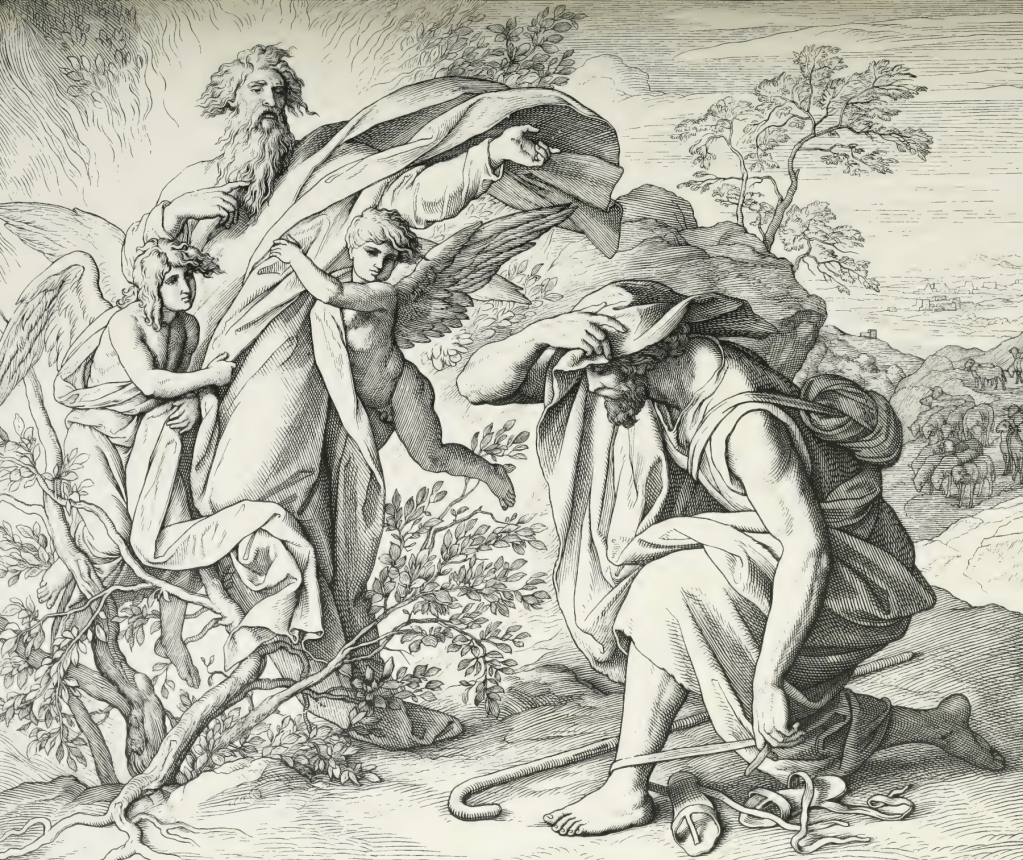

  • Notes and Useful Applications for Exodus 3:1–14 from Das Weimarische Bibelwerk (1877)

    The following is my translation of the notes and useful applications for one of the Old Testament Readings assigned for the Transfiguration of our Lord, Exodus 3:1–14, as they are found in Das Weimarische Bibelwerk (1877). Square brackets indicate my own notes and additions. For the useful applications, I recommend the reader see this very helpful article by Dr. Benjamin T. G. Mayes.

    Moses is Called to Lead Israel from Egypt, by Julius Schnorr von Carolsfeld

    I. The appearance of the Son of God in the fiery bush, and how Moses approached. (v. 1–6)

    II. The promise of God concerning help and salvation, and how Moses was called to his office. (v. 7–10)

    III. How Moses refused this call two distinct times, partly on account of his unworthiness, partly on account of the ignorance of the children of Israel, that they may not know the name of God; and how the Lord answered thereafter. (v. 11–14)

    Annotated Text

    1. Now Moses tended (in those days in the fortieth year) the sheep of Jethro, his father-in-law,1 the priest (the captain and magistrate) in Midian, and he drove the sheep out in the wilderness (into the land of Arabia, which is called the wilderness of Sinai), and came to the mountain of God (so named on account of the present and following divine revelation, called) Horeb.

    1 † Perhaps the brother-in-law, for the word from which the Hebrew comes signifies in general a relationship through marriage and can be that the son follows the father in office. Age and names can suggest this. See Exodus 2:18, 23; Numbers 10:29; Judges 1:16, 4:11, etc.

    2. And the Angel of the Lord (the Lord, the eternal self-subsisting Son of God, who afterward in the fullness of time was sent into the flesh by the Father, the Lord) appeared to him * in a fiery flame from the bush.1 And he saw that the bush burned with fire and was nevertheless not consumed (by the flame of fire).

    * Exodus 23:20; Deuteronomy 33:16 (Acts 7:30)

    1 † Thornbush, particularly a bramble-bush; from this Mount Sinai appears to have received its name.

    3. And he said (to himself with wonder), “I will (go) there and see this great sight (I will inspect and research), why the bush does not burn (what the cause might be that the green wood in the midst of which the flame of fire burns is not consumed? By this fiery bush is prefigured the mystery of the incarnation of the Son of God, that namely, in the fullness of time, He would unite true human nature to Himself personally,  and also fill it with the light of His divine majesty and divine attributes, yet so that human nature would not be harmed or consumed by the divine nature in the least, and that in such personal union His assumed human nature would complete the work of redemption of the human race, prefigured by the deliverance from Egyptian slavery.)1

    (Acts 7:31)

    1 † Whether the divine preservation of His Church in the fire and thorns of the (Egyptian) afflictions has no place here is to be considered, and it is likely that it was in view.

    4. But when the Lord saw (the Son of God in the fiery bush) that he went over (wanted to draw near) to see, God (the Son of God) called to him from the bush, and * said, “Moses, Moses!” He answered, “Here I am. (What is your desire? Speak, for Your servant listens, 1 Samuel 3:10.)

    * Genesis 22:11

    5. He said, “Do not tread here, take off your shoes from1 your feet (as a sign of your impurity); for the place upon which you stand is (on account of My divine presence and revelation through the Word and through sign of the fiery bush) a * holy land.”

    1 Hebrew: “cast them down” (For the Jewish shoes were fasted to the foot only from above with a strap, as they are still worn by the Capuchin friars.)

    * Genesis 28:17 (Joshua 5:15)

    6. And He said further, * “I am the God of your father, the God of Abraham, the God of Isaac, and the God of Jacob (I have established a gracious covenant with your forefathers, the holy patriarchs, and promised them that I would be their God, that I would nourish and protect them, that I would sanctify and renew them, and that I would bestow all good upon them, that I would resurrection them again after their death, and that I would gather them into eternal life; but, in particular, that I would give the land of Canaan to their descendants, and that the Messiah shall be born from their race).” And Moses hid his face, for he (as an impure sinner) was afraid to look upon God (the most-holy Lord).

    * Matthew 22:32 (Mark 12:26; Luke 20:37; Acts 7:37, 32)

    7. And the Lord said, “I have (indeed) seen (from before time and even now) the misery of My people in Egypt (the descendants of Abraham, Isaac, and Jacob, who are the people of My special possession), and I have heard their cries over those who drive them (King Pharoah, his counselors, and his officials); I have known their sorrow (and let it come into My heart),

    (Acts 7:34)

    8. And I have come down (I have revealed My special presence in the fiery bush and am determined) that I rescue them from the hand of Egypt (slavery and oppression), and lead them out from this land into * a good and far land, in a land in which flows milk and honey (which is rich and fruitful), namely, to the place (into the land) of the Canaanites, the Hittites, the Amorites, the Perizzites, the Hivites, and the Jebusites (whom altogether are accursed and notorious sinners, Leviticus 18:24–25).

    * Exodus 33:3 (Exodus 13:5ff; Genesis 9:25, 11:7, 15:16, 18:21)

    9. Because now the cry of the children of Israel has come before me (because the children of Israel, in their cries and prayers have set My covenant and promise before Me), and I have seen their fear (the external bodily need), how the Egyptians frighten them;

    10. so * go now, I will send you to Pharoah (the King in Egypt), that you1 lead my people, the children of Israel from Egypt (the house of slavery).”

    * Psalm 105:26; Acts 7:34 (Hosea 12:14; Sirach 45:3ff.)

    1 Hebrew: “Come now! Behold, the cry has come, etc.” (v. 9) “Come! (I say) go, for I will send you to Pharoah, and you will lead My people, etc.”

    11. Moses said to God, * “Who am I, that I should go to Pharoah and lead the children of Israel from Egypt?” (My person, reputation, and strength are far too meagre for such a great work.)

    * Exodus 4:10; 1 Samuel 18:18

    12. He said, * “I will be with you (as Immanuel, the strong God). And this shall be the sign for you (a sign of remembrance, to remind you of what I now say to you in the future, and now are assured of this blessing), that I have sent you: When you have led My people from Egypt, you will offer sacrifice to God on1 this mountain (where I have now appeared to you and have given you the call to lead My people).”

    * Genesis 31:3; Judges 6:16

    1 Hebrew: “in” (For sacrifices were never offered upon it, also upon which few were allowed come. See Exodus 24:9ff.)

    13. Moses said to God, “Behold, when I come to the children of Israel, and say to them, ‘The God of your fathers has sent me to you,’ they will say to me, ‘How shall we call His name (what is His proper name, by which He will be distinguished from the gods of the Egyptians)?’ What shall I say to them (as an answer)?”

    14. God said to Moses, * “I AM WHO I AM (I am the eternal, unchangeable God, the Creator and Preserver of all creatures, complete in Myself; I will also the fullness of time assume human nature, and in it complete the great work of redemption from spiritual slavery.).” And He said, “Thus you shall say to the children of Israel (the only true God’s name is this): ‘I AM has sent me to you (Luther: “When you come there, then I will be with you, and show Myself such that you shall know that it is I.”).”

    * Deuteronomy 4:35; Revelation 1:4, 8

    Useful Applications

    I. CORRECTION: That we ought to come to the place where God deals with us through His word with reverence, just as Moses did. (v. 1–6) II. DOCTRINE: That God alone knows how to raise up useful people for the help and comfort of His suffering Church, as He did with Moses. (v. 7–10) III. COMFORT: That those who are orderly called, even to a dangerous office, ought to comfort themselves with the assistance of God. (v. 11–12)

  • Notes and Useful Applications for Jeremiah 23:5–8 from Das Weimarische Bibelwerk (1877)

    The following is my translation of the notes and useful applications of the Old Testament Reading for the First Sunday of Advent (Ad Te Levavi), Jeremiah 23:5–8, as they are found in Das Weimarische Bibelwerk (1877). Square brackets indicate my own notes and additions. For the useful applications, I recommend the reader see this very helpful article by Dr. Benjamin T. G. Mayes.

    III. He sets before them in contrast [to this account of punishment (v. 1–4)], the prophecy concerning the true Helper and Savior Jesus Christ. (v. 5–8)

    Annotated Text

    5. “Behold, * the time (of the New Testament) is coming,” says the Lord, “that I will raise up for David (from his stem and descendants, according to My promise) † a righteous Branch (a Son); and He (namely, the Messiah) shall ** be a (spiritual) King, who will rule well, and establish justice and righteousness on earth (He will acquire perfect righteousness through His obedience and suffering,1 and appropriate it to the members of His kingdom through faith, and protect His Church against enemies).

    * Jeremiah 30:3

    † Isaiah 4:2ff.

    ** Isaiah 32:1 (33:14–16; Psalm 132:17; Isaiah 11:3ff.)

    1 † See Psalm 22:31–32; for He will be a help through an everlasting redemption, v. 6.

    6. At that time * shall Judah (the Christian Church) be helped, and shall Israel (who is each true believer in Christ) dwell secure. And this will be His name (the Messiah’s), that one will call Him (in true faith), “The Lord (the true God), who is our righteousness” (who has brought us eternal righteousness, Daniel 9:24; who also has been made righteousness for us from God, 1 Corinthians 1:30; so that we might become in Him the righteousness which avails before God, 2 Corinthians 5:21).

    * Jeremiah 33:16; Isaiah 45:24 (Isaiah 53:11; Romans 3:21)

    7. Therefore, behold, * the time is coming,” says the Lord, “that one will no longer say, ‘As true as the Lord lives, who has led the children of Israel out of the land of Egypt (in a bodily manner),’

    * Jeremiah 16:14–15

    8. but rather, ‘as true as the Lord lives, who has led forth the seed of the house of Israel (in a spiritual manner according to this type), and has brought them out from the land of the north and from all the lands1 into which I had driven them, so that shall dwell in their own land.’”

    1 † This teaches that the talk is of the general assembly of believers in the New Testament, John 10:16; Matthew 8:11; of which those from the north have been a prelude and a sample.

    Useful Applications

    III. DOCTRINE: That Christ the Son of God who has been sent form the heavenly Father into the world (signified through the true Branch of David), is the King of His believers, by whom they obtain righteousness and eternal salvation. (v. 5–6)