The following is my translation of the notes and useful applications for the Epistle Reading for the Seventeenth Sunday after Trinity, Ephesians 4:1–6, as they are found in Das Weimarische Bibelwerk (1877). Square brackets indicate my own notes and additions. For the useful applications, I recommend the reader see this very helpful article by Dr. Benjamin T. G. Mayes.
I. An admonition toward unity.(v. 1–6)
Annotated Text
1. So I now admonish you (my beloved Ephesians), I, the prison in the Lord * (for the sake of the confession of Christ), that you walk (lead such a life) as is proper to your calling into which you were called (as your Christianity, to which you have been called by God through the Gospel, requires),
* Greek: Alternatively, “I admonish you thus, as a prisoner,” or “I, who am (now) imprisoned in the Lord Christ (that is, for Christ’s sake).” The words “in Christ” refer to the exhortation, which agrees better with Ephesians 3:21.
2. with * all humility and meekness (that you be humble without pride, and friendly without murmuring), with patience (at the same being patient in suffering), and bearing with one another in love (from love, let each regard the other’s faults in the best way; from which love humility, meekness, patience and other virtues ought to spring forth),
* Acts 20:19; Colossians 3:12
3. And be diligent to keep (to guard) the * unity of the Spirit (the concord of the minds in the good, which arises from the Holy Spirit)** through the bond of peace (which ought to bind all of you together).
** However, this comes from the love of Christ, and is therefore called the “bond of perfection” (Colossians 3:14), the like of which is not to be expected from any natural concord.
4. * One body (indeed, all of you together are members of a spiritual body) and one Spirit (indeed, all of together are ruled and guided by one Spirit), as you also (through the Gospel) were called into a single hope of your calling (you all together have a single calling, and all hope for eternal salvation, Romans 8:24).
5. One * Lord (there is one Lord for you all, namely Christ, the head of this spiritual body, who has not only created you, but also redeemed you with His blood to be His own possession), one faith (you have a single confession of faith), one baptism (you have been reborn through one baptism, baptized by one Spirit into one body, and made to drink of one Spirit, 1 Corinthians 12:13).
6. * One God and Father (of us) all (we all together have one God and father in heaven), who is over you all (He has authority to command you all), and through you all (He works all good in you), and in you all (He dwells in all of you. The Father is the first person, who is over all, and from Him are all things; the Son is the second person, who is through all, he fulfills all in all, v. 10; the Holy Spirit is the third person, who is in all, Romans 11:36, since the inhabited world is full of the Spirit of the Lord, Wisdom 1:7).
* Malachi 2:10; 1 Corinthians 12:6
Useful Applications
I. CORRECTION: Toward Christian love and peaceableness; because we are one spiritual body, are governed by one Spirit, have one and the same hope of eternal life, there is one Lord of us all, we have one faith, one baptism, there is one God and Father of us all (v. 3–6).
The following is my translation of the notes and useful applications for the Old Testament Reading for the Seventeenth Sunday after Trinity, Proverbs 25:6–14, as they are found in Das Weimarische Bibelwerk (1877). Square brackets indicate my own notes and additions. For the useful applications, I recommend the reader see this very helpful article by Dr. Benjamin T. G. Mayes.
III. How a man ought to conduct himself wisely at court. (v. 6–23)
Annotated Text
6. Do not flaunt * before the king (do not put yourself forward to preside over a high office, and to carry out great affairs of the kingdom), and do not stand (in a presumptuous manner and of yourself, out of pride and lust for honor) in the place of the great (of the foremost royal counselors and servants),
(Sirach 3:22ff., 7:4–6, 13:13)
* Hebrew: “Do not force your way into positions of honor”
7. For it is better for you (if you are gifted and made fit by God to serve in distinguished offices, cf. Proverbs 22:29) that one say to you, * “Come up here,” than that you (on account of your presumption, greed for honor, and self-willed exaltation) before the prince (or before another eminent, honorable, and wise man) be humbled , so that your eyes must see ** (and afterwards you yourself have to be ashamed of it, Luke 14:9).
* Luke 14:8ff.
** Hebrew: “whom your eyes have (previously) seen, (but whom you may now no longer be seen by).” See the Hebrew of 2 Kings 25:19.
8. Do not rush hastily to quarrel; for what will you do afterwards (and how will it go with you), when your neighbor has shamed (injured and damaged) you? * (Will it not be done to you as you thought to do to your neighbor? And will they not in turn disgrace you and punish you fittingly? Deuteronomy 19:19)
(Proverbs 20:13; 17:14)
* Hebrew: “when your neighbor (opponent) puts you to shame (and demonstrates publicly how you have acted rashly)”
9. Argue your (own) case with your neighbor (mildly and modestly; counsel and help, as much as ever possible toward reconciliation and toward peace, Matthew 5:23–25, 18:15), and (above all things) do not reveal another’s secret (do not mix yourself in other people’s affairs).
(Sirach 19:13ff.)
10. So that he who hears it does not rebuke you for it (and with these words, in return, disgrace and shame you), and your evil rumor never ceases.
11. A * word, spoken in its time (with good deliberation according to the circumstance, place, time and persons) is like golden apples (Luther: “as if they were oranges and lemons”) in silver ** vessels (it is quite fitting, also pleasant and delightful to reasonable people).
* Proverbs 15:23 (Sirach 41:21)
** Hebrew: “skillfully crafted”
12. He who reproves a wise man who listens to him (so that in this way the speech of discipline achieves its desired effect), he is like a golden headband and a golden necklace (Proverbs 1:9).
* Psalm 141:5 (Proverbs 9:8–9; Sirach 6:30ff.)
13. Like the cold of the snow at the time of the harvest (namely, when the snow or ice is kept in deep pits under the earth until summertime, and then is used for the cooling of drinks and for the refreshing of languishing bodies), so is a faithful messenger to those who have sent him, and he refreshes the soul of his lords (when returns, and he has carried out his business well. Luther: “A faithful servant or subject cannot be paid enough”).
* Proverb 13:17
14. Whoever speaks much and does not keep it (Luther: “as the world does”), he is like clouds and wind without rain (Luther: “good words and nothing behind them”).
* 2 Peter 2:17 (Jude 12; Sirach 4:34)
Useful Applications
III. CORRECTION: That one ought to humble himself before high-ranking people, v. 6–7; CORRECTION: That one faithfully keep what has been spoken, v. 14.
The following is my translation of the notes and useful applications for the Epistle Reading for the Sixteenth Sunday after Trinity, Ephesians 3:13–21 as they are found in Das Weimarische Bibelwerk (1877). Square brackets indicate my own notes and additions. For the useful applications, I recommend the reader see this very helpful article by Dr. Benjamin T. G. Mayes.
II. A prayer of Paul to the Ephesians, that they ought not be scandalized at the state of Paul, but rather for that reason that they let themselves be strengthened all the more in the faith. (v. 13–21)
Notes
13. Therefore, I pray, that you do not become (or let yourself become) weary (and fall away from the truth of the Gospel) for the sake of my tribulations (persecution and bonds), which I suffer * for you (because the devil and the world hate and persecute me for this reason, because I have preached the Gospel to you), which are honor for you (because it redounds to your honor that you remain steadfast in the same doctrine, on account of which I suffer so many things. Indeed, my tribulations redound for the promotion of your eternal honor and salvation, because you are thereby strengthened in your faith when you see that I endure everything with patience for the sake of the Gospel to confirm its truth).
14. Therefore (to come back again to my former point) I bow (daily in my prayers) my knees (of the body and the heart) to the * Father of our Lord Jesus Christ,
* Ephesians 1:3
15. who is the true Father over all those called * children on heaven and earth (who is not only the Father of our Lord Jesus Christ, as His only-begotten Son, but rather also of all believers, whom He has adopted as children from grace, who are found partly in the Church Militant here on earth and partly in the Church Triumphant in heaven. Luther: “All angels, all Christians, indeed even all children of men are God’s children, for He has created them all.”),
(Ephesians 4:6; Psalm 27:10)
* Greek: “from whom (and from His grace) the enter race (of His children of grace) has the name (source and honor) of the sonship (of God).
16. that He give you according * to the riches of His glory (according to His great and glorious mercifulness), ** to be strengthened through His (Holy) Spirit in the inner man (to grow and increase in faith and in all godliness),
17. and that Christ * dwell (so that Christ may dwell according to His gracious presence) by faith (as the blessèd means of union with Him) in your hearts, and that by being rooted and grounded in love (that you may also become so strong in love toward God and the neighbor that no trial or persecution may overpower you),
* John 14:23 (Galatians 2:20; Colossians 2:7)
18. so that you may * grasp (understand and consider by faith) with all the saints (true believers, the Christians reborn and sanctified through the Holy Spirit), what is the ** breadth, and the length, and the depth, and the height, * (how exceedingly great the grace of God is toward us men, which He has proven to us in Christ, that its breadth cannot be circumscribed, but extends from morning to evening throughout the entire world, that its length stretches from eternity to eternity, that its depth can be fathomed by no one, and that its height reaches far beyond the understanding of all angels and men. Luther: “Love proves that faith is upright; it then comprehends that there is nothing so broad, , long, ,deep, or high where Christ did not have the power and could not be able to help, and it does not fear sin, death, or hell, however broad, long, deep, etc. they may be, as Psalm 139:7 also says, “Where shall I go from Your Spirit?”)
* Greek: Alternatively, “so that you, being rooted and grounded in love, may have sufficient capability to grasp”
** Job 11:8–9 (Psalm 103:12; Psalm 57:11)
*** Namely, the dwelling of God in the Spirit, v. 17. See also Ephesians 2:19–22.
19. Also (that you may likewise) know, that * Christ has love, which is much better than all wisdom (all other knowledge, and again, that the love of Christ is so great that no one can completely understand it in this life. Luther: “It is a much great thing to have love for Christ than to be able to preach much, 1 Corinthians 8:1–3, ‘Knowledge puffs up; love builds up.’ Likewise, if anyone loves God, he is known by Him”), so that you may be filled with all the fullness of God (all divine riches in heavenly goods, with every kind of gift that God bestows out of grace. Luther “that God alone rule and work in you, and you be full of Him.”).
* or, “the love of Christ, which nevertheless surpasses all understanding”
20. Now to Him, who can do (for the promotion of our salvation) exceedingly more (much more) than all that we pray or understanding, * according to the power (according to His divine power) that works in us (all good gifts in the regenerate),
* Romans 16:25
21. to Him (the same one true God) * be honor (to Him be praise) in the congregation which is in Christ Jesus (which Christ has called and preserves against all the gates of hell), for all time, from eternity to eternity (always and eternally)! Amen (that it happens in this way, and also will certainly happen in this way).
* Romans 11:36, 16:27; 1 Timothy 1:17 (Jude 24)
Useful Applications
II. CORRECTION/IMPROVEMENT: That together with Paul we ought to bend the knees before the Father of our Lord Jesus Christ and pray that He may allow us be strengthened through His Spirit in the inner man, to grow in faith and godliness (v. 14, 16). DOCTRINE and COMFORT: Because indeed no greater grace can befall us than that we are equipped and adorned with heavenly and eternally goods through the love of Christ toward us (v. 19ff.).
The following is my translation of the notes and useful applications for the Old Testament Reading for the Sixteenth Sunday after Trinity, 1 Kings 17:17–24 as they are found in Das Weimarische Bibelwerk (1877). Square brackets indicate my own notes and additions. For the useful applications, I recommend the reader see this very helpful article by Dr. Benjamin T. G. Mayes.
IV. The Resurrection of the Son of the Widow from Death (v. 17–24)
Notes
17. And after these things, the son of the woman (the widow), his hostess, became ill, and his illness was so severe, that no breath remained in him (so that his soul departed from him and he died).
18. And she (the widow) said to Elijah, * “What have I to do with you, you man of God (how badly do we harmonize together)? You have come to me that my misdeeds be remembered, and that my son would die (you are a holy man and I am a poor sinner, and I have not regarded you as one should treat such a man; therefore, I am now so heavily afflicted).
* Judges 11:12; 2 Samuel 16:10
19. He said to her, “Give me * your son.” And he took him from her bosom, and went into the room where he dwelt, and laid him upon the bed.
* 2 Kings 4:32
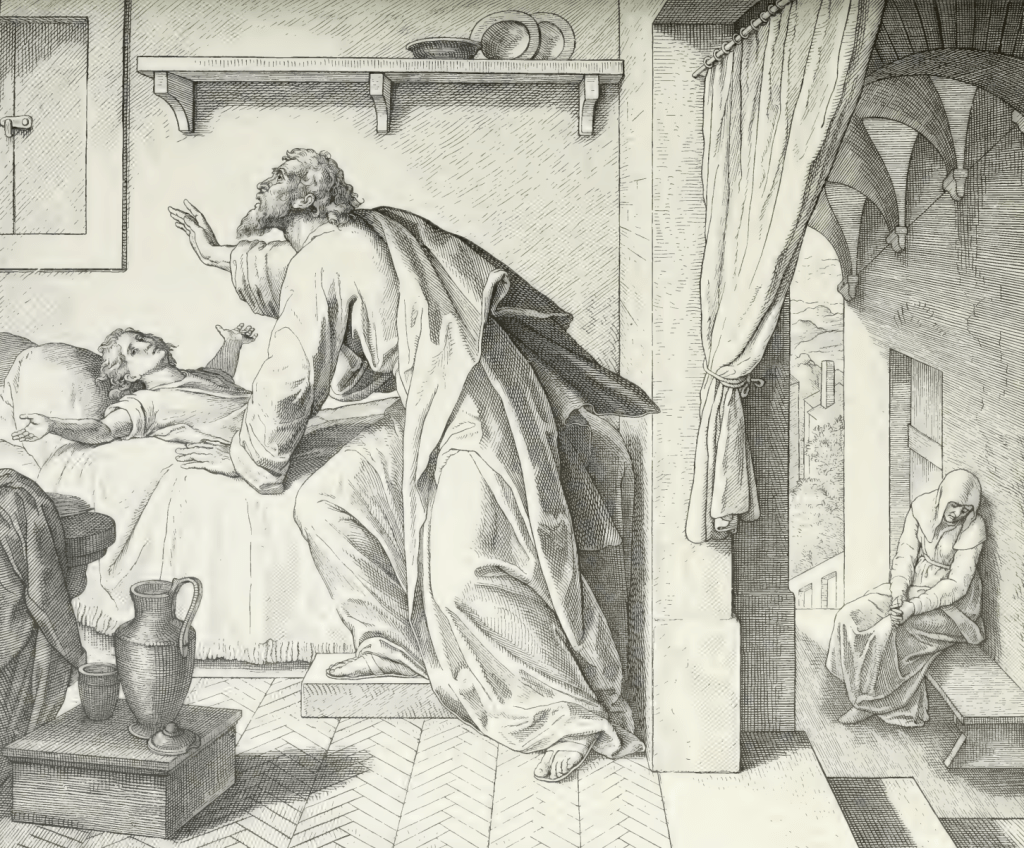
20. And he called upon the Lord (that He would give him grace and power to raise the dead boy), and said, “O Lord, my God, have You also done evil to the widow, with whom I am a guest, that You should kill her son?”
21. And he stretched himself over the child (he laid himself upon the child, spread himself over him, to warm his dead body) three times, and called upon the Lord, and said, “O Lord, my God, let the soul of this child come again to him (to his body).
(2 Kings 4:34; Acts 20:10)
22. And the Lord heard the voice of Elijah, and the soul of the child came back to him, and he became alive.
23. And Elijah took the child, and brought him down from the room into the house, and * gave him to his mother, and said, “See here, * your son lives.”
* Luke 7:15
** John 4:50
24. And the woman said to Elijah, “Now I know that you are a man of God (a true prophet), and the * Word of the Lord in your mouth is truth.”
* 2 Samuel 7:28
Useful Applications
IV. COMFORT: Elijah’s prayer, which was granted by God, reminds us that believers do not call upon God vainly in their concerns, v. 21–22. DOCTRINE: On the other hand, this woman gives an example of an unstable and timid disposition, which one ought to guard oneself against, v. 18.
The following is my translation of the notes and useful applications for the Holy Gospel of the Sixteenth Sunday after Trinity, Luke 7:11–17 as they are found in Das Weimarische Bibelwerk (1877). Square brackets indicate my own notes and additions. For the useful applications, I recommend the reader see this very helpful article by Dr. Benjamin T. G. Mayes.
Notes
II. The Resurrection of the Dead Son of the Widow at Nain (v. 11–18)
11. Now it happened afterward * that He (the Lord Jesus) came into a city (among the mountains of Hermon, located four miles away from Capernaum) with the name Nain; and many of His disciples went with Him (not only the twelve Apostles, but rather also many other who were His disciples and hearers) and many people (which followed after the Lord Christ for the sake of His teaching and miracles).
* Greek: “On the following day”
12. Now as He came near to the gate of the city, behold, there a dead man was being carried out, * who was * the only son of his mother, and she was a widow. And many people from the city went out with her (for the burial of her son).
*For the Jews had to have their graves outside of the city.
** 1 Kings 17:17.
13. And when the Lord saw her, * He was moved with pity for her (from heartful compassion) the same (grieving widow), and said to her, ** “Do not weep (excessively over the deadly departure of your son).”
* Matthew 9:36
** Jeremiah 31:16
14. And He came forward and touched (with His almighty, life-giving hand) the casket (the deathbed, the bier, upon which the young the man was openly carried), and the bearers stood. And He said, “Young man, * I (who am the resurrection and the life, John 11:25) say to (command) you, stand up.”
* Mark 5:41
15. And the dead man sat upright, and began to speak. * And He gave him (living again) to his mother. (This is the first dead person whom Christ raised in the New Testament; afterward, He also raised the daughter of Jairus, the ruler of the school, Matthew 9:25, and Lazarus, John 11:43–44, from the dead, and in His resurrection there were many bodies of the saints who were raised with Him, Matthew 27:52)
* 2 Kings 4:36
16. And fear came upon all of them (for they were greatly astonished over this great miracle), and they praised God and said, “A great prophet (who is the Messiah Himself) has risen among us, and ** God has visited His people (through the sending of this prophet in grace). ***
* The like had not happened since the time of Elisha, and thus not in nine hundred years, much less with such circumstances.
** Luke 1:68, 78 (Deuteronomy 18:15, 18; Matthew 16:14)
*** Or, according to the Greek: “And (some) said (who still regarded Him as a mere man, but nevertheless held Him to be a prophet), ‘A great prophet has risen among us.’ Or (others, who still went further said), ‘God has visited His people (through the Messiah Himself).’”
17. And this report of Him resounded in all the Jewish lands and in all the surrounding lands.
Useful Applications
II. DOCTRINE: As easy as it was for Christ to raise this young man from the dead with a word, thus will He also by His divine almighty Word raise all the dead on the Last Day (v. 14–15).
The following is my translation of the notes and useful applications for the Holy Gospel for the Nineteenth Sunday after Trinity, Matthew 9:1–8, as they are found in Das Weimarische Bibelwerk (1877). Square brackets indicate my own notes and additions. For the useful applications, I recommend the reader see this very helpful article by Dr. Benjamin T. G. Mayes.
Notes
I. The History of the Paralyzed Man (v. 1–8)
1. Then He (the Lord Christ) entered into the boat (in which He had come from Capernaum into the regions of the Gergesenes, Matthew 8:18, 28) and crossed over again and came into His own city (Luther: “Capernaum,” where He had rented a house, and stayed there during the Passover, Matthew 4:13, 11:23, 17:24; John 2:12).
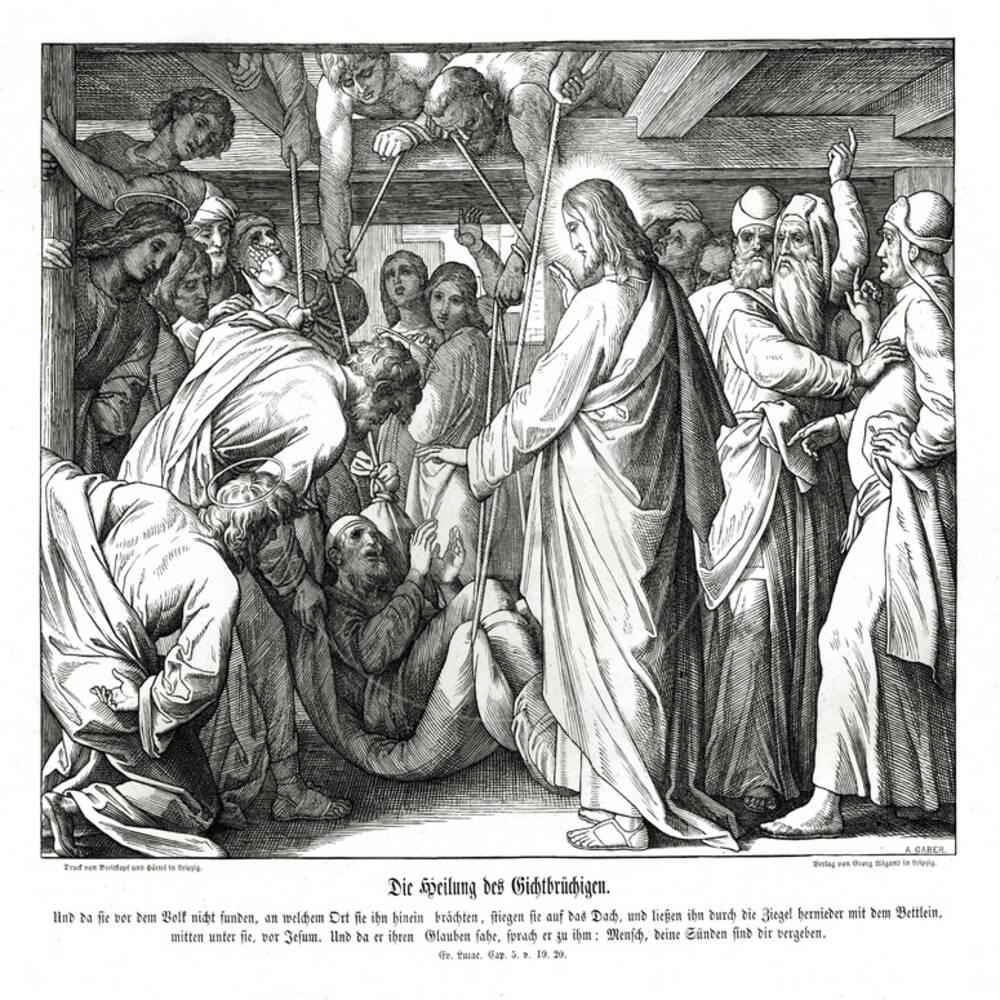
2. And behold, there * they (four of them) brought to him a paralyzed man (Luther: “whom had been afflicted by paralysis, the small or half stroke”) who was laying on a bed (He could neither move nor stir on account of his sickness. They sought a way how they might bring him in and lay him before Him; and when they could not come to Christ in any other way on account of the great multitude of people, and also could not find a place in which they could bring him in, they climbed onto the roof, where He was, and uncovered it, and let him down through the tiles with the little amongst their midst before Jesus, Mark 2:4, Luke 5:19). Now when Jesus saw their faith (understand not only the faith of the bearers, ** but also of the paralytic man himself; for if he had not believed in a saving way and at the same time with trust in Christ’s mediating office, Christ would not have forgiven his sins, nor called him son), He said to the paralyzed man, “Be comforted (and be of good courage), My son, your sins (which make you anxious in your heart) are forgiven you (Thus Christ begins His cure with the soul, because all bodily illnesses come from sin, and because the health of the body without the health of the soul is of little usefulness).”
* Mark 2:1ff. Luke 5:18 (Luke 7:50; Acts 9:33)
** Their faith came to the aid of the sick man, to promote the healing of his body in love, as far as it was possible.
3. And behold, some among the scribes (and the Pharisees, those who were sitting there and heard such) said amongst themselves (thought in their hearts), “This one (Jesus from Nazareth) blasphemes God (in that He ascribes to Himself such authority, which belongs only to God; for who can forgive sins except God alone? Luke 5:21).”
(Luke 7:49)
4. But when Jesus saw their thoughts (He knew immediate in His spirit that they thought thus within themselves, therefore), He said, “Why do you think such wicked things in your hearts (in that you falsely accuse me of blasphemy of God within yourselves, when that which I do nevertheless is my office)?
(Zechariah 8:17)
5. Which is easier (according to outward appearance and the judgement of reason), to say (to the paralyzed man), “Your sins are forgiven,” or to say, “Stand up (take up your bed) and walk?” (You think in your hearts: If I truly could forgiven this paralytic his sins in fact and truth, then I would also have been able to make him whole as well; but because this had not happened, so that is also lacking [i.e., I have not actually forgiven his sins].)
6. But so that you know (and see in fact) that the Son of Man has the authority (and indeed from His own power) to forgive sins (and that the forgiveness of sins is powerful, which I have declared to this paralytic man, and in truth has come upon him; well then I will thus make this man well before your eyes, therefore),” He then said to the paralytic, “ (I say to you,) Stand up, take up your bed (upon which you have had to lie ill and sick for very long time), and go home.”
(John 5:8; Acts 9:34)
7. And (immediately) he stoodup (so that all who those present saw, and he lifted up the little bed upon which he had lain) and went home (and praised God).
8. And the people that saw (this miracle) marveled and praised God, who had given such authority to men (they praised God, that He had sent them such a prophet who forgives sins and who could heal diseases which by nature are incurable. “All those were astonished who heard and saw this, and they were filled with fear and said, ‘We have seen extraordinary things today, and we have never seen such before,” Mark 2:12, Luke 5:26).
(Luke 7:16ff.; 1 Thessalonians 5:18)
Useful Applications
I. DOCTRINE: Christ’s true and eternal divinity shines forth from the fact that He searches out men’s hearts, forgives sins (which belongs to God alone), and heals incurable diseases (v. 2–7).
The following is my translation of the notes and useful applications for the Second Reading for the Feast of St. Michael and All Angels, Revelation 12:7–12, as they are found in Das Weimarische Bibelwerk (1877). Square brackets indicate my own notes and additions. For the useful applications, I recommend the reader see this very helpful article by Dr. Benjamin T. G. Mayes.
Notes
II. The Beginning of the Fourth Vision, in which two opposing parties are described, who have strong enmity against one another: the woman and the dragon; likewise, Michael and His angels on one side, and the dragon together with his angels on the other side. v. 19, 1–17.
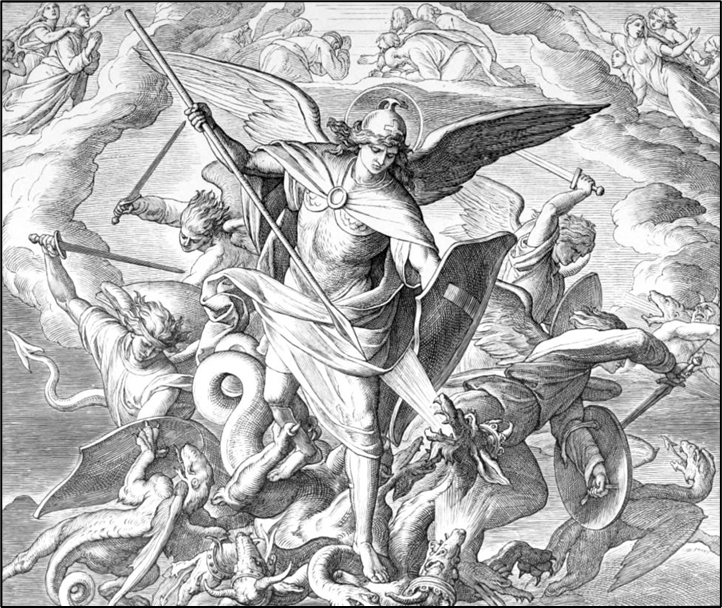
7. And there was a fight in heaven (in the Church-heaven here on earth; for after the devil, on account of his fall, has been cast out of the heaven of eternal glory, he may not come back into it again): * Michael and his angels fought with the dragon, and the dragon and his angels fought (This Michael is God’s Son, as it is explained in v. 10; He is, among other things, also called an angel for this reason, because in the protection of the Church, He carries out the office of an angel; otherwise, Michael is also the name of an archangel, Jude 9. But here Christ, the Son of God, is meant by this name, who is of one essence, one power, and one glory with God, His heavenly Father; for Michael means ‘Who is like God?’ And with this name the Holy Spirit directs us to the last chapter of the prophet Daniel, where it is proclaimed that in the last times, the great prince Michael shall arise, who stands for the holy people, Daniel 12:1. For since the dragon wants to attack the woman, that is, the true Church and the members of the spiritual body of Christ, so Christ takes His Church to Himself, and fights with His angels, by which not only the holy spirits in heaven are understood, but also all faithful teachers and preachers, against the dragon and his angels, by which not only the evil spirits who joined themselves to the devil and fell away from God are understood, but also the persecutors, the heretics, and all the scales of the hellish dragon). **
* Daniel 10:13, 21; 12:1.
** And: This battle is without doubt the blessed Reformation. If it were about the freedom of the Christian Church after the heathen persecutions [i.e., the legalization of Christianity in the Fourth Century], then one would have to seek it in the wars of Constantine the Great with Licinius, Maxentius, and so on.
8. And they did not win (for how could the devil overcome Christ, who is the power of God, 1 Corinthians 1:24? “The prince of this world is coming, and he has nothing in me,” says Christ to HIs disciples, John 14:30); also there was no more found to be a place for them in heaven (they were put to flight and cast out of heaven).
9. And the great dragon was cast out *, the old serpent (the evil enemy, who deceived our first parents through the serpent, Genesis 3:1, and has practiced his cunning and wickedness for a long time), who is called the Devil (the accuser, because he slanders God before men, Genesis 3:5, men before God, Job 1:9, and men against other men) and Satan (the adversary, because he is the enemy of God and men), who deceives the entire world (through his cunning and lies he deceives all those who allow themselves to be led by the spirit of the world, 1 Corinthians 2:12); and he was cast ** to the earth (by these words refers to the curse which God, after the fall of our first parents, pronounced upon the serpent: “Upon your belly you shall go, and dust you shall eat all the days of your life,” Genesis 3:14), and his angels were also *** cast out at that time (By this casting out of the devil from heaven it is signified that, after Christ through His death and resurrection had overcome the devil and taken power from him, Hebrews 2:14, He then, after His victorious resurrection, in which He stripped the principalities and the powers and made a show of them openly, and made a triumph out of them through Himself, Colossians 2:15, and after He sat down at the right hand of God, caused such obtained victory to be proclaimed in all the world, whereby the devil everywhere is driven out and trodden under the feet of the believers, Romans 16:20. “I saw Satan fall from heaven as lightning,” says Christ, Luke 10:18. Afterward, this overcoming and casting out took place at the time of Emperor Constantine the Great [in the Fourth Century], when the great persecutions ceased and peace was grated to the Church. In particular, this conflict and victory against the hellish dragon refers to our last times, when the kingdom of the antichrist and the doctrine of devils is attacked through the preaching of the Gospel, 1 Timothy 4:1, and are driven out of the Church-heaven; and this casting out will only fully happen on the Last Day, in which the dragon with his angels will be cast into the hellish pool, Revelation 20:14).
* Luke 10:18; John 12:31 (Revelation 20:2; Zechariah 3:1)
** Greek: “(Indeed), he was cast out,” or, “He was (I say) cast out”
*** Greek: “with him”
10. And I heard a great voice, which spoke in heaven, * “Now is the salvation, and the strength, and the kingdom, and the power of our God, His Christ ** (This is the triumph song and rejoicing of the true believers over this victory of the great prince Michael against the dragon, who in the same fight proved Himself to be an invincible hero and savior of His Church), because the accuser of our brethren has been cast out, *** who accuses them before God day and night.
* Revelation 11:15 (Job 1:9, 2:5; Zechariah 3:1)
** Greek: “Now has come (in powerful demonstrate made known and been revealed) the salvation and the power and the kingdom of our God, and the glory of His Christ (Anointed One).”
*** Greek: “is cast out (hurled down).”
11. And they * (the believers) have overcome ** him through the Lamb’s blood (because they firmly believed that Christ, through His suffering and the shedding of HIs blood, had overcome the devil for their good, and they set this victory in true faith against the devil’s accusation), and by the Word of their testimony *** (in that they remained steadfast in the confession of the Gospel, which is the testimony concerning Christ); and they have not loved their life even to death (their life was not so dear to them that in order to preserve it they would have denied Christ and His Word).
* Greek: “Also they themselves”
** Romans 8:37 (v. 17)
*** Concerning this, see Revelation 11:3.
12. Therefore *, rejoice you, you heaven, and those who dwell therein (all believers and elect of God, whose names are written in heaven, Luke 10:20, whose citizenship is in heaven, Philippians 3:20). But woe to those who dwell on the earth and on the sea (those who are minded toward earthly things, Philippians 3:19, who love the world and what is in the world, 1 John 2:15, since everything that is in the world, such as honor, riches, pleasure, power, etc., is unstable as the sea), for the devil has come down to you, and he has great wrath, and he knows that he has little time (because the time of the Judgement Day is near, in which he is to be cast into the hellish pool and will no longer exercise his malice upon the earth).
* Psalm 96:11
Useful Applications
II. COMFORT: That Christ Himself (who is signified by Michael) faithfully takes care of His believers in the militant church on earth and powerfully protects them against the devil and the antichrist, is depicted in this vision, v. 7–9.
The following is my translation of the notes and useful applications of the Old Testament for the Feast of the Holy Cross, Numbers 21:4–9, as they are found in Das Weimarische Bibelwerk (1877). Square brackets indicate my own notes and additions. For the useful applications, I recommend the reader see this very helpful article by Dr. Benjamin T. G. Mayes.
II. Concerning the grumbling of the Israelites, and how they were punished with fiery serpents. (v. 4–6)
4. Then they traveled(the Israelites by God’s command)from Mount Hor by the way of the Sea of Reeds, so that they * went around the land of Edom(because they could not obtain from them friendly passage, cf. 20:20, for which reason they deviated from the correct highway which led to the land of Canaan, and it had the appearance as though they would much sooner come to Egypt than to the land of Canaan).
* Cf. Deuteronomy 2:1.
5. And the people became * disgruntled on the way **(because they detoured so far away, also because their journey lasted so long, and they saw no end of it yet), and they spoke ** against God and against Moses(from great impatience), “Why have you *** led us out from Egypt so that we die in the wilderness? For there is no bread or water here, and our soul is nauseated over this worthless food(we have become weary of the manna, and can no longer look upon it without disgust, because we have eaten the same thing a whole forty years).
* Cf. Numbers 11:1
** These words still belong to v. 4 and are to be translated, “but the people became disgruntled over which way (or un-way); v. 5. “therefore then the people, etc.”
*** Hebrew: You have, etc. (Moses and Aaron, who was indeed dead, however while he was alive had had led the matter together with Moses).
6. Then the Lord sent fiery * serpents among the people(Luther: “Therefore, they were called fiery because the people bitten by them became fiery-red by their poison and died from the burning heat, as from a pestilence or a carbuncle); they bit the people, so that a great people in Israel died(a painful and wretched death).
* Cf. Wisdom of Solomon 16:5; 1 Corinthians 10:9.
III. Concerning their repentance, and how God averted the plague. (v. 7–18)
7. Then they came to Moses(as the serpents had already bitten many of them and a great multitude of people had perished and the others had been humbled through their punishment)and said, * “We have sinned, for we have spoke against the Lord and against you(murmured out of impatience); pray to the Lord, that He take away the serpents from us(that we might not perish so miserably). Moses prayed for the people(who nevertheless had so often shown themselves rebellious and ungrateful toward him).
* Cf. Numbers 14:40; 1 Samuel 7:6.
8. Then the Lord said to Moses, “You make a * bronze serpent(which was formed as the fiery serpents, because it was made from copper), and set it for a sign **; that whoever is bitten and looks at it, he shall live(he shall recover and through this special wondrous sign be kept alive).
* See John 3:14.
** Hebrew: on a banner-pole (so that it might stand quite high and could be seen from afar)
9. Then Moses made a bronze serpent, and set it for a sign; and when a snake bit someone, so he looked at the bronze serpent, and he remained alive.(John 3:14–15 applies such image to Christ Himself, that, whoever is wounded by the bite of the old poisonous serpent and looks Him lifted on the cross with true faith, he shall be healed spiritually and eternally.)
(2 Kings 18:4; John 6:40)
[v. 10–18 omitted due to the assigned reading]
Useful Applications
II. WARNING: With respect to the despising of God and His benefits, which is severely punished by Him, is to be seen in the people of Israel when they became disgusted with the manna, v. 4–6; III. DOCTRINE: That God demonstrates His mercy in the midst of punishment to those who turn back to Him [i.e., repent], v. 7–9.
The following is my translation of the notes and useful applications of the Epistle Reading for the Twelfth Sunday after Trinity, 2 Corinthians 3:4–11, as they are found in Das Weimarische Bibelwerk (1877). Square brackets indicate my own notes and additions. For the useful applications, I recommend the reader see this very helpful article by Dr. Benjamin T. G. Mayes.
2. A report as to whence the working [of the Preaching Office] comes. (v. 4–6)
4. But we have such a trust * through Christ to God(Luther: “that we have prepared you for the letter,” and that our Preaching Office is effective for the conversion of many people).
* Compare John 14:6ff.
5. Not * that we are sufficient of ourselves to think (much less to do or to think) something(good, which is for the promotion of our salvation or the salvation of other people)as from ourselves(from human powers), but rather, that we are sufficient, is(solely and only) from God.
* Compare 2 Corinthians 2:16; Philippians 2:13.
6. Who also has made us sufficient, to carry out the Office of the New Testament (which is an Office), not(primarily)of the letter(of the Law, which with letters was written on stone tablets, and prescribed a completely perfect obedience, which alone is not able to give grace to sinners, nor the power to such obedience), but rather of the Spirit (of the Gospel, through which the Holy Spirit works faith in the hearts of men, and is given to the faithful. Luther: “to teach the letter is to teach merely the Law and works without the knowledge of the grace of God, by which everything that man is and does is condemned and is recognized as guilty of death, for without God’s grace he can do nothing good. To teach the Spirit is to teach grace without Law and merit, by which man is made living and is saved.”). For the letter(of the Law) kills(because it gives man knowledge of his sins, Romans 3:20; it accuses man and convicts him in his heart that he is guilty of eternal death, Romans 4:15.), but * the Spirit(the Gospel) makes alive(it draws man out again from such terror of death because it directs him to Christ, the Mediator, who is the end of the Law, Romans 10:4.).
3. How the Law and the Gospel are to be held against one another, and how the Gospel is to be greatly esteemed compared to the Law. (v. 7–11)
7. But the office(of the Law in the Old Testament), that through the letter kills(v. 6)and in the stone is formed (written) **, has glory(is preached with a particular clarity, as when God glorified Moses before the people when he brought down the tablets of the Law the second time), in such a way that the children of Israel could not(properly and precisely)look * upon the appearance of Moses on account of the glory of His appearance, it nevertheless ceased(for when Moses died, this glory had ceased).
* See Exodus 34:30.
** Greek: graven –
8. How shall not much more the office (of the Gospel in the New Testament), that gives the * Spirit **,(which the Word of the Gospel writes in the heart, a particular)glory have?(which was proved in the miracles of Christ and His Apostles, as well as in the bodily glory of the appearance of Christ, which He allowed to be seen at His Transfiguration, which glory remains into eternity, and then in the powerful working of the Gospel, through which the hearts of men are enlightened.)
* See Galatians 3:14; Galatians 3:2ff.
** Greek: the office of the Spirit
9. For as the office that preached condemnation(which convicted men through the Law, that they merit condemnation), had glory; * much more does the office ** which preaches righteousness(which teaches men how they can and ought to be come righteous and be saved through Christ), have a surpassing glory.
* Greek: is glorious (that is, brings with itself and works [glory])
** See Romans 1:17; cf. 2 Corinthians 3:21; John 5:45.
10. For even that part(the office of the Old Testament), which was glorified(because the Law was given with great glory on Mount Sinai, and Moses, with a shining appearance, presented it to the people of Israel), is no to be considered glorious compared to this surpassing glory. *
* Greek: For in so far as it was honored with glory (the office of the Law), it is not even worthy that one call it (radiance or) glory, (in view of and) compared to this surpassing glory.
11. For if that has glory which ceases(since the Old Testament is abolished by the New Testament and believers are redeemed from the curse and coercion of the Law), much more will that have glory * which remains (because the New Testament will remain until the Last Day, and the benefits which have been distributed to us through the Gospel in the New Testament will extend to eternal life).
The following is my translation of the notes and useful applications of the Holy Gospel for the Twelfth Sunday after Trinity, Mark 7:31–37, as they are found in Das Weimarische Bibelwerk (1877). Square brackets indicate my own notes and additions. For the useful applications, I recommend the reader see this very helpful article by Dr. Benjamin T. G. Mayes.
III. A deaf man, who was mute. (v. 31–37)
31. And when He had departed again from region of Tyre and Sidon, He came to the * Galilean Sea, in the midst of the region of the Decapolis.
* Compare Matthew 15:29f.
Greek: And when He went back from the region of Tyre and Sidon, He came again to the Galilean Sea through the –
32. And * they brought to Him a deaf man, who was mute(the one who spoke evil, whom the devil through God’s appointment had almost completely robbed of hearing and speech)and they asked Him that He lay hands on him(and give him his hearing and speech again).
* Compare Matthew 9:32; Luke 11:14.
No possession is thought of here. What is written in Matthew 9:32 is a different history.
33. And He took him aside from the people, and placed His finger in His ear, and * He spat, and touched(with His spit)his tongue(to show that His flesh, through the personal union, is endowed with the power to do miracles, as well as to make health and living).
* Compare Mark 8:23; John 9;6.
34. And * He looked up to heaven, sighed(over the miserable condition of the human race)and said to him: “Ephphatha,” that is, “Be thou opened.”
* Compare John 11:41.
35. And immediately his ears his ears were opened, and the bond of his tongue was loosed, and he spoke right.
36. And He forbid them that they should tell no one.(The cause of such prohibition is told in Matthew 8:4)But the more He forbid them, the more they spread it.
37. And they were astonished beyond measure and said, * “He has made all well(in this miracle and in His entire way of life); He makes the deaf to hear, and the speechless to speak.
* Compare Genesis 1:31.
Greek: Also – (For they had not yet seen the like, even they they had seen other miracles.)
Useful Applications
III. COMFORT: That Christ the Lord makes all well and good, everything that was corrupted in us by the devil, as the people praise Him, v. 37; DOCTRINE and COMFORT: That also our wretched body shall partake of this [blessing], if the heart remains steadfast in Him, v. 33–37.

 PATTERN OF SOUND WORDS