The following is my translation of Aegidius Hunnius’s introduction and sermon outline for the Holy Gospel of Sexagesima (Luke 8:4–15) from his Postilla (Vol. I, pg. 266). Square brackets and footnotes are my own notes and additions.
Explanation of the Gospel
This sermon, as it is presented to us in the parable just read, the Son of God has spoken not only for Himself, but rather has also commanded it to His hearers with special diligence, when He cried out and said, “Whoever has ears to hear, let him hear!” [Luke 8:8] With this saying, as with the sound of a mighty trumpet, He awakens sleeping hearts to diligent attentiveness, seriousness and devotion for the hearing of His sermon, because there such matters are handled upon which the well-being and salvation of all the world depends, since once again, He describes the occasion of the high works of God and His Kingdom upon earth in parabolic way and opens the mystery of how it happens that not all hearers of the Word are converted and improved unto eternal life.
So then, let us present out hearts and ears, and indeed examine with a wakeful mind what God’s Son, our Lord and Teacher Jesus Christ has taught and preached to us concerning these important points. Let us not listen superficially, as the people did, who after hearing the parable, withdrew again without any investigation after spiritual understanding.1 Rather, let us persevere in the sermon of Christ with His disciples until we have heard the explanation from His mouth and have made use of it.2
1. First, we will hear the parable recounted in itself [v. 4–8].
2. Second, we will hear how the disciples desire that the parable might be explained to them and that Christ offers Himself to this end [v. 9–10].
3. Third and last, we will consider and contemplate the explanation of Christ [v. 11–15].
“Every poor sinner should therefore attend to the Word, hear it attentively, and not doubt the Father’s drawing. For the Holy Spirit will be with His Word in His power, and will work by it. That is the Father’s drawing. The reason why not all who hear the Word believe, and some are therefore deeply condemned, is not because God had begrudged them their salvation. It is their own fault. They have heard the Word in such a way as not to learn, but only to despise, blaspheme, and disgrace it. They have resisted the Holy Spirit, who through the Word wanted to work in them, as was the case at the time of Christ with the Pharisees and their followers.” (FC SD XI.77–78) ↩︎
Note the italicized portion: “The preacher’s planting and watering and the hearer’s running and hearing would both be in vain and no conversion would follow it if the power and effectiveness of the Holy Spirit were not added [1 Corinthians 3:6–7]. The Spirit enlightens and converts hearts through the Word preached and heard. So people believe this Word and agree with it. Neither preacher nor hearer is to doubt this grace and effectiveness of the Holy Spirit. They should be certain that when God’s Word is preached purely and truly, according to God’s command and will, and people listen attentively and seriously and meditate on it, God is certainly present with His grace.” (FC SD II.55) ↩︎
Here is another brief translation of Johannes Brenz’s sermon outline for the Gospel of Sexagesima (Luke 8:4–18) as found in his Postilla (pg. LXIIII).
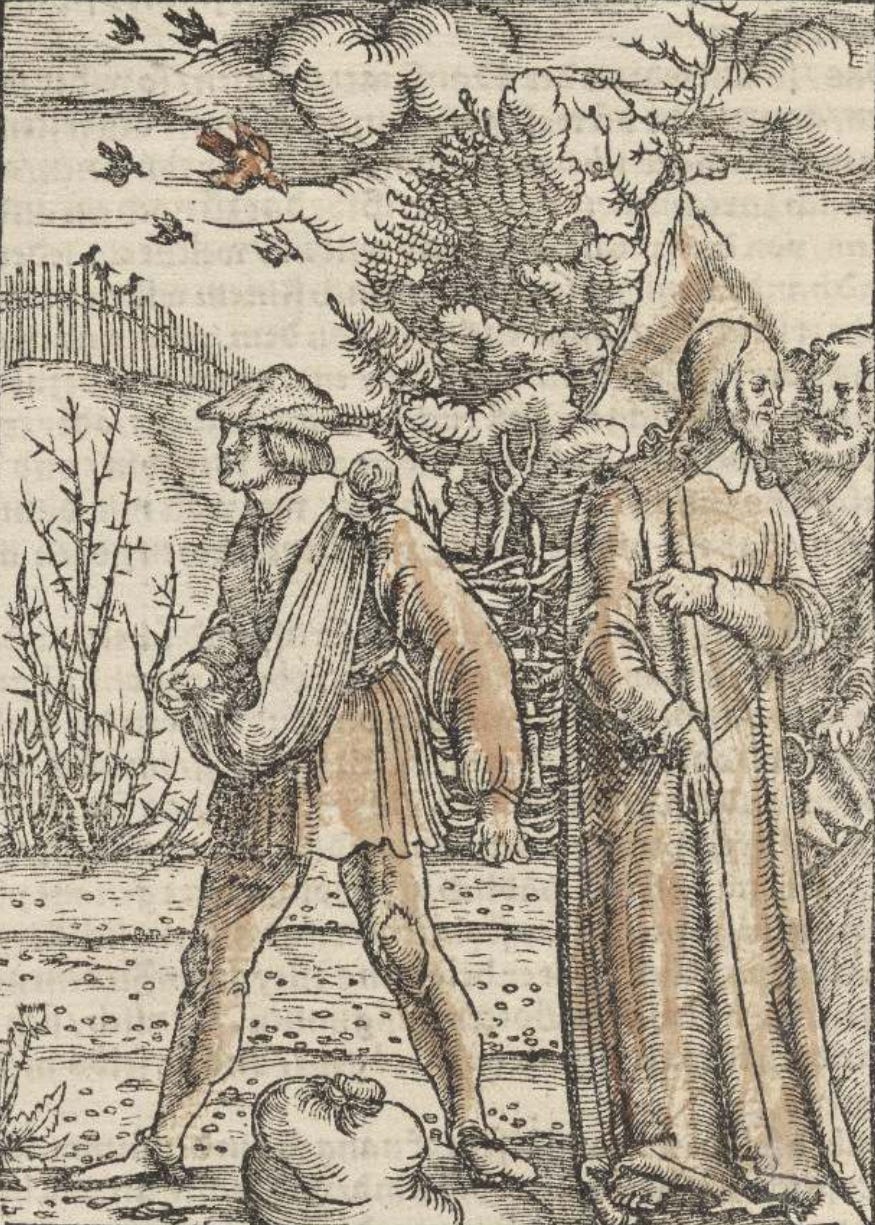
Artwork found in Brenz’s Postilla (1556), pg. LXIIII
Summary of this Gospel
In this Gospel, we learn:
First, that the doctrine of the Gospel is not the cause of all misfortune and evil, but rather Satan and our sin.
Second, what Christ’s doctrine is, namely, concerning the Kingdom of God.
Third, that our unbelief and malice are a cause that we cannot understand the Gospel.
Fourth, the hearers of the Gospel are dealt with, namely, that there are four kinds.
The first are those who according to the Gospel remain knaves (Buben) as before; and here is taught how these ought to conduct themselves so that they do not perish.
The second are those who receive the Gospel with joy, but as soon an evil wind comes, they have no faith; how these may be preserved is also taught alongside.
The third are those who because of anxiety, sustenance, or the riches of this world cannot grasp the Gospel; how these should act so that they may come to eternal life is also indicated.
The fourth are those who hear the Gospel and keep it, who will be saved.
Fifth, it is also taught how there is no estate higher before God and of more worth than another.
Last, that the Gospel, where it is preached, does not depart without fruit.
The following is my translation of Aegidius Hunnius’s introduction and sermon outline for the Epistle Reading of Sexagesima (2 Corinthians 11:19–12:9) from his Postilla (Vol. I, pgs. 255–256). Square brackets and footnotes are my own notes and additions.
Explanation of the Epistle
Beloved in the Lord, all ambition and fame-seeking was foreign and far from St. Paul; he sought his honor not in himself, but rather in God and in His Lord Christ. As he writes to the Galatians in the sixth chapter: “Far be it from me to boast, except concerning the cross of Jesus Christ” (Galatians 6:14).
But the false teachers who had snuck into the Christian congregations undertook to diminish this precious worthy apostle and make him despised among the Corinthians, which Paul would have suffered and gotten over silently if the contempt were about His person alone. However, the deceitful evil enemy most of all desired to bring the Gospel into contempt and to make wide room and opportunity for the false apostles with their unsound doctrine, so that they could come forward with it into the marketplace and sell their unfit evil truth as good, their false doctrine as pure evangelical truth, thereby falsifying the pure doctrine, leading astray the simple, and murdering souls, indeed, even wrecking the Gospel with eternal harm to many people.
Thus, the holy teacher and apostle Paul was urged by necessity to recount in an extensive record what good he did in regard to the Gospel, how much he suffered and endured over it, also that he had studied and learned his doctrine through a heavenly revelation in the paradise of God. He did all of this not for himself for his own boast, but rather for the praise, honor, and glory of God, for the advancement of the Gospel which he preached, for the edification of the Christian congregation in Corinth as well as in other places, and, on the other hand, for the annoyance the devil together with his scales, and for the detriment, destruction, and demise of his damned kingdom.
We will listen to the beloved apostle and summarize this text into two chief points:
First, how he does not make himself equal to the false apostles from Judaism only on account of his origin and blood [v. 11:22], but rather also far surpasses them in his labor and tribulation he suffered for the Gospel [v. 11:23–29], and thus boasts of his own weakness [v. 11:30, 12:5, 9].1
Second, how he also boasts of the power of God, namely, the glorious revelation that happened to him in the third heaven [v. 12:1–5], and boasts of the doctrine which he learned there to properly save its reputation against the diminishment of his enviers.
“Troubles are not always punishments or signs of wrath. Indeed, terrified consciences should be taught that there are more important purpose for afflictions, so that they do not think God is rejecting them when they see nothing but God’s punishment and anger in troubles. The other more important purposes are to be considered, that is, that God is doing His strange work so that He may be able to do His own work… Therefore, troubles are not always punishments for certain past deeds, but they are God’s works, intended for our benefit, and that God’s power might be made more apparent in our weakness. So Paul says God’s strength “is made perfect in weakness” (2 Corinthians 12:9).” (Ap XIIb.61, 63) ↩︎
The following is my translation of the notes and useful applications for the Holy Gospel of Sexagesima, Luke 8:4–15, as they are found in Das Weimarische Bibelwerk (1877). Square brackets indicate my own notes and additions. For the useful applications, I recommend the reader see this very helpful article by Dr. Benjamin T. G. Mayes.
4. Now, when a great people were with one another, and had hastened to Him (Christ) from the cities, He spoke * by a parable (to thereby clarify the dissimilarity of the hearers of the divine Word):1
* Matthew 13:3; Mark 4:2
1 † However, He used this parable on a good occasion to so great a crowd of various kinds of people, and for the most part from the countryfolk, who were present.
5. “A Sower went out to sow His Seed; and as He sowed, some fell on the way was trampled, and the birds among the heavens devoured it.
6. And some fell among the rocks, and when it came up,1 it withered because it had no moisture (no dampening, from which it could have been rooted more deeply and grown further).
1 Greek: “after it had come up” [καὶ φυὲν]
7. And some fell among the thorns, and thorns grew up with it and choked it (before it ripened).
8. And some fell on a good land, and it came up and (some) bore * a hundredfold fruit.” When He said this, He called out, “Whoever has ears to hear (and received the gift from God to grasp and to understand), let him hear (let him diligently pay attention to it and be mindful of it in his heart as to what I mean with this parable).”
* Genesis 26:12
9. Now His disciples asked Him and said, “What does this parable mean (what is signified by it)?”
(Matthew 13:10)
10. Now He said, “To you it is given to know the mystery of the Kingdom of God (this and other hidden spiritual things which God has revealed in His Word and Gospel); but to the others (those who despise such mysteries and do not allow their right understanding to be seriously applied to themselves) in parables (with success, nevertheless, from their guilt, because they do not concern themselves further with it), * that they do not see it (do not understand what they ought to know for their salvation), even if they see it (even if they, with their external eyes, see my miracles, which I perform to strengthen their faith and to make them righteous and saved through faith), and do not understand, even if they hear (what I preach to them).
* Isaiah 6:9–10; Matthew 13:14; Mark 4:12; John 12:40; Acts 28:26 (Matthew 11:25; 2 Corinthians 4:3)
11. But this is the parable (its right understanding): The seed is the Word of God.
12. Now that which is on the way, are those who hear; thereafter the devil comes and takes the (heard) Word from their hearts (tears it out of the heart or hinders it so that it does not come into the heart rightly; when the people in matters of religion are always doubting, when they secure and accustomed to sin, eagerly hear something new and splendid, sleep during the sermon and evade it with strange thoughts, do not allow themselves to be moved toward correction, etc.), so that they do not believe (draw no right, living, and active faith from hearing of the divine Word) and (thus, in the lack of true faith) are not saved.
(1 Peter 1:23; Hebrews 4:2)
13. Now that which is on the rock (the rock on which the seed of the Divine Word was sown), are those who when they hear receive the Word with joy (because they hope to have good days with it); and they have no root (the Word of God does not take deep root in their hearts, therefore there is no endurance along with their faith); for a time (so long as it goes well with them) they believe, and at a time of temptation (when cross, tribulation, and persecution break in) they fall away (from the Word of God and from saving faith).
(2 Timothy 2:10)
14. Now that which fell among the thorns (the hearers, among whom the seed of the Word was sown as among thorns), these are those,1 who hear it, and go (secure) among the cares, riches, and pleasures of this life (as soon as they have come from Church and heard God’s Word, they run and race, strive and scheme after temporal goods, vain honor, the pleasures of this life, the lust of the eyes, the lust of the flesh, and proud living, 1 John 2:16, so that these are their foremost concerns) and (with these anxieties, the seeds of the heard word) are chokedand bring forth no (ripe) fruit (so that the seed cannot bring forth any fruits of faith and good works within them).
(1 John 2:15ff.; Sirach 31:1ff.)
1 Greek: “but as concerns that which fell among the thorns, these are such who” [τὸ δὲ εἰς τὰς ἀκάνθας πεσόν, οὗτοί εἰσιν]
15. But that which is on the good land, these are those who hear (as well as understand) the Word and * retain it in a decent, good (upright) heart (purified from strange thoughts, greed, evil lust, envy, hatred, etc.), and bring forth † fruit (through a holy and godly life) in patience (so that they do not allow themselves to be turned away from God and His Word by the cross, temptation, and persecution, or by the nuisances of the world).”
The following is my translation of the notes and useful applications for the Old Testament Reading of Sexagesima, Isaiah 55:10–13, as they are found in Das Weimarische Bibelwerk (1877). Square brackets indicate my own notes and additions. For the useful applications, I recommend the reader see this very helpful article by Dr. Benjamin T. G. Mayes.
III. Consolation in the power of the divine Word, what it will work in the repentant. (v. 10–13)
Annotations
10. For just as the rain and the snow fall from heaven and do not return from there, but rather water the earth (very richly), and make it fruitful and increase so that it gives seed to sow and bread to eat;
11. Thus shall the * Word, which proceeds from My mouth also be. It shall neither return to Me empty, but rather do what pleases Me, and shall succeed in that for which I sent it (shall nevertheless be effective at all times in the hearts of certain men).
* Acts 12:24 (1 Corinthians 2:4ff.)
12. For you shall set out in joy (from your spiritual captivity), and be led in peace (into your heavenly eternal Fatherland).1The mountains and hills shall exult with glory before you, and all the trees in the field will clap with their hands (all creatures shall themselves, as it were, rejoice with you).
1 Hebrew: “be brought to this (to the Church of Christ as a gift of the Lord; see Isaiah 18:7).”
13. The fir will grow instead of the thornbushes, and the myrtle instead of the briars (the Gentiles, who were unfruitful, withered thornbushes and briars before their conversion shall be made fruitful through the Word of the Gospel and through the Holy Spirit for all good works); and it shall be a name and eternal sign for the Lord that shall never be eradicated (the call of the Gentiles and the salvation of the Church will bring redound to the eternal praise and glory of the divine name, and also be a mark of the power and saving truth of the Gospel).
(Isaiah 41:19; Matthew 16:18)
Useful Applications
III. DOCTRINE: Concerning the abundant power of the preached Word of God in the conversion and salvation of men. (v. 10–11) CONSOLATION: That God will not withdraw from His Church until the end of the world. (v. 13)
The following is my translation of the notes and useful applications for the Holy Gospel of the First Sunday after Epiphany, Luke 2:41–52, as they are found in Das Weimarische Bibelwerk (1877). Square brackets indicate my own notes and additions. For the useful applications, I recommend the reader see this very helpful article by Dr. Benjamin T. G. Mayes.
IV. The disputation of the twelve-year-old boy Jesus with the teachers in the temple. (v. 42–52)
Annotated Text
41. And His parents went every year to Jerusalem for the * Passover (to celebrate it according to God’s ordinance).
42. And when He (the Lord Christ) was twelve-years-old (at which time the children were gradually encouraged unto the public observance of the Law), they (the parents with their child Jesus) went up to Jerusalem, according to the custom of the feast.
43. And when the days (appointed for the celebration of the Passover, namely the seven days of unleavened bread, Exodus 34:18) were completed,1 and they returned to the house, the child Jesus remained at Jerusalem, and His parents2 did not know (that He had remained behind).
1 Greek: “But when they had gone up to Jerusalem according to the custom of the feast and had fully kept these (feast) days.” [Read this verse continuously from v. 42]
2 Greek: “Joseph and His mother” (So it is also to be understood in v. 41)
44. But they supposed (when they missed the Child that) He was among the companions (who had gone up with them from Nazareth in great numbers and were still behind), and they went (they returned [toward Nazareth]) a day’s journey (far), and they sought Him among their relatives and acquaintances.
45. And when they did not find Him, they went back to Jerusalem and sought Him.
46. And it came to pass after three days, they found Him in the temple (in an auxiliary building in the temple, in which there was a school) sitting among the midst of the teachers so that He could hear them (as they explained God’s Word) and asking them questions (not because He had need of their instruction, but rather that He might have an opportunity to instruct them).
47. And * all of those who heard Him, were astonished at His understanding and His answers1(over His highly-informed answer, over the wisdom that was seen in His answer).
* Matthew 7:28; Mark 1:22 (John 7:15)
2 Greek: “the answers (He gave)”
48. And when they (His parents) saw Him, they were appalled (they marveled to the highest degree over it, what this meant that such a Child should have dared to presume to speak with all the most learned men about such high and important matters). And His mother said to Him, “My Son, * why have you done this to us (that you have made so much care and anxiety for us with Your remaining behind)? Behold, Your Father and I have sought you with pains.”
* Genesis 12:18
49. And He said to them, “Why have you sought me (what need was there of the seeking)? Do you not know that I must be in that which is My Father’s? (that I must wait for that which My heavenly Father has laid upon Me?)”
(John 4:34, 17:4)
50. And they did not understand the word that He spoke with them.
51. And He went down with them and came to Nazareth, and was submissive to them (He did what His father and mother asked Him, and what He could do to please them). And His mother * kept all these words in her heart.
* Luke 2:19; Genesis 37:11
52. And Jesus * increased in wisdom,1 age (stature, height, and size), and grace with God and men (he was a child dear, sweet, and pleasant child to everyone, which thus happened through God’s special grace).
* 1 Samuel 2:26 (Acts 7:20)
1 † This is to be understood of the human nature in the state of His humiliation, to which also His age belonged.
Useful Applications
IV. CORRECTION: Because Christ, the Son of God Himself, was obedient and submissive to His mother and foster father, much more should all other children of men be obedient and submissive to their parents. (v. 51) DOCTRINE: Catechesis is a work sanctified by Christ Himself and is the highest edifying work. (v. 46–47) CORRECTION: Christ’s love for the temple also shows where one ought to fondly go and keep the children. (v. 42, 49ff.)
The following is my translation of the notes and useful applications for the Holy Gospel for the Twenty-First Sunday after Trinity, John 4:47–54, as they are found in Das Weimarische Bibelwerk (1877). Square brackets indicate my own notes and additions. For the useful applications, I recommend the reader see this very helpful article by Dr. Benjamin T. G. Mayes.
II. How Jesus was received in Nazareth and in other places, and also how the royal official’s son was freed from the fever. (v. 43–54)
Annotated Text
47. And there was a royal official (a distinguished servant in the house of Herod the tetrarch, who nevertheless was considered a king by the common man and thus was called a king, Matthew 14:1, 9; Mark 6:14), whose son lay sick in Capernaum. This one heard that Jesus came (He had learned that Jesus had come) from Judea in Galilee, and he went to Him (to Cana, about five miles’ way), and he asked Him that He come down (go with him to Capernaum) and help his son, for he was sick unto death (therefore, he also supposed that Christ would have to be present himself for so dangerous an illness, and that he could not perform this work of healing if he were absent, much less raise him from the dead if he should die).
48. And Jesus said to him: * “If you do not see signs and wonders, ** then you will not believe (“You Jews believe no more than you see. If I go with you, you suppose that I could help your son; but what kind of faith is that?” To believe rightly means not to doubt at all about that which one does not see, Hebrews 11:1, and to ground oneself in the omnipotence and goodness of God insomuch that he can and will help, even above and against all sense and reason).”
* John 2:18; 1 Corinthians 1:22
** behold presently with your own eyes. The answer is aimed at the request to come down in v. 47 and agrees with Matthew 9:18.
49. The royal official said (further, in the weakness of his faith) to Him, “Lord, come down, before my child dies (otherwise, Your presence will be in vain).”
50. Jesus said to him, “Go (at this My Word, to which you shall attach firm faith), * your son (has not died as you think, but) lives (through the divine power of this My Word, and when you come home, you will find him alive and well).” The man believed the Word that Jesus spoke to him, and he went (in certain confidence that the Lord’s Word would come to pass; therefore, he also did not hurry home all at once, to which he could have come that same evening if he had wanted, but rather remained overnight on the way).
* 1 Kings 17:23
51. And while hewas going (further, on the next day), his servants met him, proclaimed it to him and said, “Your son lives (and is completely alive, healthy, and strong).”
52. Then he investigated from them the hour in which it had become better with him. And they said to him, “Yesterday, around the seventh hour (according to our time, around 1 PM in the afternoon) the fever left him.”
53. Then the Father realized (and heard precisely) that itwas (exactly) around the hour in which Jesus had said to him, “Your son lives (v. 50).” And he (as now he had been fully convinced of the divine miraculous power of Christ) believed along with his entire household (his wife, children, and household servants were brought through to true faith in Christ. And some hold that this royal official’s wife was Joanna, who is mentioned in Luke 8:3, and that she is called the wife of Chuza, the steward of Herod, who followed the Lord and ministered to Him from her own possessions).
(Acts 16:32, 18:8)
54. This is now the second sign that Jesus did when He came from Judea into Galilee. (The first is described in John 2:7ff.)
Useful Applications
II. DOCTRINE: What faith or heartfelt confidence in Christ’s Word and promise has for power and might is testified by the royal official (v. 50–53). DOCTRINE: But how the Lord Jesus often uses many wondrous preparations and arrangements to awaken and to strengthen faith is seen from both stories (v. 16–54).
The following is my translation of the notes and useful applications for the alternate Gospel Reading for the Commemoration of the Lutheran Reformation (Reformation Day), John 8:31–36, as they are found in Das Weimarische Bibelwerk (1877). Square brackets indicate my own notes and additions. For the useful applications, I recommend the reader see this very helpful article by Dr. Benjamin T. G. Mayes.
II. A discussion with the Jews concerning the office of Christ, concerning the true freedom of the children of Abraham and their characteristics, as well as concerning the divinity of Christ. (v. 12–58)
Annotated Text
31. Then Jesus now said to the Jews who believed in Him, “If * you (steadfastly) remain in My Speech (and My Words remain in you, John 15:7), so you are My true disciples (those to whom the end of faith, eternal salvation, will be gifted).
* John 7:17; 15:10, 14.
32. And you will know the truth (have the faith of God’s elect, the knowledge of the truth according to godliness, in the hope of everlasting life, Titus 1:1–2), and the truth (such blessed knowledge of salvation, which consists in the forgiveness of sins, Luke 1:77) * will make you free (from slavery to sin, John 8:34, and from eternal death, John 8:51).”
* John 8:36ff. (Romans 6:13; Galatians 5:1; 1 Peter 2:16)
33. Then they answered Him (namely, the others who were still unbelieving Jews, who were mixed with those believers), “We are Abraham’s seed, * we have never been anyone’s slaves (bondsmen) at anytime (The Jews said this out of lying presumption and a proud mind, for in truth the situation was something much different, as is known from the histories). ** How can You say then, ‘You shall be free?’”
(Matthew 3:9; Jeremiah 2:14)
* Greek: “and” – (By the former, they boast of a free origin, but with one, they boast of a free estate.)
** Nevertheless, it could also be that those who lived at that time and spoke with Christ had wanted it to be understood only of themselves, as those who were indeed subjects of the Emperor, but who were not slaves and still lived according to their own laws.
34. Jesus answered them and said, “Truly, truly, I say to you, * whoever sins (whoever lets sin reign in his mortal body, gives obedience to its lusts, and gives his members over to sin as instructions of unrighteousness, Romans 6:12–13), he is sin’s slave (and is free concerning righteousness, whose end is eternal death, Romans 6:20–21).
* Romans 6:16, 20; 2 Peter 2:19; 1 John 3:8.
35. However, the * slave (as it goes in common life) does not remain eternally in the house (in this way also whoever is a slave of sins and a bondsman of the devil, 1 John 3:8, 2 Timothy 2:26; and such a one who remains stiff-necked without repentance has no part nor inheritance in the house of God and in the eternal kingdom of heaven, John 14:2, even though he finds himself among the external heap of the congregation of God); the Son (that is, God’s) remains (in the same house of God) eternally (and with Him those also remain therein, who hold fast the confidence and the boast of hope until the end, Hebrews 3:6).
* Genesis 21:10
36. So now, if the Son * makes you free (through the heavenly truth, John 8:32), so you will be truly (and eternally) free (from sin, death, and hell).”
The following is my translation of the notes and useful applications for the Old Testament Reading for the Eighth Sunday after Trinity, Jeremiah 23:16–29, as they are found in Das Weimarische Bibelwerk (1877). Square brackets indicate my own notes and additions. For the useful applications, I recommend the reader see this very helpful article by Dr. Benjamin T. G. Mayes.
IV. A repetition of the rebuking sermon, where Jeremiah recounts at length the sins of the false shepherds and how God will punish them. (v. 9–32)
Annotated Text
16. So says the Lord (the God) of Sabaoth: * “Do not listen to the words of the (hypocritical) prophets, who prophesy to you (only peace and good). They deceive you (with such caressing sermons), for they preach to you a vision of their own heart (what they themselves have thought), and not from the mouth of the Lord.
* Jeremiah 6:14, 14:14, 27:14–15
17. They say to those who blaspheme me * (to all idolatrous and wicked sinners, when they ought to admonish them to repentance): ‘The Lord has said, “It will go well for you.”’ And to all those ** who walk according to the darkness of their heart, they say: ‘No misfortune will come upon you’ (but they lead themselves and the people astray).”
* Hebrew: “despise.” (Even if it did not happen outright, this nevertheless was the fruit of the inappropriate comfort amidst ruling wickedness.)
18. For * who has stood in the council of the Lord, who has seen and heard His Word? (Who has told them what they so audaciously prattle? I know nothing of it.) Who has understood and heard His Word? (They or I? Is it not so that the Lord has not sent them? The result will show it, for…)
* Romans 11:34ff. (Isaiah 40:13ff.)
19. Behold, a * storm (misfortune and punishment) of the Lord shall come with fury (will come with great power upon them), and a terrible tempest will fall upon the head of the godless.
* Jeremiah 30:23; Psalm 11:6
20. And * the Lord’s wrath (kindled over them) will not cease, until He does and carries out what He has in His mind; afterward (when these things come to pass, and still even more perfect at the time of the New Testament), you will learn it. (Who as correctly preached and prophesied? I, who preach God’s wrath and punishment, or they, who only preach peace? For so says the Lord concerning them:)
* Jeremiah 30:24
21. “I * did not send the (imagining) prophets, yet they ran (and they prophesied); I did not speak to them (that it shall go well for the Jews), yet they prophesied (no misfortune would come upon them).
* Jeremiah 14:14ff. (27:15, 29:9)
22. For if they (would have) remained in My council * (revealed by Me for the salvation of men, which is true repentance and faith in the promised Messiah, Acts 20:21, 27), and had preached My ** words to My people, then they*** (my people) would have turned from their wicked nature and from their wicked life. (They would have zealously admonished them to conversion. Luther: “God’s Word converts; every other doctrine misleads, etc.” Do they think then that because I am in heaven that I do not know their deeds on earth?)
* That is, the order of grace, according to which repentance and true faith are included together with all the promises.
** 1 Peter 4:11 (Jeremiah 27:18; Luke 24:47)
*** Hebrew: “then they would have — preached to my people, and they – would have admonished them to repent.” (For to preach repentance, especially when corruption has taken root is the sign of a true prophet.)
23. “Am I not a God who is near (and sees all),” says the Lord, “and not a God who is far? (And who does not know what you teach and do? Luther: “They are so secure and brazen, as if I did not see their false doctrine and wicked life.”)”
(Acts 17:27)
24. “Do you think that someone * can hide himself secretly so that I cannot see Him?” says the Lord; “Do I not fill heaven and earth?” (Not with such an extension, but rather with such omnipresence that not even a little room may be named where I would not be present, yet as an immeasurable spirit, John 4:24) says the Lord.
25. “I hear well that * the (hypocritical) prophets (so dangerously) preach and falsely prophesy (teach) in My name (of which they boast in a seductive manner) and say, ‘I have dreamed, I have dreamed! (The Lord has revealed it to me in a dream.)
* Hebrew: “which”
26. When will the (false) prophets cease, who falsely prophesy and prophesy the deceit of their heart, *
Hebrew: “How long will it continue (in this way)? Does it then stand with these these prophets (in their hearts and pleasure, Ezekiel 13:2) that they preach lies? Or are they prophets to set forth the deceit of their hearts?”
27. and who want * (gladly that it be brought so far in religion) that my people should forget my name (of the Lord) for their dreams (through their prophecies, which they say, that I have revealed to them in a dream), which one preaches to another, just as (in previous times) their fathers forgot my name for Baal?
(Judges 3:7ff.)
* Hebrew: “who then want”
28. A (false) prophet who has dreams preaches (in spite of everything) dreams (Luther: “Let him leave My name in peace, and not say that it is My Word what he dreams, but rather that it is his own word and have his own name.”); but whoever has My Word (that I have placed in his mouth), let him preach My Word correctly. (And let him see to it well that such not be mixed with false doctrine and human ordinances * , for) How do chaff (false doctrine) and wheat (my Word, the heavenly nourishment for the soul) go together?” says the Lord (“The power of my Word is quite different and higher than what breaks forth in their prophesy”).
(Ezekiel 20:39; 1 Peter 4:11)
* as well as set forth the complete order of salvation (see v. 22).
29. Is * My Word not as a (powerful and piercing) fire (which kindles, purifies, and cleanses the hearts of the godly),” says the Lord, and as a (strong) hammer, whichsmashes (the hard) rocks (that is, the stiff-necked and hardened consciences of the godless)? (In that they are powerfully convicted and overcome by My Word.)
* Hebrews 4:12 (Luke 24:32)
Useful Applications
IV. DOCTRINE: That the hearts of men are struck through the preached word (as the spiritual hammer) and are broken for true repentance (v. 29).
The following is my translation of the notes and useful applications for the Holy Gospel of the Sixteenth Sunday after Trinity, Luke 7:11–17 as they are found in Das Weimarische Bibelwerk (1877). Square brackets indicate my own notes and additions. For the useful applications, I recommend the reader see this very helpful article by Dr. Benjamin T. G. Mayes.
Notes
II. The Resurrection of the Dead Son of the Widow at Nain (v. 11–18)
11. Now it happened afterward * that He (the Lord Jesus) came into a city (among the mountains of Hermon, located four miles away from Capernaum) with the name Nain; and many of His disciples went with Him (not only the twelve Apostles, but rather also many other who were His disciples and hearers) and many people (which followed after the Lord Christ for the sake of His teaching and miracles).
* Greek: “On the following day”
12. Now as He came near to the gate of the city, behold, there a dead man was being carried out, * who was * the only son of his mother, and she was a widow. And many people from the city went out with her (for the burial of her son).
*For the Jews had to have their graves outside of the city.
** 1 Kings 17:17.
13. And when the Lord saw her, * He was moved with pity for her (from heartful compassion) the same (grieving widow), and said to her, ** “Do not weep (excessively over the deadly departure of your son).”
* Matthew 9:36
** Jeremiah 31:16
14. And He came forward and touched (with His almighty, life-giving hand) the casket (the deathbed, the bier, upon which the young the man was openly carried), and the bearers stood. And He said, “Young man, * I (who am the resurrection and the life, John 11:25) say to (command) you, stand up.”
* Mark 5:41
15. And the dead man sat upright, and began to speak. * And He gave him (living again) to his mother. (This is the first dead person whom Christ raised in the New Testament; afterward, He also raised the daughter of Jairus, the ruler of the school, Matthew 9:25, and Lazarus, John 11:43–44, from the dead, and in His resurrection there were many bodies of the saints who were raised with Him, Matthew 27:52)
* 2 Kings 4:36
16. And fear came upon all of them (for they were greatly astonished over this great miracle), and they praised God and said, “A great prophet (who is the Messiah Himself) has risen among us, and ** God has visited His people (through the sending of this prophet in grace). ***
* The like had not happened since the time of Elisha, and thus not in nine hundred years, much less with such circumstances.
** Luke 1:68, 78 (Deuteronomy 18:15, 18; Matthew 16:14)
*** Or, according to the Greek: “And (some) said (who still regarded Him as a mere man, but nevertheless held Him to be a prophet), ‘A great prophet has risen among us.’ Or (others, who still went further said), ‘God has visited His people (through the Messiah Himself).’”
17. And this report of Him resounded in all the Jewish lands and in all the surrounding lands.
Useful Applications
II. DOCTRINE: As easy as it was for Christ to raise this young man from the dead with a word, thus will He also by His divine almighty Word raise all the dead on the Last Day (v. 14–15).






 PATTERN OF SOUND WORDS