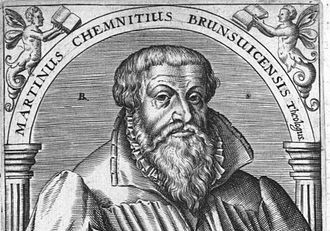
The following is my translation of Martin Chemnitz’s explanation and homily outline for the Sixth Sunday after Trinity (Postilla, Vol. II, pgs. 348–50). Chemnitz’s Gospel text is Matthew 5:20–26. Square brackets indicate my own notes and additions. Curly brackets indicate marginal notes in the original text. I have also broken up some of the larger paragraphs for the sake of readability.

Gospel Text – Matthew 5:20–26
Jesus said to His disciples, “Unless your righteousness is better than the scribes and the Pharisees, you will never come into the kingdom of heaven. You have heart that it was said to those of old, “You shall not murder, but whoever murders, he shall be liable to judgment.” But I say to you, Whoever is angry with his brother will be liable to judgment. Whoever says to his brother, “Racha!” [i.e. empty-head], will be liable to the council. Whoever says, “You fool!”, will be liable to the hellish fire. For if you are offering your gift at the altar, and there remember that you have something against your brother, so leave your gift there before the altar, and go to him and be reconciled with your brother, and then come and offer your gift. Be well-disposed (wilfertig) toward your brother quickly, because you are still on the way with him in order that your adversary not hand you over to the judge, and the judge hand you over to the servants, and you are thrown into the dungeon. I tell you, truly, you will never come out from there until you have paid the last mite (Heller).”
Explanation
{Summary of the Doctrine of This Gospel}
In this text we have the explanation of the Fifth Commandment, how we ought to rightly understanding what the meaning of this word is when it says, “You shall not murder.” Now you often hear that the Gospels are so divided that one can therein can set forth the Christian doctrine and teach it to the common man. Now since the Law and the Gospel are the chief parts of Christian doctrine, the ancients [i.e., the Church fathers] have thus ordained it that on Sundays they ordinarily teach the Law and the Gospel. So we now we have hear the explanation of the Fifth Commandment, and not the entire Law altogether. Why is it then useful and good that one learn the Law? And why is it good that the correct understanding of the Law is urged in the Church? John thus distinguishes between the Law and the Gospel: “The Law was given through Moses, but grace through Jesus Christ.” [John 1:17] Now since the preaching of the Gospel properly belongs to the office of Christ, what need is there, then, that the Law be urged?
Christ Himself shows here in this Gospel why the one who shall teach the Gospel must first preach the Law. This is now the reason: The Pharisees thought that they could be saved through their good works. They asked nothing about the Gospel because they thought, “If we can be saved through ourselves when we do much as is possible for us, then what need do we have of Christ?” This stood in the way so that Christ could not teach the Gospel without the Law, therefore, Christ takes up the Law first.
Another error still hindered Christ so that He could not teach the Gospel. Christ had now preached the Gospel an entire year. Now there were many people who thus understood it: “If [the Gospel] has the meaning that God does not forgive sin on account of merit, but solely for the sake of CHRIST’S merit, why should we then ask about the Law? Let it thunder freely! We have nothing to do with it!” As CHRIST says, “I have not come to abolish the Law. This is not the meaning [of the Gospel]. I have come to fulfill the Law. Therefore, it is not the same whether the Law is kept or not kept. I say to you, before heaven and earth should pass away, it shall not happen that a single letter or tittle pass away from the Law which is not thus fulfilled.” [Matthew 5:18]
{Use of the Doctrine of the Law for Our Time}
Thus now that Christ had a reason that He wanted to preach the Gospel, so He had to first make the way through the Law. This reason applied at that time, so does one now have the reason that he should also preach the Law? Pay attention to the entire world and to all men, and then you will see that we have much more reason than Christ to urge the Law.
{Against the Papists}
One one side, we have the papacy. The Papists allow it to become sour for themselves, live strictly, etc., then they say that they thereby merit forgiveness of sins. When much is said of the Gospel, it does not strike them where the path has not been first made through the Law, that no one can become righteousness and be saved through the Law.
{As Well as the Evangelicals}
And pay attention also to those who hold to and confess themselves to the doctrine of the Gospel, and then you will see how greatly it is also necessary for them that this preaching of the law remain in practice among them next to the Gospel. For many think thus, “The Gospel holds these both against one another, that God is indeed angry because of sin; however the Gospel says, ‘Do not ask about that. Do not concern yourselves with it. God is merciful, who has given His Son for our sins, it is now all good.” In this opinion, many people go on their way and heap up sin day to day and yet still want to be saved nonetheless.
However the people that do this misuse the Gospel as a cover for shame (Schandideckel), and this is not its use. Therefore, one ought always to preach and teach the Law next to the Gospel and what is meant by this, that God in the law is an enemy of sin (der Sünde feindt ist), and makes Himself known otherwise and is friendly toward us in the Gospel, and allows His wrath to fall and speaks grace to those who repent, believe, and lead a new life. For a Christian must be able to distinguish this, and “He is a good theologian,” says Luther, “who properly knows and understands the distinction between both of these doctrines, the Law and the Gospel.” Whoever does not consider this distinction or reflect on it, also goes away in security and brings God’s judgement upon his neck.
This reminder serves to this end, that each person may know what the use of the doctrine of the Law is for us, and how we ought to rightly understand it. Therefore, certain commandments of the law are interpreted and explained by Christ in order that one can understand from it the right understanding of the doctrine of the entire Law.
{Division of the Sermon}
In order that we may deal with this Gospel in a useful manner, so we want to lay out its doctrine briefly and simply in these points, and divide this sermon into three parts:
- That in this Gospel Christ teaches how the Law shows us what kind of righteousness we have through Christ. Likewise, how the Law shows directs us from our own works to Christ’s works and merit.
- How here the right understanding and use of the Fifth Commandment, and under it, the entire Law, is shown to us; how a Christian, who has now become righteous ought to make use of the Law unto true repentance (rechter Buß) so that he may remain in right faith with Christ.
- What ought to move and cause us that we gladly reconcile with our neighbor and do not delay reconciliation for a long time, and how we are to be good-willed and well-disposed toward this.
We will now divide the sermon briefly into these three points, and deal with them in a simple manner.
Concerning the First Part
{Concerning the True Righteousness Which Counts Before God}
The Lord Christ begins in today’s Gospel by saying, “Unless your righteousness is better than the Pharisee’s righteousness, you will not come into the Kingdom of Heaven” (Matthew 5:20). Here, you hear that Christ is speaking of such a righteousness that is necessary for us unto salvation, through which we come into the Kingdom of Heaven. And He lays out this righteousness through the explanation of the Law. He shows what sort of righteousness it must be through which we ought to be saved.
{The Pharisee’s Opinion}
The Pharisees were of the opinion that they would be saved, all their heart and mind were set on it; so now they took the Law unto themselves, they were zealous for it, as much as they could, they allowed it to become sour for themselves. Nevertheless they clearly saw that they could not keep the Law entirely and ward off all wicked sinful desires and inclinations toward evil, nor control their wicked thoughts. But that this is still not the perfect keeping of the Law, our Lord here shows this to them in the actual explanation and exposition of the Fifth Commandment and several others in the following text. Thus, by this He takes away from them all their thoughts and false delusions which they had previously imagined. For they thought thus: “It is indeed true that God says in the Fifth Commandment that a man ought not be angry; however, how can a man entirely refrain from this, that he should nevermore be moved to anger? So, this is also one of the lesser sins (der geringen Sünde), God does not ask much about it if a man only takes care that he does not kill his neighbor with his fist. Whatever other transgressions happen alongside this against the Fifth Commandment, God is surely at peace with it, He does not want to deal so strictly with us if we only do so much as is possible for us and bring it as far as we can; and by this, we merit eternal life.”
These were the thoughts of the Pharisees and the scribes which they built and founded their salvation upon; if one meant good and did what he could, then God must be at peace with him, especially if he guarded himself against great sins and vices, then that would be entirely enough.
{Christ’s Position}
However, Christ will not let this be good enough for them; rather, He says, “Unless your righteousness is better than that of the Pharisees, then you cannot go into the Kingdom of Heaven” (Matthew 5:20). For this is the meaning of the Ten Commandments, they want to be kept pure and perfectly; if the least thing, even a tittle, is lacking, then all the rest counts for nothing. Indeed, even if were possible for a man to keep the entire Law except for the least letter, then a man cannot thereby be saved. The reason is this: God did not give His Law in such a way that He says, ‘Whoever keeps some of it and as much as he can, he is excused even if he cannot keep all of it perfectly.’ Rather, it says, “Whoever does not keep all that is written in the Law, he is cursed and condemned.” Therefore, the Apostles St. James says, “If anyone keeps the entire Law and sins in one point, he is guilty of all of it” (James 2[:10]).
Indeed, dear Lord God, who then can be righteous if God deals so strictly with us? “No one,” says Paul, “if He deals so strictly with us” (Galatians 3[:10]; Romans 2). For God demands a perfect obedience, indeed He deals so strictly and demands such a strict obedience from us that it is impossible for even one to keep and fulfill it all. And whoever does not keep it perfectly as God has commanded, he is cursed.
{To What End the Law Ought to be Preached}
Now to what end does this doctrine serve when it is presented to us so earnestly that it brings us to despair when we hear that God demands that which is impossible for us to keep in His Law and says that if we do not do it perfectly, then we shall be condemned? Does not such a doctrine bring nothing other except despair? Answer: No, that is not God’s intent, that thereby He should seek such a thing. Rather this is directed to this that it ought to drive us and direct us away from our merit and works to another ground upon which we should build our salvation; and that we should dismiss the Pharisees and scribes who allow it to be sour for themselves and suppose they will thereby be saved. However, the Law says, “It is lacking in you, you cannot do it. There is no one who can keep the Law.” It is certainly true that you do not kill with your fist; yet, you still sin against the Fifth Commandment with thoughts and words when you hate your neighbor and transgress against him with words and say, “You fool.” And when you do this, then you are guilty of the hellish fire. For the Law demands a perfect obedience of anyone who wants to be saved otherwise through the Law. The righteousness of the Pharisees will not avail us, there must be a better righteousness [Matthew 5:20]. But where, then do I obtain this righteousness? We do not find it in ourselves, but rather a mercy seat (ein Gnadenstul) has been set before us, namely, Jesus Christ (Romans 3[:25–26]; 1 Corinthians 1[:30]). There we find the righteousness which is perfect and endures before God.
The word for mercy seat in Greek is ἱλαστήριον. “God set forth [Christ] as a mercy seat (ἱλαστήριον) by His blood” (Romans 3:25) . It is a reference to the mercy seat which was placed upon the ark of the covenant in the Old Testament (see Exodus 25:17–22). The blood of sacrificed animals in the OT was placed upon the mercy seat to make atonement before God (e.g., Leviticus 16:13–19).
{What is the True Righteousness}
What kind of righteousness is this then? There are many people who fall into this opinion as if it were such a righteousness that because God has given us His Son that it now has the meaning as if God said, “I have indeed said in the Law ‘You shall not murder; you shall not commit adultery; etc.,’ but now I want to let go of all of it; I will not even think of sin anymore.” So many of us understanding this article concerning righteousness. But Christ leads us to another ground on this from which one can see what is the meaning of this article. And the ground comes from the Law. And now Christ thus says, “I have come to give you life; but I have not come for this purpose: to abolish the Law, that God no longer ask whether or not the Law is kept.” No, the Law must be fulfilled, and it is laid out as such, just as Paul precisely explains in Galatians 3 and in Romans 3. Therefore, you ought to know that not only is the one who murders guilty, but also whoever says to his brother “Fool!” is guilty of the hellish fire; whoever says “Racha!” [i.e., empty-head] is liable to the council. God has written this with His finger; it cannot be changed. All of it must be fulfilled if you want to be saved through the Law. Now Christ has come that He give us the righteousness which God demands of us in the Law. For we could not obtain such a righteousness from ourselves. What now has Christ done? Did He say, “This shall not longer be in force”? No. The Father says of Him, “You are in the stead of man. There it is written, “Cursed is the man who does not keep everything that is written in the Law” [Deuteronomy 27:27]; whoever acts against it, he is guilty of the hellish fire. You must bear this, if man is to be saved otherwise.” For the Law cannot fail. It is God’s eternal unchangeable will. Therefore, you should not think thus: “God will no longer pay attention to sin.” No! Everything must be fulfilled which has been written. Because we cannot do this, God therefore sent His Son who has fully satisfied the Law, and we are justified for His sake because He has fulfilled the Law.
One must mark this well, for whoever does not pay attention here cannot comport himself in this matter, but rather falls into such thoughts: “Well, God is indeed the enemy of sin, but now that His Son has come, He has let His wrath fall away and no longer upholds the Law.” Those who think this way fall into security (Sicherheit); but we must stand fast upon this ground: It is impossible that a tittle of the Law ought remain unfulfilled. It must all be fulfilled, but we cannot do it. Therefore, the Son of God has come who has taken the Law upon Himself and fulfilled it; and for His sake, because He has fulfilled all of it, we are also righteous. Thus, the Law drives us away from our own righteousness to another righteousness. The Law must be fulfilled, but we cannot fulfill it; therefore, Christ comes in our stead and fulfills the entire Law that we thus might obtain eternal righteousness.
{Conclusion of the First Part}
This is the first part that we ought to mark in this sermon, namely, that the Lord Christ did not only preach the Gospel to His hearers, but rather also the Law. He thereby remove this delusion from the hearts of the people so that they do not think that God has now allowed His law to fall away because He has given His Son to as Redeemer of the world, and that now each man may do whatever he wants and that it would in no way harm him. CHRIST has paid for all sin and made full satisfaction. Likewise, the LORD says that this is not its meaning. The Law is the unchangeable will of God, and it must remain and must be fulfilled. When the Pharisees then come and say, “Behold, we do the Law and keep it; we our diligent that we conduct ourselves obediently in our whole life and conduct to it as much as possible. Thus, we will be justified through works of the Law, right?”
“Yes,” says CHRIST, “If you could keep it perfectly, then that would be something, then you would be saved by it, but there it is lacking and it fails you. For if you already do as much as is possible for you, and live externally according to the Law and guard yourselves against gross actual sin—murder, manslaughter, adultery, fornication, and the like—yet, you nevertheless have evil desire and inclination in your heart, then you still have evil thoughts and words which are contrary to God’s Law. Therefore, if your obedience is not perfect, then you cannot thereby stand before God. You must look for a better righteousness.” Where does a man find this? “Christ has made righteousness for us by God.” (1 Corinthians 1[:30]. See that you lay hold of Him, then you shall be saved through Him. This is the first doctrine.
Concerning the Second Part
{Explanation of the Fifth Commandment}
Forthcoming.
Concerning the Third Part
Forthcoming.
{Conclusion of the Sermon}
These are the three parts of doctrine that we ought to maintain from this sermon.
- What is the true righteousness which counts before God, how we ought to rightly know and learn this from the Law and the Gospel.
- Concerning the right understanding of the Law of God, that it is not enough that one does something, but rather that one must entirely keep it.
- How one ought not live in envy and hatred (Neid und Hassz), but rather be well-disposed toward reconciliation in order that God also forgive us our deficiencies and errors (Mängel und Fehl).
 PATTERN OF SOUND WORDS